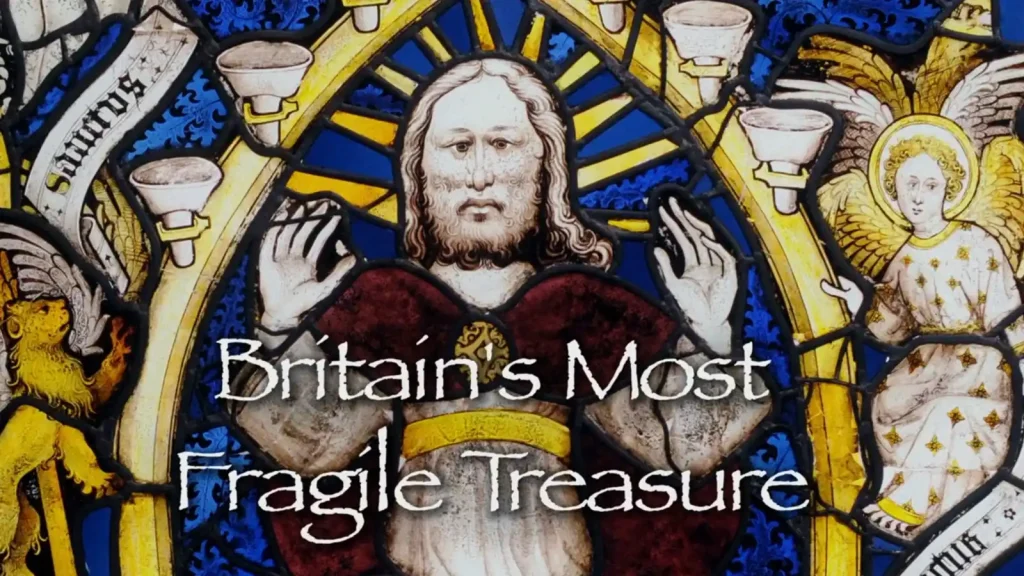
Britain’s Most Fragile Treasure: Imagine standing inside the hallowed walls of York Minster. Your eyes are drawn upwards, captivated by a shimmering wall of light and color. This is the Great East Window. Towering at an astonishing 78 feet, it is a true giant of the art world. In fact, it holds the title of Britain’s largest medieval stained-glass window. Yet, for all its immense scale, it is also Britain’s most fragile treasure. It is a masterpiece painted in light, a storybook preserved for centuries in delicate, breakable glass. This colossal work stands as a testament to a forgotten age of faith and artistry.
Remarkably, this vast and intricate vision sprang from the mind of a single artist. His name was John Thornton of Coventry. Thornton was a mysterious master craftsman, one of the earliest English artists we know by name. In the early 15th century, he undertook a commission of unbelievable ambition. He sought to create a window that would not only illuminate a cathedral but also narrate the entire history of the world. Consequently, Thornton’s work stands as a singular achievement, a beacon of individual genius in an era we often associate with anonymous craftsmanship.
The Great East Window has rightfully been called England’s Sistine Chapel. Within its 311 jewel-like panels, the whole of Christian cosmology unfolds. The epic story begins with the very first day of creation. It then journeys through time to depict the final, terrifying moments of the Last Judgment. However, what makes this achievement even more astounding is its timing. John Thornton completed his masterpiece a full century before Michelangelo ever lifted a brush to the Vatican’s ceiling. Therefore, this window represents an incredible, audacious leap forward in artistic storytelling and scale.
Think of it as a divine graphic novel from the Middle Ages. Its 311 individual panels work together to form a coherent, breathtaking narrative. For a largely illiterate population, this was their Bible made visible. Each scene, rich with symbolism and vibrant color, communicated complex theology in a way everyone could understand. You can imagine medieval worshippers gazing up in awe. They would follow the stories of prophets, saints, and angels, all playing their part in God’s great plan. The window was not just decoration; it was a powerful tool for education and devotion.
Helping us to decipher this luminous manuscript is historian Dr. Janina Ramirez. With her infectious passion, she unlocks the secrets that have been sealed in the glass for over 600 years. Dr. Ramirez acts as our guide. She bridges the immense gap between our modern world and the medieval mind that created this wonder. She helps us to not only see the beauty of the Great East Window but to truly understand its profound meaning. Through her eyes, the silent figures in the glass begin to speak again.
For centuries, however, this priceless work of art was locked in a silent battle with time. The relentless march of years, coupled with the corrosive effects of pollution, had taken a heavy toll. The vibrant colors were dimming under layers of grime. The lead that held the glass together was beginning to fail. Therefore, a heroic effort was needed to save it. An elite team from the York Glaziers Trust embarked on an epic five-year project. Their mission was to conserve the window and restore it to its original, dazzling glory.
The first step of this monumental task was almost unthinkable. The conservators had to carefully dismantle the entire window. Imagine the pressure and the precision required. Panel by fragile panel, a team of highly skilled experts gently removed the glass from its ancient stone mullions. For the first time in six centuries, John Thornton’s masterpiece was brought down to earth. This act, while fraught with risk, presented a golden opportunity for discovery. It was a chance to meet the window on intimate terms, free from its towering, distant perch.
This unique situation allowed Dr. Ramirez to examine Thornton’s greatest work at incredibly close quarters. Suddenly, details that were impossible to see from the cathedral floor sprang to life. She could trace the confident sweep of a painter’s brush. She could observe the subtle textures and intentional imperfections that gave the figures their character. Looking at the panels on a workbench, you could almost feel the presence of the medieval artists. It was a profoundly human connection, reaching across the centuries to touch the hands that made this miracle.
Moreover, this close inspection revealed the secrets of Thornton’s technique. It answered a long-standing question: how did medieval artists create images of such delicacy with only the simplest of tools? The team discovered how silver stain was used to create brilliant yellows and golds. They saw how artists painted directly onto the glass with a mix of ground glass and metal oxides. This mixture was then fired in a kiln to become permanent. In fact, it was a sophisticated, multi-stage process that combined artistry with a kind of medieval chemistry, all to manipulate light itself.
Britain’s Most Fragile Treasure
Ultimately, the Great East Window is far more than just a work of artistic genius. It serves as a portal into the medieval world and mind. Looking at these panels, we see a world shaped by a powerful, all-encompassing faith. Their hopes for salvation and their fears of damnation are rendered in vivid, unforgettable imagery. The window tells us what they believed, what they valued, and how they saw their place in the universe. Consequently, we gain a deep and personal insight into the people of the past.
Nowhere is this more evident than in the window’s stunning depiction of the Apocalypse. This section, which dominates the upper reaches of the window, brings the Book of Revelation to terrifying life. We see angels with trumpets, monstrous beasts rising from the sea, and the final, dramatic sorting of souls. For the medieval viewer, this was not fantasy. It was a literal depiction of a future they believed was coming. Even today, the power of these images to inspire awe, and perhaps a little fear, is undiminished.
The conservation team at York Glaziers Trust performed a modern miracle of their own. They painstakingly cleaned every single piece of glass, removing centuries of accumulated dirt. This process revealed colors that no living person had ever seen. Using a combination of traditional skills and cutting-edge science, they repaired cracks and stabilized the delicate paintwork. Furthermore, they created a new, state-of-the-art protective glazing. This outer shield now protects the medieval glass from the elements, safeguarding its future for generations to come.
Today, the Great East Window is back in its rightful place at York Minster. It shines with a renewed brilliance, a testament to both its medieval creators and its modern saviors. It is so much more than a beautiful object or a historical relic. It is a living story that connects us directly to our own past. In its fragile, luminous surface, we see the genius of John Thornton. We see the lost world of the Middle Ages. And ultimately, we see a timeless reflection of who we once were, and who we still are, all preserved in the magic of light and glass.
The Great East Window of York Minster: A Story in Light
The monumental Great East Window of York Minster is truly Britain’s Most Fragile Treasure. For six centuries, this colossal work of art has dominated the cathedral’s east end. Towering at 78 feet, it is the country’s single largest medieval stained-glass window. Many consider it England’s Sistine Chapel, yet it was created a full century before Michelangelo’s famous masterpiece. In its ambition and scope, it is just as breathtaking. This masterpiece of medieval art aimed to capture nothing less than the entire history of the world, from the first day of creation to the Last Judgment.
This incredible work matters now more than ever. For the first time in generations, we have the chance to see it up close. A massive art restoration project, led by the dedicated team at York Glaziers Trust, has seen the window completely dismantled. All 311 panels have been painstakingly removed from their stone framework. This process allows conservators to clean and repair centuries of damage. It also provides a unique opportunity for historians and the public to understand the secrets held within the glass. This is a rare moment of rediscovery.
This exploration will delve into the heart of Britain’s Most Fragile Treasure. We will journey back in time, uncovering the evolution of stained glass as an art form. We will follow the meticulous work of the conservators as they peel back layers of history. Furthermore, we will investigate the life and work of the window’s mysterious creator, a master craftsman named John Thornton. Finally, we will learn to read the incredible stories he told, especially the dramatic and terrifying depiction of the Apocalypse.
The story begins in the city of York. Its significance in British history provides the backdrop for such a grand artistic undertaking. Under the Romans, it was the major northern town of Eboracum. Later, the Vikings established their trading hub of Jorvik on the same ground. By the medieval period, York had become the second city of England and, for a time, the country’s administrative capital. This history of power and influence is reflected in its cathedral, the largest medieval Gothic cathedral in all of northern Europe. York Minster stands as a testament to the city’s historic importance.
Entering a cathedral like York Minster in medieval times was an overwhelming experience. The soaring architecture, filled with light and space, was designed to inspire awe. It made the individual feel small in the face of God’s magnificent creation. The air would have been thick with the smell of incense and the sound of sacred song. While the intricate stonework provides the building with its undeniable grandeur, its stained glass gives the cathedral its true beauty. In fact, York Minster contains the largest and most important collection of medieval glass in the entire country.
At the heart of this collection is its crowning glory: the spectacular Great East Window. Constructed in just three years between 1405 and 1408, it is a towering tribute to the creative heights of stained glass. It tells a story not just through its images, but through its very medium. Before the advent of oil painting, medieval artists used light itself to illustrate the wonders of their faith. For a population that was largely illiterate, the colorful images were a bible they could read visually. The light pouring through the windows was seen as the very light of the Lord.
The Evolution of a Luminous Art Form
The art of stained glass did not appear overnight. It evolved over many hundreds of years, culminating in the masterpieces of the 15th century. According to Professor Richard Marks, an authority on the history of stained glass, the earliest fragments found at Saxon sites had no painting on them at all. They were simply colored pieces of glass arranged in patterns. He suggests we should imagine these early works as mosaic windows. They would have created a kaleidoscope of different colors and shapes, but likely had no figurative scenes before the 9th century.
The first painted windows still resembled these early mosaics. They featured bold, dense colors, predominantly reds and blues, separated by dark bands of lead. Think of them as vibrant walls made of glass. They were certainly sophisticated and could tell stories, but the technique limited their translucency. However, a dramatic change occurred in the 14th century that revolutionized the art form. This development was a crucial step on the path toward the complexity seen in the Great East Window of York Minster and other works of medieval art.
This fundamental innovation was the application of silver stain. This technique allowed glass painters to create two colors, white and yellow, on a single piece of glass without using a lead line to separate them. This had an enormous impact on the translucency of the glass. Artists could now make much greater use of white glass, flooding interiors with more light. This technical freedom paved the way for a completely new aesthetic. It moved away from the dense, wall-like effect of earlier windows toward something more ethereal and painterly.
This development allowed artists to create figures with incredible detail and life. The late 14th-century works that preceded John Thornton’s masterpiece are not just flat figures. Instead, their faces are animated with detailed shading. This masterful technique creates a sense of depth, making the figures feel three-dimensional. They appear to project out from their niches, almost like sculpture rendered in paint. This was the sophisticated artistic tradition that John Thornton would both inherit and perfect when he began his work at York Minster.
Uncovering Britain’s Most Fragile Treasure: Conservation and Discovery
The current art restoration provides an unprecedented insight into how this masterpiece was made. Sarah Brown, director of the York Glaziers Trust, explains that the process begins with immense care. First, the team makes a one-to-one rubbing of every panel. This creates a detailed chart mapping each piece of glass and every lead line. The panels are then photographed to document their condition before the delicate process of dismantling begins. This methodical approach ensures that every fragment is accounted for during the long restoration journey.
Once on the workbench, the panels reveal the stunning quality of the original painting. The medieval craftsmen were extraordinarily expert. They applied layers of paint wash to model the figures and create shadow. Crucially, they often painted on both the interior and exterior surfaces of the glass. This created complex, layered effects that gave the images a remarkable depth and texture. The restoration work allows us to appreciate these subtle details, which have been hidden from view for centuries high up in the cathedral walls.
However, the conservators must also navigate the damage from previous interventions. These historic repairs have often created more problems. For example, some glass from an 1820s restoration is covered in graffiti, with names and dates scratched directly onto the surface. In one unfortunate case, somebody etched the word “top” right across God’s forehead. Furthermore, a 1940s restoration used a very heavy and disfiguring gauge of lead. This dense network of lead blocked light and obscured much of the delicate original artwork beneath it.
Modern conservation techniques can now correct much of this damage. Where a piece of glass is broken, conservators can use advanced adhesives to edge-bond the fragments back together. This makes the piece whole again without the need for clumsy lead repairs. In rare cases where a piece is completely lost, a new section can be painted to restore the image’s clarity. This sensitive work is helping to bring Britain’s Most Fragile Treasure back to its original glory. The goal is to see more glass and less lead, allowing the paintings to be seen as they were intended.
The Master of the Minster: In Search of John Thornton
Of all the remarkable things about the East Window, perhaps the most surprising is that we know who made it. His name was John Thornton, a master craftsman from Coventry. He was invited to York around 1405 to undertake this hugely prestigious project. He was effectively a superstar artist for his time, known for his wonderfully soft and painterly style. This style, known as the International Gothic, was associated with the highest quality artistic projects throughout Europe. Thornton was entrusted with creating the biggest and most important window in York Minster.
A 17th-century transcript of the original Latin contract provides a fascinating insight into his work. According to historian Tim Ayers, the document makes a key distinction. It obliges John Thornton to “portraiture” the window with his own hands, but only to “paint the same, where need required.” This suggests that “portraiture” referred to the initial design phase. Thornton himself created the master drawings. The actual painting could then be carried out by his large, collaborative workshop, a common practice for medieval art projects of this scale.
The contract also reveals just how highly valued John Thornton was. He was paid four shillings a week, a very handsome sum. In addition, he received an annual payment of one hundred shillings. The Dean and Chapter also reserved the right to give him a £10 bonus upon completion. This was a great deal of money. To put it in perspective, the king’s own glazier at the time was paid only one shilling a day. Thornton’s contract guaranteed him work for three years, reflecting his status as an exceptional and sought-after artist.
The paper trail does not end there. Evidence suggests Thornton was a savvy businessman operating on a national scale. Documents show he became a Freeman in York, allowing him to operate in the city. Yet just a year later, he was back in Coventry taking out a long-term lease on a house. It appears he was running workshops in both cities simultaneously, over 100 miles apart. This suggests a great business operating across the North of England and deep into the Midlands, a truly remarkable enterprise for the 15th century.
Art historians continue this detective work by searching for his distinctive style in other churches. Stylistic similarities have been noted in other windows at York Minster and in the city’s parish churches. These works show the same technical sophistication and feature figures with wide eyes and long, bulbous noses. A key monument outside of York is Great Malvern Priory in Worcestershire. Its east window shows many of the same characteristics. While John Thornton remains an elusive figure, this evidence helps complete a picture of a brilliant and successful medieval artist.
Reading the Apocalypse: The Narrative of the Great East Window
The Great East Window tells the story of everything. Its 311 panels depict the entire history of the world as understood by medieval Christians. The narrative begins with God the Father at the very apex of the window, creating the world. It then flows downward, covering the Old Testament before dedicating a massive section to the New Testament’s final, dramatic book. Eighty-one panels—more than a quarter of the entire window—are dedicated to depicting scenes from the Book of Revelation, the biblical prophecy of the end of the world.
This focus on the Apocalypse reflects a popular obsession in the Middle Ages. Written by Saint John of Patmos, Revelation foretells Christ’s Second Coming, when the Earth will be destroyed and the dead will rise for the Last Judgment. For medieval Christians, the great dread was that the end of the world might be imminent. They needed to be constantly ready to have their souls judged by God. As a result, the Apocalypse became a hugely popular and powerful theme in medieval art, appearing everywhere from grand cathedrals to small parish churches.
One can even see this theme in other windows likely made by John Thornton’s workshop. The Pricke of Conscience window, in the nearby parish church of All Saint’s North Street, depicts an apocalypse story from a popular 14th-century poem. It illustrates the terrifying last fifteen days of the world, when the seas will burn and earthquakes will level the land. It was another visceral reminder that the destruction of the Earth was part of God’s divine plan to save the faithful. These images were designed to be both terrifying and inspiring.
John Thornton’s depiction of these events in the Great East Window is purely visual and incredibly powerful. We see angels blowing trumpets that unleash hail and fire upon the Earth. A great mountain, burning with fire, is thrown into the sea, turning a third of it to blood. The great star Wormwood falls from heaven, poisoning the rivers and killing many. These are not subtle allegories; they are direct, vivid illustrations of biblical prophecy. They were designed as a “Poor Man’s Bible,” giving people unforgettable images to carry in their minds. The art restoration project aims to preserve these pictorial details, allowing the window to tell its dramatic story with renewed clarity for centuries to come.
A Light That Bridges Centuries
Standing before the Great East Window today, restored to its medieval brilliance, we witness something extraordinary: a conversation across time. John Thornton’s masterpiece speaks not just to the faithful of his era, but to anyone who has ever gazed upward seeking meaning, beauty, or connection to something greater than themselves. In an age when we often feel disconnected from our past, this luminous treasure offers a profound reminder that human creativity and spiritual longing transcend the boundaries of time.
The window’s recent restoration reveals a deeper truth about preservation itself. When the York Glaziers Trust carefully dismantled those 311 panels, they weren’t just cleaning glass—they were excavating layers of human story. Each fragment held not only Thornton’s original vision but also the marks of every generation that followed: the Victorian restorer’s heavy hand, the 1940s conservator’s well-meaning but clumsy repairs, even the graffiti artist who dared to etch “top” across God’s forehead. These layers remind us that every cultural treasure is also a palimpsest, written and rewritten by each age according to its values and capabilities.
What makes Thornton’s achievement particularly resonant today is how he solved a timeless challenge: how do you tell complex stories to diverse audiences? His solution—transforming light itself into narrative—feels remarkably contemporary. Like the best modern storytellers, he understood that powerful imagery transcends literacy levels, cultural boundaries, and even centuries. The terrifying beasts rising from apocalyptic seas, the angels with their world-ending trumpets, the careful gradations of hope and fear painted across hundreds of faces—these images retain their emotional punch because they tap into fundamental human experiences of awe, dread, and wonder.
The technical innovations revealed during restoration also speak to our current moment. Thornton’s workshop pioneered techniques that married artistry with chemistry, experimenting with silver stain and layered painting to manipulate light in unprecedented ways. Their collaborative approach—master designer working with skilled craftspeople across multiple locations—mirrors today’s creative industries. Even his business model, running workshops in York and Coventry simultaneously, anticipates our networked, multi-location professional world.
Perhaps most importantly, the Great East Window challenges our assumptions about innovation and progress. Created a full century before Michelangelo touched brush to the Sistine Chapel’s ceiling, it demonstrates that artistic breakthroughs don’t follow neat chronological lines. Medieval England, often dismissed as a dark age, produced this luminous testament to technical sophistication and narrative ambition that rivals any later achievement.
As climate change and pollution continue to threaten cultural heritage worldwide, the successful conservation of Britain’s Most Fragile Treasure offers hope. The York Glaziers Trust’s meticulous work proves that with sufficient skill, patience, and resources, we can preserve these irreplaceable links to our past for future generations. Their achievement reminds us that conservation is itself a creative act—not just maintaining what was, but enabling what might be discovered.
The next time you find yourself in a space filled with light and color, whether it’s a cathedral, museum, or even a modern building with thoughtfully designed windows, remember Thornton’s legacy. Look up. Let the light tell its story. In our increasingly digital age, there’s something profound about experiencing art that exists in physical space, that changes with the weather and the time of day, that has been touched by human hands and seen by human eyes for over six centuries.
The Great East Window continues to shine, a beacon connecting medieval vision to contemporary understanding, reminding us that the most fragile treasures often prove the most enduring.
FAQ Britain’s Most Fragile Treasure
Q: What is the Great East Window of York Minster?
A: The Great East Window stands as Britain’s largest medieval stained-glass window, towering at an impressive 78 feet. Additionally, this magnificent masterpiece contains 311 individual panels that collectively narrate the entire history of the world according to medieval Christian understanding. Furthermore, experts consider it Britain’s most fragile treasure due to its delicate glass construction and six-century age.
Q: Who created the Great East Window and when was it completed?
A: John Thornton of Coventry, a master craftsman and one of the earliest named English artists, created this extraordinary work. Remarkably, he completed the entire window in just three years between 1405 and 1408. Moreover, Thornton received exceptional compensation for his time, earning four shillings weekly plus an annual hundred-shilling payment, reflecting his superstar status in medieval England.
Q: Why is the Great East Window called ‘England’s Sistine Chapel’?
A: This comparison highlights the window’s extraordinary artistic ambition and narrative scope, depicting Christian cosmology from creation to the Last Judgment. However, Thornton’s masterpiece predates Michelangelo’s Sistine Chapel ceiling by a full century, making it even more remarkable. Consequently, the window represents an audacious leap forward in artistic storytelling that rivals any later Renaissance achievement in complexity and scale.
Q: What stories and scenes does the window depict?
A: The window functions as a divine graphic novel, beginning with God the Father creating the world at its apex. Subsequently, the narrative flows through Old Testament stories before dedicating 81 panels—over a quarter of the entire window—to apocalyptic scenes from the Book of Revelation. Therefore, medieval worshippers could follow prophets, saints, and angels through vivid, educational imagery that served as their visual Bible.
Q: How was the Great East Window recently restored?
A: The York Glaziers Trust undertook an epic five-year conservation project, carefully dismantling all 311 panels for the first time in six centuries. Initially, conservators created detailed rubbings and photographs before removal. Subsequently, they painstakingly cleaned centuries of accumulated grime, revealing colors no living person had previously seen. Finally, they installed state-of-the-art protective glazing to safeguard the medieval glass for future generations.
Q: What makes the Great East Window so fragile?
A: Several factors contribute to the window’s fragility, including its delicate glass construction and 600-year exposure to environmental damage. Additionally, pollution and time had caused vibrant colors to dim under layers of grime. Furthermore, previous restoration attempts, particularly heavy lead work from the 1940s, actually obscured original artwork. Consequently, modern conservation techniques now focus on using more glass and less lead to preserve Thornton’s original vision.
Q: What innovative techniques did medieval artists use to create stained glass?
A: Medieval craftsmen employed sophisticated methods that combined artistry with chemistry to manipulate light itself. Crucially, they used silver stain to create brilliant yellows and golds on single glass pieces without lead separation. Moreover, artists painted on both interior and exterior glass surfaces using ground glass and metal oxides. This mixture was then fired in kilns, creating complex layered effects that gave images remarkable depth and texture.
Q: Why does the window focus heavily on apocalyptic imagery?
A: Apocalyptic themes reflected medieval Christianity’s popular obsession with the end times and Last Judgment. Specifically, people feared the world’s end might be imminent and needed constant readiness for divine judgment. Therefore, Thornton’s vivid depictions of angels with trumpets, burning mountains, and monstrous beasts served as both terrifying warnings and inspiring reminders of God’s ultimate plan for salvation through dramatic visual storytelling.
Q: How much was John Thornton paid for his masterpiece?
A: Thornton received exceptionally generous compensation that reflected his artistic celebrity status. Specifically, he earned four shillings weekly plus one hundred shillings annually, with potential for a £10 completion bonus. To illustrate this wealth, the king’s own glazier earned merely one shilling daily. Additionally, documents reveal Thornton operated workshops simultaneously in York and Coventry, demonstrating his remarkable business acumen across medieval England.
Q: What can visitors experience when viewing the restored window today?
A: Today’s visitors witness the window shining with renewed medieval brilliance, displaying colors previously hidden for centuries. Furthermore, the restoration allows appreciation of Thornton’s confident brushstrokes and subtle textures that create lifelike character in the figures. Most importantly, viewers experience a profound connection across time, seeing not just artistic genius but also a living story that bridges medieval vision with contemporary understanding through the transformative power of light and glass.