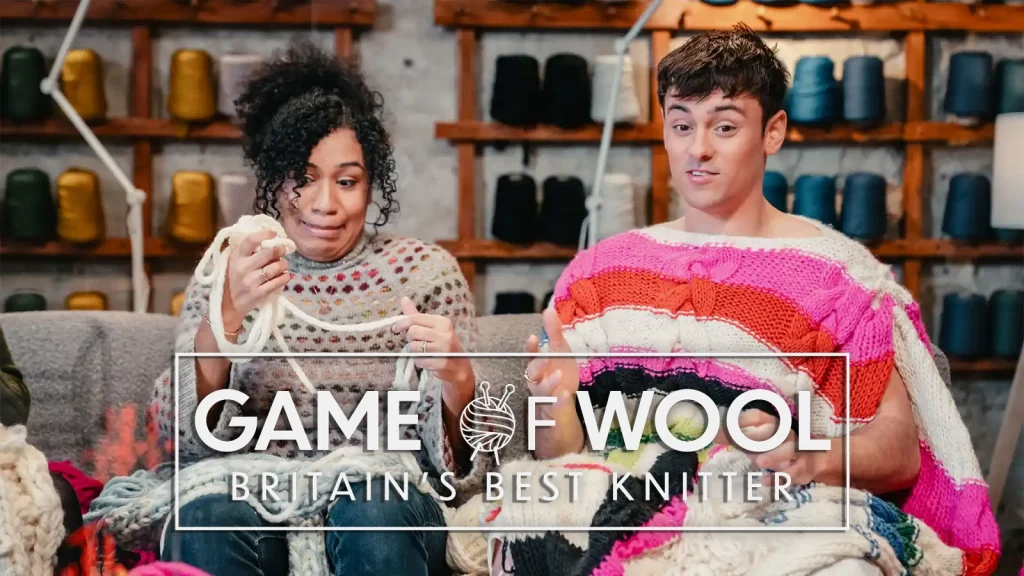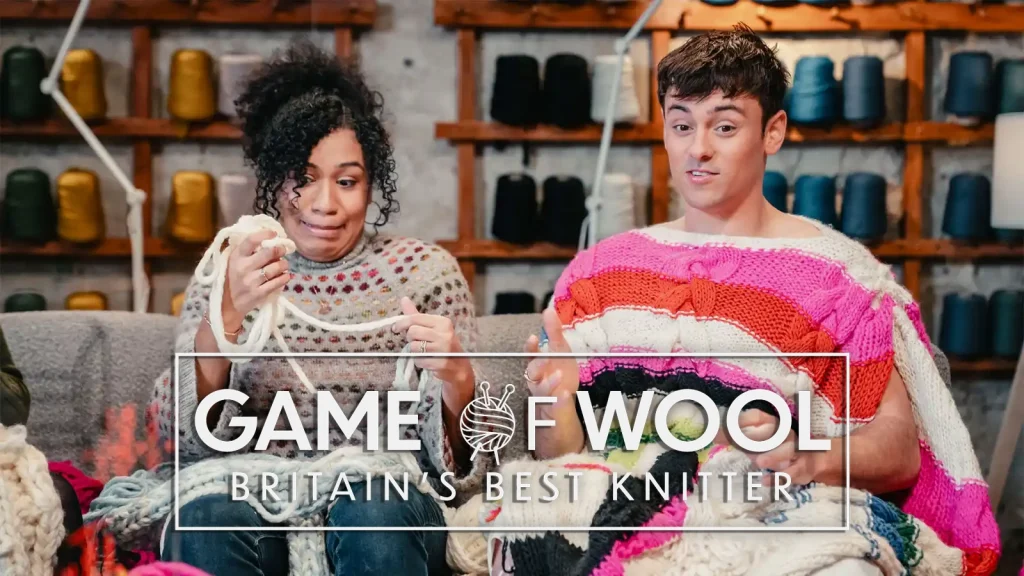
Game of Wool Britain’s Best Knitter episode 4: There is a distinct, rhythmic comfort found in the clicking of needles. It is a sound that whispers of home, warmth, and tradition. For fans of the UK knitting show taking the nation by storm, that sound signals excitement. We are talking, of course, about the Game of Wool. This competition has hooked viewers with its cozy atmosphere and high stakes. Now, we arrive at a pivotal point in the series. Welcome to Game of Wool Britain’s Best Knitter episode 4.
However, this is not just any ordinary week in the studio. The tension is palpable, yet the theme is delightfully playful. It is officially Kids Week. Consequently, the remaining amateur knitters must channel their inner child. They need to tap into a sense of wonder that often fades with adulthood.
Leading the proceedings is a man who needs little introduction. We all remember the viral images of the Olympic champion diver knitting poolside in Tokyo. Those moments brought a global spotlight to the craft. Now, seeing Tom Daley host this series feels like a natural evolution. He isn’t just a presenter; he is a passionate participant in the community.
Furthermore, Tom Daley knitting alongside the contestants adds a layer of genuine camaraderie. He understands the frustration of a dropped stitch. He knows the sheer panic of running out of yarn. His presence bridges the gap between elite sports mentality and creative gentle arts. In this episode, his enthusiasm for the “Kids Week” theme is infectious. After all, he is a father himself. Therefore, he understands exactly how durable and fun these projects made from wool need to be.
The episode kicks off with a solo challenge that tests both technical skill and pure imagination. The brief sounds simple, but it is deceptively tricky. The knitters must devise imaginative fancy dress outfits for children. However, knitting clothing for kids is a unique beast. Children are honest critics. If the wool itches, they will scream. If the fit restricts movement, they will refuse to wear it. Therefore, the competitors must balance comfort with the “wow” factor. We see sketches of dragons, fairies, and perhaps even tiny superheroes.
The studio transforms into a playground of color. Skeins of yarn in bright primaries and neon pinks fly off the shelves. It looks like a rainbow exploded in a yarn shop. Nevertheless, the clock is ticking. Speed is essential here. Yet, speed often leads to mistakes. A single twisted stitch can ruin the drape of a costume. The knitters furrow their brows, their hands moving like blur. They are sculpting memories with every loop of fiber.
Watching over this colorful chaos are the formidable judges. Di Gilpin and Shelia Greenwell are royalty in the fiber world. They are not easily impressed by flashy colors alone. They look for structural integrity and technical mastery.
Di Gilpin often focuses on the heritage and mathematics behind the pattern. She wants to see that the knitter understands the architecture of the garment. On the other hand, Shelia Greenwell has a sharp eye for finish and wearability. During Game of Wool Britain’s Best Knitter episode 4, their scrutiny intensifies. They pull at seams. They check the tension. For the fancy dress challenge, they are looking for whimsy that doesn’t sacrifice quality. Can these costumes withstand the rough and tumble of a child’s playdate?
The feedback is direct. Sometimes it is harsh. However, it is always delivered with a desire to push the knitters to be better. The quest to find the UK knitting champion demands nothing less than perfection.
The Team Challenge: Weaving Magic Together
After the solo dust settles, the dynamic shifts. Knitting is often a solitary pursuit. We imagine the knitter alone in a rocking chair. However, this Game of Wool TV show likes to shake things up. The second half of the episode features a daunting team challenge.
The teams must craft intricate, interactive wall hangings. This creates a fascinating new set of problems. A wall hanging is art, but making it “interactive” adds a layer of engineering.
Perhaps they will add pockets with hidden toys. Maybe they will create textures that invite little hands to touch and explore. The challenge requires disparate creative voices to harmonize.
Unfortunately, collaboration can sometimes lead to tangles. Personalities clash like colors that don’t match. One person wants a forest theme; another wants outer space. They must compromise quickly.
Moreover, the scale of these projects made from wool is significant. These are not small baby booties. These are large statement pieces. The physical labor involved is immense.
Game of Wool Britain’s Best Knitter episode 4
Throughout the episode, the star of the show remains the material itself. Wool is an incredible medium. It is forgiving yet stubborn. It stretches, it blocks, and it warms. In Game of Wool, we see the versatility of this fiber. It transforms from a string into a shield for a knight or a soft meadow on a wall. The show does a fantastic job of highlighting sustainable choices too.
Additionally, the sensory experience of the show is high. You can almost feel the softness through the screen. It offers a digital hug to the viewer. This is why the knitting competition genre is growing. In a digital world, we crave the analog reality of handmade things.
Despite the cozy vibes, do not forget this is a contest. Someone will leave the barn. The pressure in Game of Wool Britain’s Best Knitter episode 4 reaches a boiling point. Mistakes happen. A team might miscalculate their measurements. A solo crafter might not finish a sleeve in time. The cameras catch every grimace and every sigh of relief.
Tom Daley often steps in to offer moral support. He reminds them to breathe. He reminds them why they love knitting challenges in the first place. It is about the joy of creation. Yet, the desire to win is fierce. The title of UK knitting champion opens doors. It validates years of practicing late at night.
Game of Wool Britain’s Best Knitter episode 4
Game of Wool Britain’s Best Knitter episode 4 opens with the comforting yet high-pressure atmosphere that has come to define this unique competition. As the remaining seven contestants gathered in the yarn barn, the stakes felt significantly higher, marking the halfway point of the series. The rhythmic clicking of needles usually fills the air, but this week presented a curveball that tested versatility and technical breadth. The theme was Kids Week, a genre that demands durability, whimsy, and a keen understanding of how children interact with textiles. For the loyal audience of the UK knitting show, this signaled an hour of adorable aesthetics clashing with brutal time constraints.
The episode began with the host, Tom Daley, setting the stage for a week dedicated to playfulness and imagination. As an Olympic champion diver knitting enthusiast, Daley understands the discipline required to master a craft, and his presence offered a supportive anchor for the nervous participants.
The competition has whittled down the field to the strongest contenders, leaving no room for simple errors or lack of planning. This week, the judges were looking for more than just technical proficiency; they demanded characters that could spark a child’s storytelling mind. The pressure was palpable as the knitters prepared to transform yarn into tangible magic.
For the solo challenge, the brief was strictly defined yet creatively open. The judges, Di Gilpin and Sheila Greenwell, tasked the amateur knitters with creating a fancy dress costume suitable for a toddler. However, there was a significant technical constraint: the outfit had to be constructed entirely using crochet.
This mandate threw several contestants off balance, as many are primarily knitters who view crochet as a secondary skill. The requirements were threefold, demanding a main body, characterful headgear, and durable embellishments that could withstand the rough and tumble of playtime. With only twelve hours on the clock, time management became as critical as stitch selection.
The yarn barn became a hive of frantic energy as the competitors conceptualized their designs. The shift from knitting needles to crochet hooks required a mental adjustment, forcing the makers to think about fabric structure differently. Crochet creates a denser, more structural fabric than knitting, which is advantageous for costumes but unforgiving if the tension is incorrect. The knitters had to demonstrate that they could create seamless shapes, intricate textures, and recognizable characters without relying on the drape of traditional knitted fabric.
As the clock ticked down, the room filled with the vibrant colors of childhood. From safari explorers to crayons, the variety of concepts highlighted the diverse creative backgrounds of the participants. The judges wandered the floor, offering critiques that were equal parts encouraging and terrifying. They were looking for originality and structural strength, warning the contestants that basic designs would not suffice at this stage of the Game of Wool.
The Crochet Solo Challenge in Game of Wool Britain’s Best Knitter Episode 4
The solo challenge in Game of Wool Britain’s Best Knitter episode 4 proved to be a definitive test of adaptability. The requirement to use crochet exclusively meant that the contestants could not hide behind their preferred knitting techniques. Isaac, who has shown steady improvement throughout the series, decided to tackle an ambitious Explorer costume. His design was praised for its intellectual approach to texture. He utilized a spike stitch for the main body of the safari vest, a technique where the hook works down into the row below to create a long, vertical stitch.
This choice was strategic, as it mimicked the woven texture of canvas fabric typically found in explorer gear. Isaac further elevated his piece with complex intarsia crochet, charting a map of the globe onto the back of the outfit, and engineered a pith helmet that required precise structural integrity.
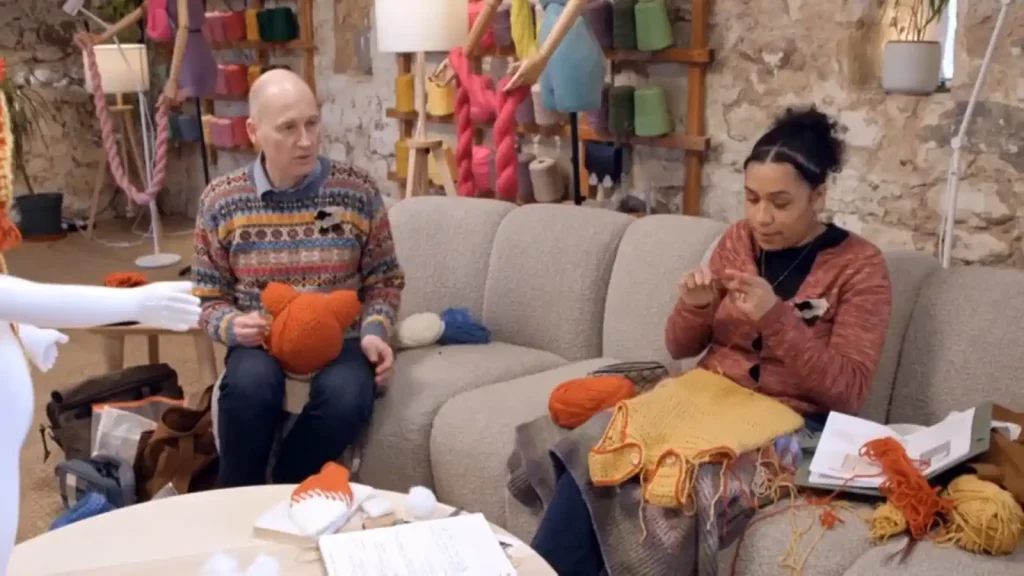
In contrast to Isaac’s technical rigor, other knitters focused on personal nostalgia. Holger drew inspiration from his childhood inability to pronounce the word “fox,” creating a character named “Futs.” His design featured striped dungarees secured with hand-crocheted buttons and a headpiece that utilized a brushed yarn technique.
By vigorously brushing the yarn, Holger created a fuzzy, fur-like texture for the fox’s whiskery sideburns, adding a sensory element that appealed to the judges. The centerpiece of his outfit was a bushy tail, which required careful attachment to ensure it wouldn’t droop or detach during play. The judges, particularly Sheila Greenwell, appreciated the whimsical backstory and the solid construction of the garment.
However, not every risk paid off. Tracy attempted to create a Queen Bee costume, aiming for high impact with yellow and black stripes. To construct the wings, she employed a non-traditional method, using hair curling bands wrapped in yarn to create the wing shape. While the idea demonstrated out-of-the-box thinking, the execution proved problematic.
The hair curling bands added significant weight to the back of the costume, pulling the fabric away from the body and distorting the fit. The judges noted that while her cluster stitches added a nice texture to the bee’s body, the engineering failure of the wings detracted from the overall success of the outfit.
Technical Hurdles and Creative Concepts
The challenge also highlighted the varying levels of crochet experience among the group. Dipti, a librarian, chose a concept based on the children’s book The Day the Crayons Quit. She attempted to turn the toddler into a walking crayon, constructing a simple tube shape for the body and a cone for the hat. Her ambition lay in the lettering; she attempted intarsia crochet to spell out “Crayon” on the front of the suit.
This technique involves changing colors mid-row to create a graphic image or text. Unfortunately, Dipti struggled with the execution. The lettering appeared messy, and she used long floats of yarn that compromised the neatness of the design. Furthermore, the sizing was off, resulting in a garment that gaped significantly at the back.
On the other end of the spectrum, Ailsa showcased how historical inspiration could inform modern craft. Designing a Zebra outfit, she referenced a knitting pattern from the 1950s to create irregular stripes. Rather than standard uniform lines, she manipulated the height of her stitches to create a natural, organic flow that mimicked a real zebra’s coat. This attention to detail wowed the judges, who praised the “cracking pattern” and the expressive eyes on the headpiece. Ailsa’s work demonstrated that even within the constraints of a twelve-hour challenge, deep knowledge of stitch history can provide a competitive edge.
Lydia, coming off a win the previous week, opted for a crowd-pleasing Lion romper. She utilized the loop stitch to create a thick, tactile mane around the hood and cuffs. The loop stitch creates decorative loops of yarn on the surface of the fabric, perfect for imitating animal fur. While the judges acknowledged that a lion was not the most original concept, they could not fault her execution. The fit was described as a “feat of engineering,” and the tail was attached securely, proving her technical competence.
Simon, who had struggled with planning in previous weeks, redeemed himself slightly with a Knight’s costume. He used a granny square stitch to mimic the look of chainmail and constructed a helmet that was praised as a solid piece of construction. His accessory, a mace made with tight double crochet stitches, added a playful yet safe element to the ensemble.
The Team Challenge: A Game of Consequences
Following the solo presentations, the atmosphere shifted as the knitters were divided into two groups for the team challenge. In a twist consistent with the playful theme, the judges introduced a game of “Consequences” to determine the design of their projects. Each team member had to draw a section of a creature—head, body, or legs—without seeing what the previous person had drawn. This resulting “exquisite corpse” drawing would serve as the blueprint for an interactive wall hanging destined for a child’s bedroom.
The teams were split into Team Sea Creature (Dipti, Holger, Lydia, and Simon) and Team Shapes (Tracy, Isaac, and Ailsa). The objective was to create a cohesive wall hanging that incorporated interactive and sensory elements. This challenge tested not just their knitting and crochet skills, but their ability to communicate and collaborate under extreme time pressure. They had eight hours to bring their disjointed drawings to life using wool.
Team Sea Creature immediately faced hurdles. Their drawing depicted a monster rising from the depths, requiring them to create panels that transitioned from the sky to the deep ocean. However, they failed to agree on a unified scale or background technique early in the process. Simon worked on a sky-blue background for the head, while Lydia and Dipti worked on different shades of water, and Holger tackled the seabed. The lack of a centralized plan meant that as the deadline approached, they were left with panels of different widths and tensions.
Divergent Strategies in Group Knitting
The contrast between the two teams became the defining narrative of the second half of Game of Wool Britain’s Best Knitter episode 4. Team Shapes adopted a highly strategic approach. Recognizing that their drawing was abstract and geometric, they decided to unify the project with a common background color—a neutral cream. They also agreed to knit a garter stitch border on every panel. Garter stitch is a stable, non-curling stitch pattern, and using it as a frame ensured that when the panels were eventually sewn together, they would lie flat and match perfectly in width.
This decision by Team Shapes allowed them to focus on the interactive elements without worrying about the final assembly. Isaac created a circular caterpillar body using waffle and cable knits to provide tactile variety, complete with I-cord legs that could be pushed and pulled. Tracy designed a striking triangular face with “Zentangle” inspired embroidery and sparkly yarn hair. Ailsa finished the bottom panel with a skirt featuring lace-up shoes, allowing a child to practice tying knots. Their communication was seamless, and their “book character” creature began to emerge as a polished, professional piece.
Conversely, Team Sea Creature descended into chaos. The ambitious nature of their underwater world worked against them. They incorporated zippers—one for the monster’s mouth and one for a vest—which are notoriously difficult to insert into knitted fabric. While the zips themselves were technically impressive, the overall assembly was a disaster.
Because they hadn’t agreed on a border or a fixed width, the panels did not align. In the final hour, the panic was visible. They were forced to roughly sew the pieces together, resulting in visible seams and a wall hanging that bulged and distorted. The lack of cohesion was evident, with the judges later noting that it looked like four separate projects forced together rather than a single collaborative artwork.

Judging the Wall Hangings
When the eight hours concluded, the difference in quality was stark. Di Gilpin and Sheila Greenwell inspected the wall hangings with their characteristic attention to detail. Team Shapes presented a wall hanging that was celebrated for its unity. The cream background made the colorful, geometric character pop, and the garter stitch borders ensured the piece hung beautifully straight. The judges were enchanted by the character, noting it looked like it belonged in a children’s book. The interactive elements, from the tie-up shoes to the pullable legs, were perfectly executed and age-appropriate.
Team Sea Creature’s effort received a much harsher critique. While the judges acknowledged individual moments of brilliance—such as Holger’s intarsia feet with pom-pom toenails and Lydia’s bubbly texture on the tentacles—the piece failed as a wall hanging. The “step” visible where the crochet panel met the knitted panel was a glaring error. The visible stitching used to join the panels was described as “not brilliant,” and the overall aesthetic was deemed chaotic. The distinct lack of communication regarding tension and sizing ultimately doomed their project. The judges pointed out that in a knitting competition, the finish is just as important as the concept, and Team Sea Creature had failed to consider how the piece would hang.
The Verdict: Big Knitter and Cast Offs
As the episode neared its conclusion, the judges retreated to deliberate on the fate of the amateur knitters. The performance in the team challenge weighed heavily on their decisions, but the solo challenge provided the individual data points needed to distinguish the safe from the endangered. It was clear that Team Shapes had won the group task, which put Tracy, Isaac, and Ailsa in a strong position.
The title of “Big Knitter” for the week was awarded to Isaac. His trajectory throughout the competition had been one of steady ascent, but this week he truly broke away from the pack. His Explorer outfit was technically superior, utilizing advanced stitch work to mimic specific fabrics, and his leadership in the team challenge helped secure the win for Team Shapes. The judges cited his clear vision and the “Planet Earth” precision of his intarsia globe as reasons for his victory. It was a moment of triumph for the young knitter, solidifying his status as a frontrunner in the Game of Wool TV show.
Conversely, the decision of who to cast off came down to a few struggling contestants. Simon was scrutinized for his limited stitch repertoire, though his helmet construction saved him. Tracy’s wings were a failure, but her team performance was strong. Ultimately, it was Dipti who was asked to leave the yarn barn. Her Crayon outfit suffered from significant fit and finish issues, particularly the gaping back and messy lettering. Furthermore, her contribution to the losing team did not elevate the project enough to save her. The judges felt she had reached the limit of her technical skills and was beginning to feel out of her depth among the other knitters.
The Role of Guidance and Community
Throughout Game of Wool Britain’s Best Knitter episode 4, the presence of the judges and host played a vital role in the narrative. Tom Daley, as the Tom Daley host figure, provided more than just time checks; he offered empathy. When the contestants were stressing over zips or rushing to finish seams, Daley’s background as a competitor allowed him to relate to their anxiety. He bridged the gap between the technical demands of the judges and the emotional experience of the makers.
Di Gilpin and Shelia Greenwell continued to establish themselves as formidable figures in the world of projects made from wool. Their critiques, while sometimes sharp, were always grounded in a desire to see the craft elevated. They constantly pushed the knitters to move beyond their comfort zones, demanding that they explore new stitches and construction methods. Their feedback on the importance of “swatching” and measuring before beginning a team project was a valuable lesson not just for the contestants, but for the viewers at home.
The episode also highlighted the camaraderie that develops in such high-stress environments. Even as Team Sea Creature crumbled under the pressure, there was a sense of shared destiny. When Dipti was announced as the knitter leaving the show, the emotional response from the group was genuine. The sound of the remaining contestants chanting her name and the tearful goodbyes underscored that while this is a competition, it is also a community bound by a shared passion for wool.
Looking Ahead in the Game of Wool
As the credits rolled on Game of Wool Britain’s Best Knitter episode 4, the preview for the next week promised even more complex challenges. The remaining six knitters will face tasks involving “knitted food good enough to eat” and the creation of an “ultimate textured cardigan.” With the field narrowing, the margin for error is practically non-existent. The departure of Dipti serves as a reminder that creativity must be matched by technical execution.
For fans of the Game of Wool, this episode was a masterclass in the versatility of yarn. It demonstrated that knitting and crochet are not just about making scarves or blankets; they are engineering disciplines that allow for the creation of intricate costumes and interactive art. The survival of the remaining contestants will depend on their ability to internalize the judges’ feedback: plan effectively, measure twice, and never underestimate the importance of a good finish. As the competition heats up, the click of the needles will only get faster, and the designs more ambitious, keeping the UK knitting show audience firmly hooked.
FAQ Game of Wool Britain’s Best Knitter episode 4
Q: What is Game of Wool Britain’s Best Knitter and who hosts the show?
A: Game of Wool is a UK knitting competition show that searches for Britain’s best amateur knitter through various creative challenges. The series is hosted by Tom Daley, the Olympic champion diver who gained international attention for knitting poolside in Tokyo. His genuine passion for the craft brings authentic camaraderie to the competition, as he understands both the technical challenges and emotional pressure contestants face. Furthermore, his presence bridges elite athletic discipline with creative fiber arts, creating a uniquely supportive atmosphere throughout the series.
Q: What challenges did contestants face during Kids Week in episode 4?
A: Episode 4 featured two distinct challenges centered around children’s items. The solo challenge required contestants to create fancy dress costumes for toddlers using exclusively crochet techniques within twelve hours. This proved demanding because many competitors primarily knit rather than crochet, forcing them to adapt their skills. Subsequently, teams tackled an interactive wall hanging challenge based on a game of Consequences. They had eight hours to transform randomly drawn creature designs into cohesive, child-friendly art pieces incorporating sensory elements like zippers, textures, and movable components.
Q: Who are the judges on Game of Wool and what do they look for?
A: Di Gilpin and Sheila Greenwell serve as the formidable judges on Game of Wool. Di Gilpin focuses on heritage techniques and the mathematical architecture behind patterns, ensuring contestants understand garment construction fundamentals. Meanwhile, Sheila Greenwell scrutinizes finish quality and wearability with exceptional attention to detail. During episode 4’s Kids Week, they demanded projects that balanced whimsy with structural integrity. The judges particularly emphasized that costumes must withstand children’s rough play while maintaining professional construction standards, pushing contestants beyond basic technical proficiency.
Q: What made Isaac’s Explorer costume stand out in the solo challenge?
A: Isaac’s Explorer outfit demonstrated exceptional technical mastery and strategic design thinking. He utilized spike stitch for the safari vest body, working the hook down into previous rows to create vertical texture mimicking woven canvas fabric. Additionally, he incorporated complex intarsia crochet to chart a globe map on the back, showcasing advanced color-work skills. His precisely engineered pith helmet required structural integrity calculations. This combination of ambitious concept and flawless execution earned him Big Knitter honors for the week, solidifying his position as a frontrunner in the competition.
Q: Why did Team Sea Creature struggle with their wall hanging project?
A: Team Sea Creature’s failure stemmed from fundamental communication breakdowns and lack of unified planning. Members worked on panels with different widths, tensions, and background techniques without establishing common measurements or borders. Consequently, when assembly time arrived, their pieces didn’t align properly, creating visible steps where crochet met knitting. Although individual elements like Holger’s intarsia feet and Lydia’s textured tentacles showed creativity, the overall piece appeared chaotic rather than cohesive. The judges emphasized that successful collaborative projects require early agreement on technical specifications, not just creative vision.
Q: How did Team Shapes achieve victory in the group challenge?
A: Team Shapes succeeded through strategic planning and unified execution. They immediately established a neutral cream background color and agreed to frame every panel with garter stitch borders. This crucial decision ensured panels would lie flat and match in width during final assembly. Their communication remained seamless throughout, allowing members to focus on innovative interactive elements like Isaac’s pullable caterpillar legs and Ailsa’s lace-up practice shoes. The resulting wall hanging resembled a professional children’s book illustration, with the judges praising its cohesion and age-appropriate functionality.
Q: What technical mistakes led to Dipti’s elimination from the competition?
A: Dipti’s departure resulted from multiple technical failures in both challenges. Her Crayon costume featured messy intarsia lettering with long yarn floats that compromised the design’s neatness. Moreover, significant sizing errors caused the garment to gape dramatically at the back, demonstrating poor construction planning. Her contribution to Team Sea Creature’s losing wall hanging didn’t compensate for these solo challenge shortcomings. The judges felt she had reached her technical ceiling and couldn’t match the advancing skill levels required. This elimination highlighted how precision and proper finishing separate competitors at this competition stage.
Q: What crochet techniques were showcased during the fancy dress challenge?
A: Episode 4 displayed remarkable crochet technique diversity. Contestants employed spike stitch for texture, cluster stitches for dimensional effects, and loop stitch to create fur-like manes. Ailsa referenced 1950s patterns for irregular zebra stripes by manipulating stitch heights. Simon used granny squares to mimic chainmail appearance. Tracy experimented with unconventional materials, wrapping hair curling bands in yarn for wings. However, intarsia crochet proved particularly challenging, requiring precise color changes mid-row. These varied approaches demonstrated that crochet offers distinct structural advantages over knitting for costume construction, creating denser, more stable fabrics.
Q: Why is Kids Week considered especially challenging for knitting competitors?
A: Children’s items present unique design constraints that test makers’ versatility. Garments must prioritize comfort since kids refuse to wear scratchy or restrictive clothing. Durability becomes critical because children’s play subjects items to extreme stress. Additionally, successful designs must capture imagination while maintaining technical integrity. The crochet requirement in episode 4 added complexity, forcing primarily-knitting contestants beyond their comfort zones. Furthermore, sizing accuracy matters tremendously for proper fit on active toddlers. These combined demands require makers to balance engineering precision, material knowledge, and creative storytelling simultaneously.
Q: What lessons can viewers learn from the team challenge dynamics?
A: The contrasting team performances offered valuable collaborative lessons. Successful teamwork requires establishing technical parameters before beginning creative work, as Team Shapes demonstrated with their border and background decisions. Conversely, Team Sea Creature showed how individual brilliance cannot salvage projects lacking unified vision and measurement standards. Effective communication about tension, sizing, and assembly methods proves essential when multiple makers contribute components. The episode emphasized that in collaborative fiber arts, agreeing on foundational elements early prevents catastrophic assembly failures later. These principles apply beyond competition contexts to any group crafting endeavor.