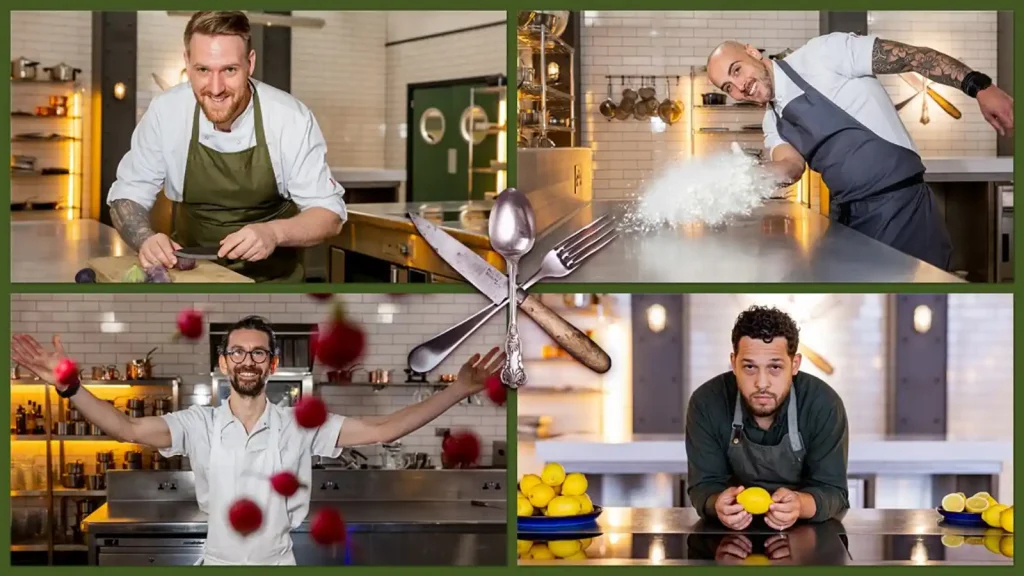
Great British Menu 2026 episode 10: Wales arrives on Great British Menu 2026 with all the drama and passion the nation is famous for. Episode 10 marks the opening of the Welsh heat, and it does not disappoint. Four talented chefs step into the kitchen, each determined to represent their country with pride, creativity, and extraordinary cooking.
The brief this series is a thrilling one. Chefs must celebrate the British film industry through their food. It sounds unusual, but the results are breathtaking. Dishes become stories. Plates become tributes. Every bite carries a piece of cinematic history.
From the very first moment, the atmosphere crackles with competitive energy. These four Welsh chefs are not here to play it safe. They arrive with bold ideas, strong flavours, and a deep connection to their Welsh roots. The British film industry has given them rich material to work with, and they are determined to honour it beautifully. The competition opens with canapes, moves through the starter round, and then arrives at the fish course. Each stage raises the stakes a little higher. Furthermore, each dish must tell a story. That is a tall order, even for experienced professional cooks.
Presiding over the Welsh heat this week is veteran judge Tommy Banks. A Michelin-starred chef himself, Banks brings both warmth and rigour to the judging table. He knows great cooking intimately. Consequently, he is not easily impressed. Banks is celebrated for his inventive, produce-led style. He appreciates dishes that are honest, seasonal, and technically precise. The Welsh chefs will need to deliver all three qualities to earn his respect. Additionally, they will need their food to carry genuine emotional resonance. That is where the film industry brief becomes both a gift and a challenge.
Two of the most talked-about dishes in this episode both feature celeriac as their hero ingredient. It is a fascinating coincidence — or perhaps a sign of how deeply Welsh chefs connect with earthy, grounded produce. However, the similarities end at the vegetable itself. The two dishes could hardly be more different in inspiration or execution.
The first celeriac dish pays homage to Under Milk Wood, the beloved 1972 film adaptation of Dylan Thomas’s radio play. Richard Burton narrated the original BBC broadcast and starred in the film. He is perhaps the most iconic Welsh actor of all time. Accordingly, this dish carries enormous symbolic weight. The chef uses celeriac to evoke the misty, poetic landscape of Llareggub — the fictional Welsh village at the heart of Thomas’s masterpiece.
The second celeriac creation looks further afield for its inspiration. It honours T.E. Lawrence — Lawrence of Arabia — whose story was immortalised in David Lean’s sweeping 1962 epic. The film remains one of the greatest ever made. Therefore, the pressure on this dish is immense. The chef must somehow translate desert grandeur and personal mythology onto a single starter plate.
Great British Menu 2026 episode 10
This is what makes Great British Menu 2026 episode 10 so compelling. The cooking is not just technically skilled — it is deeply thoughtful. These chefs are doing something genuinely difficult. They are translating cinema into cuisine. Moreover, they are doing it under intense competition conditions, with a Michelin-starred judge watching every move. Food and film share more than people realise. Both depend on atmosphere, timing, and emotional impact. A great dish, like a great scene, lingers long after it is over.
As the episode builds toward its conclusion, the tension becomes almost unbearable. Tommy Banks scores each dish carefully and honestly. Some chefs soar. Others stumble. Ultimately, only the strongest cooking will earn a place at the banquet table. Great British Menu 2026 consistently delivers these moments of genuine drama. Nevertheless, the Welsh heat feels particularly charged. The cultural stakes are high. Wales has a proud, distinctive voice in both food and film. These chefs carry that voice into the kitchen with them.
By the end of episode 10, one chef will face elimination. The rest will push forward, carrying their ambitions — and their love of Welsh culture — into the next round. The British film industry has rarely been celebrated quite like this. Through remarkable cooking, extraordinary storytelling, and fierce competition, Great British Menu 2026 reminds us why this programme remains unmissable television.
Great British Menu 2026 episode 10.
Great British Menu 2026 episode 10 opens the Welsh heat with a collision of culinary ambition, national pride, and a film industry brief that pushes four talented chefs to the very edge of their creative range. Wales arrives on the Great British Menu stage carrying its own distinct identity — a culture rich in poetry, landscape, and storytelling — and the chefs competing this week have clearly absorbed every last drop of that inheritance. The kitchen crackles from the first moments, not merely because the cooking is technically demanding, but because each dish carries the weight of something deeply personal. These are not chefs cooking to a formula. They are cooking to prove something.
The brief for this heat centres on British cinema, a theme that demands both intellectual rigour and emotional resonance from every plate. Chefs must translate celluloid into flavour, finding connections between beloved films, iconic figures, and ingredients that speak authentically to Welsh identity. It is a brief that rewards lateral thinking, and it immediately separates those who have done the creative groundwork from those still searching for a foothold. The cooking, food, and ideas on display in this episode reflect a competition that has hit its stride.
Tommy Banks, the Michelin-starred veteran judge presiding over the Welsh heat, brings a measured authority to the judging table. His reputation for precision and his unflinching willingness to call out a dish that falls short of its ambition make him an ideal adjudicator for a heat as competitive as this one. His assessments are never cruel but they are always honest, and that honesty shapes the entire rhythm of the episode. The chefs know they cannot coast.
Four chefs enter: Cai, Liam, Dai, and Trystan. Each brings a distinct sensibility to the competition, and the early exchanges in the kitchen quickly establish where the battle lines fall. Cai and Liam emerge as the most technically consistent performers from the outset, while Dai and Trystan carry flashes of brilliance that are not always matched by execution. The dynamic is compelling precisely because none of the four feels entirely safe.
The canape round sets the tone immediately. These are small dishes but they carry enormous strategic importance — a weak canape signals a lack of refinement, while a brilliant one announces a chef who understands the relationship between restraint and impact. This episode’s canape performances reveal sharply differing approaches to the brief, and Tommy Banks scores them with a directness that reverberates through the rest of the day. The Welsh heat is underway, and the standard is already high.
What follows across the starter and fish courses is a series of dishes that oscillate between the genuinely extraordinary and the frustratingly close-but-not-quite. Great British Menu 2026 has consistently produced heats where the gap between first and last place is narrower than the scores suggest, and Wales is no exception. The chefs are closely matched in ambition if not always in delivery, and that tension makes every score feel consequential.
The cultural touchstones woven through this episode are particularly resonant. Dylan Thomas, Richard Burton, T.E. Lawrence — these are figures who belong not just to Wales but to the broader world, and the chefs who engage with them most successfully are those who find the specific Welsh thread within the universal story. The cooking, food, and film brief intersects with Welsh literary and historical identity in ways that feel genuinely illuminating rather than merely decorative.
By the time the starter and fish scores are announced, the heat has already produced moments of real drama. One dish has drawn rare and unambiguous praise. Another has left Tommy Banks searching for something to celebrate. The competition is tightening, and the chefs heading into the second day carry very different emotional burdens. Wales has delivered exactly the kind of heat that Great British Menu 2026 demands at its best.
Great British Menu 2026 Begins the Welsh Heat: The Canape Round Sets the Battlefield
The canape course in Great British Menu competition carries a significance that its small scale belies. A single bite must establish a chef’s identity, communicate the brief, and demonstrate technical control — all simultaneously. In episode 10, the four Welsh chefs approach this challenge with markedly different strategies, and the results set the competitive hierarchy for the day with unusual clarity.
Cai’s canape draws on the imagery of Welsh landscape and cinema with a lightness of touch that Tommy Banks clearly appreciates. The dish is precise and considered, and it lands well. Liam’s contribution is similarly accomplished, demonstrating the kind of confident minimalism that tends to score strongly in this round. Both chefs emerge from the canapes with their momentum intact.
Dai and Trystan find the canape round more turbulent. Dai’s dish shows ambition but struggles with coherence — the components do not entirely resolve into a unified experience, and Tommy Banks notes the disconnect. Trystan’s canape is technically cleaner but feels less anchored to the brief. Neither score is catastrophic, but both chefs are immediately aware that they are chasing the field rather than leading it. The opening exchanges have established a pecking order that will define the pressure each chef carries into the heavier courses.
The Starter Course: Two Visions of Wales on a Plate
The starter course in this episode produces what will likely be remembered as the defining exchange of the Welsh heat. Two chefs choose celeriac as their primary ingredient, but the similarity ends there. The dishes diverge so dramatically in concept, execution, and emotional register that Tommy Banks is left comparing not just plates but entire philosophical approaches to the brief.
Cai’s starter honours Under Milk Wood, Dylan Thomas’s celebrated radio play, and pays tribute to Richard Burton, the Welsh actor who brought it to life on screen with unforgettable gravity. The dish uses celeriac as its backbone, building around it a set of flavour relationships that evoke the mood and landscape of Thomas’s work. It is a dish grounded in specificity — not a vague gesture toward Welsh culture but a precise engagement with a particular text and a particular voice. Tommy Banks responds to it with genuine enthusiasm. The cooking is confident, the food is beautifully realised, and the connection to the brief is unmistakable.
The second celeriac dish, offered by another competitor, takes T.E. Lawrence as its subject. Lawrence, though born in Wales, spent most of his famous life in the deserts of the Middle East, and the dish attempts to honour that duality. The concept is intellectually interesting — the idea of a Welsh ingredient navigating a world far from home resonates with Lawrence’s own biography — but the execution does not fully deliver on the premise. Tommy Banks identifies the gap between intention and result with characteristic precision, acknowledging the ambition while being clear about where the dish falls short.
The contrast between the two celeriac starters becomes the episode’s central dramatic engine. Great British Menu 2026 regularly produces these moments where a shared ingredient reveals the distance between two chefs’ creative capacities, and episode 10 provides a particularly vivid example. The cooking on both plates is technically competent, but the food on Cai’s plate achieves something the other cannot quite reach: genuine emotional coherence.
Great British Menu 2026 and the Fish Course: Drama, Precision, and Unexpected Tension
The fish course raises the stakes considerably. By this stage, the scores from canapes and starters have created a competitive landscape where no chef can afford a stumble, and the pressure is visible in the kitchen. The approaches taken in the fish course reveal a great deal about each chef’s ability to perform under sustained scrutiny.
Liam’s fish course demonstrates the technical assurance that has characterised his cooking throughout the day. His dish is elegant, well-structured, and shows a clear understanding of how to let a central ingredient speak without overwhelming it with peripheral complexity. Tommy Banks scores it highly, and Liam consolidates his position among the heat’s frontrunners. The cooking is disciplined, the food is refined, and the brief connection is handled with intelligence.
Dai’s fish course introduces a moment of real tension. The dish has genuine merit — there are elements of real skill and thoughtfulness in its construction — but inconsistencies in execution undermine what could have been a breakthrough performance. Tommy Banks is direct about the shortcomings, and Dai knows it. The score that follows reflects a course that promised more than it ultimately delivered.
Trystan’s fish course is more assured than his earlier efforts and suggests a chef who has found his rhythm as the day has progressed. The improvement is noted by Tommy Banks, but the ground Trystan needs to make up after a difficult canape round is significant. The fish course scoring tightens the competition without resolving it, leaving all four chefs genuinely uncertain about their position ahead of the second day.
Richard Burton, Dylan Thomas, and the Weight of Welsh Identity in Great British Menu 2026
The decision by a competitor to honour Richard Burton and Dylan Thomas through the starter course is one of the most culturally ambitious moves of the episode. Both figures occupy a specific and exalted place in Welsh cultural memory: Thomas as the poet who turned the Welsh landscape and its people into literature of world-class standing, Burton as the actor who possessed a voice capable of making that literature vibrate with human truth. Together, they represent the expressive and performative dimensions of Welsh identity.
The dish built around this pairing succeeds because it does not attempt to illustrate the connection literally. It does not try to put a poem on a plate or recreate a film in miniature. Instead, it works through atmosphere and ingredient — using the earthiness of celeriac to evoke the heavy, damp, deeply rooted quality of Dylan Thomas’s Wales, and layering around it flavours that suggest drama and intensity. The result is a dish that rewards the knowledgeable diner while remaining immediately pleasurable for those without the cultural reference points.
Tommy Banks’s praise for this dish is notable for its specificity. He does not simply say the dish tastes good. He engages with the concept, acknowledges the ambition, and confirms that the execution has matched it. In the context of Great British Menu 2026, where veteran judges are famously difficult to impress on conceptual grounds, this kind of response carries real weight. The cooking, food, and cultural intelligence on this plate have converged in a way that the competition celebrates at its highest level.
T.E. Lawrence, Duality, and the Risk of Intellectual Ambition
The T.E. Lawrence dish offers a compelling counterpoint to the Burton-Thomas starter. Lawrence of Arabia is a figure of genuine complexity — a man whose Welsh origins are often forgotten amid the scale of his exploits in the Middle East, and whose identity was perpetually divided between worlds. As a subject for a Great British Menu dish, he offers extraordinary creative possibilities. The challenge is to honour the duality without losing coherence on the plate.
The dish in question takes celeriac, a distinctly European root vegetable, and attempts to inflect it with flavours that gesture toward the landscapes Lawrence navigated during his most famous campaigns. The intention is clear and the concept is genuinely interesting. However, the execution produces a dish that feels pulled in two directions without fully committing to either. The Welsh ingredient and the desert-influenced flavour profile sit alongside each other rather than integrating into something new.
Tommy Banks identifies this as the dish’s central weakness. The idea is strong but the food does not resolve the tension it creates. In a competition as demanding as Great British Menu 2026, an interesting failure is still a failure — and the scores reflect that reality. However, the ambition behind the dish is worth acknowledging. Taking T.E. Lawrence as a subject requires genuine intellectual courage, and the chef responsible for this plate has not played it safe. That willingness to reach beyond the obvious is, in a different context, exactly the quality that produces exceptional cooking.
Scoring, Strategy, and the Mathematics of a Competitive Welsh Heat
By the end of the starter and fish courses, the scores in episode 10 have produced a competitive landscape that is genuinely unpredictable. Cai’s strong performance across both courses places him in a commanding position, and Liam’s consistency ensures he remains a serious threat. Dai and Trystan are in more precarious positions, though neither is out of contention.
The mathematics of Great British Menu competition reward consistency above all else. A chef who scores sevens across every course will frequently outperform a chef who scores a nine and a five. This episode illustrates that principle clearly: the chefs who have maintained the highest floor across canapes, starters, and fish are better positioned than those who have achieved individual brilliance at the cost of overall consistency.
Tommy Banks’s scoring approach reflects this understanding. His scores are not generous, but they are proportionate. He reserves his highest numbers for dishes that genuinely earn them, which means that when a high score appears, the chefs in the kitchen understand its significance immediately. The cooking and food in this episode have received assessments that will shape the decisions made on day two with absolute clarity.
Great British Menu 2026 Welsh Heat: The Chef Departures and What They Reveal
The competitive dynamics established across the canape, starter, and fish courses point firmly toward the end-of-day reckoning that defines each heat. With scores locked in and Tommy Banks having delivered his verdicts with characteristic directness, the pressure on the lower-scoring chefs is intense. The Welsh heat, like all Great British Menu heats, will eventually require a departure, and the scores accumulated through the first day determine who carries the greatest risk.
What the episode reveals about the chefs is perhaps as important as the scores themselves. Cai has demonstrated a rare quality: the ability to translate genuine cultural knowledge into cooking without allowing the intellectual dimension to overwhelm the sensory experience. His Richard Burton and Dylan Thomas starter is the episode’s outstanding dish not merely because it tastes excellent but because it achieves what the brief demands at the highest level.
Liam has shown that technical precision and clarity of thought are sufficient to compete at this level, even without the same degree of cultural storytelling. His cooking is trustworthy and his food is consistently high-quality, which are not small virtues in a competition where a single careless moment can unravel an entire day’s work.
Dai and Trystan have both shown enough quality to suggest that the gap between them and the frontrunners is not insurmountable, but the first day’s scores have created a deficit that only exceptional cooking on day two can close. The Welsh heat is heading toward a conclusion that feels both inevitable and genuinely dramatic.
The Role of Tommy Banks in Shaping the Great British Menu 2026 Welsh Experience
Veteran judges in Great British Menu carry a specific responsibility that goes beyond simply awarding scores. They shape the creative dialogue of the heat, signalling through their responses which ideas have landed, which have fallen short, and which have been received with genuine admiration. Tommy Banks fulfils this role with considerable skill throughout episode 10.
His Michelin-starred background gives him the technical vocabulary to assess the cooking at the highest level, but what distinguishes his judging in this episode is his engagement with the cultural dimensions of the brief. He does not merely evaluate whether a dish is well-executed; he considers whether the dish has succeeded on its own terms, whether the concept is coherent, and whether the cooking and food together justify the ambitions the chef has set for themselves.
This approach creates a judging framework that rewards intellectual honesty. A chef who sets modest goals and achieves them will not score as highly as a chef who sets ambitious goals and comes close to achieving them — provided the gap between intention and execution is not too wide. Tommy Banks manages this framework with a fairness that the chefs in the Welsh heat clearly respect, even when his verdicts are uncomfortable.
What Great British Menu 2026 Episode 10 Signals for the Welsh Heat Ahead
Episode 10 closes with the heat’s shape clearly defined but its conclusion still unresolved. The fish course scores have tightened the competition in ways that ensure the second day will be fiercely contested, and each chef enters that day carrying specific information about where they need to improve. Great British Menu 2026 has already established itself as one of the stronger series in recent memory, and the Welsh heat is a worthy contribution to that standard.
The themes explored through this episode — Welsh identity, British cinema, the relationship between landscape and memory — have produced cooking that feels genuinely connected to the world beyond the kitchen. The best dishes in episode 10 do not merely taste good. They mean something. They locate the brief in a specific cultural moment and ask the diner to think as well as eat.
As the Welsh heat progresses, the chefs who have established strong foundations through the first day’s cooking will need to maintain their standards under increasing pressure. Those who have fallen behind will need to produce food of a different order entirely. Great British Menu 2026 shows no signs of offering easy paths to the final, and the Welsh heat, with its rich brief, its closely matched field, and its exacting veteran judge, is proving no exception to that pattern.
FAQ Great British Menu 2026 episode 10
Q: What is Great British Menu 2026 episode 10 about?
A: Great British Menu 2026 episode 10 opens the Welsh heat, featuring four chefs competing to represent Wales. The British film industry serves as the creative brief. Chefs craft canapes, starters, and fish courses inspired by iconic films and Welsh cultural figures. Veteran judge Tommy Banks scores every dish with characteristic precision and honesty.
Q: Who are the four chefs competing in the Great British Menu 2026 Welsh heat?
A: The four Welsh heat competitors are Cai, Liam, Dai, and Trystan. Each chef brings a distinct cooking style and creative approach to the film industry brief. Cai and Liam emerge as the most consistent performers. However, Dai and Trystan both display moments of genuine brilliance throughout the competition.
Q: Who is the veteran judge in the Great British Menu 2026 Welsh heat?
A: Tommy Banks, the Michelin-starred chef, serves as veteran judge for the Welsh heat. He brings authoritative technical knowledge and a rigorous engagement with the film industry brief. Additionally, he evaluates whether each dish achieves coherence between its concept and execution. His scoring directly shapes the competitive standings after each course.
Q: What is the creative brief for the Great British Menu 2026 Welsh heat?
A: The brief centres on the British film industry. Chefs must draw inspiration from iconic films and celebrated cultural figures to create their dishes. Furthermore, they must connect their chosen subjects authentically to Welsh identity. The brief rewards lateral thinking and penalises superficial or unconvincing links between concept and cooking.
Q: Which cultural figures inspire the starter dishes in episode 10?
A: Two starters take inspiration from distinctly Welsh figures. One dish honours poet Dylan Thomas and actor Richard Burton, celebrating their collaboration on Under Milk Wood. The other pays tribute to T.E. Lawrence, whose Welsh origins are often overlooked. Both chefs use celeriac as their primary ingredient, though their interpretations differ dramatically.
Q: How does the Richard Burton and Dylan Thomas starter perform with Tommy Banks?
A: The dish draws genuine and specific praise from Tommy Banks. It uses celeriac to evoke the earthy, rooted quality of Dylan Thomas’s Wales, with layered flavours suggesting dramatic intensity. Importantly, the cultural references enhance rather than overwhelm the eating experience. Tommy Banks acknowledges both the ambition and the execution, awarding it as the episode’s standout dish.
Q: Why does the T.E. Lawrence celeriac dish fall short in the Welsh heat?
A: The T.E. Lawrence dish presents an intellectually ambitious concept but struggles with execution. The chef attempts to balance Welsh ingredients against desert-influenced flavours, reflecting Lawrence’s divided identity. However, the components sit alongside each other rather than integrating convincingly. Tommy Banks acknowledges the concept’s strength while noting that the food does not resolve the tension the dish creates.
Q: How important is the canape round in Great British Menu competition?
A: The canape round carries considerable strategic weight despite its small scale. A single bite must establish a chef’s identity, communicate the brief, and demonstrate technical control simultaneously. In episode 10, Cai and Liam score strongly, while Dai and Trystan face an immediate deficit. Consequently, the canape scores shape the pressure each chef carries into the heavier courses.
Q: What happens during the fish course in Great British Menu 2026 episode 10?
A: The fish course intensifies the competition considerably. Liam produces an elegant, technically assured dish that consolidates his position among the frontrunners. Dai delivers a course with genuine merit but suffers from inconsistencies in execution. Trystan, meanwhile, improves on his earlier performances. Nevertheless, the scores leave all four chefs uncertain about their standings ahead of day two.
Q: What does Great British Menu 2026 episode 10 reveal about the Welsh heat overall?
A: Episode 10 establishes a Welsh heat defined by cultural ambition, closely matched talent, and uncompromising judging. The best dishes connect Welsh identity to the film industry brief with genuine intellectual honesty. Furthermore, the episode demonstrates that consistency across all three courses outperforms isolated brilliance. Tommy Banks’s exacting standards ensure that only the most complete cooking advances toward the final.