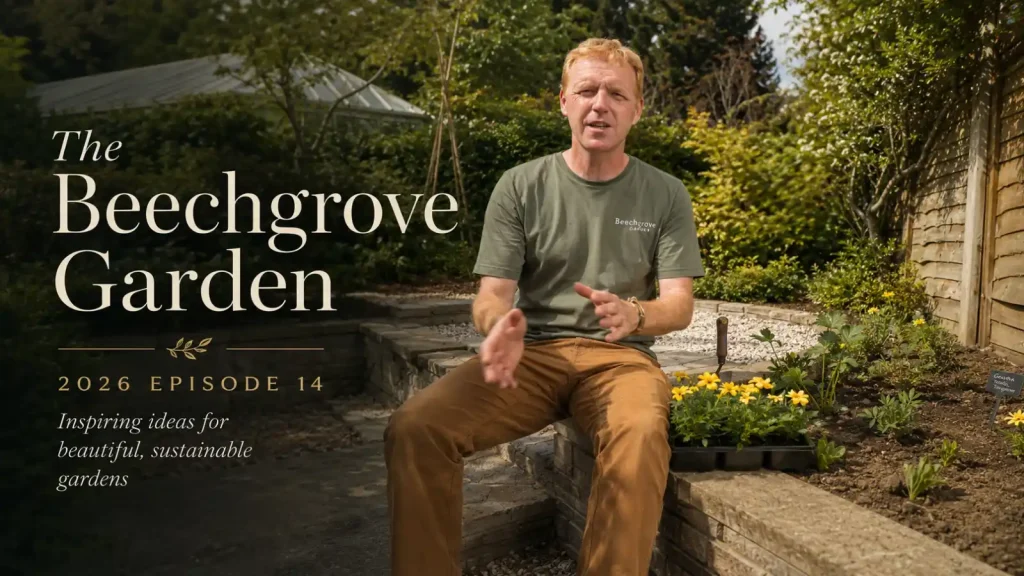
The Beechgrove Garden 2026 episode 14 turns its attention to something every gardener understands instinctively: the value of returning to old projects and judging them honestly. Filmed just outside Aberdeen, this instalment pairs Brian Cunningham and Lizzie Schofield as they revisit planting decisions made months and even years earlier, then push forward with fresh ambitions on a terraced slope, in a renovated herb garden, and across a growing cut flower plot. The result is a practical, confident episode built around espalier fruit training, late-season perennials, foliage for bouquets, and a garden designed entirely for birds.
What makes The Beechgrove Garden 2026 episode 14 stand out is its emphasis on patience and correction. Brian checks the apple and pear trees he planted in spring, tying in leaders and shaping the boldest cuts a fruit grower ever makes. Lizzie steps back into the herb garden she revamped two years ago, deciding what has earned its place and what needs replacing. Both presenters treat the garden as a living experiment, not a finished display.
Alongside these projects, the episode delivers its signature handy hints, a visit to a remarkable conservation garden in the Borders, and a thoughtful look at designing outdoor spaces for people living with dementia. Every idea here is rooted in doing rather than admiring, which is exactly why gardeners keep coming back to Beechgrove.
One of Brian’s central projects this year tackles a problem that defeats many gardeners: how to plant and maintain a slope safely. His solution is a series of terraces, which make the ground easier to work and considerably safer to move around. Stone and sleepers do the structural heavy lifting, holding back the soil and stopping it from washing away down the incline whenever the rain arrives.
The terraces already carry their structure plants and the specimens destined to become topiary, positioned deliberately to capture views across the garden. Brian points out that conventional planting logic gets bent here. Normally you place tall plants at the back and shorter ones at the front, but a terrace invites mixing and matching, because the changing levels let you play with height in ways a flat bed never could.
Into this framework, Brian adds late seasonal perennials chosen to deliver colour from July and August onwards. Actaea ‘Brunette’ leads the selection, a plant he says he would happily grow anywhere, prized for the white bottlebrush flowers that float above dark foliage. His only concern is the bare lower stems, so he underplants with a mound-forming geranium called Ann Folkard to disguise them. The combination of drifting white flowers above and spreading colour below is exactly the layered effect he wants.
The Beechgrove Garden 2026 episode 14
Planting at Eye Level to Bring Small Flowers Into Focus
The lowest terrace becomes the most personal part of the design, and it reveals a clever piece of thinking that runs right through The Beechgrove Garden 2026 episode 14. This is the spot where you sit with a drink at the end of the day, so Brian fills it with plants he normally has to crouch down to appreciate. Raising them onto a terrace brings their detail right up to eye level for the first time.
Lily of the valley goes in for its foliage, which takes on an almost tropical look beside the small pond, and for the white scented flowers that will now sit within easy view. Epimedium follows as a brilliant foliage plant whose flower detail usually hides at ankle height. Then comes sedum ‘Stardust’, chosen because it acts like a magnet to butterflies.
The payoff Brian describes is genuinely charming. He pictures himself sitting on the low terrace at night with a glass of wine, surrounded by butterflies at eye level rather than somewhere down by his feet. It is a small design decision with an outsized emotional reward, and it captures the show’s habit of tying practical planting to real, lived pleasure.
For late summer structure and colour, Brian also works in an aster called ‘Jungfrau’, which he rates highly for the season and doubles as an excellent cut flower. Stachys, Euphorbia and grasses join the scheme to add that sense of motion, the gentle movement that makes a border feel alive rather than static.
Refreshing the Beechgrove Herb Garden Two Years On
Lizzie returns to the herb garden she overhauled two years ago, and her honest verdict is that it genuinely needed the work at the time, having looked tired and worn. Her original redesign lifted the slabs and relaid them in a quadrant style, creating four distinct planting areas that could each hold a different range of herbs. Two years on, the structure has proved its worth, but the planting now needs judgement.
Some original plants stayed and thrived, including a handsome bronze fennel and gorgeous chives. New additions have earned their keep too. Sweet cicely has produced beautiful pods that smell strongly of liquorice when rubbed, and a Dyer’s chamomile now sits nearby. Many of these newer herbs double as ingredients for different types of tea, extending their usefulness well beyond the kitchen.
Maintenance drives this visit. Lizzie chops back the sorrel to stop it spreading and to prevent it running to seed. Her reasoning is precise: once a plant goes to seed, it pours its energy into seed production rather than the fresh green shoots gardeners actually want for cooking. The chives can be cut right back to the ground for a complete refresh, though she happily lets some flower, since the blooms brighten salads, add colour, and give the bees a welcome feast.
Replacing Struggling Herbs With Hardy, Fragrant Alternatives
Not everything in the herb garden has succeeded, and Lizzie’s willingness to pull out failures is instructive. A chocolate mint looks distinctly unhappy, so it comes out. She explains that all the mint was planted in pots sunk into the ground, a deliberate tactic to stop these vigorous plants spreading and bullying their neighbours out of space. Even with that precaution, this particular mint has not thrived.
In its place goes a purple sage, completely hardy and happiest in a sunny spot with free-draining soil. Lizzie works fresh compost into the area to give the new plant a proper start, confident it will settle in well. She notes its culinary range too, from stews and soups to a few chopped leaves scattered over a toasted cheese sandwich, a suggestion she plans to try herself.
Sweet cicely brings a different management challenge. It has set seed and thrown up a crowd of little seedlings, which Lizzie digs out before they can take over and crowd out other herbs. She also introduces hyssop, another fully hardy herb with a lovely peppery smell that suits stews and soups. Part of the mint family, it grows to somewhere between 60 centimetres and a metre, carrying beautiful purple flower spikes, and she sets off to find it the perfect position.
Training Espalier and Cordon Fruit Trees in a Small Space
Brian’s most technically absorbing project in The Beechgrove Garden 2026 episode 14 began in April with a simple, liberating message: the size of your garden should never stop you having an orchard. You do not need a sprawling lawn to grow apple trees. A small border will do, whether against a shed, a garage, or even freestanding, provided you install horizontal wires to train the plants against.
Apples and pears are the fruits to choose here, since plums will not cooperate with this method. Brian demonstrates two approaches, cordons and horizontal espalier, and stresses that the buying happens in winter, so gardeners should plan ahead and visit a specialist nursery for one-year-old trees. Crucially, he advises asking for spur-bearing types rather than tip-bearing ones, because spur-bearers produce those stubby fruiting clusters that deliver the heaviest crops.
The cordons grow at a 45-degree angle, spaced roughly 70 centimetres apart, though up to a metre works. Brian likes how this lets several trees share a single strip, so a mid-season apple, a late apple and a couple of pears can occupy one garage-side border and spread the harvest across two or three months. Planted as bare-root trees in April, they went straight into the ground at that deliberate angle, which encourages the evenly spaced growth that carries the fruit.
The Bold First Cut That Shapes an Espalier
At this point in the season, Brian explains, the work is all about formal training, guiding each plant into the shape it must ultimately hold. Bamboo canes make this far easier. He shows an untrained tree already curving into a banana shape and explains why that matters: he wants a firm, straight stem, so he ties the cane in at multiple points to eliminate any kink before it sets.
The spacing between wires sits at around 30 centimetres, and working only to that measurement without a cane almost guarantees a slight bend. As the season advances, side shoots or laterals will appear, which is exactly what Brian wants, because in the coming weeks these become the basis of the spur system. When tying in, he keeps every knot loose around the bamboo, never tight, since a strangling tie would kill the very growth he is trying to fatten.
The horizontal espalier draws his real enthusiasm, and it demands the boldest move a plant grower ever makes. When the tree went in, Brian cut away a good third of it with a snip just above a wire, a decision that still makes him nervous despite years of practice. This one responded perfectly, producing the three shoots he needed: a new leader to tie in and carry upwards, plus two side shoots destined to form the horizontal arms.
Those arms cannot simply be bent straight down. Instead, they grow at 45 degrees first, matching the cordon principle, to achieve evenly spaced foliage before being lowered. Next winter, while the branches are still pliable and not yet rigid, Brian will peel them down and tie them along the wire, then repeat the process. He estimates two or three years to completion, and a Christie variety pear already trained to that final horizontal form shows precisely the impressive winter result he is chasing.
Bird Garden Scotland and the Power of Planting for Wildlife
The episode travels to Bird Garden Scotland, just north of Lauder in the Borders, a conservation charity that opened in 2022 after extensive planting and planning centred entirely on the needs of its hundreds of resident birds. Co-founder Mark Haillay recalls arriving thirteen years ago to a flat, empty field. The first priority was trees, packed in wherever possible to serve as backdrop, habitat and windbreak all at once.
The site now unfolds around an avenue, the first structure built to give access to the grounds. On one side sits a large paddock with black swans, emus and wallabies, and on the other a series of orchards. Along the avenue, two wide strips of ground demonstrate a strikingly low-effort approach. Mark hesitates to call them beds, because he has not dug them over or weeded them. He simply pushed plants into the gaps, and blue poppies have flourished in their first year from last season’s seedlings.
Conditions explain the success. The water table runs high and the ground stays moist, which suits primulas, while a line of beech trees drops leaves every autumn that enrich the soil with organic material the blue poppies love. It is a persuasive lesson in matching plants to the ground you already have rather than fighting it. Elsewhere, a fruit cage has finally gained its netted roof to keep birds off raspberries, gooseberries, redcurrants, blueberries and blackberries, whose fruit becomes jam sold in the visitor centre and used in the baking.
Gardening in Harmony With Birds and Turning Waste Into Fertiliser
Bird Garden Scotland offers a genuinely different model of pest control, and it reframes how The Beechgrove Garden 2026 episode 14 thinks about wildlife. Slugs are almost absent, because chickens, ducks and partridges roam freely and clear them out. The chosen silkie chickens cannot fly, which is deliberate: they eat slugs, graze, keep the ground tidy and reach only the low-hanging fruit, leaving everything higher up untouched.
The trade-offs are honest. Vegetables here live inside aviaries, because before Mark built them, pigeons would watch the salad go in and strip it the moment his back was turned. Those vegetable aviaries are ironically the one place slugs do cause trouble, since the tidying birds cannot get inside. Government flockdown rules, which require domestic and pet birds to be kept apart from wild birds, mean polytunnels play a seasonal role in housing the flock.
That housing produced an accidental gardening win. Chickens kept in a polytunnel over winter left behind guano mixed with wood bedding, and this combination of wood and chicken manure turned out to be a brilliant fertiliser for tomatoes. Some was dug in and some left on top as a slow release, so every watering trickles more nitrogen into the soil. The results speak plainly: the tomato plants are strikingly green and clearly thriving.
Mark’s closing advice distils the whole philosophy. If you have room, plant trees, because they provide habitat, roost and food. If not, plant bushes, and if there is no room even for those, sow wild flowers. A switchback path built with gentle hairpin bends for buggies and wheelchairs left ugly spoil on either side, so wild flower seed went down instead of grass. Three years on it returns every year, buzzing with insects that in turn draw a vast wild bird population to what was once bare field.
Handy Hints for Bird-Friendly Pots and Easy Cuttings
Brian translates the Bird Garden ethos into something achievable on a patio or in a small back garden, proving you need neither geese nor chickens to help wildlife. His handy hint centres on sowing wild flowers in a large pot. He has already planted a sunflower that will bring colour later in the year and, crucially, produce seeds for birds to pick at through late summer.
For quicker impact he suggests sowing annual flowers such as cornflowers or calendulas, acknowledging the season is running a little late this year. Looking further ahead, he sows teasel, brilliant for birds but biennial, meaning it grows now and flowers next year. To bridge the gap he mixes in honesty, which flowers this year, and predicts the bees and birds will come flocking to the combination.
Lizzie contributes a satisfying propagation hint drawn from the herb garden. Eight weeks earlier she took cuttings from a Southernwood Cola plant, which smells convincingly of cola, and stood them in a glass jar of water on a windowsill. They have since developed a healthy root system, so she pots them into gritty compost and gives them a thorough drink, expecting new growth within a couple of weeks. She recommends it as a perfect project for children, who get genuinely excited watching roots grow, making it a lovely route into gardening.
Growing Foliage and Structure for the Cut Flower Garden
The cut flower plot showcases another returning experiment with a clear verdict. Earlier in the season, Lizzie and Brian set out to bust the myth that a peony cannot be moved and still flower. One relocated peony, kept at its original planting depth, is now blooming beautifully. A second, deliberately planted much deeper, carries no blooms at all. The comparison proves the point neatly: you can move a peony, provided you keep it at exactly the same depth and level.
The plot’s dried flower crop is developing well, with Limonium and Nigella coming along nicely. The Drumstick Scabious disappointed with poor germination, so the gap has been filled with an annual grass, a Panicum called Frosted Explosion, which promises to look fantastic in dried arrangements. This willingness to substitute and adapt runs through the whole cut flower operation.
Foliage is the real focus of this visit, because good foliage adds the drama and structure that lift a bouquet. Lizzie plants a foxtail barley annual grass whose barley-like seedheads bring airy texture and movement. Amaranthus ‘Velvet Curtains’ delivers scarlet-red foliage and matching flower spikes, growing to between 50 centimetres and a metre and holding its colour beautifully in both fresh and dried arrangements. It is exactly the kind of statement plant that makes an arrangement memorable.
Foliage as the Backbone of a Beautiful Bouquet
The Beechgrove Garden 2026 episode 14 makes a persuasive case that flowers alone rarely make the best bouquet. The garden team has successfully germinated a eucalyptus called Baby Blue, and Lizzie explains its structural job. Eucalyptus gives delicate flowers and heavier blooms something to rest against, holding everything upright within the arrangement rather than letting it flop.
Timing matters for harvesting it. She plans to cut the eucalyptus at around 60 centimetres, while the leaves keep their lovely disc-like, rounded shape. Leave it too long and the leaves start to elongate and lose that appeal, so the window is deliberately early. It is a small detail, but it separates a professional-looking bouquet from an ordinary one.
Two more plants complete the foliage palette. Lemon verbena and fennel provide a green backdrop and a great filler that makes the blooms pop, while adding the considerable bonus of wonderful scent. Together these choices show how a cut flower garden is planned as much for its greenery as its flowers, and how much thought goes into every supporting cast member.
Designing a Dementia-Friendly Garden for Comfort and Memory
The most quietly moving strand of The Beechgrove Garden 2026 episode 14 revisits how a garden can be adapted to help people living with dementia, and how beneficial that can be to their care. Gardens brim with multi-sensory stimulation, from the scent, touch and colour of plants to the sounds of wildlife, all of which can relieve tension, aggression and frustration while encouraging a more positive mood.
Layout comes first. Because people with dementia can become easily disorientated, the aim is the simplest possible plan, ideally a single circular route around the garden that avoids junctions where a left-or-right decision could cause confusion. Keeping everything on one level is ideal, though real gardens rarely oblige, so where steps cannot be avoided, even a simple handrail makes a real difference. Since dementia is progressive, an area with steps might be usable at first and then closed off later, and some plants, such as a lovely cloud pine, may sadly have to go.
Paths should be wide and clear, but that does not demand stripping out every plant that brushes against them. A Weigela can be tidied by nibbling off the stems straying onto the path once flowering finishes, which encourages more upright shoots, and a deciduous azalea needs only a couple of trims. As mobility declines, a flatter surface that accepts a wheelchair or mobility aid becomes wiser, ideally with concrete edging to stop wheels rolling off into lawns or beds.
Plants, Shade and Sensory Design for Living With Dementia
Plant choice carries emotional weight in a dementia-friendly garden, offering a genuine opportunity to reconnect with memories. That is why the person living with dementia should be involved in the decisions, choosing what they would like to see growing. A plot of marigolds, tomatoes, lettuce and sweet peas might strike some gardeners as old-fashioned, yet it may transport someone back to the front garden of their earlier life, which is exactly the point.
Sun brings a practical caution, since some medications can cause sunburn. A pergola or even a temporary parasol helps on bright days, and a well-positioned Japanese maple offers perfect dappled shade. Dense, dark corners are best avoided, and a yew is singled out as the kind of plant that creates gloom feeling uninviting and out of bounds, rather than the welcoming atmosphere the garden should have.
Finally, plant form doubles as navigation. A Siberian iris keeps its grassy foliage even after flowering, and its texture is easily recognised by touch, helping someone identify a corner or a point to navigate. A nearby Hosta, with its larger leaves and glaucous colour, provides contrast that marks the next point along the route. For anyone visually impaired, these tactile and visual cues turn the planting itself into a gentle, reassuring map.
Taken together, The Beechgrove Garden 2026 episode 14 rewards the gardener who plans for the long term, corrects mistakes without sentiment, and designs with both wildlife and people in mind. From espalier arms shaped over years to butterflies drawn up to eye level, from bird-friendly wild flowers to a garden built around memory and touch, every project here proves that the best gardening is a conversation between patience, observation and care. Next week George and Calum take over, lifting the first early tatties, checking the hard-pruned privet hedge, and inspecting the clubroot-resistant brassicas, continuing the same honest habit of returning to see how things have grown.
FAQ The Beechgrove Garden 2026 episode 14
Q: Can you grow apple trees in a small garden?
A: Yes, you don’t need a large lawn to grow apple or pear trees. A small border works well, whether against a shed, a garage, or freestanding, as long as you install horizontal wires to train the plants against. Cordons and espaliers let several trees share one narrow strip, spreading the harvest across two or three months.
Q: Why choose spur-bearing fruit trees instead of tip-bearing?
A: Spur-bearing apples and pears form stubby fruiting clusters along the branches, which produce the heaviest crops. Tip-bearing types only fruit at the end of the previous year’s growth, giving far less. When buying one-year-old trees from a specialist nursery in winter, ask specifically for spur-bearing varieties to maximise your yield on trained cordons and espaliers.
Q: Why are cordon fruit trees planted at a 45-degree angle?
A: The 45-degree angle encourages evenly spaced growth all the way up the plant, which is where the fruit forms. Bare-root cordons go straight into the ground at this angle, spaced roughly 70cm apart or up to a metre. The tree naturally wants to grow straight, so you keep tying the leader in to hold that diagonal.
Q: How do you start training a horizontal espalier?
A: It begins with a bold cut, removing roughly a third of the tree with a snip just above a wire. This forces three shoots: a central leader that grows upwards, plus two side shoots that become the horizontal arms. The arms first grow at 45 degrees for even foliage, then get peeled down and tied along the wire the following winter while still pliable.
Q: Can you move a peony and still get it to flower?
A: Yes, the common myth that peonies won’t flower after moving is untrue. The key is planting depth. A relocated peony kept at its original depth flowers beautifully, while one planted much deeper produces no blooms at all. Always lift and replant a peony at exactly the same depth and level to keep it flowering successfully.
Q: Why should you cut back herbs before they go to seed?
A: Once a plant runs to seed, it channels its energy into producing seeds rather than fresh green shoots. Cutting back sorrel and chives prevents this and encourages tender new growth for cooking. Chives can be cut right to the ground for a complete refresh, though leaving some to flower adds colour to salads and feeds the bees.
Q: Why is mint planted in pots sunk into the ground?
A: Mint is vigorous and spreads aggressively, bullying neighbouring plants out of their space. Sinking it in pots within the ground contains the roots and stops it taking over. When a variety like chocolate mint fails to thrive, it can be swapped for a hardy alternative such as purple sage, which prefers a sunny spot with free-draining soil.
Q: Why is foliage important in a cut flower bouquet?
A: Foliage adds drama, structure and movement that flowers alone cannot provide. Eucalyptus gives delicate and heavy blooms something to rest against, holding the arrangement upright. Foxtail barley brings airy texture, Amaranthus adds scarlet drama, and lemon verbena and fennel act as scented green fillers that make the blooms pop in both fresh and dried arrangements.
Q: How can you make a garden more attractive to birds?
A: If you have room, plant trees, since they provide habitat, roost and food. If not, plant bushes, and if space is very tight, sow wild flowers. Wild flowers draw insects, and insects bring in the birds. Even a large patio pot sown with sunflowers, cornflowers and teasel offers seeds and shelter that attract birds and bees.
Q: How do you design a garden for someone living with dementia?
A: Keep the layout as simple as possible, ideally a single circular route that avoids confusing left-or-right junctions. Aim for one level, adding handrails where steps can’t be avoided, and use wide, clear paths. Choose familiar, sensory plants like Siberian iris and Hosta for touch and contrast, and involve the person in choosing plants that reconnect them with memories.