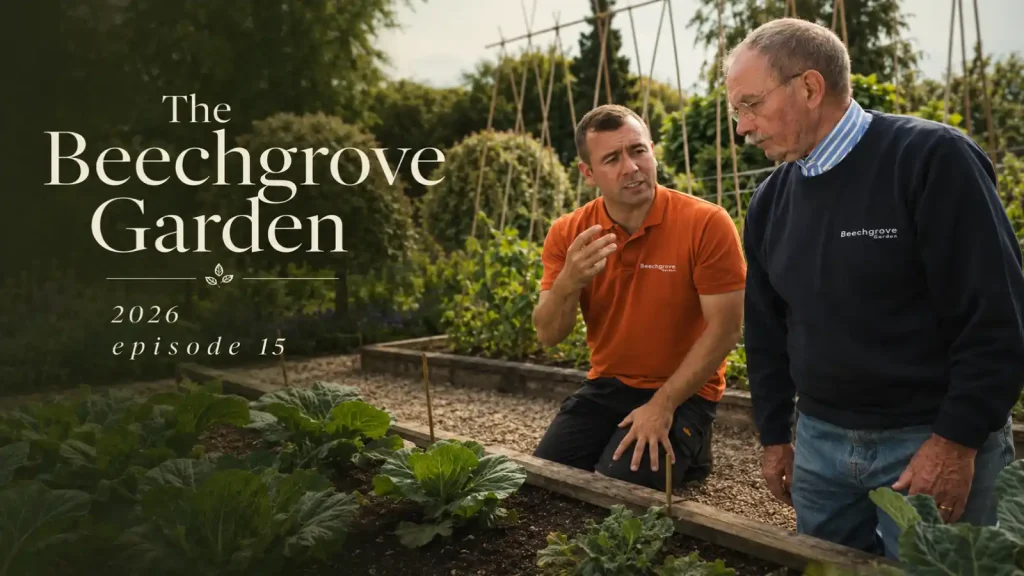
The Beechgrove Garden 2026 episode 15 reunites George Anderson and Calum Clunie for one of the most satisfying moments in the gardening calendar: lifting the first early potatoes from the vegetable plot. The crop was hit by frost earlier in the season, so genuine suspense hangs over the harvest. Will the new variety Francis, which stubbornly refuses to flower, actually produce anything worth eating? The answer surprises even two of Scotland’s most experienced gardeners.
Beyond the potato reveal, the episode delivers an unusually rich mix of practical advice for the home garden. George checks whether his fig cuttings have finally rooted after months of patient waiting. Calum builds a wildlife-friendly pond in a pot for his scent-themed competition plot. A trial of clubroot-resistant brassicas produces its first visible verdicts, and the fruit cage gets a summer overhaul covering apples, redcurrants and gooseberries.
Meanwhile, a visit to Musselburgh introduces Eli Appleby-Donald and her wife Kate, whose compact back garden proves that limited space is no barrier to abundance. Their story of expensive early failures, hard-won learning and ingenious vertical growing gives Beechgrove Garden 2026 one of its most relatable segments of the summer. Add in handy hints on plum suckers and rose deadheading, and episode 15 becomes essential viewing for gardeners at every level.
As George puts it, it wouldn’t be Beechgrove without doing something with potatoes. Back in April, in the first programme of the series, Brian and Carole planted first earlies both outside on the plot and in sacks. Now, in The Beechgrove Garden 2026 episode 15, the moment of truth arrives. The variety on trial is Francis, one George admits he has never grown before.
Francis immediately breaks the rules that gardeners rely on. Normally, first earlies flower, and those blooms act as the traditional signal that tubers have formed below the surface. Conventional varieties such as Epicure flower reliably. Francis, however, simply doesn’t produce flowers at all. That raises a genuine question: has the plant put its energy into the tubers instead, or is there nothing worth lifting? Calum decides to bite the bullet and dig.
The sack trial adds another layer of intrigue. One bag was planted with three seed potatoes, the recommended average, while another was planted with five. Calum’s expectation follows textbook logic: the bag of five should produce more potatoes but smaller ones, while the bag of three should deliver fewer, bigger tubers. Specifically, that is not what happens. The three-tuber bag produces a surprising number of small potatoes, while the bag of five yields noticeably larger ones. Both men laugh at the result. As George observes, it doesn’t matter what you think is going to happen in gardening — sometimes it’s simply different.
The Beechgrove Garden 2026 episode 15
The outdoor crop tells its own story. George finds fewer potatoes than he hoped, describing most of the harvest as “wee bulls” — or “wee chats”, as they used to call small potatoes in East Lothian — with only two or three decent-sized tubers on every shaw. He also notes how dry the compost sits at the bottom of the sacks, a detail worth remembering for anyone growing potatoes in containers at home.
Harvest quantity is only half the verdict. Later in the episode, George boils up the freshly lifted Francis potatoes and invites Calum to taste them. This is where the variety redeems itself. Calum finds them quite nice but noticeably dry — to which George offers the perfect Scottish rejoinder: the reason they’re dry is that you can get more butter on them.
Beyond the humour, the assessment is genuinely useful for anyone choosing seed potatoes for next year. Francis holds together when the fork goes in rather than collapsing, which George and Calum agree makes it a good boiler. The flavour earns praise from both presenters. For a variety that produced no flowers, kept its growers guessing all season, and survived an early frost, that is a respectable result.
The wider lesson lands quietly but firmly. Trial results at Beechgrove repeatedly show that expectations, seed packet promises and conventional wisdom only go so far. The magic, as George says, happens when the potatoes are on a plate. For home gardeners weighing up new varieties against old favourites, growing a small test batch and judging it in the kitchen remains the most honest evaluation method there is.
The Beechgrove Garden 2026 Episode 15 Puts Clubroot-Resistant Brassicas to the Test
The Beechgrove Garden 2026 episode 15 opens in the trials area, and the news there is sobering. The soil has been infected with clubroot, one of the most persistent diseases a vegetable gardener can face. Rather than abandoning the bed, George and Calum turned the problem into an experiment. At the beginning of April, they planted calabrese and cabbages in the contaminated ground — some varieties marketed as clubroot-resistant, others openly described on the seed packet as susceptible.
Two months on, the results are starting to show. The resistant varieties at either end of the bed look good to reasonable. In the middle, the susceptible varieties tell a more complicated story. A small variety called Prestar is holding up surprisingly well — a little small, but healthy, and potentially a good choice for somebody feeding a small family. Green Magic, by contrast, is visibly struggling. As George drily notes, it’s not very magical.
The diagnostic detail here is where the expert garden knowledge shines. George points out the tell-tale leaf symptoms on the failing plant: purples, yellows and a pale green washing through the foliage. That discolouration indicates roots that are struggling and failing to take up nutrients. When that happens, the plant essentially believes it is going to die, which is why it has bolted and run to seed. Importantly, a neighbouring plant of the same type looks fine, suggesting the disease may sit in little pockets across the bed rather than uniformly through the soil.
The trial doesn’t end here. George and Calum plan to let every plant grow on for the rest of the series, then dig them all up at the end and examine the roots properly. For gardeners battling clubroot in their own plots, that final root inspection promises the most valuable evidence of the year.
Apple Thinning and Summer Pruning Secrets from the Fruit Cage
George’s session in the fruit cage delivers some of the most immediately actionable gardening advice of the episode. The first job concerns apples, and it hinges on a phenomenon many growers in Scotland will recognise. At the end of June and beginning of July, apple trees typically experience what’s known as June drop, when underdeveloped fruits fall from the branches naturally. This year, that hasn’t happened. George shakes the branch hopefully, but the clusters stay put.
That leaves clusters of three apples, each with pips developing inside — fruits that will all grow, but none of them to full size. The solution is deliberate thinning. By removing two apples from a cluster of three, all the tree’s energy flows into the single remaining fruit. George works methodically across the shoots, thinning until he’s satisfied there will be enough apples to eat, with a crop that stores right through into winter.
The second job looks further ahead. The tree’s extension growth is just starting to slow, and now is the moment to shape where next year’s fruit buds will form. George counts up from the base of each new shoot — one, two, three, four, maybe five or six leaves — and snips it off there. Consequently, fruit buds concentrate down towards the base of the shoot, and the whole top of the tree stays compact. It’s restrictive pruning with a clear purpose: a manageable tree that puts its effort into fruit rather than leafy sprawl.
For anyone with an apple or pear tree in their home garden, the timing matters as much as the technique. This is a mid-summer job, done while the tree can still redirect its energy usefully. Leave it too late, and both the fruit size and next year’s bud placement suffer.
Cordon-Trained Redcurrants and Gooseberries Keep Pigeons at Bay
Moving to the soft fruit, George makes a persuasive case for growing redcurrants and gooseberries as cordons rather than open bushes. His reasoning is refreshingly practical: pigeons. A sprawling bush gives birds a comfortable perch from which they can fill themselves up with berries the moment ripening begins. A tall, narrow cordon offers no such landing pad. George has suffered pigeon raids on his own allotment plants growing up a fence, so this advice comes from hard experience.
The pruning method itself is simple and repeatable. At the top of the redcurrant cordon, George nips out the growing tip of the leading shoot, stopping it in its tracks and concentrating growth at the base. Then he works down the plant, taking every side shoot back to one or two buds. The effect is twofold: light floods in to help the berries ripen and sweeten, and the grower can actually see the fruit to judge when it reaches peak ripeness. The same treatment applies to white currants and pink currants alike.
The gooseberry gets identical handling, and the plant George works on demonstrates why the method earns its keep — wonderful upright growth with fruit carried all the way from top to bottom. Long, vigorous shoots draw energy away from the fruit, so cutting them back to two or three buds redirects that vigour into the berries and their sweetness. At Beechgrove, fruit netting keeps the birds out entirely, but the cordon system remains valuable insurance for allotment growers without that protection.
One crucial exception closes the segment. Blackcurrants are completely different and must not be pruned this way. Their pruning waits until harvest time — a job for much later in the season. It’s a distinction that saves gardeners from a common and costly mistake.
Calum’s Scented Competition Plot Gains a Wildlife Pond in a Pot
The presenters’ competition returns in The Beechgrove Garden 2026 episode 15, and the theme this year is One of the Senses. Each presenter has been assigned a sense to interpret through planting, and Calum considers himself lucky to have drawn smell. His latest addition takes the plot in an unexpected direction: a small pond, built in a pot, designed with both fragrance and wildlife in mind.
The pond build is a masterclass in small-scale water gardening. Calum plants water mint and adds a water lily housed in a special aquatic basket. The container is filled with rainwater rather than tap water, and pebbles create a gentle ramp so wildlife can enter and exit as they please — a small touch that transforms a decorative feature into a genuine ecogarden habitat. The pebbles serve a second purpose too. Aquatic baskets must not sit too deep, and raising the water lily closer to the surface prevents a real risk of it dampening off.
The scented planting around the pond is establishing beautifully. Salvias and lavenders planted earlier in the year are now producing fragrance and settling in. Calum’s favourite, though, is the chocolate cosmos, specifically the variety Cherry Chocolate — hardier than most of its kind, but still needing help through a Scottish winter. His technique: dig the planting hole slightly deeper than the pot, so the plant sits below surface level for extra insulation, then mulch in autumn. The plant will reach roughly 45cm tall by 30cm wide.
Pelargoniums and nemesia add further layers of scent, with Calum growing plenty of nemesia in pots at home this year. No scented plot would be complete without roses, and he has chosen two varieties: Peace and Ruby Wishes. Even the strip of lawn earns its place in the scheme — in Calum’s opinion, there’s no finer smell in the garden than freshly cut grass. Carole returns in September to judge the plots and reveal the 2026 Golden Shovel winner, though Calum hints he may still have one or two surprises up his sleeve.
George’s Fig Cuttings Finally Reveal Their Roots
Few storylines in Beechgrove Garden 2026 have demanded more patience than George’s fig propagation experiment. Right at the very beginning of the series, he inserted a number of fig cuttings into a pot and, memorably, into an old lemonade bottle. A month and a half ago, leaves appeared — encouraging, but not proof of success. Leaves can emerge from stored energy in the cutting. Roots are the real prize.
Now George can finally reveal the result. Roots are visible at the base of the cuttings in the lemonade bottle, and the cuttings under the propagation dome have grown so vigorously they are physically pushing the dome upwards. When George tips the pot out, his delighted expression says everything before the evidence appears: a fantastic root system on each cutting. The gamble has paid off completely.
The next stage is careful separation and potting on. George teases each cutting apart so it keeps its own little root system, then pots them individually into an open, airy potting mix with a little nutrient in it — any decent mix will do. Critically, he doesn’t firm the compost hard. Pressing too firmly risks knocking the fragile new roots off the base of the cutting. Instead, a gentle shoogle settles the soil around the stem. The freshly potted figs then go back under a dome, so they acclimatise gradually rather than facing the shock of the big wide world all at once.
The long-term plan is elegant. Each fig will grow as a single straight stem, then have its top pinched out to form a bushy head — a bit like a lollipop on a stick, in George’s words. Grown in big pots, the plants can move outside when the sun shines and into the glasshouse over winter, with a little extra spring heat extending the fig crop. For viewers at home, George recommends exactly this approach: a fig in a large pot beats a plant permanently squeezed into the corner of a glasshouse.
A Musselburgh Home Garden That Turns Small Space into Big Results
The featured garden visit takes viewers to Musselburgh, where Eli Appleby-Donald and her wife Kate have created a garden of variety, colour and contrast in a genuinely compact space. Their success rests on imaginative planters, distinct zones and vertical growing — but it only came after honest, expensive failure. When the couple moved in during January 2012, Eli had never had a garden before. In that first year, they spent hundreds of pounds on plants, and almost all of them died.
The reason, Eli admits with disarming candour, was ignorance of the fundamentals: sunlight, shade and clay soil. They bought things that were pretty and put them where they wanted to see them. Everything since has been learning — a lot of learning. That learning now shapes every corner of a garden that many gardeners would envy.
The centrepiece is Flower Island, a large multi-level planter built right in the middle of the lawn. Its different heights and sections allow different types of plants to coexist, but its real genius is soil control. Heavy clay dominates the area, so the planter lets Eli mix soil to suit whatever she wants to grow — ericaceous compost for acid-lovers, moister or drier blends as needed.
A variegated hebe currently steals the show, buzzing with bees around its little purple flowers. As an evergreen, it keeps giving colour through winter when the flowers are gone, part of a deliberate strategy of placing year-round interest at points across the garden and flipping colour into foliage, including dramatic dark purples set against surrounding greens.
Vertical Growing Ideas That Maximise Every Inch of a Small Garden
The seating area — affectionately called the chill-outery — showcases the garden’s most photographed feature: an entire wall of flowers built from four wooden pallets. Mexican fleabane drapes over the structure, softening the joinery, while dianthus provides vivid pops of colour. Eli’s top tip for any seating area, however, is night-scented phlox. The flowers open in the evening and release an incredible perfume, and they feed night pollinators. Moths, she reminds viewers, matter just as much as bees.
The pallet wall took several iterations to perfect, and the breakthrough was irrigation. Rain reached the top pockets but never cascaded down, leaving the lower sections permanently dry. The solution is a water butt connected to a solar-powered pump, feeding little drippers in every pocket with both water and feed. Hand-watering had been simply too much work, and the wall never looked as good as it does now.
The productive side of the garden mirrors the ornamental. A tower of strawberries stands beside a tower full of outdoor tomatoes — in Scotland — chosen specifically as dwarf and micro varieties with short growing seasons that guarantee a ripe crop before the season ends. Dwarf French beans grow directly above them.
The towers are essentially stacked pots, watered and fed from the top so everything cascades down. Eli reckons she harvests as much from these towers as a raised bed would yield, on a really tiny footprint. Her advice for anyone with a small home garden is direct: grow up and make the most of your space, even for fruit and veg.
Her herbaceous border completes the picture, working with the clay rather than against it. Crocosmia thrives, astrantia keeps the bees happy, and a clever trick fills the inevitable gaps: plants like the phlox Fashionably Early kept in decent-sized pots, dropped into spaces where foliage hides the container. It fills gaps instantly and lets her audition plants before committing. The garden may not be “proper”, she says — but it’s nice, and it makes her happy. That, ultimately, is the point.
Harvest Season Begins on Calum’s Budget-Friendly Family Veg Plot
While Beechgrove’s main vegetable plot enjoys generous proportions, Calum recognises that most people don’t have that luxury. This year he created a space deliberately sized to match the average plot people have at home, with one governing aim: extracting as many crops as possible from a small footprint. In The Beechgrove Garden 2026 episode 15, that plot moves decisively into harvest mode.
The lettuce beds demonstrate the cut-and-come-again principle — the more you cut, the more juicy leaves regrow. The mini greenhouses are starting to show fruit, receiving a weekly feed, with ventilation kept open in the hot weather to maintain airflow. The broccoli has already delivered three heads — three family meals — and is now producing secondary crops. By continually removing the side shoots, Calum expects more side shoots to follow, stretching the harvest further.
Fruit gets equally clever treatment. Strawberries are already helping with desserts, but to prolong the fruit season Calum pots up a patio raspberry — a variety specifically suited to a 40-centimetre pot. He plants it in John Innes No.2, a topsoil-based compost that supports root and plant growth, with two non-negotiable rules for container fruit: never let the compost dry out, and feed weekly with tomato feed. Even the pea supports reflect the budget-conscious, green garden ethos: red dogwood stems, saved after the winter cut-back rather than thrown out, now protect and support the peas ahead of a harvest expected within about a month.
One final intervention shows how site conditions shape technique. The plot sits on a windy site, so Calum pinches out the growing tips of his broad beans just above the flowers. Stopping the upward growth pushes all the energy into bean production — and removing that young, juicy foliage should also deter blackfly, which absolutely love it. Meanwhile, the courgette growing in the decomposing compost heap needs no feeding at all, while its potted counterpart, having depleted its soil, joins the weekly tomato-feed rota. It’s resourceful, family-focused gardening from start to finish.
Handy Hints from The Beechgrove Garden 2026 Episode 15: Plum Suckers and Rose Deadheading
The week’s handy hints tackle two summer jobs that gardeners routinely get wrong. The first concerns the Victoria plum. George identifies two shoots emerging near the base of the tree: one carries the same leaves as the Victoria plum itself, while the other — with funny-coloured shoots — comes from the rootstock. Those rootstock suckers have to go, but the removal method makes all the difference.
Cutting suckers off with secateurs, George explains, actively makes the problem worse. Any fragment left behind gives rise to lots and lots more shoots, doubling the trouble. Instead, he presses down with finger and thumb and tears the sucker out completely, removing the tissue it grows from. Tear them off, don’t cut them off — because if you cut them, they’ll just grow back stronger. It’s a ten-second job that saves years of recurring frustration.
The second hint keeps roses flowering right up until the first frost. Regular summer deadheading stops the plant diverting energy into hips and keeps it producing flowers instead. There’s a disease-prevention angle too: faded blooms left on the plant turn mushy and slimy in the rain, creating a real chance of fungal disease taking hold. But effective deadheading means more than nipping off the dead flower. Count back five leaves from the spent bloom and cut just above a leaf joint on a nice thick stem. A strong side shoot will break from that point, producing a better plant with really strong blooms deep into autumn.
Together, these hints capture what makes Beechgrove’s advice so trusted. Neither job requires special equipment or expert garden credentials — just the right technique, applied at the right moment.
George and Calum close the episode in the wildlife garden, which is looking fantastic. Calum admires the pillar effect created by the foxgloves — plants that keep giving, starting low and rising until, as George jokes at his own expense, they stand about as tall as he is. Which, he concedes, is not very tall. The easy warmth between the two presenters has anchored the whole episode, from the potato banter to the shared taste test, and it carries through to the sign-off.
Looking ahead, next week brings Brian and Ruth to the garden, where they will examine the pests and diseases that affect your plants — a natural follow-on from this week’s clubroot investigation. Brian will also check on the wildflower seed mix he sowed back in April, another long-running experiment approaching its moment of truth. Every episode remains available on BBC iPlayer whenever viewers want to catch up.
The Beechgrove Garden 2026 episode 15 ultimately succeeds because it never separates expertise from honesty. A potato trial that defies its own predictions, a brassica bed where the “susceptible” variety outperforms expectations, and a Musselburgh garden built on hundreds of pounds of dead plants all tell the same truth: gardening rewards observation, patience and the willingness to be surprised. For anyone shaping their own plot this summer — whether a sprawling vegetable garden or a pallet wall of flowers — that lesson is worth more than any seed packet promise.
FAQ The Beechgrove Garden 2026 episode 15
Q: Why do Francis potatoes not produce flowers?
A: Francis is an unusual first early variety that simply does not flower, unlike conventional varieties such as Epicure. Gardeners normally rely on flowering as the signal that tubers have formed below the soil. With Francis, the only way to know is to lift the plants. At Beechgrove, the flowerless plants still produced a worthwhile crop with good flavour, proving the variety puts energy into tubers without blooming.
Q: How many seed potatoes should you plant in a grow bag?
A: Three seed potatoes per bag is the normally recommended average. The Beechgrove trial compared a bag of three against a bag of five, expecting the five to give more but smaller potatoes. Surprisingly, the opposite happened: the bag of five produced much bigger tubers, while the bag of three yielded numerous small ones. The result shows potato growing rarely follows predictions exactly.
Q: What are the signs of clubroot in cabbages and calabrese?
A: Look for foliage discolouration mixing purples, yellows and pale green. These symptoms indicate struggling roots that cannot take up nutrients. The stressed plant effectively believes it is dying, so it bolts and runs to seed prematurely. Clubroot can also sit in small pockets of soil, which explains why one plant fails while an identical neighbour stays healthy in the same bed.
Q: Why should you thin apples after June drop?
A: June drop, which hits Scotland in late June and early July, naturally sheds underdeveloped fruits. When it fails to happen, clusters of three apples remain, all competing for energy. Removing two fruits from each cluster channels everything into the single remaining apple, producing larger fruit that stores through winter. Thinning continues across the whole tree until enough eating apples remain.
Q: Why grow redcurrants and gooseberries as cordons?
A: Cordons stop pigeons landing on the plants and stripping the berries, which happens easily on sprawling bushes. Summer pruning the side shoots back to one or two buds also lets sunlight reach the fruit, helping berries ripen and sweeten. The same method suits white and pink currants. Blackcurrants are completely different, however, and should not be pruned until harvest time.
Q: How do you make a wildlife pond in a pot?
A: Fill a container with rainwater rather than tap water, then plant water mint and a water lily in a special aquatic basket. Add pebbles to create a ramp so wildlife can enter and exit freely. Importantly, the pebbles also raise the lily basket closer to the water surface, because planting it too deep creates a real risk of the lily dampening off.
Q: How long do fig cuttings take to root?
A: Fig cuttings taken at the start of the Beechgrove series showed leaves after several weeks but only revealed proper roots months later. Once rooted, separate each cutting carefully with its own root system and pot it into an open, airy mix. Avoid firming the compost hard, which can knock roots off the cutting base. Keep the young plants under a dome to acclimatise gradually.
Q: Why should you tear off plum tree suckers instead of cutting them?
A: Cutting rootstock suckers with secateurs leaves tissue behind that regrows as lots more shoots, doubling the problem. Instead, press down with finger and thumb and tear the sucker out completely. Identify suckers by their differently coloured shoots and leaves, which do not match the grafted variety above. On a Victoria plum, only shoots carrying true Victoria foliage should stay.
Q: What is the correct way to deadhead roses in summer?
A: Count back five leaves from the faded flower and cut just above a leaf joint on a thick stem. A strong side shoot breaks from that point, giving better blooms right up to the first frost. Simply nipping off the dead flower is not enough. Removing faded blooms also prevents mushy, slimy petals in wet weather, which can trigger fungal disease.
Q: How can you grow more fruit and vegetables in a small garden?
A: Grow vertically. Stacked pot towers planted with strawberries, dwarf French beans and short-season dwarf or micro tomatoes can match a raised bed’s harvest on a tiny footprint, even outdoors in Scotland. Water and feed from the top so it cascades down. Additionally, cut-and-come-again lettuce and patio raspberries in 40cm pots stretch harvests further, fed weekly with tomato feed.