Welcome back to Gardening Australia 2025 Episode 34! We are so glad you could join us. This week, we are diving deep into gardens that truly feed the soul. We explore places of lush wonder and surprising creativity. It’s an episode absolutely packed with inspiration. You will find brilliant ideas for every corner of your home, inside and out. So, grab a cup of tea, settle in, and join us on this beautiful journey. (watch gardeners world 2025 here)
First up, Costa Georgiadis ventures into a true backyard sanctuary. It’s a lush rainforest garden, tucked away in the suburbs. This garden is a living testament to patience and vision. It proves you can create a completely new microclimate. All it takes is clever planting and dedication. The air here feels different—cool, fresh, and deeply alive. You can almost hear the garden breathing around you.
This special place is a masterclass in ambitious garden design. The garden’s passionate owner shares their secrets with Costa. They focused on building a dense, protective canopy. This canopy then acts like a green umbrella. It protects the delicate understory plants below. It’s all about creating successful layers. Tall palms and native figs create the essential structure.
Below them, a vibrant tapestry of ferns and gingers thrives. Brightly colored coleus and impatiens add pops of color. Many native plants are used throughout the space. They are chosen specifically to attract local wildlife. For example, birdsong fills the air, creating a natural soundtrack. This is a garden that engages all the senses.
Costa learns how this incredible design evolved over decades. It started as a bare, sun-scorched patch of grass. Now, it’s a self-sustaining, thriving ecosystem. This kind of transformation takes time, of course. But the rewards are truly immense. It shows how thoughtful Australian gardening can mimic our most beautiful wild places. This segment is pure, unfiltered inspiration for anyone dreaming big.
Meanwhile, Josh Byrne has found a collector with a sky-high passion. He is exploring a huge, mesmerizing epiphyte collection. These are fascinating plants that grow on other plants, not in soil. Think of them as living jewels of the plant world. They cling to bark, branches, and even rock faces. Orchids, staghorns, and colorful bromeliads create a vertical wonderland.
We get a close look at these captivating species. Many are stunning native plants, like the iconic staghorn fern. These natives are perfectly adapted to our unique climate. Josh discovers how the owner cares for this massive collection. Watering, for instance, is a unique challenge. You must mist and soak, but never let them get soggy.
Mounting them is another key skill. This is where diy gardening really comes alive. The owner shows Josh some simple techniques. You can create stunning living art for your own garden. All you need is some timber, fishing line, and sphagnum moss. It’s a wonderful project for a weekend afternoon.
The collection itself is truly breathtaking. It’s a powerful reminder that a garden doesn’t just grow on the ground. You can use walls, trees, and hanging structures. This segment offers practical, achievable tips. It’s perfect for anyone wanting to start their own collection. Even a single, well-placed epiphyte can transform a shady patio. Josh leaves inspired, and you will too.
Next, Jerry Coleby-Williams visits a very unusual farm. He is investigating a groundbreaking subtropical hops operation. Hops, as you know, are the key ingredient in beer. They are usually grown in cool, temperate climates. Think of Tasmania or Victoria. Therefore, finding them thriving in the warm subtropics is a huge surprise.
This farm challenges everything we thought we knew about this plant. Jerry learns about the special techniques they use. The farmers have chosen specific, low-chill varieties. They also use innovative growing methods. These methods essentially “trick” the plants into flowering. This is pioneering Australian gardening in action. It shows incredible adaptation and resilience.
Gardening Australia 2025 Episode 34
Jerry explores the rows of climbing bines. He learns how they manage pests and water in this warmer climate. Plus, the high-quality end product supports local craft brewers. It’s a fantastic story of agricultural innovation. It proves that with passion, Australian growers can achieve the remarkable.
Are your indoor spaces feeling a little static or dull? The wonderful Tammy Huynh has you covered. This week, she gets incredibly creative with indoor plants. She moves beyond just placing a single pot on a shelf. Instead, Tammy explores the art of grouping, styling, and placement. She shows how plants can become living, breathing decor.
This whole segment is full of clever garden hacks. Tammy demonstrates some simple and fun diy gardening projects. For example, she creates a stunning kokedama, or Japanese moss ball. It’s a beautiful way to display a plant. She also shares her best tips for propagation. You can learn to turn one plant into many, completely for free!
These are practical, stylish ideas that anyone can try at home. Tammy also discusses the vital art of matching the plant to the place. Do you have a dark, low-light corner? No problem. She has the perfect, hardy plant for that. Her advice helps you keep your green friends happy and healthy. Consequently, your home will feel more vibrant and peaceful.
She even explores how to choose pots and containers. The right pot can be like the perfect frame for a picture. It completes the look. This is how you thoughtfully weave nature into your daily life. It’s all about creating a personal green oasis indoors.
Finally, we meet someone truly special. Gardening Australia introduces us to an artist. She has crafted a vibrant, personal sanctuary. Her garden is a living, breathing extension of her art. Every path, every structure, and every planting tells a personal story. This is garden design as pure, unadulterated self-expression.
The space is a joyous riot of color, texture, and form. She combined her love for painting with a passion for horticulture. The result is a garden that feels both wild and intentional. Sculptures she created are nestled among blooming perennials. Winding, mosaic-tiled paths invite slow, mindful walking. You never know what you’ll find around the next corner.
She uses many beautiful native plants in her design. They create a sustainable and beautiful habitat. The garden is a haven for her, and for local wildlife. Bees, butterflies, and native birds fill the space. It’s a collaboration between the artist and nature itself.
This story connects deeply with the emotional side of gardening. It’s not just about the plants; it’s about creating a place of peace. It becomes a space for healing, creativity, and inspiration. Her journey reminds us that our gardens can be our greatest masterpieces. It’s a truly moving and uplifting end to the show.
This episode of Gardening Australia has been a true journey of discovery. We’ve seen how Australian gardening can be many different things. It can be a lush rainforest, a vertical collection, or a surprising farm. It can be a simple, stylish indoor pot. Or, it can be a sprawling artistic statement.
Whatever form it takes, gardening connects us. It connects us to the earth, to our creativity, and to ourselves. Hopefully, you’ve found a spark of an idea in tonight’s show. We hope you feel inspired to get out there. Get your hands dirty, and grow something beautiful. We’ll see you next time.
Gardening Australia 2025 Episode 34 delivers a rich tapestry of horticultural inspiration, exploring gardens that function as deep personal sanctuaries and hubs of surprising creativity. This episode dives into the ambitious creation of a private rainforest, the technical challenge of growing exotic crops, and the profound connection between gardening and personal history. It demonstrates how spaces can be utterly transformed through patience, vision, and a deep respect for nature. The journey highlights a core theme in modern Australian gardening: the garden as a place of healing, innovation, and legacy.
This focus on personal expression through horticulture is incredibly relevant. Many gardeners seek to create more than just a pretty space; they aim to build a microclimate, a productive patch, or a living memorial. The stories in this episode provide a powerful blueprint for these ambitions. We see how a suburban block can become a temperate rainforest. We also learn how subtropical growers can defy climate norms to produce cool-weather crops. This blend of passion and problem-solving is at the heart of gardening.
The scope of Gardening Australia 2025 Episode 34 is impressively broad. It travels from a lush, shaded wonderland in Sydney to a sun-drenched, experimental farm in Brisbane. The episode also visits a Perth collection brimming with generational history. Furthermore, it steps inside a Melbourne home where the garden physically merges with art. This breadth ensures ideas for every type of gardener, from the apartment dweller to the acreage owner. It emphasizes creative diy gardening solutions for all scales.
Beyond these feature stories, the episode provides foundational knowledge. It tackles common pest problems with practical, effective solutions. It also offers advice on selecting the right plants for challenging conditions. Segments explore the specifics of growing in shallow containers and the science behind simple composting. This balance of inspiring garden design and practical advice is crucial. It empowers viewers to not only dream big but also to execute those dreams successfully using native plants and clever techniques.
This episode also serves as a masterclass in specialized horticulture. It delves into the specific needs of niche plant families. We learn about orchids, bromeliads, hoyas, and epiphytic cacti. The expert advice provided is not just theoretical. It comes from passionate collectors who have spent decades perfecting their craft. They share their precise potting mixes, propagation methods, and wintering strategies. These valuable garden hacks are born from hard-won experience.
Ultimately, the episode reinforces the idea that a garden is a journey, not a destination. It is a living, breathing entity that reflects the gardener’s life, passions, and even their losses. We begin this exploration with a visit to a garden that embodies this philosophy. It is a stunning example of long-term vision, where a barren slope was transformed into a thriving ecosystem. This private sanctuary showcases the profound power of regeneration.
A Rainforest Reborn in Grays Point
On Dharawal country in Grays Point, south of Sydney, Jim and Vicky have spent 32 years cultivating a garden that echoes its temperate rainforest surroundings. Bordered by the Royal National Park, their 750-square-meter property was initially an unkempt, sloping backyard. It was choked by one of the worst weeds of national significance: lantana, which in some places grew ten meters high. Jim recalls not even knowing where his property ended. Armed with an axe, machete, and saw, he began the arduous task of clearing the infestation completely.
Once the lantana was gone, the garden began to reveal its potential. The first plants to return were ferns. Initially mown down by the local deer population, these ferns flourished after Jim installed a fence. They turned out to be magnificent Cyathea cooperi tree ferns, which now tower up to 20 meters. These ferns, along with existing Sydney red gums, helped establish a new microclimate. They created the essential canopy that allowed a true rainforest understory to thrive.
This transformation was guided by a distinct garden design philosophy. Jim envisioned the space as a “series of rooms and corridors and windows.” This approach cleverly frames views of the nearby Hacking River and forest. His guiding principle for maintenance is equally clear: “what lands on the forest floor stays on the forest floor.” This natural mulching system suppresses weeds, retains moisture, and feeds the soil. It allows the garden to behave just as a natural forest should.
While the garden relies heavily on natural regeneration, some plants were added. A large Banksia integrifolia is a third-generation specimen from his mother’s garden. Acacias and tea-trees were also planted. However, most of the garden’s current dominant plants invited themselves in. These include native palms, various ferns, and a large sandpaper fig. The only original tree to survive the lantana (besides the gums) was a New South Wales Christmas bush. For more tender rainforest plants, Jim installed misting jet sprays to maintain humidity.
The Gardener’s Passions: Orchids and Wildlife
Jim, a professor of medicine and a renal physician, views his garden as a “chemistry set.” He finds joy in watching the science of nature at work. This passion is most evident in his shadehouse and his love for orchids. He describes his fascination with orchids as an “incurable disease” that has held him since he was 15. He is a keen enthusiast, particularly of dendrobium hybrids. He has developed a simple method for mounting these epiphytes onto the large sandstone boulders in his garden.
This diy gardening technique is straightforward. Jim uses a hammer, masonry nails, and thin wire. First, he splays the orchid’s roots and removes most of the old growing medium. He then places the plant on the rock. The orchid is secured by stretching the wire across the root ball, attaching it to nails hammered into the sandstone. Finally, he adds a bit of leaf mulch around the base, largely for aesthetics. The orchid roots eventually grow aggressively over the rock, locking the plant in place.
Jim’s “happy place” is his shadehouse, a mesh-enclosed room filled with more orchids, bromeliads, and pitcher plants. The space is ventilated by the breeze and watered by misting jets fed by a rainwater tank. This shadehouse is also a sanctuary for three native green tree frogs. Ollie and Greenie are 21-year-old brothers Jim raised from tadpoles. They were later joined by a female named Freda. These frogs act as the “caretakers” of the greenhouse, providing natural pest control.
Because of the frogs, Jim uses no insecticides or fertilizers in the shadehouse. The frogs’ waste fertilizes the plants, and they manage the insects. Jim supplements their diet weekly with live crickets. The frogs have become so popular they have their own social media following and are the subject of a children’s book Jim wrote. The wider garden also teems with life, including marsh frogs, Peron’s tree frogs, and a rescued short-necked turtle named Murray, reflecting the health of this thriving ecosystem.
Cultivating Hops in the Subtropics
Meanwhile, in Cleveland, south of Brisbane, Steve Mitchell and Andrew Carson are defying horticultural norms. They are successfully growing Humulus lupulus, or hops, a crop traditionally farmed in cool climates. Their passion project began in 2017 with a single American Cascade variety in Steve’s front yard. The primary challenge they face is day length. Hops require long spring and summer days, ideally 16.5 hours, to support their vegetative growth. Flowering is triggered by a decrease in day length.
Brisbane’s longest summer day is only 13.75 hours. This shorter photoperiod tricks the plants into flowering too early, stunting their growth and reducing yield. The solution came from experiments in South Africa: supplemental lighting. Steve and Andrew now have rows of 6-meter-high trellises strung with light bulbs. These lights extend the “day,” allowing them to control the vegetative cycle. They can make the plants bigger and, consequently, decide exactly when they flower.
The vines themselves are vigorous, climbing coir fibre strings made from coconut plants. Hops always grow clockwise and, in good conditions, can grow up to six inches per night. For home growers, Andrew advises they need full sun, good compost, and plenty of fertilizer. They are “very hungry,” requiring high nitrogen for growth and potassium for flowering. He also warns that their vigorous nature means they can easily overtake a garden if not managed.
The farmlet grows a mix of American varieties like Cascade, Australian varieties like Red Earth, and a new US-developed variety called Vista. Vista is prized for being drought-tolerant, disease-resistant, and high in the oils that give craft beers passionfruit and citrus notes. The different varieties provide brewers with a range of flavors and bitterness levels. When it is time to harvest, the lights are turned off. The change in day length triggers flowering, and the cones are ready in about seven weeks. The fresh hops have a shelf life of under 24 hours, meaning they must go from “paddock to pint” on the same day.
DIY Gardening from Gardening Australia 2025 Episode 34
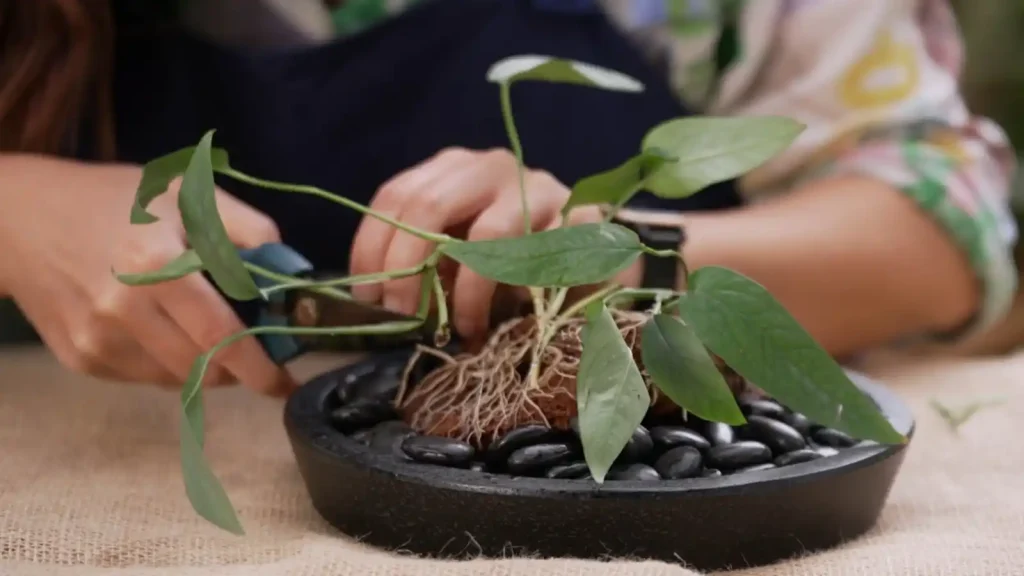
Gardening Australia 2025 Episode 34 is also packed with creative projects for home gardeners. One of the most artistic is the cultivation of lithophytes, or plants that grow on rocks. This technique is inspired by epiphytes (plants growing on trees) and is a unique way to display certain species. The key is using lava rock. Its porous nature wicks water from a saucer below, keeping the rock consistently damp. Other types of rock will not work.
A range of epiphytic plants, such as ferns, aroids, ficus, and some orchids, are suitable. The project demonstrates the method using an Epipremnum pinnatum ‘Cebu Blue’. First, a small plant is selected, and all the soil is washed from its roots to prevent rot. Damaged roots are trimmed. The roots are then splayed over the lava rock like an “octopus on coral.” The plant is gently but firmly secured using string or fishing line.
The rock is then placed in a shallow saucer backfilled with pebbles or gravel. The pebbles help slow evaporation. The entire display is watered, soaking the rock and filling the saucer. It requires bright, indirect light and regular misting while the roots adhere. The saucer must be topped up every few days, as the plant has no soil to hold moisture. Over time, the plant will acclimatise and send new roots over the rock.
For gardeners interested in food, the episode highlights growing vegetables in very shallow containers. Paris Market carrots, a small round variety, are grown in a tubestock crate only 10cm deep. The crate is lined with newspaper or cardboard to hold the potting mix while still allowing drainage. Seeds are scattered, lightly covered, and tamped down. Because the container is shallow, it must be kept well-watered. This simple setup is also perfect for cool-season crops like peas and salad greens, or summer crops like basil.
Simple Solutions and Garden Hacks
Beyond large projects, the episode addresses common gardening problems with practical garden hacks. One segment debunks the myth that watering leaves on a hot day will burn them. While this is false, watering the leaves is still not recommended. It is not unsafe, but the moisture can encourage fungal diseases on susceptible plants. This is especially true for food crops like tomatoes, cucumbers, and pumpkins. The correct solution is always to water the ground deeply, where the roots can access the moisture.
Another common pest, the citrus leaf miner, is also tackled. This grub tunnels under the leaf’s surface, causing distortion. Spraying a pest oil, which works by smothering, will not reach the protected grub. The correct management is a two-step process. First, you must prune off all the damaged and distorted material and bin it. After removing the infected growth, then you spray the new growth with pest oil. This deters the night-flying moth from laying new eggs.
Finally, the episode offers a simple composting method for those without space or confidence for a traditional bin. The “dig-and-drop” method requires only a spade and a patch of garden. Fruit and vegetable scraps, as well as brown paper bags, can be used. However, meat and seafood scraps should be excluded, as they attract rodents and foxes. A hole is dug—about 35cm in loamy soil, or a shallower 25cm in heavy clay to ensure oxygen can aid decomposition. The scraps are dropped in, covered with soil, and packed down.
A Legacy of Plants: Hoyas and Cacti
In Perth, a stunning collection of hoyas and epiphytic cacti showcases a passion handed down through generations. Irene Daniels and her husband, Kevin, are the custodians of a collection started by Irene’s grandfather, Stan Hardy. Stan was a passionate cactus collector. He gave cuttings to Irene’s father, Rex, who then specialized in epiphytic cacti like epiphyllums and schlumbergeras, later adding hoyas. Before Rex passed, Irene and Kevin moved the massive collection to their property, building new shadehouses to accommodate it.
Irene, who is now the president of the Epiphytic Cacti and Hoya Society, shares the specific care these rainforest-type plants need. They require humidity but cannot have “wet feet,” as hoyas are prone to root rot. They grow under standard shadecloth. In winter, the more sensitive plants are moved into a hothouse, sometimes with a heater, or even inside the house. Kevin’s potting mix is key: a very free-draining blend of orchid bark, vermiculite, and premium potting mix. He also adds cinnamon, which acts as a natural fungicide.
Hoyas, they explain, like to be root-bound and may only need repotting every one or two years. Epiphytic cacti, however, often grow lopsided and need to be repotted more frequently. Propagation methods also differ. Epiphyllum leaves are cut, allowed to callus for several days, and then planted in mix. Hoyas, conversely, are cut and can be dipped in honey as a rooting hormone. They are planted immediately and must be kept continually wet for one to two months until their roots develop.
The collection is vast, but Irene has sentimental favorites. These include the Hoya loyceandrewsiana, or “dinner plate hoya,” for its huge leaves, and the twisted “Indian rope” hoya. Kevin prefers the prolific flowerers, like the Carnosa and Pubicalyx varieties. The epiphytic cacti, such as ‘Liberty Glow’ and ‘Snow Leopard’, have stunning, vibrant blooms, even if they only last for a couple of days. For Irene, tending these plants is a direct connection to her father and grandfather.
Sanctuaries in Gardening Australia 2025 Episode 34
The power of a garden to act as a sanctuary is a theme that resonates deeply in Gardening Australia 2025 Episode 34. In Melbourne, visual artist Claudia Rubinstein lives in a home where art and garden are one. Her house and garden are her “sanctuary,” and the garden itself is her “muse.” Most of her paintings feature botanical foliage, and she constantly draws reference from the plants surrounding her. Her home is filled with art, decor, and “a collection of stories,” with botanica as the unifying theme.
Her garden contains plants that connect to her childhood in Canada, such as birch trees. It is also a place of healing. Three years ago, Claudia lost her son, Ollie. A great pianist, Ollie is memorialized in the garden with a “piano garden” she built for him. This act of creation is also reflected inside the house. Claudia transformed one room into a “Forest Room.” She took one of her paintings—a forest scene of blues, greens, and whimsical images—and had it made into wallpaper.
This room was a special project, intended to be a place of “awe and wonder.” For Claudia, it represents a place where Ollie is at peace. She explains that creating this beautiful space has, in a way, given her a sense of closure. Her story is a poignant reminder of the garden’s role in processing life and loss. As she notes, spending time in any green environment is calming, and her garden is the center of her creative and emotional world.
The Seasonal Gardening Checklist
Finally, the episode provides a comprehensive checklist of seasonal tasks for gardeners across Australia. In cool areas, it is time to take cuttings of Correa for hedging. Gardeners should also tip-prune banksias to keep them bushy, being careful to retain the old wood where next year’s flowers will form. It is also the right time to sow Delicata squash seeds.
In warm-temperate zones, gardeners can plant Calibrachoa in hanging baskets for a splash of color. Passionfruit should be planted in pairs, about a meter apart, to aid pollination. Hardy Hebe shrubs should be trimmed back by a third after they finish flowering to maintain their compact shape.
For subtropical gardeners, planting marigolds is a great companion-planting task to attract pollinators. It is also a good time to plant flowering gums to provide food for flying foxes. Okra, a reliable summer crop, can be sown now in full sun.
In the tropics, strappy native plants like Lomandra can be planted to stabilize soggy spots. The vanilla pod vine, a climbing orchid, is ready for its yearly trim, and the cuttings can be easily grown. It is also an ideal time to divide bromeliads, potting up the pups or mounting them directly onto trees.
Lastly, in arid regions, drought-hardy geraniums will bloom through summer with regular morning watering. Pomegranate flowers are out, and gardeners can ensure fruit set by transferring pollen with a small paintbrush. Cuttings of rosemary can also be planted now into moist propagation mix.
FAQ Gardening Australia 2025 Episode 34
Q: What is Gardening Australia 2025 Episode 34 primarily about?
A: This episode explores gardens that serve as personal sanctuaries and creative expressions. It features diverse gardening projects including a suburban rainforest transformation in Grays Point, an innovative subtropical hops farm, specialized epiphyte collections, and artistic garden design. Additionally, the episode provides practical DIY gardening techniques, pest management solutions, and seasonal planting advice tailored to different Australian climate zones.
Q: How did Jim and Vicky transform their Grays Point property into a rainforest?
A: Over 32 years, they cleared severe lantana infestations using axes and machetes on their 750-square-meter property. Furthermore, they allowed natural regeneration by protecting emerging Cyathea cooperi tree ferns, which grew up to 20 meters tall. Jim created a microclimate by establishing a protective canopy with existing Sydney red gums and added palms. His maintenance philosophy involves leaving forest floor debris as natural mulch, which suppresses weeds and enriches soil organically.
Q: Can hops be successfully grown in subtropical climates like Brisbane?
A: Yes, Steve Mitchell and Andrew Carson have pioneered subtropical hops cultivation in Cleveland, south of Brisbane. The primary challenge involves Brisbane’s shorter summer days, which only reach 13.75 hours compared to the 16.5 hours hops require. Their innovative solution uses supplemental lighting to extend daylight artificially, controlling vegetative growth and flowering timing. Consequently, they successfully grow varieties like Cascade, Red Earth, and Vista, supporting local craft brewers with fresh hops.
Q: What are lithophytes and how do you create a lithophyte display?
A: Lithophytes are plants that naturally grow on rocks, similar to epiphytes that grow on trees. To create a display, use porous lava rock placed in a shallow saucer filled with pebbles. Select suitable plants like ferns, aroids, or orchids, wash all soil from roots, and secure them to the rock using fishing line. The lava rock wicks water from below, keeping roots consistently moist. However, regular misting and saucer refilling are essential since there’s no soil to retain moisture.
Q: How should citrus leaf miner infestations be properly managed?
A: Effective management requires a two-step approach rather than simply spraying. First, prune and dispose of all damaged, distorted leaves since the grubs tunnel beneath leaf surfaces where sprays cannot reach them. After removing infected material, spray new growth with pest oil, which deters the night-flying moth from laying additional eggs. This method addresses both existing infestations and prevents future damage, unlike spraying alone which proves ineffective against protected larvae.
Q: What makes epiphytic cacti and hoyas require special care?
A: These rainforest-type plants need humidity without waterlogged conditions, as hoyas are particularly susceptible to root rot. Kevin Daniels uses a free-draining potting mix containing orchid bark, vermiculite, premium potting mix, and cinnamon as a natural fungicide. Moreover, hoyas prefer being root-bound and need repotting only every one to two years. Winter protection is critical, requiring relocation to heated hothouses or indoor spaces. Propagation methods differ: epiphyllum cuttings must callus before planting, while hoya cuttings can be dipped in honey and planted immediately.
Q: Does watering leaves on hot days actually burn plants?
A: This is a common myth that Gardening Australia debunks. Watering leaves on hot days will not burn foliage. However, wet leaves can encourage fungal diseases on susceptible plants, especially food crops like tomatoes, cucumbers, and pumpkins. Therefore, the best practice involves watering the ground deeply where roots can access moisture effectively. This approach avoids disease risks while ensuring proper hydration for plant health and growth.
Q: What is the dig-and-drop composting method mentioned in Episode 34?
A: This simple composting technique suits gardeners without space for traditional bins. It involves digging holes approximately 35 centimeters deep in loamy soil or 25 centimeters in heavy clay to ensure adequate oxygen for decomposition. Fruit and vegetable scraps plus brown paper bags can be used, but meat and seafood must be excluded to avoid attracting rodents and foxes. Simply drop scraps into the hole, cover with soil, and pack down firmly for natural decomposition.
Q: How did Claudia Rubinstein use her garden as a healing sanctuary?
A: After losing her son Ollie three years ago, visual artist Claudia created a memorial piano garden honoring his passion for music. She transformed her Melbourne home where art and garden merge, using botanical themes throughout her space. Additionally, she created a Forest Room with custom wallpaper featuring her own forest painting, designed as a place of awe and wonder. This creative process provided closure and demonstrates how gardens serve as therapeutic spaces for processing grief and celebrating memories.
Q: What vegetables can be grown in shallow 10cm containers?
A: Paris Market carrots, a compact round variety, thrive in containers only 10 centimeters deep like tubestock crates. Line containers with newspaper or cardboard to retain potting mix while allowing drainage, then scatter seeds lightly and keep consistently watered. This shallow growing method also works excellently for cool-season crops including peas and salad greens, or summer crops like basil. The technique proves ideal for apartment dwellers or gardeners with limited space seeking fresh, homegrown produce.


