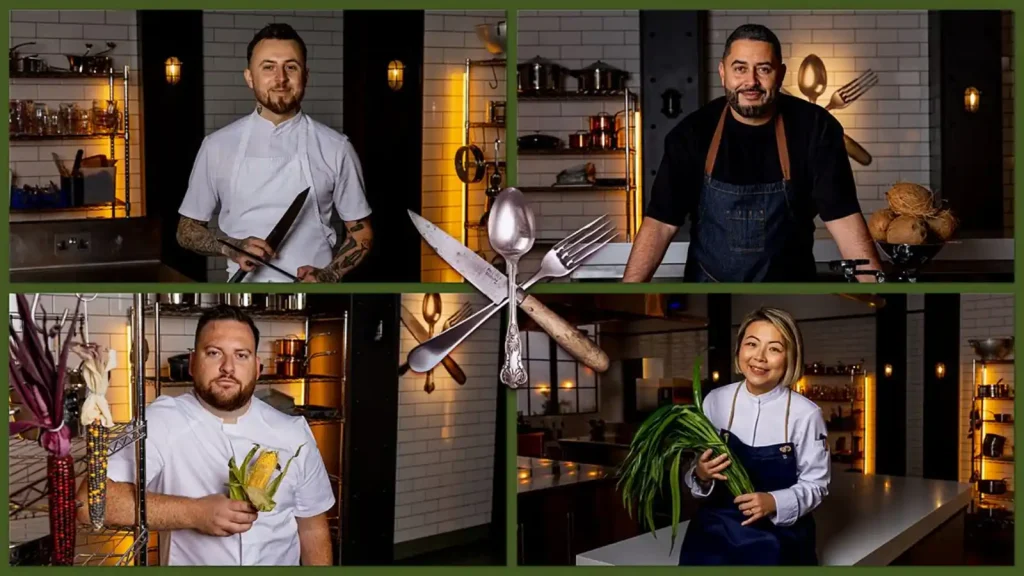
Great British Menu 2026 episode 13 arrives with a bold cinematic premise, sending four ambitious chefs from North East England and Yorkshire into the kitchen to cook food inspired by the British film industry. This week’s competition raises the stakes considerably, with each dish expected to honour an iconic film, a beloved genre, or a defining moment in British cinema history. The challenge is not merely technical — it demands storytelling on a plate, a quality that separates competent cooking from genuinely memorable competition food. Paul Ainsworth, the veteran judge and long-time friend of the competition, takes his seat at the judging table ready to assess whether the chefs have matched culinary ambition with creative vision.
The four competing chefs are Tommy Banks, Robbie Lorraine, Steph Moon, and Oli Williamson. Each brings a distinct identity to the competition. Tommy Banks is a celebrated name in British fine dining, known for his precision and intellectual approach to ingredients. Robbie Lorraine brings the energy and confidence of a chef who believes deeply in bold flavour. Steph Moon carries considerable experience and a reputation for refined, emotionally resonant cooking. Oli Williamson, meanwhile, is the wild card — a chef whose dishes provoke strong reactions and who seems to relish doing things differently. Together, they represent a formidable and varied field from a region with a rich and underappreciated food culture.
The British film industry theme gives this week’s competition an unusual creative dimension. Unlike themes rooted in geography or season, cinema demands a kind of conceptual translation — a chef must first understand what makes a film significant, then find a way to express that significance through flavour, texture, and visual presentation. Some films lend themselves naturally to this exercise. Others require a more oblique approach. The chefs in Great British Menu 2026 episode 13 have clearly thought hard about their choices, and the results range from the elegantly understated to the theatrically extravagant.
The opening canape round sets the tone immediately. This is where first impressions are formed and where the competition’s emotional temperature is established. A strong canape communicates a chef’s personality and ambition in a single bite, leaving the judge with an immediate sense of what the rest of the week might hold. Paul Ainsworth, himself a chef of considerable standing, brings both technical rigour and a genuine warmth to the judging process, and his assessments carry real weight. His scoring across the canape, starter, and fish courses determines who progresses and who faces elimination.
Cooking to a cinematic brief is, in many ways, an exercise in restraint as much as invention. The temptation to over-explain, to load a dish with too many references and symbols, is significant. The best dishes this week are those that absorb their inspiration quietly, allowing the food itself to lead while the story unfolds through careful eating. The chefs who understand this instinctively tend to produce the most coherent and satisfying results. Those who chase the concept too aggressively risk losing the flavour in favour of spectacle — a trap that professional competition cooking sets with particular reliability.
The regional dimension adds another layer of meaning. North East England and Yorkshire together form one of Britain’s most characterful food regions — coastal, agricultural, industrially rich in heritage, and deeply proud of local produce. The chefs are expected not merely to reference the film brief but to anchor their cooking in the identity of their region. This double obligation — be cinematic and be regional — is what makes Great British Menu 2026 episode 13 particularly demanding. A dish that achieves both simultaneously is a genuine accomplishment, and the judges know exactly what they are looking for.
Paul Ainsworth’s presence as veteran judge is significant beyond his scoring role. He functions as a kind of conscience for the competition — someone who has cooked at this level, who understands the pressure, and who can therefore assess not just what is on the plate but what the chef was trying to achieve. His feedback tends to be direct and specific, and the chefs respond to him with a combination of respect and anxiety that generates some of the week’s most revealing moments. His engagement with the food is visibly genuine, and his enthusiasm when a dish truly lands is infectious.
The episode moves through its three courses — canapes, starters, and fish — with the structured intensity that defines the Great British Menu format. Each course is cooked, plated, and presented independently, and the cumulative scores determine the standings at the close. By the end of episode 13, the competition’s shape for the rest of the week is already clearly drawn. The chefs who have delivered on their cinematic concepts while keeping their cooking precise and their flavours compelling have established themselves as serious contenders. Those who have stumbled face the task of recovery in the days ahead.
Great British Menu 2026 Episode 13 Opens With Canapes and Cinematic Ambition
The canape round introduces all four chefs’ creative visions simultaneously, and the range of approaches is striking. Tommy Banks presents a canape built around a precise and elegant concept, one that immediately signals his instinct for restraint and refinement. His offering reflects the kind of thinking that made him a significant figure in British food — every element on the plate earns its place, and the whole communicates a clear idea without overreaching.
Robbie Lorraine takes a more theatrical approach, leaning into the visual drama that the film brief invites. His canape is designed to make an immediate impression, and Paul Ainsworth responds to it with evident interest. However, the veteran judge’s assessment balances admiration for the concept with a degree of scrutiny about the execution. In the canape round especially, technical precision matters enormously — a single bite must do a great deal of work.
Steph Moon’s canape demonstrates her characteristic thoughtfulness. Her approach to the cinematic brief is more interior than Lorraine’s, drawing on feeling and atmosphere rather than spectacle. The result is a canape that rewards attention, one where the second impression is richer than the first. Oli Williamson, meanwhile, arrives with a canape that polarises — exactly the kind of outcome his cooking tends to produce. Ainsworth engages with it seriously, his feedback both pointed and considered.
The Starter Course and the Gladiator-Inspired Pearl Barley Dal
The starter course is where the competition’s most discussed dish of the week emerges. One of the chefs — the transcript identifies this as a pearl barley dal inspired by Gladiator — arrives at the judging table with a dish that carries genuine ambition. The choice of Gladiator as inspiration is bold: a Roman epic translated into a dal, using pearl barley as its foundation, is a striking piece of conceptual cooking that risks both admiration and confusion.
The dal itself is built with considerable care. Pearl barley provides a texture that is simultaneously rustic and refined — chewy, substantial, and receptive to the spiced, layered flavours that a dal construction demands. The Gladiator reference is worked into the dish through its visual presentation and its flavour architecture, suggesting the scale and drama of the film without resorting to literal quotation. Paul Ainsworth’s response to this dish is one of the more revealing moments of the episode — his engagement with the concept is genuine, and his assessment of whether the execution matches the ambition drives a significant portion of the starter round’s tension.
The other starters compete on their own terms. Tommy Banks’s starter brings the precision that characterised his canape, building on his week’s emerging identity as a chef who trusts understatement. The cooking is technically immaculate, and the flavours are compelling. However, in a round where boldness is being rewarded, his restraint creates an interesting counterpoint. The scoring reflects this tension between different kinds of excellence.
Steph Moon’s starter demonstrates the emotional intelligence that defines her cooking. She has chosen her film reference carefully, and the resulting dish has a coherence — conceptual and culinary — that impresses Ainsworth. The veteran judge responds to food that has clearly been thought through from the inside, and Moon’s starter reflects exactly that quality of careful, purposeful construction. Her score in this round positions her well in the standings.
Black-and-White Monkfish and the Newcastle Film Noir Fish Course
The fish course produces the episode’s most visually arresting dish: a black-and-white monkfish that draws its inspiration from Newcastle film noir. The concept is immediately compelling. Film noir’s visual language — deep shadow, high contrast, the interplay of light and dark — translates into a culinary aesthetic that is both striking and coherent. The choice of Newcastle as the noir setting gives the dish a specific regional identity, rooting the cinematic reference in the geography of the competing region.
The monkfish itself is a demanding choice. Its dense, meaty texture requires precise cooking — too little heat and it remains unpleasant, too much and the flesh tightens and loses its subtle sweetness. The black-and-white visual presentation requires careful work with colour — likely through the use of ingredients that contribute achromatic tones without compromising flavour. Squid ink, for instance, offers an obvious black element, while cream or white vegetable purées provide the contrasting register. The challenge is making these visual choices feel culinarily motivated rather than cosmetically imposed.
Paul Ainsworth’s assessment of the noir monkfish is one of the episode’s centrepieces. He reads the dish carefully, engaging with both its visual logic and its flavour. His verdict on whether the concept has been successfully embodied in the food — rather than merely illustrated by it — carries substantial weight. A high score here would be a significant statement of intent from the chef responsible.
The other fish courses each pursue their cinematic briefs with varying degrees of success. Robbie Lorraine’s fish dish continues the theatrical energy he brought to his canape, pushing flavour intensity and visual drama simultaneously. The question, as always with Lorraine’s cooking, is whether the ambition is matched by the execution. Ainsworth’s scoring is precise, and the difference between a dish that nearly works and one that fully lands is measured in points that reshape the competition standings.
Great British Menu 2026 Episode 13 and the Role of Paul Ainsworth as Veteran Judge
Paul Ainsworth’s function as veteran judge in Great British Menu 2026 episode 13 is worth examining closely. He is not simply a scorer — he is a calibrating presence whose reactions shape the competitive atmosphere of the entire week. His background as a working chef, one who has competed at the highest levels of British cooking, means that his feedback carries a kind of authority that external critics cannot replicate. He has stood at a pass under pressure. He understands what it costs to execute a complex dish in a competition kitchen.
His assessments across the canape, starter, and fish courses follow a consistent logic: he rewards dishes where concept and execution are in genuine alignment, and he identifies quickly when one is running ahead of the other. A beautiful concept with ragged execution frustrates him visibly. A technically immaculate dish that has no real idea behind it leaves him similarly cold. He is looking for food that works on both levels simultaneously, and his scoring reflects this dual standard with considerable rigour.
The chefs respond to Ainsworth differently. Tommy Banks, whose cooking shares something of Ainsworth’s intellectual rigour, engages with the veteran judge’s feedback in a way that suggests mutual respect. Robbie Lorraine, whose style is more extroverted, seems energised by Ainsworth’s engagement even when the verdict is mixed. Steph Moon reads his reactions carefully, adjusting her understanding of her own performance in real time. Oli Williamson, characteristically, seems to have cooked for the dish’s own sake and awaits the verdict with a particular kind of equanimity.
Ainsworth’s warmth is as important as his rigour. He brings genuine enthusiasm to the judging table, and when a dish genuinely excites him, that enthusiasm communicates itself clearly. These moments — a bite that produces an involuntary positive reaction, a flavour that surprises him — are the moments that competitors work toward all week. In episode 13, several such moments occur, and they are among the most compelling sequences the episode produces.
Scoring, Standings, and the Shape of the Competition After Great British Menu 2026 Episode 13
By the close of the three courses, the scoring has produced a hierarchy that reflects the week’s creative and technical dynamics with considerable clarity. The cumulative points from canapes, starters, and fish courses establish which chefs are in a strong position heading into the meat and dessert courses and which face the challenge of recovery. The episode ends without a definitive elimination — that comes later in the week — but the standings already communicate a great deal about the competition’s direction.
Tommy Banks’s consistent precision has accumulated well. His scores across the three courses reflect a chef who has not produced a single weak dish but who may have left some points on the table by choosing restraint where boldness might have scored higher. His position in the standings is strong, but not commanding. The gap between him and the competition is narrow enough to keep the week genuinely open.
Robbie Lorraine’s theatrical energy has paid dividends in some courses and cost him in others. His highest scores reflect moments where his ambition was matched by his execution — dishes that communicated a genuine idea through technically accomplished cooking. His lower scores mark the places where the concept outran the delivery. Overall, his standing is competitive, and his evident hunger to perform suggests he will push hard in the remaining courses.
Steph Moon’s emotionally intelligent cooking has scored with particular consistency in the starter course. Her fish dish has added further points to a tally that places her in a genuinely strong position. Her approach to the cinematic brief — interior, atmospheric, rooted in feeling rather than spectacle — has resonated with Ainsworth in ways that suggest she understands the veteran judge’s aesthetic priorities better than some of her competitors.
Oli Williamson’s position after episode 13 is the most interesting of the four. His scores reflect the polarising quality of his cooking — some courses have produced notably high points, others have been more modest. His approach to the British film industry theme has been the most idiosyncratic of the four competitors, and Ainsworth’s responses to his dishes have ranged across a wider spectrum than those given to any other chef. He remains a genuine contender, but his path through the competition is harder to predict.
Great British Menu 2026 Episode 13 and the Meaning of Regional Identity in Cinematic Food
The interplay between regional identity and cinematic inspiration is one of the most interesting aspects of Great British Menu 2026 episode 13. North East England and Yorkshire together form a region with a particular character — industrial heritage, coastal landscape, agricultural abundance, and a food culture that values directness and quality of ingredient over ornament. These qualities sit in an interesting relationship with the film industry brief, which invites theatricality and conceptual ambition.
The chefs who navigate this tension most successfully are those who have found genuine points of intersection between the two briefs. The Newcastle film noir monkfish is the episode’s clearest example — it draws on the specific cultural identity of the region (Newcastle, its streets, its noir associations) and translates that identity into a cinematic reference that feels earned rather than imposed. The dish is simultaneously regional and cinematic because the region and the cinema have been allowed to speak to each other, rather than being layered on top of each other.
The Gladiator pearl barley dal achieves something similar, though through a less geographically specific route. Pearl barley is a northern grain with deep roots in British agricultural cooking, and its use as the foundation for a dish inspired by a Roman epic creates a productive cultural friction — ancient Rome meeting northern England through the mediating lens of British cinema. The result is a dish with multiple layers of meaning, and it is precisely this layered quality that competition food at this level is designed to produce.
The chefs who have struggled, where they have struggled, are those whose cinematic references have remained somewhat disconnected from their regional identity. A dish that honours a British film without finding a way to locate that honour in the specific produce and culture of North East England and Yorkshire is missing one of the brief’s fundamental demands. Paul Ainsworth’s scoring reflects this awareness, and the episode’s standings ultimately reward chefs who have understood the full complexity of what was being asked of them.
The British Film Industry Brief and Its Demands on Competition Cooking
The British film industry has produced some of the world’s most distinctive cinema — from the social realism of the 1960s to the heritage dramas of the 1980s, from science fiction to comedy, from noir thrillers to contemporary prestige drama. This breadth of reference gives the competing chefs an enormous range of material to draw from, and the choices they make reveal something significant about their cultural sensibilities and their approach to conceptual cooking.
The film brief also demands a particular kind of confidence. A chef who chooses a well-known, widely beloved film takes on the risk of audience expectation — if the dish does not honour the film in a way that feels right, the disappointment is proportionally larger. A chef who chooses a more oblique or personal reference risks confusion or disconnection. The safest choices are those where the film is legible and the translation to food is inspired — where a viewer who knows the film immediately understands why this particular dish has been made in this particular way.
Gladiator and film noir represent two very different points on this spectrum. Gladiator is one of the most globally recognised British-produced films of the modern era — its scale, its spectacle, and its emotional directness are familiar to virtually every adult viewer. The decision to translate it into a pearl barley dal requires a willingness to work against expectation, to take a film associated with grandeur and translate it into something grounded and humble. The success of this translation in episode 13 suggests that the chef responsible understood both the film and the food with genuine depth.
Film noir, by contrast, is a more specialised reference — one that rewards viewers who understand the tradition’s visual and narrative conventions. The Newcastle film noir monkfish works because it finds a specific, local inflection for a broader cinematic language. It does not simply invoke noir in the abstract; it places noir in a particular place and time, giving the dish a rootedness that abstract reference cannot provide. This specificity is, ultimately, what separates the most successful dishes in Great British Menu 2026 episode 13 from those that gesture toward their cinematic inspirations without fully inhabiting them.
The competition, as episode 13 demonstrates, rewards the chefs who take the brief seriously enough to do real conceptual work — to find the point where a film’s meaning and a region’s identity and a chef’s own cooking voice all converge on a single plate. When that convergence happens, the results are remarkable. When it does not, the gap between concept and execution becomes visible in every bite. Paul Ainsworth’s judging table is, in this sense, the place where the ideas are finally tested against the food, and where the week’s real story begins to emerge.
FAQ Great British Menu 2026 episode 13
Q: What is Great British Menu 2026 episode 13 about?
A: Great British Menu 2026 episode 13 features four chefs from North East England and Yorkshire competing across canape, starter, and fish courses. The theme is the British film industry. Veteran judge Paul Ainsworth scores each dish and determines the standings heading into the rest of the week.
Q: Who are the four chefs competing in episode 13?
A: The four competing chefs are Tommy Banks, Robbie Lorraine, Steph Moon, and Oli Williamson. Each brings a distinct cooking style to the competition. Tommy Banks is known for precision, Robbie Lorraine for bold flavour, Steph Moon for refined emotional depth, and Oli Williamson for unpredictable, provocative dishes.
Q: Who is the veteran judge in Great British Menu 2026 episode 13?
A: Paul Ainsworth serves as the veteran judge in episode 13. He is a respected chef and a long-time friend of the competition. His assessments are direct and specific. Additionally, his experience as a working chef means he understands both the technical and conceptual demands placed on the competitors.
Q: What is the British film industry theme and how do chefs interpret it?
A: The British film industry theme requires each chef to inspire their dishes from iconic British films or cinematic genres. Furthermore, chefs must anchor their cooking in the identity of North East England and Yorkshire. The most successful dishes find a genuine intersection between regional produce and cinematic reference, rather than treating the two briefs separately.
Q: What is the Gladiator-inspired dish in the starter course?
A: One chef presents a pearl barley dal inspired by the film Gladiator. Pearl barley provides a rustic yet refined texture that absorbs spiced, layered flavours effectively. The dish works conceptually because it translates the epic scale of the film into humble, grounded northern ingredients. Paul Ainsworth engages closely with the concept during judging.
Q: What is the black-and-white monkfish dish in the fish course?
A: The black-and-white monkfish is a fish course inspired by Newcastle film noir. Its visual presentation uses contrasting achromatic tones to reflect noir’s signature aesthetic of deep shadow and high contrast. However, the dish also roots its cinematic reference in a specific regional setting. Flavour and concept work together, rather than one serving merely as decoration for the other.
Q: How does Paul Ainsworth score dishes in Great British Menu 2026?
A: Paul Ainsworth scores dishes based on the alignment between concept and execution. He rewards food where both elements are in genuine balance. Specifically, a technically immaculate dish with no real idea behind it scores poorly, as does a strong concept undermined by ragged execution. His dual standard rewards chefs who succeed on both levels simultaneously.
Q: How do the standings look after the canape, starter, and fish courses?
A: After three courses, Steph Moon holds a strong position thanks to consistent scoring across starters and fish. Tommy Banks has accumulated well through precision cooking. Robbie Lorraine sits competitively but unevenly, with high scores where ambition met execution. Meanwhile, Oli Williamson remains a genuine contender despite a wider range of scores across the three courses.
Q: Why is regional identity important in Great British Menu 2026 episode 13?
A: Regional identity is central to the Great British Menu format. Chefs must represent North East England and Yorkshire through their ingredients, flavour references, and cultural knowledge. Therefore, dishes that honour a British film without connecting it to the region’s specific produce and heritage miss a fundamental requirement. The most praised dishes this week achieve both the cinematic and the regional brief simultaneously.
Q: What separates the strongest dishes in episode 13 from the weaker ones?
A: The strongest dishes in Great British Menu 2026 episode 13 achieve a genuine convergence of film reference, regional identity, and the chef’s own cooking voice. Consequently, they feel inevitable rather than constructed. Weaker dishes tend to treat concept and food as separate concerns, using visual or thematic references as surface decoration. Paul Ainsworth identifies this gap consistently and his scoring reflects it with precision.