In Great British Menu 2026 episode 8, the three talented chefs from Central England are midway through their regional heat. The pressure is real, the stakes are high, and every plate matters. So far, these chefs have impressed and surprised in equal measure. Now, however, the real test begins. Main course and dessert are where chefs reveal their true character. These are the courses that linger in the memory long after the meal ends.
This year’s theme celebrates the British film industry. It is a rich, evocative brief that clearly ignites the imagination. Central England has deep ties to cinema history, and the chefs are leaning into that connection beautifully. Each chef has interpreted the brief in their own distinct way. Their dishes do not simply reference films. Instead, they tell stories through food. That is a far harder thing to achieve, and it is wonderful to watch. Cooking at this level is like directing a film. Every element must serve the bigger picture. Nothing appears on the plate without purpose.
Joining the judging panel for this episode is Tom Shepherd. He is a respected and experienced figure in British fine dining. His presence brings both gravitas and genuine expertise to the table. Tom is not easily impressed. He has cooked at the highest levels himself. Therefore, the chefs know that only their very best work will earn his approval. Furthermore, Tom brings a deep appreciation for cooking that is rooted in storytelling. He understands what it means to craft a dish with emotional depth. That quality matters enormously in a competition built around such a rich cultural theme.
One of the standout dishes in Great British Menu 2026 episode 8 is a beautifully crafted duck breast. It arrives alongside a silky celeriac bread sauce. Together, they form a dish inspired by the special effects team behind Christopher Nolan’s Inception. That film was groundbreaking in its visual ambition. Similarly, this dish pushes the boundaries of what food can express. The duck is rich and precisely cooked. The celeriac bread sauce adds warmth, earthiness, and a quiet sophistication. It is a clever tribute. The dish captures Inception’s dreamlike quality without resorting to gimmicks. Instead, the chef allows the ingredients to do the talking. The result is food that feels both cinematic and deeply satisfying.
Then comes the dessert, and it is genuinely spectacular. One chef presents an edible film reel incorporating white chocolate and a delicate ginger mousse. This is where cooking becomes theatre. The dish is visually striking from the very first moment. However, presentation alone does not win points on Great British Menu 2026.
The flavours must justify the ambition. White chocolate can easily become cloying. Used well, though, it is luxurious and elegant. Here, the ginger mousse cuts through the sweetness with a gentle, warming heat. The balance is precise and considered. Moreover, the film reel concept is executed with genuine craft. It does not feel like a novelty. Instead, it feels like a heartfelt love letter to cinema. That emotional resonance is exactly what this brief demands.
Central England has a fascinating relationship with the film industry. Several major productions have been filmed across the region. From historic estates to urban landscapes, the area offers extraordinary variety. Consequently, the chefs have plenty of material to draw from. Their dishes reflect genuine local pride. They are not simply cooking to a theme. They are cooking to their own heritage and experience. That personal connection always elevates competition cooking. You can taste the difference when a chef is genuinely invested in their dish. The food carries an extra layer of meaning.
Great British Menu 2026 episode 8
Reaching the halfway point in a regional heat is both a relief and a pressure point. The chefs have shown what they can do in the earlier courses. Now, however, they must close strongly. In competition cooking, momentum matters enormously. A brilliant starter can be undone by a weak dessert. Therefore, the chefs must maintain focus and consistency across every single plate. Additionally, the dynamics between the competitors are fascinating to observe. There is mutual respect, certainly. Yet underneath that respect lies fierce, burning ambition. Every chef in that kitchen wants to progress.
That ambition is the question hanging over every moment of Great British Menu 2026 episode 8. Someone will be leaving the competition. Only the chef who demonstrates the most consistent brilliance will advance. Tom Shepherd’s verdict will carry enormous weight. His eye for detail is sharp. His standards are uncompromising. And his feedback, when it comes, will be both honest and revealing. The cooking in this episode is genuinely thrilling. Each chef has brought something original and heartfelt to the brief. Nevertheless, only one can move forward.
Great British Menu 2026 continues to deliver exactly what fans of the series love. It combines extraordinary cooking with genuine human drama. Episode 8 is no exception. The Central England heat has produced memorable dishes and compelling competition. Furthermore, the film industry theme has drawn out real creativity from all three chefs. The results are dishes that feel both ambitious and deeply personal. If you love food, film, or simply great television, this episode is not to be missed. Pull up a chair, settle in, and enjoy one of the finest cooking competitions British television has to offer.
Great British Menu 2026 episode 8
Great British Menu 2026 episode 8 arrives at the most revealing moment of any culinary competition. Two courses down, three chefs still standing, and just three points separating them on the leaderboard — the Central England regional heat enters its most consequential day. Nikita leads on 17 points, Ash sits on 15, and Louisa follows just behind on 14. In any other competition, such margins might feel comfortable. In the context of Great British Menu 2026, they amount to nothing more than the thinnest of breathing room.
The format strips away all comfort. Only two chefs will progress to the judges’ chamber. The third, regardless of talent or ambition, goes home. With main course and dessert still to cook, every decision in the kitchen, every element on every plate, carries a weight that the earlier courses never quite demanded. Main and dessert are where a chef’s true priorities surface — not the technical flourishes performed in the relative safety of a starter, but the bigger, bolder statements that define a menu’s character.
The episode begins with a significant change to the veterans’ bench. Spencer Metzger, who awarded his first-ever ten on the programme during the fish course, has returned to his restaurant. In his place steps Tom Shepherd, a Michelin-starred chef from Birmingham and winner of the banquet main course in 2023. His arrival is warmly received but also sharpens the atmosphere considerably. Tom is not there merely to observe — he will assess every plate, score every course, and ultimately decide which two chefs earn the right to continue. His stated ambition is clear: he wants no stone unturned, every element of every dish functioning at its absolute best.
Tom’s presence carries a particular resonance for the Central England heat. He has walked the same competitive road these three chefs are now navigating. He knows the pressure of cooking a main course in this kitchen, and he knows what it takes to produce food worthy of the national banquet. His expectations are calibrated accordingly. During briefings, he tastes individual components with focused attention, identifies weaknesses early, and challenges each chef to justify the choices they have made. His feedback is direct but never unkind, always analytical, always searching for the version of each dish that could be genuinely exceptional.
The theme running through this year’s competition is film and cinema, with each dish connected to a movie and a figure from the Central England region. All three chefs approach the brief differently, but the unifying ambition is consistent: to make food that tells a story, that carries cultural meaning, and that still achieves the technical level required for a banquet-worthy result. The creative pressure does not diminish the culinary demands — it intensifies them. A dish that arrives with a compelling concept but flawed execution earns no credit for good intentions.
As the cooking begins, it becomes immediately clear that all three chefs have prepared extensively. Each has a game plan, a sequence of preparation, a set of priorities. However, Great British Menu 2026 has a habit of testing the distance between a plan and its execution. Sauces must reduce while proteins are being butchered. Pastry must rest while garnishes are assembled. The kitchen operates at a pace that compresses decision-making until everything converges at the pass at once. For Louisa, Ash, and Nikita, the next few hours will define not just their place in this competition, but the standard of food they can produce under maximum pressure.
The main courses on this day span an impressively varied range of cuisines and culinary references. They move from Greek-inflected lamb to a Pride and Prejudice-inspired pork feast by way of a whole-duck exercise in Inception-themed layering. Each concept is rooted in the region. Each execution involves a different set of technical challenges. Together, they produce a main course session that Tom Shepherd describes as genuinely impressive, even as specific errors prevent any of the three dishes from reaching their full potential.
Desserts, arriving after the pre-dessert interlude, deliver a different kind of intensity. Choux pastry, tempered white chocolate eggs, and handmade film-reel spheres test technical skills that have no shortcuts. The scores from the dessert round ultimately decide the competition. When they land, they reshape the leaderboard entirely, sending two chefs forward and ending the journey of one who had performed with remarkable consistency throughout the week.
Great British Menu 2026: Louisa’s Lamba Mia Main Course
Louisa arrives at the main course with 14 points, her position in the competition already precarious. Her dish, titled Lamba Mia!, draws its inspiration from the film Mamma Mia!, specifically from Dame Julie Walters, who played Rosie in the movie and hails from Birmingham. The film’s Greek island setting shapes the entire culinary direction. Louisa commits to a Greek-influenced main course, threading Mediterranean flavours through every element.
The centrepiece is lamb rump, scored and fat-rendered, then cooked to a medium finish. Alongside it sits a moussaka constructed from braised lamb shank, topped with béchamel foam. Louisa also prepares a red pepper and olive oil purée with a hit of sherry vinegar for acidity, a goat’s curd element, and an olive tapenade formed into sphere shapes, coated in a cocoa butter glaze. The presentation is brought to the pass to the sounds of ABBA’s Waterloo and served on a disco-floor setting, a theatrical touch that earns immediate appreciation.
However, the cooking session generates significant anxiety. Louisa acknowledges that her moussaka lacks sufficient cinnamon flavour and adds more mid-service. More critically, when she reaches the plating stage under severe time pressure, she forgets to add the roasted aubergines — the component that provides structural layering within the moussaka and grounds the dish in its classical reference.
The omission is noticed immediately. Tom also observes that the lamb shank filling has a loose texture, closer to a ragù than a properly layered moussaka, and questions whether lamb shank was the right cut for the purpose. The lamb rump itself is praised for tenderness, though the resting period was shorter than Louisa wanted. The cocoa butter-glazed olive tapenade spheres draw a pointed observation: if an element does not make the dish better, its presence on the plate becomes difficult to justify. Louisa self-scores at five, though Tom ultimately awards seven.
Great British Menu 2026: Nikita’s Dinner at Pemberley
Nikita enters the main course as the competition leader on 17 points. Her dish, Dinner at Pemberley, draws from Chatsworth House in Derbyshire, which served as a filming location for Pride and Prejudice, connecting to her Derby roots and to Jane Austen’s fictional Pemberley estate. The concept is a feast — abundant, multi-component, served on sharing platters.
The protein is a pork tomahawk, from which Nikita separates the belly to cook on the barbecue and the chops to sear with butter and curry leaves before finishing in the oven. She also produces a hot water crust pastry pie filled with braised pork cheeks in Madeira sauce, topped with a sweet corn, tamarind, and chat masala mix. Accompanying elements include sweet corn chevdo — blended sweet corn with mustard seeds, curry leaves, turmeric, and a touch of chilli — and potato pettis, hollow potato cases stuffed with curried sweet corn and deep-fried before service. Roasted carrots in a sesame masala and a green coriander and mint chutney complete the plate.
The cooking is exhilarating to watch and produces food of genuine quality in most elements. The barbecued pork belly earns specific praise — Tom notes he has never encountered pork belly cooked from raw on a barbecue and found it excellent. The pie receives strong marks: the hot water crust pastry is crisp, the pork cheek filling tender without losing its structural integrity. The potato pettis are described as the mildest part of the dish, providing necessary relief within an intensely spiced menu.
However, the pork chop, the loin portion of the tomahawk, arrives undercooked. Nikita herself acknowledges this immediately, describing the error as unacceptable at this level. Tom also notes that the pie filling, being quite loose, might benefit from individual servings to maintain structural presentation. Nikita receives eight points, retaining her lead but knowing the gap remains tight.
Great British Menu 2026: Ash’s A Dream Within a Dream
Ash approaches the main course from a position of controlled intensity. Her dish, A Dream Within a Dream, is inspired by the film Inception, connecting to Staffordshire via two visual effects artists who worked on the film and won an Oscar for their contributions. The thematic idea mirrors the film’s structure: multiple layers of the same subject, each revealing a different dimension. In food terms, this means utilising the whole duck.
Ash breaks down a whole duck crown, splitting it to achieve an even cook across the breast. She cooks the duck on the barbecue, separates the legs into a confit, and threads the liver and heart onto an offal skewer. The jus gras sauce is made entirely from duck fat and bones, producing a richly flavoured result that Tom describes as sauce being the most important element of any dish.
The celeriac element is constructed as a bread sauce variation — celeriac softened in butter, blended to a smooth, velvety consistency with a hint of nutmeg. Nectarines are poached in a warming spice liquor of cinnamon, star anise, vanilla, and rooibos, acting as a fruit relish. Hen-of-the-woods mushrooms are barbecued and glazed. The finished dish is presented alongside a curated playlist to listen to whilst eating.
The cooking of the duck across all its components is described as a masterclass. The crown is perfect in cuisson, the legs deliver an entirely different texture, and the offal skewer represents a commitment to whole-animal cooking that earns immediate admiration. Tom praises the celeriac bread sauce as inspired — the decision to substitute celeriac for bread transforms an already excellent classical preparation into something genuinely original. His only reservation concerns the nectarine element, which he finds a little light relative to the richness of everything else on the plate. Ash scores herself nine. Tom awards nine as well, the highest main course score of the day.
Pre-Dessert and the Blind Tasting
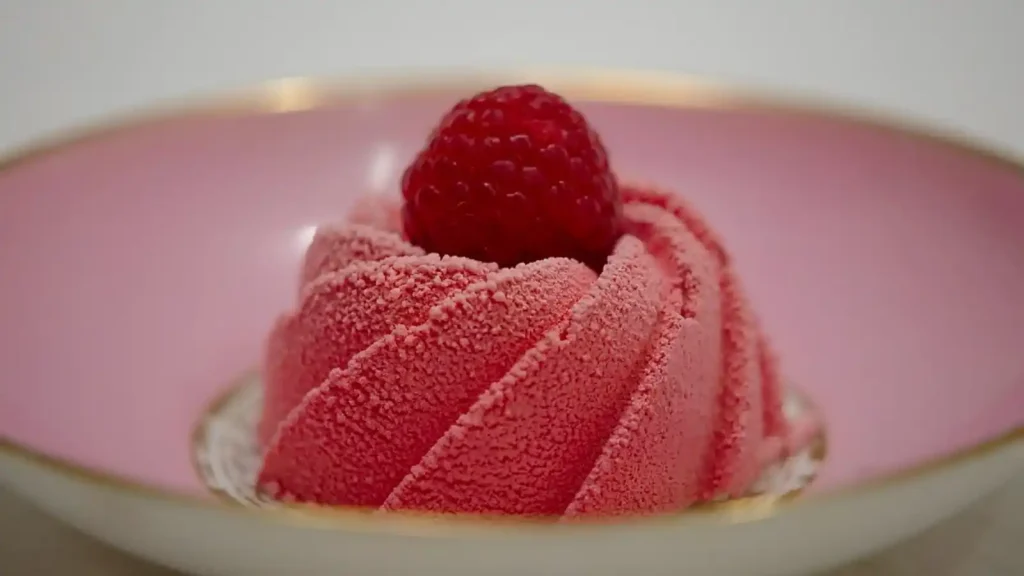
Before the full desserts, each chef presents a pre-dessert, and Tom tastes all three blind. Nikita produces a lime sorbet inspired by Bend It Like Beckham, connecting to Leicester through actress Parminder Nagra. The sorbet incorporates black salt and cumin, referencing Indian lemonade, with a yoghurt foam and candied mango. Ash makes a yoghurt mousse shaped and coated in pink cocoa butter, with a raspberry gel centre, inspired by Calendar Girls and dedicated to Dame Julie Walters. Louisa creates a jalapeño and cucumber sorbet she calls Spice Blast, with a coconut foam, lime, and popping candy.
The blind tasting produces a clear ranking. Tom finds the black salt in Nikita’s offering difficult to move past, noting its sulphurous quality. Ash’s mousse is described as savoury and underpowered, lacking salt and sugar balance. Louisa’s Spice Blast, however, wins decisively. Tom describes it as delicious, super refreshing, and genuinely clever, calling it his favourite without hesitation. He correctly identifies all three chefs’ dishes, and the pre-dessert result builds considerable momentum for Louisa heading into the final course.
Great British Menu 2026: Three Desserts, Three Technical Challenges
The dessert round in Great British Menu 2026 produces three dishes of striking individual ambition. All three chefs choose technically demanding approaches that carry real risk under competition conditions. The results range from genuinely flawless to very nearly exceptional.
Nikita’s dessert, The Beginning of the End, draws its inspiration from The Grand Budapest Hotel and Ralph Fiennes, who was born in Ipswich. The visual centrepiece is a recreation of the film’s fictional Courtesan au chocolat — three choux buns of descending sizes, stacked upon each other. The largest contains jaggery ice cream, the middle holds banana custard, and the smallest carries a chocolate ganache. All three sit on a banana and date sponge with caramelised peanuts. Nikita has practised the choux extensively, describing the preparation as muscle memory.
Tom’s assessment notes that the presentation and technical approach are both sublime, specifically praising the three different sizes of choux as absolutely sublime. His criticism centres on the jaggery ice cream, which he finds too sweet, suggesting a peanut butter ice cream might have provided a more savoury counterbalance. He also feels the banana custard in the middle layer loses itself among the competing flavours and textures, and proposes that the chocolate ganache might have been more effective as a warm sauce. Nikita receives eight for dessert.
Louisa’s dessert, The Final Reel, is built to resemble an old-fashioned film reel and draws its regional inspiration from Bramley apples, which originate in Nottingham. She layers a ginger and white chocolate mousse around a rum caramel-soaked sponge, a Bramley apple purée, and compressed Granny Smith apple, all set in a sphere mould. The sphere is completed with a tempered white chocolate disc lid, which she brings to the pass to the iconic Pearl and Dean cinema theme. A sharp apple and ginger granita accompanies the dish, as does a Bramley apple purée described for its beautiful balance of sweetness and acidity.
The tempered white chocolate is executed perfectly — clean crack, precise technique, beautifully finished. Tom specifically notes that tempering chocolate in a competition kitchen represents a technical challenge that cannot be overlooked, and describes it as a masterclass. The granita earns enthusiastic praise, described as proper and punchy, with the right texture when pulled directly from the freezer. Tom’s only criticism is that the sponge is slightly denser than ideal. Louisa gives herself an eight; Ash awards a ten outright; Nikita agrees with ten, offering no notes. Tom scores Louisa nine.
Great British Menu 2026: Ash’s Second City Easter Egg
Ash’s dessert represents the most technically demanding construction of the session. Second City Easter Egg takes its inspiration from the film Ready Player One, filmed in Birmingham, in which the central challenge involves locating a hidden golden egg inside a virtual game world. Ash recreates this concept in edible form: a handmade tempered white chocolate egg, individually formed for each guest, filled with passion fruit curd and vanilla mousse, resting on a kataifi pastry nest.
The kataifi is made from Feuilles de Brick, shredded into fine strands and formed into a nest — the perfect structural base for the egg and a visual reference to the film. Tempering white chocolate to the correct crystalline structure so that it achieves a clean snap on cracking is among the most technically demanding skills in pastry work. To do so under competition conditions, without specialist equipment, is formidable. Tom’s reaction when he cracks the egg is immediate and unambiguous.
His formal feedback describes the dish as faultless — the kataifi nest acting as the perfect foil and holder for the egg, the marriage of passion fruit and white chocolate described as absolutely phenomenal, the technical ability required to produce something so refined in this kitchen explicitly acknowledged. He finds nothing more he could add to make the dish better, and awards Ash a ten. Both Ash and Nikita independently give the dish top marks, with Nikita saying simply: ten, no notes.
Main Course Scores and the Final Leaderboard
After main course scoring, the standings shift but remain extraordinarily tight. Louisa receives seven for Lamba Mia!, bringing her to 21 points. Nikita receives eight for Dinner at Pemberley, taking her to 25 points. Ash receives nine for A Dream Within a Dream, climbing to 24 points. The gap between Nikita and Ash narrows to a single point, with Louisa now five behind the leader.
Dessert scoring confirms what the pre-dessert blind tasting had already suggested. Ash’s Second City Easter Egg receives ten points, delivering a perfect score and the highest possible dessert result. Louisa’s The Final Reel receives nine. Nikita’s The Beginning of the End receives eight. The dessert scores push Ash to 34 points in total for the day and consolidate her position ahead of Nikita.
The final combined scores across the entire heat conclude with Nikita on 33 points, Ash on 34 points, and Louisa on 30 points. Tom acknowledges that on any other week, Louisa’s score of 30 would in itself be a result worthy of progression. The competition’s depth, however, makes no allowances for strong-but-not-quite-enough performances.
Great British Menu 2026: Louisa’s Exit and the Road Ahead
Louisa leaves the competition with considerable grace. Her cooking throughout the Central England heat demonstrated genuine creativity and a willingness to take risks — the film reel dessert in particular arrives as one of the more technically polished and visually striking dishes of the session. Her final words acknowledge disappointment at not reaching the judges’ chamber, but also a pride in her nine for The Final Reel, a score that represents the best individual result of her heat.
Tom Shepherd, concluding the session, describes it as having been an absolute privilege to watch three such skilful chefs at work. He expresses genuine conviction that at least one banquet-worthy dish exists within this menu — a verdict that sends Ash and Nikita forward carrying real expectation. Both chefs have produced food of the highest order when it mattered most. Ash’s perfect score for dessert and nine for main course confirm her as the heat’s standout performer across this episode. Nikita’s consistent positioning throughout the week, combined with the undeniable quality of her Pemberley concept, means she enters the judges’ chamber as a credible contender.
The gap between the two remaining Central England chefs is a single point. The judges’ chamber will determine whether that margin holds any meaning. What Great British Menu 2026 has already demonstrated, through this remarkable regional heat, is that the food coming out of Central England carries ambition, originality, and serious technical depth. Ash and Nikita now carry that standard forward, knowing that the most demanding table of all still lies ahead.
FAQ Great British Menu 2026 episode 8
Q: What happens in Great British Menu 2026 episode 8?
A: Great British Menu 2026 episode 8 covers the main course and dessert stages of the Central England regional heat. Three chefs — Nikita, Ash, and Louisa — compete for two places in the judges’ chamber. Veteran judge Spencer Metzger is replaced by Michelin-starred Birmingham chef Tom Shepherd, winner of the 2023 banquet main course. With just three points separating all three competitors, every plate carries enormous weight.
Q: Who judges Great British Menu 2026 episode 8?
A: Tom Shepherd steps in as the veteran judge for episode 8. A Michelin-starred chef from Birmingham, Tom won the banquet main course in 2023. He replaces Spencer Metzger, who returns to his restaurant after the fish course. Tom tastes and scores all main courses and desserts, ultimately deciding which two Central England chefs progress to the judges’ chamber.
Q: What does Louisa cook for her main course in episode 8?
A: Louisa cooks Lamba Mia!, a Greek-inspired dish dedicated to Birmingham actress Dame Julie Walters. The plate features lamb rump, a lamb shank moussaka with béchamel foam, red pepper and olive oil purée, goat’s curd, and cocoa butter-glazed olive tapenade spheres. Unfortunately, Louisa forgets to add the roasted aubergines to her moussaka under time pressure. Tom Shepherd awards her a seven.
Q: What is Nikita’s main course dish in Great British Menu 2026 episode 8?
A: Nikita presents Dinner at Pemberley, inspired by Chatsworth House in Derbyshire, the Pride and Prejudice filming location. The feast includes barbecued pork belly, roasted pork chops, a hot water crust pork cheek pie in Madeira sauce, sweet corn chevdo, potato pettis stuffed with curried sweet corn, and roasted carrots in sesame masala. However, the pork chop arrives undercooked, costing Nikita marks. Tom awards an eight.
Q: How does Ash’s main course perform in episode 8?
A: Ash’s main course, A Dream Within a Dream, earns the highest main course score of the episode. Inspired by the film Inception and its Staffordshire Oscar-winning visual effects team, the dish uses the entire duck — barbecued breast, confit leg, and an offal skewer of liver and heart. A celeriac bread sauce, nectarine poached in rooibos and vanilla, hen-of-the-woods mushrooms, and a jus gras complete the plate. Tom awards nine.
Q: What are the pre-desserts in Great British Menu 2026 episode 8?
A: All three chefs present pre-desserts, which Tom Shepherd tastes blind. Nikita makes a lime sorbet with black salt and cumin, inspired by Bend It Like Beckham. Ash presents a pink cocoa butter-coated yoghurt mousse with raspberry gel, inspired by Calendar Girls. Louisa creates Spice Blast — a jalapeño and cucumber sorbet with coconut foam and popping candy. Tom ranks Louisa’s Spice Blast first, calling it genuinely clever and delicious.
Q: What dessert does Ash cook in episode 8 and what score does she receive?
A: Ash presents Second City Easter Egg, inspired by the film Ready Player One, which was filmed in Birmingham. Each guest receives a handmade tempered white chocolate egg, filled with passion fruit curd and vanilla mousse, resting on a kataifi pastry nest. Tom Shepherd describes the dish as absolutely faultless, praising the marriage of tart passion fruit with sweet white chocolate. He awards a perfect ten, calling the technical execution sublime.
Q: What is Louisa’s dessert in Great British Menu 2026 episode 8?
A: Louisa’s dessert is The Final Reel, designed to resemble an old-fashioned cinema film reel. She builds a sphere of ginger and white chocolate mousse around a rum caramel-soaked sponge, Bramley apple purée, and compressed Granny Smith apple. A perfectly tempered white chocolate disc completes the reel, brought to the pass to the Pearl and Dean theme tune. Additionally, a sharp apple and ginger granita accompanies the dish. Tom awards nine.
Q: Who gets eliminated in Great British Menu 2026 episode 8?
A: Louisa is eliminated at the end of episode 8. Her final combined score of 30 points, while genuinely impressive, falls short of Ash’s 34 points and Nikita’s 33 points. Tom Shepherd acknowledges that Louisa’s score would have secured progression in most other weeks. Furthermore, her nine for The Final Reel represents a personal high point. Ash and Nikita advance to the Central England judges’ chamber, separated by just one point.
Q: What is the film and cinema theme in Great British Menu 2026?
A: The 2026 series of Great British Menu tasks chefs with creating dishes inspired by films and cinema, celebrating British contributions to the movie industry. Each dish must connect to a film and a specific person or place from the chef’s region. In the Central England heat, dishes reference Mamma Mia!, Inception, Pride and Prejudice, The Grand Budapest Hotel, Ready Player One, and Calendar Girls. The theme pushes chefs to balance creative storytelling with exceptional cooking.