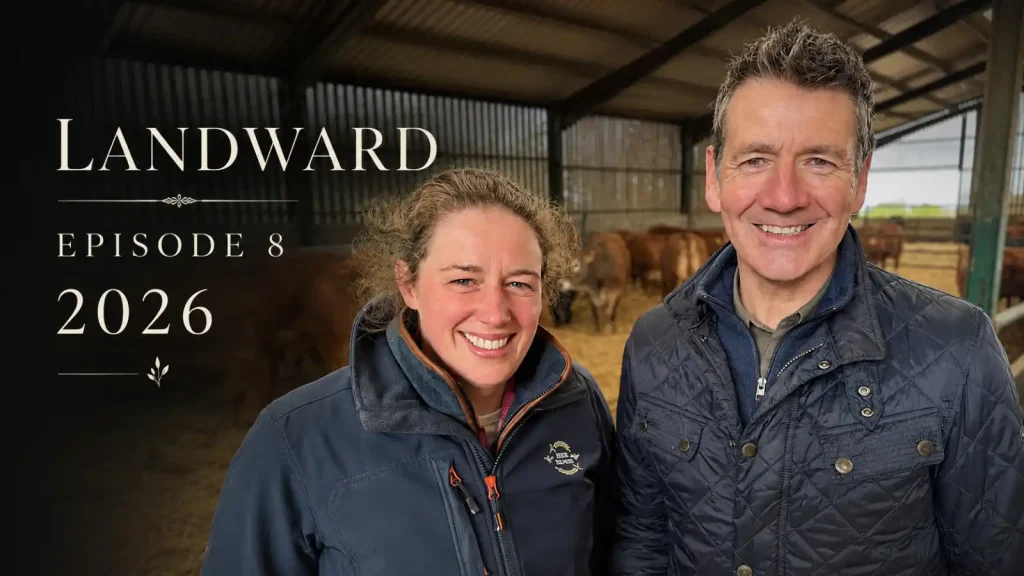
Landward episode 8 2026 delivers four sharply distinct stories across Scotland: the cattle turnout day at Bee Edge Farm near Eyemouth, a retrospective on fencing pioneer Jock Bryce of Morebattle as part of the programme’s 50th anniversary celebrations, the trail of a young Arctic walrus named Magnus who turned up at harbours along Scotland’s north coast, and a dual investigation into the country’s marine soundscape — from a cutting-edge acoustic monitoring project in Argyll to the centuries-old stones of Old Home Farm at Fyvie Castle in Aberdeenshire. Together they cover livestock management, agricultural history, climate change, marine conservation, and the quiet revolution happening between fishermen and scientists on Scotland’s west coast.
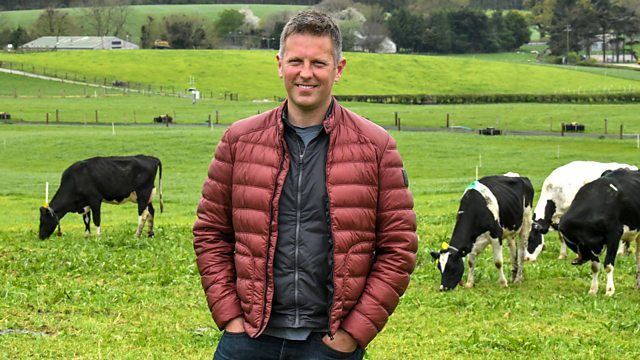
Spring grass is the best grazing of the year. High in protein and readily digested, it is what Annabel Hamilton and her father Will have been watching and waiting for at Bee Edge, a mixed farm covering more than 1,000 hectares of crops in the Borders near Eyemouth. Today is the day the barn doors open and more than 200 Limousin cross cattle get their first taste of open pasture since September.
This is not a spontaneous decision. Annabel explains that the timing depends on two things: the amount of grass left in the fields and the overnight temperature. Limousin cattle, she says, are a breed that likes to be pampered. When the nights get cold in September, they come inside. They stay there until the grass reaches roughly ankle height and the thermometer stops dipping so sharply after dark. Even then, she adds, they are being cautious about how many go out at once given that the evenings are still a touch nippy.
The Hamiltons chose Limousins deliberately. Their destination is the high-quality butcher market, and this breed delivers the conformation — particularly the muscular rear end — that buyers want to see. Annabel and Will purchase the animals between nine and twelve months old and keep them for roughly another year before they go to slaughter. “Someone once said to me that you’ve got to enjoy what you look at every day,” Annabel says. For her, these cattle are exactly that.
The preparation before the turnout is methodical. Gates are shut. Escape routes are blocked. The cattle are funnelled so they can only go one way. Once the barn doors swing open, the result is dramatic. They thunder through in a mass of noise and movement, kicking up their heels across the spring pasture in what Annabel compares to the Scottish Grand National. Dougie, watching from the side, admits he would not want to be standing in their path.
Annabel confesses she worries more than her father does about the excitement levels. Her main concern is that a particularly energetic animal might charge through the fence at the bottom of the field — leaving her to spend the afternoon rounding it up. The running looks worse than it is, she reassures him. They will be fine. And watching them spread out in the spring sunshine, calming quickly into the business of grazing, it is hard to argue with that.
The turnout marks more than just a practical shift in livestock management. For Annabel, it signals that summer is slowly on its way. There is a build-up towards it each year, she says, a sense of anticipation on the farm. When the cattle start going outside, you know the season is turning.
Landward episode 8 2026
Landward’s 50th Anniversary: Remembering Jock Bryce, the Fencing Pioneer From Morebattle
Part of Landward episode 8 2026’s golden anniversary programming sees Cammy revisit the archive and head to Morebattle in the Scottish Borders to catch up with Jock Bryce — a man he first met on the programme back in 1983. Cammy places Jock in striking company: John Logie Baird, Alexander Fleming, and Jock Bryce. Most people will not have heard of the last one, Cammy admits. In the world of agricultural fencing, however, he is a legend.
The 1983 archive footage captures a craftsman at full stride. That year alone, Jock put up enough fencing to stretch from Edinburgh to Glasgow. He specialised in electric fencing and invented his own post driver machine, which he patented and which went on to be used around the world. He also built a specially adapted motor tricycle to pay out fencing wire without the endless back-and-forth trudging that the job traditionally required. One man. One machine. A fence installed almost anywhere.
The backstory behind that ambition is remarkable. Jock grew up farming alongside his father near Kale Water. From birth to age 22, farming was all he knew. Then his father’s ill health forced the sale of the family farm. Everything Jock knew came to an abrupt end at the farm sale. His father gave him £25 and he started out alone, with nothing but a mell — a heavy manual post-driving hammer — and the willingness to dig every hole by hand. “When you’ve no other options, you’ve just got to get on with it,” Jock says. “There was no use greeting about it.”
From £25 and a Mell to 13 Patents: Jock Bryce’s Life in Agricultural Innovation
Working alone forced Jock to mechanise. He had no choice. To do the job at any kind of scale by himself, he had to engineer solutions that would save a man and, as he puts it, a monumental amount of time. Over four decades he accumulated 13 patents and won numerous awards. His wife Jennifer eventually left her career in teaching to join the business, managing the daytime calls from manufacturers while Jock worked in the field. Their two sons Andrew and Stuart now run the operation. A grandson works there too.
Cammy gets a hands-on demonstration of the post driver machine at Morebattle. The hammer weighs 500 kilos and delivers 82 tonnes of impact. Jock talks Cammy through positioning the post, lets him operate the lever, and gives him a satisfied “spot-on, son” when the post drops cleanly into the ground. The ease of it is the point. What once took a team of men swinging mallets for hours, one person can now accomplish in seconds.
Jock is retired but still likes to keep his hand in. His philosophy of craft has not changed. “In every job you finish, you leave your scent behind you,” he says. “And if you do it right, you’ll be asked back. That’s a great thing — to earn respect.” Forty-plus years since Landward first featured him, the business he built from £25 and nothing else remains very much going strong.
Magnus the Walrus: An Arctic Visitor Turns Up at Scotland’s North Coast Harbours
In Lossiemouth Harbour on the Moray Coast, a young walrus made a 24-hour stop, hauling himself out onto the end of a finger pier and resting there long enough to attract a crowd before slipping back into the sea. Leanna arrives slightly too late to see him in person. Plenty of others had their cameras ready. He had already appeared at Stronsay Harbour in Orkney a few days before, and in the days following Lossiemouth he made impromptu visits to Macduff, Findochty, and Hopeman.
The animal was named Magnus. Martin Boon — Boonie — from the British Divers Marine Life Rescue charity was called in to assess him. Boonie regularly responds to call-outs involving sea mammals around Scotland’s coast. A walrus, he admits, is not a typical case. His assessment of Magnus based on the photographs: decent condition, considering the animal has travelled roughly 2,500 miles. The most likely point of origin is Svalbard, one of the Arctic’s major walrus habitats where large herds gather on sea ice.
Magnus is a young animal. His tusks are small — walrus tusks grow continuously with age, and short ones indicate a juvenile of around four to six years old. Those tusks, Boonie explains, are used for hauling out onto sea ice: the walrus drives them forward like ski poles to drag its bulk across the surface. Magnus also carries a few minor wounds, visible in the photographs, but nothing serious. He is built for cold water, protected by a thick layer of blubber. Superficial marks picked up along the way, Boonie concludes.
Climate Change and Walrus Sightings: Why Magnus May Not Be Scotland’s Last Visitor
The question Leanna presses on is whether Magnus’s arrival represents a trend. Boonie’s answer is direct. In 18 years with the charity, he had not seen a walrus once. In a single year, Scotland recorded two. That is not coincidence. It is an indication that sightings are happening more often.
The reason connects to climate change. As global temperatures rise, sea ice in the Arctic melts. That ice is walrus habitat — where they rest, breed, and feed. With the ice cap retreating, walrus are being pushed to look further afield for both food and the stable platform they need to haul out and rest. Scotland’s harbours and jetties offer an approximation of that solid surface. The waters here are not what these animals evolved for, Boonie notes, but they are making do with what they find.
Magnus was last tracked near the southern tip of Norway, around 300 miles across the North Sea, apparently heading home. But the implication of his visit lingers. Scotland’s north and east coasts may increasingly become transit points for Arctic wildlife displaced by shrinking habitat. Climate change, as Landward episode 8 2026 makes clear through this single remarkable animal, is not an abstract future problem along Scotland’s coastline. It is already reshaping which species appear, and how often.
Fishermen and Conservationists Joining Forces: The Argyll Acoustic Monitoring Pilot
Back in Tayvallich on Scotland’s west coast, Dougie returns to Hans Unkles, a solar-powered boat operator he previously featured on Landward. This time Hans is not just running his pioneering zero-emission vessel — he is taking part in an unlikely collaboration between creel fishermen and marine conservation scientists.
Hannah Lightly from the Hebridean Whale and Dolphin Trust is the driving force behind a community-led acoustic monitoring project. The idea is simple in theory and elegant in practice. Underwater acoustic listening devices — sound traps — are slipped inside lobster pots and lowered to the seabed alongside the fishermen’s regular creels. The devices record continuously, picking up the vocalisations of whales, dolphins, and porpoises as well as the broader marine soundscape: vessels passing overhead, the crackling of snapping shrimp, the high whistles of common dolphins moving through the water. Every three to four days, when Hans hauls his gear, he retrieves the mic and returns it to Hannah.
The recorded sounds are striking. Snapping shrimp produce a fizzing, popping noise that Hannah describes as frying bacon or popping candy — caused by their claws snapping shut and creating a collapsing bubble. Common dolphins, she explains, are now present in Scottish waters year-round, a shift that itself reflects changing conditions. The acoustic data will go towards long-term monitoring of the west coast’s marine environment. Hannah’s concern is clear: the seas are becoming noisier, more polluted, and busier. Consistent baseline data is essential for tracking how much and how fast things are changing.
Why West Coast Fishermen Are Willing to Carry Scientific Equipment on Their Boats
The collaboration between fishing and science is not without friction, as Hans acknowledges openly. The risk he identifies is real: if the acoustic monitoring detects endangered species in an area where fishermen regularly work, there is a genuine possibility that fishing could be restricted there. That prospect gives many in the industry pause.
Hans has made his own calculation. He wants to protect the areas he fishes, both because it is the right thing to do and because a healthy marine environment sustains his livelihood. The data might create constraints, but it might equally help make the case for better-managed waters. He is candid about why others might not share his view, and he does not judge them for it.
Crucially, the project is designed not to ask anything extra of the participants. The monitoring devices fit into existing gear. The recording runs in line with normal hauling schedules. Fishermen do not alter their operations at all. On previous deployments, the presence of the device in the pot made no measurable difference to what Hans caught. Two other creel fishers are already part of the pilot alongside Hans, and more have expressed interest in joining if the project expands.
The data gathered will support long-term monitoring across the west coast’s waters, building what Hannah calls an accurate and consistent picture. For Hans, contributing to that picture is straightforward. “So much of the fishing industry doesn’t collaborate with scientists,” he says. “It’s really important to make a connection and join the two together.”
Old Home Farm at Fyvie Castle: What Aberdeenshire’s Historic Steadings Reveal About Scottish Farming
From the water to the land — and to a piece of agricultural architecture in Aberdeenshire that has been standing for nearly 250 years. Rosie visits Old Home Farm at Fyvie Castle, built in 1777 by the Honourable General William Gordon at a moment when Scotland’s agricultural landscape was transforming rapidly.
The context matters. In 1777, stone steadings were the cutting edge of farming infrastructure. Scottish landowners were investing in large-scale, purpose-built farm complexes to signal their wealth and their commitment to modern agricultural practice. Gordon’s building at Fyvie was exactly that: a massive, multi-purpose structure representing an ambitious step away from small-scale crofts. Trust surveyor Caroline Webster explains that the Gordon family saw it as both a functional model farm and an architectural statement — fine stonework using a mix of sandstone and granite, a courtyard layout, piggeries, a cart shed, worker accommodation integrated into the same buildings as the stables.
The National Trust for Scotland has managed Fyvie Castle since the 1980s, but only took full ownership of the farm complex two years ago. Old Home Farm currently sits on the Buildings at Risk Register. Despite that precarious designation, the Trust has ambitious plans — a multi-million-pound, decade-long restoration programme with the castle at its heart but the farm buildings central to the vision.
Graffiti on the Apple Store Walls: The Workers Who Left Their Mark at Fyvie
The history stored inside Old Home Farm’s walls goes well beyond its architectural function. Trust team member Sarah Eggleton shows Rosie the interior of the apple store, where workers scratched their names and dates into the walls over more than a century of occupation. The graffiti runs from 1880 through the 20th century and into living memory: the last entry is dated 2020 and marks the Covid pandemic.
For historians, this is primary evidence of a kind that archives alone cannot provide. The names on the walls are a record of who was actually present, who worked here, who lived alongside the horses in accommodation attached to what eventually became Lord Leith’s showpiece stables. In the 1890s, a horse-loving owner arrived at Fyvie and transformed part of the complex into an ornate stable block — what Caroline Webster calls the real golden age of Fyvie. The craftsmanship inside is extraordinary: intricate timber detailing, quality fittings, the visible evidence of serious money being spent on a space designed to impress.
Worker accommodation sitting directly beside that extravagance was, Sarah explains, actually forward-thinking for its time. Having farm workers housed in the place where they worked was not common practice. The building did both. And those workers left their own history embedded in the plaster and stone, a counterpoint to the owners’ grandeur that the Trust is now determined to honour.
The restoration plan for Old Home Farm centres initially on the courtyard, with a proposed café, retail units, and exhibition spaces. Eventually the ambition is to develop the whole complex. The Trust is actively seeking stories from local communities — specifically people who might recognise names among the graffiti and be able to put lives behind them. The building itself has been the primary historical record. Now the people around it are being invited to complete the story. Landward episode 8 2026 frames it well: Old Home Farm’s buildings showcase change and innovation in farming across three centuries, but within their walls, they hold human stories too. Those stories are only now beginning to be fully told.
FAQ Landward episode 8 2026
Q: Why do Scottish beef farmers bring their cattle indoors during winter?
A: Most Scottish beef and dairy farmers house cattle indoors from around September onwards, driven by two main factors: falling overnight temperatures and declining grass availability. Breeds like Limousin are sensitive to cold and do better sheltered during the harshest months. Once spring grass reaches a usable height and nights stay mild enough, the cattle are turned back out to pasture.
Q: Why is spring grass considered the best grazing of the year for cattle?
A: Spring grass is high in protein and easily digested, making it nutritionally superior to the conserved feed cattle receive indoors over winter. Farmers look for grass at roughly ankle height before turning cattle out, ensuring there is enough quality growth to sustain the herd without damaging the sward early in the season.
Q: Why do Scottish farmers choose Limousin cattle for the beef market?
A: Limousin and Limousin cross cattle are favoured for high-quality butcher markets because of their muscular conformation, particularly at the rear end. Farmers at Bee Edge Farm near Eyemouth buy them between nine and twelve months old and keep them for around another year, targeting premium buyers who demand well-muscled, clean-finished animals.
Q: Who is Jock Bryce and why is he important to Scottish farming?
A: Jock Bryce of Morebattle in the Scottish Borders is a pioneering figure in agricultural fencing. Starting out alone with just £25 after his family farm was sold, he built a business from the ground up, inventing and patenting 13 innovations including a mechanised post driver used worldwide. In a single year he installed enough fencing to stretch from Edinburgh to Glasgow. His sons and grandson now run the company he founded.
Q: How does a mechanised post driver machine work and why did it change fencing?
A: Jock Bryce’s patented post driver uses a 500-kilogram hammer delivering 82 tonnes of impact to drive fence posts into the ground in seconds. Before mechanisation, fencing required teams of workers swinging mallets by hand for hours. The machine allows a single person to install a fence almost anywhere, dramatically reducing time and labour costs across agricultural operations worldwide.
Q: Why is a walrus appearing in Scottish harbours, and is it becoming more common?
A: Walrus are appearing in Scottish waters more frequently as climate change shrinks their Arctic sea ice habitat. As the ice cap melts, these animals must search further afield for food and resting spots, and Scottish harbour structures provide a usable surface to haul out. Two walrus visited Scotland in a single recent year — unusual enough that a marine rescue charity worker with 18 years’ experience had never previously encountered one.
Q: How far did Magnus the walrus travel to reach Scotland’s north coast?
A: Magnus travelled approximately 2,500 miles, most likely from Svalbard in the Arctic — one of the main walrus habitats where large herds gather on sea ice. He stopped at Stronsay Harbour in Orkney before moving south to Lossiemouth on the Moray Coast, then continued along the coast to Macduff, Findochty, and Hopeman. He was later spotted near the southern tip of Norway, apparently heading back.
Q: How do underwater acoustic listening devices help monitor whales and dolphins?
A: Underwater acoustic devices record the vocalisations of whales, dolphins, and porpoises continuously from the seabed, capturing everything from dolphin whistles to the snapping of shrimp claws. Deployed inside lobster pots by creel fishermen off Argyll’s west coast, the recordings are retrieved every three to four days and analysed to build a long-term picture of marine mammal presence and sea conditions across Scotland’s west coast waters.
Q: Why are some west coast fishermen reluctant to take part in marine acoustic monitoring?
A: The core concern is that acoustic data revealing endangered species in a fishing area could lead to restrictions on where fishermen are permitted to operate. It is a genuine dilemma: fishermen want healthy seas for the long-term survival of their industry, but sharing information that could result in immediate access limits is a significant commercial risk. Participants in the Argyll pilot understand this tension and acknowledge why others hesitate.
Q: What can the historic farm buildings at Fyvie Castle tell us about Scottish agricultural history?
A: Old Home Farm at Fyvie Castle, built in 1777, reflects a pivotal shift in Scottish agriculture when landowners invested in large stone steadings to signal wealth and embrace modern farming methods. The complex housed piggeries, cart sheds, worker accommodation, and eventually ornate stables added in the 1890s. Workers’ graffiti on the apple store walls, dated from 1880 to 2020, preserves human history that written archives alone cannot provide. The National Trust for Scotland now plans a multi-million-pound, decade-long restoration.