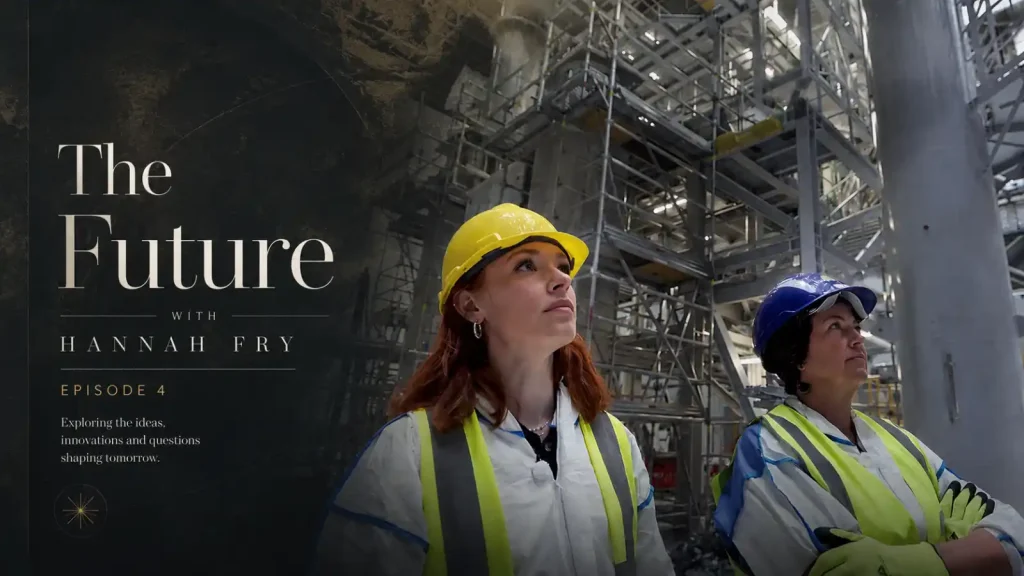
The Future with Hannah Fry episode 4 turns the spotlight on nuclear fusion, the technology many scientists call the holy grail of limitless clean energy. Professor Hannah Fry travels into the contested heart of the fusion race, asking the question that defines the entire field: will a star built on Earth arrive in time to help us survive the climate crisis, or is it simply too good to be true? Her journey moves from a $22 billion construction site in rural France to a quiet industrial park in Los Angeles, weighing colossal international ambition against the speed and hunger of private capital.
The stakes are enormous, and Fry frames them without exaggeration. Fusion promises almost unlimited electricity with no carbon dioxide and no long-lasting nuclear waste. If it works, it could replace fossil fuels entirely and unlock feats that today seem impossible, from greening deserts to growing food out of thin air. That promise sits against a hard reality. The climate is, in the words of one scientist she meets, teetering on the brink of disaster.
What makes this instalment so gripping is the tension between hope and frustration. The people closest to fusion believe in it completely. Yet even they admit the technology may come too late to rescue us. Fry, a mathematician trained to read the patterns in human behaviour, arrives expecting a saviour and leaves with a more complicated, more interesting picture of what fusion might actually become.
Fusion is the same process that powers the sun, and the physics behind it explains why scientists chase it so relentlessly. Splitting an atom releases huge energy, the principle behind nuclear explosions. Doing the reverse, forcing two atoms together, releases a gigantic amount more. Fry puts the scale in plain terms. Fusion has the potential to be tens of millions of times more potent than burning fossil fuels.
The numbers are staggering. Just one gram of hydrogen, fused, would give off the energy equivalent of seventy barrels of oil. No carbon dioxide. No dangerous, long-lived waste. That combination is what makes fusion the single technology so many people point to as the answer to climate change and to all of humanity’s energy problems at once.
The promise reaches further than electricity, though, and this is where The Future with Hannah Fry episode 4 sharpens its argument. Limitless green energy would not merely swap one power source for another. It would make power-hungry feats affordable. Imagine pulling salt from seawater cheaply enough to green the deserts. Imagine using electricity and specialised microbes to grow food from almost nothing. Abundance, not just sustainability, is the real prize.
The Future with Hannah Fry episode 4
The Brutal Physics That Makes Fusion So Hard to Achieve
For all its promise, fusion is fiendishly difficult, and the reason lies inside the atom itself. Atoms do not want to fuse. To force them together, you first have to heat hydrogen to a temperature hotter than the centre of the sun. That single requirement creates a cascade of engineering nightmares.
You cannot simply pour superheated hydrogen into a container, because no material on Earth can survive those temperatures. Scientists solved this with an elegant idea. Build a massive doughnut-shaped structure called a tokamak, then suspend the searing plasma in mid-air using powerful magnets. The plasma never touches the walls because, in theory, it never touches anything at all.
In practice, the plasma fights back. It flails around wildly, threatening to escape and strike the sides at any moment. Controlling it means moving the magnets in perfect time to keep hold of something that refuses to stay still. This relentless instability is one of the core reasons fusion has resisted decades of effort, and it explains the running joke that shadows the whole field. Fusion, people say, is always thirty years away, no matter how far forward in time you go.
The state of the science underlines how early this all still is. In December 2022, for the first time ever, scientists in California got more energy out of a fusion reaction than they put in to trigger it. A genuine milestone, yet a humbling one. The surplus would only have boiled about a gallon of water, and that experiment was never even designed to generate practical electricity.
Inside Iter, the $22 Billion Star Machine Rising in France
The centrepiece of The Future with Hannah Fry episode 4 is Iter, an experiment so vast it borders on the absurd. Hidden inside a colossal construction site in a sleepy corner of France, this is a project Fry describes as a monster in every sense. It represents an international cooperation between thirty-five nations, all trying to make fusion a reality, and it carries a $22 billion price tag.
Iter’s history reveals how slow this work can be. Conceived in the 1980s, it took twenty years of designing and fundraising before ground was finally broken in 2007. Construction has continued for over fifteen years since, and the cranes still towering over the site make clear how much remains undone. Crucially, Iter will never be connected to the grid. It is an experimental reactor with a single mission: to prove that fusion reactors can work at all.
Sabina Griffith has given sixteen years of her life to Iter, watching more than one million components come together piece by painstaking piece. Standing in the assembly hall where the machine is taking shape, she struggles to contain her emotion as the project finally becomes real. The scale, she tells Fry, genuinely freaks the team out. In physics, she notes, size matters, because the vacuum vessel needs enough volume inside it to host enough fusion reactions to count.
The Strongest Magnet Ever Built and the Temperatures Beyond the Sun
The goal of Iter’s reactor is to produce a fusion reaction stable enough to generate ten times more energy than is put in. Achieving that demands magnets of almost mythical power. The reactor uses eighteen toroidal field magnets, and Fry is shown one that holds a startling record. It is the strongest magnet ever built, with the capacity to lift two aircraft carriers.
The engineering challenge intensifies inside the Pit, where the tokamak itself is being assembled. Fry watches the first installed segment of the giant doughnut-shaped reactor, one of nine that will eventually fit together. This is where hydrogen atoms will fuse and produce vast heat. The principle behind what follows is almost comically humble. In a commercial version, that heat would make steam to turn a turbine. As one scientist admits, what you essentially have is a very fancy steam turbine.
The temperatures involved defy intuition. At the heart of the burning plasma, conditions reach around 150 million degrees Celsius, roughly ten times hotter than the core of the sun. Yet just metres away sit the gargantuan magnets, which must be kept colder than the dark side of the moon or they simply will not work. To manage this violent contrast, the tokamak’s thermal shield is coated with nearly a tonne of silver.
Even that is not enough to last forever. One of the fundamental problems with fusion is whether a reactor can hold this burning plasma long enough that the materials do not need constant replacement. These components are enormous, costly and difficult to make. The open question, still unanswered, is whether they will survive long enough to avoid being swapped out again and again.
Twenty Lost Years and the Frustration at the Heart of Iter
Beneath Iter’s technical triumphs runs a current of genuine frustration, and Fry draws it out with a single quiet question. Asked whether he ever wakes at two in the morning worried it might not work, one veteran scientist refuses the premise entirely. He would not be there if he doubted it. He has given his whole life to the field and is certain it will work. What he cannot yet say is whether it will work routinely, repeatedly, and cheaply enough to replace coal and oil as a commercial energy source.
The timeline tells its own sobering story. Experiments were scheduled to begin around 2025, but it will not be until the late 2030s that anyone knows whether this type of reactor can work commercially. A project beholden to the funding and politics of thirty-five nations moves at the speed those politics allow, and that speed has been painfully slow.
The frustration becomes explicit when Fry presses further. One scientist admits he is frustrated they could not go faster, and lays much of the blame on funding and resourcing. Construction could have begun in the late 1990s. Instead, he estimates, the world effectively lost around twenty years. Those twenty years matter enormously when the climate is teetering on the brink of disaster today. Fusion would not have solved the climate problem outright, he concedes, since wide-scale generation is still decades away regardless. But twenty precious years could have been saved.
Fry leaves Iter with a feeling she names honestly: a tiny bit of disappointment, not in what she saw but in what it implies. She had clung to the idea that fusion would be the thing that saved us. If even the people running the best-funded, most advanced project do not believe it will pull us out of the mess, then thirty years suddenly looks optimistic.
The Scale of the Energy Problem Fusion Is Racing to Solve
The middle of The Future with Hannah Fry episode 4 widens the lens to explain why the timeline matters so acutely. There is now broad agreement that we must decarbonise the entire energy system, covering power, heating and transport together. Reaching the Paris Agreement’s target of net zero by 2050 means confronting a moving target, because energy demand itself is changing fast.
The figures reframe the challenge. Global electricity consumption currently sits at about 24,000 terawatt hours. As developing economies grow and transport systems turn greener, the world will need roughly three times today’s level of clean electricity. That is an extraordinary leap, and Fry is blunt about the gap it creates.
Clean energy is booming, and renewables are expanding rapidly. Even so, renewables alone will struggle to meet such enormous demand. This is the precise space fusion is meant to fill. The unresolved question driving the rest of the episode is whether fusion can genuinely close that gap, or whether it will arrive too little, too late and too expensive to matter, a lost cause dressed up as a dream.
How Private Fusion Companies Like TAE Aim to Win the Race
If Iter represents fusion as grand international science, the second half of The Future with Hannah Fry episode 4 offers a sharply different vision. Fry meets physicist Arthur Turrell, an expert on plasma and reactor design, who is candid about the obstacle. The technology costs are gigantic right now, simply because building anything for the first time is expensive when you are still figuring it out.
Turrell offers a hopeful analogy drawn from recent history. A decade ago, RNA vaccines sounded like science fiction. Then a terrible global pandemic arrived, society pooled its resources and effort, and the technology was made to work. The lesson is that concentrated investment can collapse timelines that once looked impossible. Whether fusion ends up being a cost-effective way to generate energy, he admits, is something we genuinely do not yet know.
The private sector’s answer takes physical form in an unassuming Los Angeles industrial park, where there is not a giant tokamak in sight. Here, TAE Technologies has raised $1.2 billion to pursue a radically different design. Erik Trask and Jim McNiel let Fry sit at the controls and run the machine herself, walking her through the steps to prepare, arm and trigger it. She half-expects an explosion. Instead, she gets near silence, and a memorable maxim from the team. Safe is quiet, and quiet is cheap.
TAE’s Linear Reactor and the Case for Smaller, Modular Fusion
TAE’s approach rethinks the tokamak from the ground up. Rather than a doughnut, the company takes that shape, cuts it in the middle, stretches it out and pinches the ends into a linear reactor. The payoff is structural. Magnets are only needed in the centre, not wrapped all the way around the vessel, which removes one of the most expensive and energy-hungry features of conventional designs.
The physics is unconventional but deliberate. TAE creates rings of hydrogen and deuterium at opposite ends of the vessel and slams them together to start fusion. The design exploits the natural magnetic field the plasma generates, then uses specialised particle-accelerator beams to hold it in place. Whether this experimental method ultimately works remains an open question, but the goal is clear. Cut the engineering costs and shed the giant magnets, and you arrive at something far closer to a commercially viable product.
Size is central to the pitch. TAE’s reactor is strikingly compact, and because these machines are smaller, they are more modular. They could be built in factories, loaded into shipping containers and sent anywhere in the world. McNiel sketches a vivid future, with a reactor placed beside a Red Sea desalination plant, pumping fresh water and growing a new garden in the Middle East. When fusion works, he insists, there are no losers.
Public Money Versus Private Speed in the Multibillion-Dollar Fusion Race
The deepest argument running through The Future with Hannah Fry episode 4 is not technical but financial and philosophical. TAE has raised its money entirely through private equity and venture firms, with effectively no federal funding. What the industry needs, McNiel argues, is a huge infusion of capital so it can get there faster, and he reaches for the moon landing to make his case.
The comparison is pointed. Going to the moon cost about $25 billion in 1960s dollars, roughly $250 billion today, and it was achieved in around nine years. Why, he asks, can we not summon that ambition now? Fry pushes back with a sharp observation. The space programme was government-funded, paid for by the central federal government, whereas this new fusion drive runs on private money. McNiel counters with SpaceX, noting that Elon Musk launched the company in 2002 and reached space by 2008, arguing that private industry can move faster than government institutions.
That speed is not infinite, and the team knows it. Asked how close they are to net energy gain, they revive the old joke with a twist. Fusion is always thirty years away, they have been at it for twenty-four, so only six years remain. Joking aside, they expect their sixth-generation machine to demonstrate getting more power out than they put in by the mid-2020s. Even then, the harder test follows. The electricity has to be cheap enough to actually sell, because engineering, ultimately, is what drives cost.
What Fry Concludes About Fusion, Climate and the Future We Build
By the end of her journey, Fry’s view has shifted in a way that gives the episode its emotional spine. She arrived wanting to know whether fusion could help fight climate change. She leaves convinced that the promise of fusion is bigger than that single question. Cheap, clean, abundant energy for everyone on the planet is the real horizon.
The contrast between the two visions reshapes her optimism. At Iter she felt deep frustration radiating from people who have dedicated their lives to a solution they believe in completely, yet feel no one is listening to them. At TAE she sensed that same energy turned outward into excitement, because within a capitalist framework, fusion is something that could be exploited and accelerated. She admits she is more optimistic than she was at the start of the day, persuaded by the agility of the private sector and the drag of working inside a vast, multinational, government-funded institution.
Her closing thought reframes the entire debate around fairness and agency. Everywhere on Earth, she reflects, people live lives as rich as her own and deserve the same level of energy consumption. Fusion, if it arrives, could deliver exactly that. The future, she insists, does not simply happen. You actively go out and build it. And, she adds with a laugh, it would be quite nice to make some money along the way. That blend of idealism and pragmatism captures precisely why The Future with Hannah Fry episode 4 lands as both a warning and a genuine note of hope.
FAQ The Future with Hannah Fry episode 4
Q: Why is nuclear fusion called limitless clean energy?
A: Fusion generates power the same way the sun does, fusing atoms to release enormous energy. It produces no carbon dioxide and no long-lasting nuclear waste. Just one gram of hydrogen releases the energy equivalent of seventy barrels of oil, making fusion potentially tens of millions of times more potent than burning fossil fuels.
Q: Why is nuclear fusion so difficult to achieve?
A: Atoms resist fusing together, so hydrogen must be heated hotter than the centre of the sun. No container can survive those temperatures. Scientists suspend the superheated plasma in mid-air using magnets, but the plasma flails wildly and constantly threatens to escape, demanding split-second magnetic control.
Q: What is a tokamak and how does it work?
A: A tokamak is a massive doughnut-shaped structure designed to hold a fusion reaction. Powerful magnets suspend the burning plasma inside so it never touches the walls. Because the plasma moves unpredictably, the magnets must shift in time to keep hold of it, which is a central engineering challenge of fusion.
Q: How much does the Iter fusion project cost?
A: Iter carries a $22 billion price tag and represents cooperation between thirty-five nations. Conceived in the 1980s, it took twenty years of designing and fundraising before ground was broken in 2007. Importantly, it will never connect to the grid. Its only goal is proving that fusion reactors can actually work.
Q: How hot does the plasma inside a fusion reactor get?
A: Inside Iter, the burning plasma reaches around 150 million degrees Celsius, roughly ten times hotter than the core of the sun. Meanwhile, the gargantuan magnets just metres away must stay colder than the dark side of the moon. To manage this contrast, the thermal shield is coated with nearly a tonne of silver.
Q: What happened in the December 2022 fusion breakthrough?
A: For the first time ever, scientists in California got more energy out of a fusion reaction than they put in to trigger it. However, the surplus would only have boiled about a gallon of water. The experiment was never designed to generate practical electricity, so its value was scientific rather than commercial.
Q: How powerful are the magnets used in fusion reactors?
A: Iter uses eighteen toroidal field magnets to contain the plasma. One of them is the strongest magnet ever built, with the capacity to lift two aircraft carriers. These magnets generate the intense fields needed to hold a reaction stable enough to produce ten times more energy than is put into it.
Q: How is TAE Technologies’ fusion approach different from a tokamak?
A: TAE takes the doughnut shape, cuts it in the middle, stretches it out and pinches the ends into a linear reactor. This requires magnets only in the centre rather than wrapped around the whole vessel. The compact, modular design aims to cut engineering costs and create a more commercially viable product.
Q: Can private companies build fusion faster than governments?
A: TAE argues private industry moves faster, pointing to SpaceX launching in 2002 and reaching space by 2008. The company raised $1.2 billion through private equity and venture firms with no federal funding. Critics note the moon landing was government-funded, fuelling debate over whether public money or private capital wins the fusion race.
Q: Will fusion come too late to solve the climate crisis?
A: Possibly. Iter’s experiments will not confirm commercial viability until the late 2030s, and scientists admit roughly twenty years were lost to funding delays. Even supporters concede fusion alone would not have solved climate change. Global electricity demand is set to nearly triple, and renewables alone will struggle to fill that enormous gap.