The Grand Tour built two of England’s most extraordinary stately homes, and Hidden Treasures of the National Trust 2026 episode 2 follows the conservators, curators and gardeners working to protect their legacies at Ickworth in Suffolk and Attingham Park in Shropshire. This is an hour built around inheritance, obsession and money spent freely – two young aristocrats who travelled across Europe, collected lavishly, and left behind houses still being decoded today. At its centre sits one of Georgian society’s most notorious scandals: a faded double portrait that may finally reveal the truth about a duke, his wife and her lover.
The strongest thread running through Hidden Treasures of the National Trust 2026 episode 2 is the Grand Tour itself, described in the film as the original gap year. For aristocratic young men, mostly, it meant travelling to Paris, Rome and beyond to absorb classical culture, history and heritage. Many also used it to go wild and spend enormous sums. They returned with paintings, sculpture, furniture, books and ideas, and those souvenirs reshaped the great houses of Britain.
Two men embody that impulse in this episode. One built a round house in Suffolk to display his haul. The other inherited a fortune at eighteen and blew much of it on Italian treasures. Both stories still echo through the rooms their descendants and the National Trust now protect.
In rural Suffolk sits one of the most distinctive houses in England: Ickworth, a building so unusual that staff warn arriving visitors they are “a bit odd, because we are round.” Its 82 rooms and 1,800 acres are cared for by a team of 33, and senior collections and house officer Naomi still photographs the approach up the drive almost daily. The house has been called both a stupendous folly and a hulk newly arrived from another planet. It was as strange in its own time as it remains today.
This extraordinary edifice was the vision of one man, Frederick Hervey, the 4th Earl of Bristol, also known as the Earl Bishop. Witty, intelligent and an astute collector of art, he was also difficult and complex, the kind of guest you might invite to dinner once. He reportedly could not sit still for five minutes and spent more time abroad than at home.
Frederick’s restlessness carried him across Europe on the Grand Tour of a lifetime. He needed somewhere to show off his lavish souvenirs, so he built Ickworth as a round house flanked by two galleries. His vision even allowed for local artists to visit, since they lacked, as he put it, the purse strings for such European trips. Today the walls form a who’s who of old masters, with works by Romney, Lawrence, Gainsborough, Hogarth, Reynolds, Titian, Angelica Kauffman and an Élisabeth Vigée Le Brun self-portrait.
Hidden Treasures of the National Trust 2026 episode 2
The Faded Portrait At The Heart Of A Georgian Society Scandal
Tucked away upstairs, a more mysterious image draws the attention in Hidden Treasures of the National Trust 2026 episode 2. It is a watercolour and pastel of Frederick Hervey’s daughter, Elizabeth Foster, known as Bess. Said to be his favourite daughter, she was attractive, beguiling and prone to trouble. What makes the picture so intriguing is who stands beside her: Georgiana, the Duchess of Devonshire, the undisputed queen of high society and, as one expert puts it, the Kim Kardashian of the eighteenth century.
The meeting of these two women sparked one of the most sensational scandals of Georgian society. In 1782 Georgiana and Bess formed an instant, deep friendship, and Georgiana invited Bess to move into the home she shared with her husband. Bess then began an affair with that husband, the Duke of Devonshire. Over the following years, some form of approved ménage à trois developed between the three. Even in an era when extramarital affairs were common, it became a society scandal.
That tangled relationship inspired the Bafta-winning film The Duchess, with Hayley Atwell as Bess, Keira Knightley as Georgiana and Ralph Fiennes as the cold, adulterous Duke. The double portrait at Ickworth, painted by society artist John Downman, captures the same trio at the centre of the gossip. After decades lurking in an upstairs bedroom, the faded picture was sent away for conservation, with the team hoping it might shed light on a relationship historians still debate.
Reviving A 240-Year-Old Couple On The Conservator’s Bench
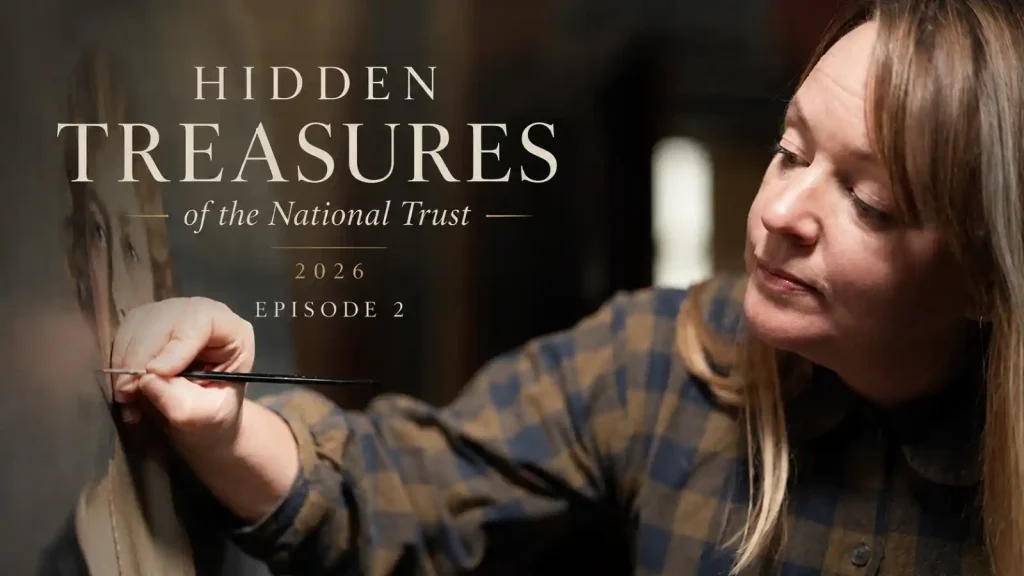
Paper conservator Louise was the first to peer behind the public face of the picture, aiming to return radiance to what she called a 240-year-old couple. As a work of art she found it exquisite, the detail amazing, but a dark yellow staining covered the surface and a strange streak ran through the middle. Downman, she explained, painted on a fine tissue applied to a secondary layer. That tissue had lifted and hovered like a drumskin, with fine fracturing across the layers that left her, by her own admission, a little nervous and twitchy.
Treatment began with the frightening task of removing the canvas lining from the back, a stage where Louise found herself holding her breath. She then moved the portrait onto a vacuum table, spraying a mixture of alcohol and water to wash the paper below while checking constantly with blotting paper that no pigment lifted away. Adhesive on the back, possibly from the old canvas, made the moisture stubborn to draw through. At one point she joked she might be there all day.
The patience paid off. The wash lifted much of the yellow discolouration, and Louise was able to secure the lifting tissue back to its support by applying a consolidant through the front, bonding the layers without disturbing the delicate colours. When the cleaned portrait finally returned to Ickworth, the team gasped at the transformation, struck that they could now see the two women’s faces and the colour of their dresses, a result one curator called nothing short of a miracle.
How The Grand Tour Reshaped Britain Beyond The Great Houses
The portrait was painted in the late eighteenth century, at the height of the Grand Tour’s popularity, when neoclassical fashion was leaving an indelible mark across the country. The episode widens its lens here, showing how Palladianism and the English baroque, both classically inspired by Rome, shaped not only stately homes but everyday life. The influence survives, as one expert notes, in postboxes, graveyards, banks and anything with a portico.
Architects such as John Nash and the Adam brothers reshaped English architecture with a complete disregard for local vernacular and styles. For ordinary people in farms around the great estates, the sudden appearance of a vast classical temple in the landscape must have been awesome and baffling at once. That collision of imported grandeur and rural England frames the episode’s second great house.
Baffling locals near Shrewsbury was the vast Attingham Park, a 196-roomed house that now welcomes over half a million visitors a year, making it one of the most popular properties in the National Trust. Collections and house officer Ryan has worked and lived there for three years, and still pauses before opening to think, “I call this place work.” His morning routine becomes a domestic Grand Tour of its own, down to setting doors at ninety-degree angles exactly as the house once kept them.
Two Brothers, Two Fortunes And The Largest Italian Royal Furniture Outside Italy
Built in 1785 and later revamped by John Nash, Attingham belonged to the Lords Berwick. Thomas, the 2nd Lord Berwick, inherited incredibly young and, like any eighteen-year-old with vast money, went on a Grand Tour, collected loads of paintings, and asked Nash to remodel the house around a picture gallery to show them off. As one staff member dryly notes, it was possibly not the best time to inherit a fortune if you intended to make sensible decisions. Thomas spent his inheritance, and shortly before his death in 1832 his collection vanished under the auctioneer’s hammer to pay his debts.
It fell to his younger brother William, the 3rd Lord Berwick, to steady the ship. Like many younger sons he entered the diplomatic service and proved far more of a saver than a spender. Serving at the courts of Sardinia and Naples before Italian unification, he used his diplomacy to bag a bargain, returning with around sixty pieces of gilded, painted furniture that once graced the Queen of Sardinia’s palace. The result is the largest collection of royal Italian furniture outside Italy, sitting improbably in Shropshire.
Collections and house manager Derw describes it as status-symbol furniture, never subtle, very much part of Attingham’s appeal. With around 65 pieces in all and some in poor repair after two centuries, the team launched a major project, sending five damaged examples 200 miles to the Royal Oak Foundation Conservation Studio at Knole in Kent. Wrapping each piece, Derw said, was like packaging a very awkward present he wanted to look like a work of art.
The Patient Art Of Gilding Royal Furniture Back To Life
At Knole, conservator Abi took charge of the regal furniture, calling it a privilege since it is not every day one works on royal pieces. She found wear on the arms and damage around the noses of carved dolphins, with fragile gilding that needed stabilising. To restore the lustre she worked with loose-leaf gold, an extremely thin hammered sheet, noting that every carat carries a slightly different colour, from rose and champagne to white gold. Because the material is expensive, choosing the right shade matters enormously.
The real skill, Abi explained, lies in making new gilding refuse to stand out. After applying fresh gold she knocked back its shine with very fine wire wool, then used a recipe of gilder’s liquor, a dilute glue, tinted with pigment to bring the colour down and simulate decades of wear. There are secret recipes and tricks, she said, for achieving exactly the right aged look, and knowing when to stop is part of the craft. Her love of gold leaf began in childhood, helping her mother with distressed gilding on curtain rails, work she thought of as magic.
A 200-year-old chest of drawers presented a different challenge: missing a back foot, it had been resting on a block of wood for years. Abi turned a replacement by hand on a lathe, taking care that the new foot was exactly the right size so it would not throw the chest off balance. Slow and steady, she insisted, is always the way. When the conserved suite finally returned to Attingham, the moment of unpacking drew open-mouthed wonder, with staff describing it as totally like Christmas and vowing to spend the rest of the day just looking at it.
Restoring A Lost Pond And A Vanishing Freshwater Habitat
Conservation at Attingham extends well beyond the house. On the 1,400-hectare estate, a new project set out to save an endangered and fast-disappearing wildlife habitat, namely a pond. Working with the Shropshire Wildlife Trust, the team aims to restore eleven ponds, with project manager Jane explaining that freshwater habitats have reduced massively over recent decades. The goal is to restore homes for great crested newts and other threatened reptiles, amphibians, insects, birds and small mammals that depend on water.
The work fell to specialist contractors Des and his older brother Dan, whose main trade is sports-field drainage, making pond-building, in their words, drainage in reverse. They needed to clear a dried-up, overgrown pond, excavate the silt and reach a vital clay layer to seal it, targeting a metre and a half of water depth. Their easy sibling rivalry mirrored the Berwick brothers’ contrasting characters, a parallel the episode draws out with a light touch.
Lacking the flock of sheep that Capability Brown once used to tread clay and seal a new lake, the brothers relied on an eight-tonne digger, marvelling at the Victorian navvies who dug canals and railways by hand. Months later, after hoping for rain, they returned to find the pond full and overflowing, an outcome Jane called inspiring and beyond expectation. With one habitat recovered, the team can now press on with restoring the estate’s remaining ponds.
The Election Dresses That Told The Story Of 1906
Back at Ickworth, the collection charts the ups and downs of eleven generations of the Hervey family, and a recent rediscovery left the team scratching their heads. Two children’s party dresses, in store for decades, belonged to sisters Marjorie and Phyllis Hervey, three-times great-granddaughters of Frederick Hervey. Their significance was unappreciated until staff unpacked them, and one stained front prompted a fond guess about a long-ago ice cream or milkshake at a party.
The dresses were worn when the girls’ father, naval officer Captain Frederick Hervey, stood as a Conservative candidate at the 1906 general election. He and his wife Theodora dressed the girls to support his campaign, an unusual move for the time. One dress carried symbols of the British Empire; the pink dress featured cartouches of British industry, including a carpenter, a smithy and weavers, thought to have been painted by Theodora with the girls’ help.
Curators Emma and Chloe connected the imagery to the era’s fierce debate over tariff reform, free trade and the price of bread, summed up by the Liberal slogan “Big loaf, little loaf.” Hervey won his seat, but the Conservatives lost the wider argument, contributing to the 1906 Liberal landslide.
Saving the dresses fell to textile conservator May, who feared they might be beyond help as the fragile silk disintegrated in every direction. Working under pure nerves, she dyed pale pink support patches, fixed them with crepeline, and balanced repair against preserving the silk’s sheen. The painstaking work, supported by national curator Emma’s research, ultimately let the dresses return to display reunited with the sisters’ portraits for the first time in over a century. As the Hidden Treasures of the National Trust 2026 episode 2 closes, the once-forgotten gowns become fully fledged objects again, ready to tell the story of a family, a campaign and the enduring legacy of the Grand Tour for years to come.
FAQ Hidden Treasures of the National Trust 2026 episode 2
Q: Why is Ickworth House built in a round shape?
A: Ickworth in Suffolk was the vision of Frederick Hervey, the 4th Earl of Bristol, known as the Earl Bishop. He designed the unusual round house with two flanking galleries to display the art and treasures he collected on the Grand Tour. Staff describe it as completely esoteric, and it was as unusual in its own time as it remains today.
Q: What was the Grand Tour and why did it matter?
A: The Grand Tour was effectively the original gap year for aristocratic young men. They travelled to Paris, Rome and beyond to absorb classical culture, history and heritage. Many also spent enormous sums, returning with paintings, sculpture, furniture, books and ideas. Those souvenirs reshaped Britain’s great houses and influenced architecture far beyond them.
Q: What was the scandal between Bess and the Duchess of Devonshire?
A: Elizabeth Foster, known as Bess, formed an instant deep friendship with Georgiana, Duchess of Devonshire, in 1782. Georgiana invited Bess to live with her and her husband, the Duke of Devonshire. Bess then began an affair with the Duke, and over several years an approved ménage à trois developed between the three, becoming a notorious Georgian society scandal.
Q: Is the film The Duchess based on Bess and Georgiana?
A: Yes. The Bafta-winning film The Duchess dramatises the same trio at Ickworth’s centre. Hayley Atwell plays the seductive Bess, Keira Knightley plays Georgiana, and Ralph Fiennes plays the cold, adulterous Duke who keeps both women under one roof. The story teases the rumour that Bess and Georgiana became lovers, sparking tension in a loveless marriage.
Q: How was the faded double portrait of Bess and Georgiana restored?
A: Paper conservator Louise tackled heavy yellow staining and a lifting tissue layer painted by John Downman. She removed the canvas lining, then washed the paper on a vacuum table using a careful alcohol and water mixture. After lifting the discolouration, she secured the loose tissue with a consolidant. The cleaned faces and dress colours emerged, a transformation the team called a miracle.
Q: Why does Attingham Park have the largest royal Italian furniture collection outside Italy?
A: William, the 3rd Lord Berwick, served as a diplomat at the courts of Sardinia and Naples before Italian unification. A careful saver, he used his position to bag a bargain, returning with around sixty gilded, painted pieces that once graced the Queen of Sardinia’s palace. This status-symbol furniture remains Attingham’s defining feature in rural Shropshire.
Q: What happened to Thomas, the 2nd Lord Berwick’s fortune?
A: Thomas inherited Attingham incredibly young, around eighteen, then went on a Grand Tour, collected many paintings, and had John Nash remodel the house for a picture gallery. He spent recklessly, and shortly before his death in 1832 his collection was auctioned off to pay his debts. His prudent younger brother William stepped in to steady the estate.
Q: How do conservators gild antique furniture without it looking new?
A: Conservator Abi applied loose-leaf gold, an extremely thin hammered sheet, choosing carefully since each carat carries a different shade. She then knocked back the shine using fine wire wool. A tinted recipe of gilder’s liquor, a dilute glue with pigment, lowered the colour to simulate decades of wear, helping fresh gilding blend seamlessly with the original surface.
Q: Why is Attingham restoring ponds on its estate?
A: Freshwater habitats have reduced massively over recent decades. Working with the Shropshire Wildlife Trust, Attingham is restoring eleven ponds to support great crested newts and other threatened reptiles, amphibians, insects, birds and small mammals. Contractors Des and Dan excavated silt to reach a sealing clay layer, and the recovered pond filled completely after rain.
Q: What is the story behind the 1906 election dresses at Ickworth?
A: Sisters Marjorie and Phyllis Hervey wore the dresses when their father, Captain Frederick Hervey, stood as a Conservative in the 1906 general election. One showed symbols of the British Empire; the pink dress displayed cartouches of British industry, supporting the tariff reform debate. Textile conservator May saved the disintegrating silk, reuniting the gowns with the sisters’ portraits for the first time in over a century.