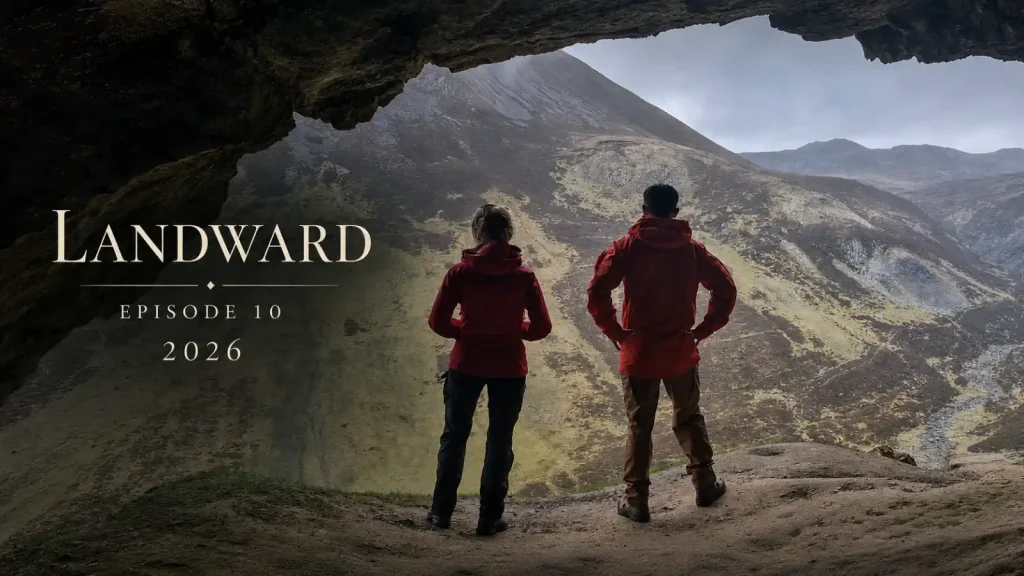
Dougie is in Rogart for Landward episode 10 2026, a vibrant crofting community in East Sutherland where small-scale agriculture still shapes daily life and the future of an entire way of working the land hangs in the balance. This instalment marks 50 years of the programme and returns to crofting, the subject it has covered since its very first broadcasts.
Alongside that anchor story, Landward episode 10 2026 travels west to the Bone Caves near Inchnadamph, where rising visitor numbers are damaging a site half a million years in the making, then onward to rare damselflies at Castle Fraser, surviving elms in Assynt, and a 23-year-old dairy farmer who landed the chance of a lifetime in Dumfries and Galloway.
The thread connecting every report is access and protection. Who gets to farm, who gets to visit, and what survives the pressure of a changing climate and a changing economy. Crofters face soaring land prices. Heritage sites face graffiti and campfires. Elms face a beetle that now flies further north as temperatures climb. Each story carries real stakes, real expertise, and a clear sense of what stands to be lost.
What emerges is a portrait of rural Scotland holding on, adapting, and occasionally getting a remarkable break. From a postie who lived in a caravan for over a decade to chase a croft, to a young woman who cried when she was handed a research farm, Landward episode 10 2026 finds resilience in unexpected places and treats farming, conservation, and country life as one continuous argument about stewardship.
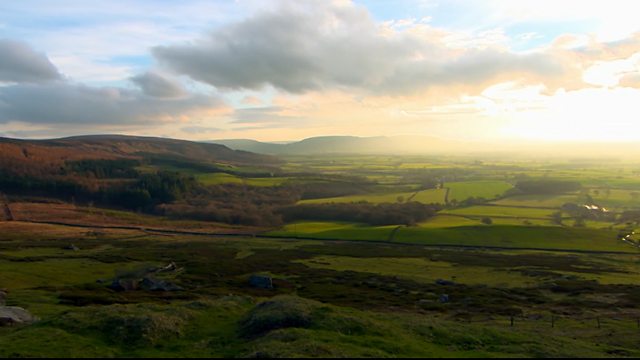
Rogart sits in East Sutherland, a township defined by small parcels of worked land that blend arable ground, pasture, and hill grazing. The joke among crofters is that a croft is a small piece of land surrounded by legislation. That legislation is precisely what gives the place its character and its tensions.
The programme reaches back to 1976, when an episode landed just as the Crofting Reform Act granted crofters the right to buy their land and homes rather than rent them. At the time, opinions split sharply. One contributor called the bill a disaster, warning it would let people make a quick gain by selling crofts off in bits. A reporter of the era predicted communities would fill with owner-occupiers and incomers with fat pocketbooks seeking a retreat from the world.
Half a century later, the verdict is mixed but far from catastrophic. There are around 21,000 crofts in Scotland, and in Rogart at least, crofting remains at the heart of community life. The fear of total collapse never materialised. Instead, subsequent legislation opened doors, and the central challenge shifted from ownership rights to simple affordability.
Landward episode 10 2026
How First-Generation Crofters Built a Life From a Caravan and a Digger
Jonathan and Mairi Hedges represent something increasingly rare: first-generation crofters who chose this life without inheriting it. They have crofted for nearly two decades, but getting their croft took persistence and a stroke of luck. After searching across the Northern Highlands, they met a Rogart crofter who assigned them a workable croft, a secure tenancy that could be passed down through generations.
That generosity changed everything. The crofter believed the family would actually work the land, and Mairi describes Rogart now as the place where they intend to die. It is a striking statement of belonging from someone who was not a crofter before. Yet the path was punishing. They arrived with land but no habitable house.
The early years tested their resolve completely. The family turned up in a small touring caravan and bought a digger, tying the awning to the machine to stop it blowing away in the wind. A bigger caravan followed, useful with three children at the time and a fourth on the way. They lived in a static caravan for twelve years before securing funding from the Croft House Grant Scheme to build a proper home. Jonathan, a full-time postie covering Rogart, Lairg, and the north coast, embodies the reality that crofting is rarely a full-time income on its own.
The Affordability Crisis Threatening the Next Generation of Crofters
Jonathan’s experience pushed him into advocacy, and he now chairs the Scottish Crofting Federation. From that vantage point, he identifies a problem that has barely shifted since 1976: getting young people onto crofts. The ambition is the same as it ever was. The obstacle is money.
Crofts are expensive, and by Jonathan’s assessment, probably overpriced in the current housing market. Cost, he says plainly, is the main barrier. Prices vary enormously depending on whether a croft house is included and how much tourism potential the land carries. Rogart enjoys a small advantage here precisely because it is not especially touristy, which keeps house prices from spiralling the way they have in more scenic, visitor-heavy areas.
Despite the pressures, Jonathan remains cautiously optimistic. He believes a parish like Rogart could support itself, just about. He repeats a saying that crofting cannot feed Scotland, but it can feed part of Scotland, and he expects that contribution to grow more important over time. After fifty years, crofting faces huge challenges, yet in places like Rogart it is still going strong, which is the reassuring counterweight to all the warnings.
Why the Bone Caves Near Inchnadamph Are Under Threat From Tourism
Further west, Shahbaz treks into the hills of Assynt with geologist Marie Marsden of the North West Highlands Geopark, a charity set up to promote and protect the ancient landscape. Their destination is the Bone Caves, naturally formed in limestone cliffs and reached after about half an hour of walking. The reward at the top, Shahbaz admits, is well worth the climb.
The geology alone is staggering. The story begins around 500 million years ago, when the limestone formed in what was then a shallow tropical sea. The caves themselves are far younger, carved roughly 200,000 years ago when the limestone became re-exposed and water dissolved channels through it. Modern documentation only arrived in the late 1880s, and excavations a century ago revealed the Ice Age remains that gave the site its name.
Those discoveries are extraordinary. Researchers found animal bones dating back around 50,000 years, including reindeer, brown bear, and northern lynx. Even the remains of a polar bear turned up, something nobody would expect to find in Scotland. Marie suggests glacial waters may have carried some bones into the caves, while evidence of early humans points to other explanations. The mix of causes is part of what makes the site scientifically priceless.
Geoconservation and the Fight to Protect a 500-Million-Year-Old Landscape
The summer tourist season brings vital income to the Highlands, but the surge in visitor numbers carries a cost. Marie has started noticing serious problems at the Bone Caves. There have been several incidents of graffiti on the walls and the cave floor, rubbish dropped, toilet paper left behind, and even evidence of campfires found by a volunteer the previous year. Each incident chips away at something irreplaceable.
The damage matters on two fronts. Scientifically, careless behaviour could destroy future discoveries before researchers ever reach them. Aesthetically and culturally, it degrades a place of real beauty that should remain open for others to enjoy. Marie’s work centres on geoconservation, which she defines as identifying, protecting, and managing sites of geological significance so people can visit and learn without ruining them for future generations.
Crucially, the protection is not merely a polite request. The Bone Caves are legally designated as an ancient monument by Historic Scotland and form part of a Site of Special Scientific Interest, meaning it is illegal to destroy or damage the site’s features. Even so, Marie’s main appeal is simpler and rooted in the Scottish Outdoor Access Code: take your litter home, do not light campfires, and leave the place as you found it. Leave no trace, as Shahbaz summarises it, is the whole philosophy in three words.
The Rare Damselflies and Dragonflies Thriving at Castle Fraser
In Aberdeenshire, Leanna visits the Flight Pond in the grounds of Castle Fraser, a body of water with an unexpected origin. In the 19th century, the estate owners dug it out specifically to attract wildfowl for shooting. Today its purpose has inverted entirely. The pond is now a peaceful refuge where birds thrive and where iridescent insects, sometimes called flying jewels, dazzle in the summer light.
These insects are damselflies and dragonflies, members of an order known as the Odonata. At least ten different species can be found at Castle Fraser, some of them extremely rare. National Trust for Scotland ranger Vivian Bisset explains that the pond’s high-quality, sheltered water creates an ideal environment for them. The standout resident is the northern damselfly, an endangered species found nowhere else in the UK outside Scotland.
A closer look reveals a hidden world. Under warm sunshine the adults land freely on visitors, and right now marks the peak of breeding season. Adult damselflies live only ten to fifteen days, just long enough to breed, with mating pairs forming a distinctive love-heart shape as the male latches on to protect the female while she lays. The eggs then begin a far longer underwater life cycle lasting two to five years depending on species.
What Damselfly Larvae Reveal About Freshwater Habitat Health
Dipping a net through the pond with a slow figure-of-eight motion brings the underwater drama to the surface. The tray fills with life that Leanna compares to a sci-fi film, and Vivian agrees it looks a little like something out of Alien. A leech crawls along the bottom, and among the debris sit several damselfly larvae, identifiable by three forking tails called lamellae and a head already shaped like the adult insect.
These larvae are no passive grazers. Despite looking sweet and delicate, they are voracious predators, feeding on small translucent midge larvae moving through the water. That appetite delivers a direct benefit to anyone who has suffered a Highland summer evening, because the damselflies help keep the midge population in check. As Leanna notes, we can thank them when we are not being bitten.
The abundance of larvae signals a healthy, thriving habitat, but the Trust is not standing still. Echoing those 19th-century owners, they have dug a new pond to expand the wetland, designed specifically with the northern damselfly in mind and positioned within the insect’s natural dispersal range in the hope it will colonise on its own. Damselflies matter as indicators of good freshwater quality and as regulators keeping other invertebrate populations in balance. They are, as both women happily conclude, also just genuinely cool.
How a 23-Year-Old Dairy Farmer Won a Once-in-a-Lifetime Opportunity
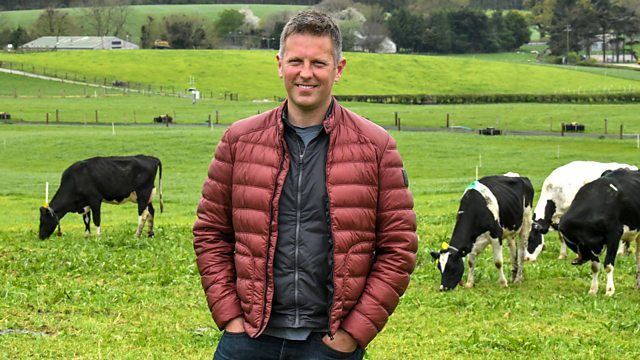
In Dumfries and Galloway, Cammy meets Jordan Duddy, a 23-year-old who has taken on Acrehead Farm near Dumfries. While many people her age are still figuring life out, Jordan knows exactly what she wants. She grew up milking and calving cows and rearing heifers alongside her father on dairy farms in Cumbria and Northern Ireland, so she already knew the dairy game inside out before her big break arrived.
That break came through a social media post her dad spotted. The owner wanted a contract farmer in a joint venture where the contractor earns a wage but the landowner retains the business and financial risk. Jordan knew she had to apply because no comparable opportunity existed. The honest backstory is that she and her dad had started getting on each other’s nerves working together every day, and he effectively told her to get herself away to Dumfries. When she saw the farm, beautiful and perfect for grazing cows, she described the chance as unreal.
Winning it meant beating dozens of applicants. Jordan had to submit a business plan and three years of cash flows, proving she could survive a notoriously volatile milk market. Her strategy was disciplined: build the plan around the worst price she could live on and demonstrate the farm could work even with prices at rock bottom. When Scotland’s Rural College, which owns Acrehead, rang to offer her the job, she cried and asked if they were joking.
Block Calving, New Zealand Friesians, and the Risk of Running a Farm Alone
Acrehead was a dairy research centre running around 200 Holsteins until SRUC chose to bring in Jordan. The deal hands her freedom to run the farm exactly as she likes, but with a sharp edge: she only receives a share of the profits, so if the farm makes no money, neither does she. That alignment of risk and reward shapes every decision she makes.
Her vision is a clear break from the previous intensive, year-round indoor system. Jordan is shifting from Holsteins to New Zealand Friesians and moving the herd outdoors almost all year on a block-calving system. She respects the Holsteins for the sheer volume of milk they produce and acknowledges they suit many farmers well, but grazing cows is what she knows and what she believes will work best on a farm this good. Her father still drops by to tell her what to do, which she admits keeps her sharp.
For Cammy, who knows first-hand how hard it is to break into farming, Jordan’s story stirs a little envy and a lot of admiration. Opportunities like this are rare and vital, and he is convinced there are plenty more young farmers like her who simply never get the chance. Having spent an afternoon working the milking parlour alongside her, he has no doubt SRUC chose the perfect candidate. Her ambition for the future is refreshingly direct: more cows, everything outside, everything the way she wants it.
Why Assynt’s Surviving Elms Matter in a Warming Climate
The programme returns to Assynt for its closing story, where rugged peaks usually steal attention but a quieter wonder grows in the gullies. Scattered across the area are more than 100 mature elms, beautiful trees that have become a genuinely rare sight across the UK. Since the 1970s, Dutch elm disease has killed roughly 90% of Britain’s elms, which makes this northern stronghold remarkable.
Fritha West from the University of St Andrews explains why these trees endured. The beetle that carries the disease-causing fungus flies furthest in temperatures around 20 degrees, conditions that were historically unusual this far north. The bare landscape, harsh winds, and cold weather effectively shielded Assynt’s elms for decades. As the climate warms, that natural protection is beginning to erode, tying the elms’ fate directly to the same climate change pressures reshaping agriculture across the country.
Fritha refuses to call decline inevitable. Other parts of the UK offer lessons in protection, and concrete steps can reduce the risk. Limiting elm firewood imports is a major one, since beetles can stow away in transported wood and open a new route of infection. These elms are not doomed by default, but their survival now depends on deliberate human care rather than climate alone.
The Assynt Elm Project and the Stories Keeping a Species Alive
Fritha’s awareness-raising forms part of the Assynt Elm Project, a community-founded scheme that promotes appreciation of the trees and encourages locals to protect them. One of its most imaginative outputs is a story map, an interactive online resource gathering tales about individual elms and the many ways people in the area have related to them over the years. The contributions range from locals whose families have lived here for generations to children who have adopted a tree.
The project has an artistic dimension too. Over the past two years, photographer Chris Puddephatt has hiked to Assynt’s most remote gullies and crags to capture the elms in every season and weather, building an incredible library of images. Many trees cling to the sides of rocks in places deer cannot reach, since the foliage is highly palatable. One large old elm looks like a tropical paradise up close, then reveals itself clinging to a massive mountainside, a sight Rosie likens to something from a Tolkien film.
The next generation is being drawn in directly. High Life Highland Ranger Andy Summers leads pupils from Lochinver Primary to a wych elm they have affectionately christened Elmo, teaching them to identify the species and even to watch for Dutch elm disease beetles. The children clearly adore it, and Fritha believes these experiences will stay with them for years, deepening their commitment to protecting and planting elms. As the disease creeps ever northwards, that emotional connection may prove just as valuable as any scientific intervention.
Across crofts, caves, ponds, dairy parlours, and ancient woodland, this episode keeps circling the same quiet truth. The Scottish countryside survives not through grand gestures but through individuals willing to fight for a croft, carry their litter home, dig a new pond, gamble on a young farmer, or teach a child the name of a tree. Landward episode 10 2026 leaves Rogart with that idea firmly planted, a reminder that country life endures because people keep choosing, against real odds, to look after it.
FAQ Landward episode 10 2026
Q: Why is crofting so hard for young people to get into?
A: Cost is the main barrier, because crofts are expensive and arguably overpriced in the current housing market. Prices swing wildly depending on whether a croft house is included and how much tourism potential the land carries. Areas heavy with visitors push prices even higher, which prices out most young entrants despite genuine demand to work the land.
Q: What did the 1976 Crofting Reform Act actually change?
A: The Act gave crofters the right to buy their land and homes rather than only rent them. Critics warned it would let people sell crofts off in bits for quick gain and fill communities with wealthy incomers. Fifty years on, that predicted disaster never fully arrived, and around 21,000 crofts still exist across Scotland.
Q: How were the Bone Caves near Inchnadamph formed?
A: The limestone formed around 500 million years ago, when this part of Scotland sat under a shallow tropical sea. The caves themselves are far younger, carved roughly 200,000 years ago. When the limestone became re-exposed, water moved through it and slowly dissolved the channels and hollows visible today.
Q: What animal bones were found in the Bone Caves?
A: Excavations revealed bones dating back around 50,000 years from a surprising range of animals. Finds included reindeer, brown bear, and northern lynx, plus the remains of a polar bear, which nobody expects in Scotland. Glacial waters may have carried some bones in, while early human activity could explain others.
Q: Why are rising visitor numbers damaging the Bone Caves?
A: Increased tourism has brought graffiti on the walls and floor, dropped rubbish, abandoned toilet paper, and even campfires inside the caves. This careless behaviour threatens future scientific discoveries and spoils a place of real beauty. The site is legally protected as an ancient monument and a Site of Special Scientific Interest.
Q: What makes the northern damselfly at Castle Fraser so rare?
A: The northern damselfly is an endangered species found nowhere else in the UK outside Scotland, which makes its presence at Castle Fraser genuinely significant. The Flight Pond offers high-quality, sheltered water that lets it thrive. At least ten Odonata species live here, several of them rare, drawn by the pond’s excellent conditions.
Q: How long do damselflies live and how do they breed?
A: Adult damselflies live only ten to fifteen days, just long enough to breed during the summer peak. Mating pairs form a distinctive love-heart shape as the male latches on and guards the female from predators while she lays. The eggs then develop underwater for two to five years, depending on species.
Q: Why do damselfly larvae indicate a healthy pond?
A: Damselflies signal good freshwater quality and a balanced ecosystem, so abundant larvae point to a thriving habitat. Despite looking delicate, the larvae are voracious predators that feed heavily on midge larvae. Consequently they help keep midge numbers in check and regulate other invertebrate populations across the wider environment.
Q: How did a 23-year-old win the chance to run Acrehead Farm?
A: Jordan Duddy spotted the contract farming opportunity through a social media post and beat dozens of applicants. She submitted a business plan and three years of cash flows, proving she could survive a volatile milk market. Her strategy built everything around the worst price she could live on, showing the farm worked even at rock bottom.
Q: Why have Assynt’s elms survived Dutch elm disease?
A: Since the 1970s, Dutch elm disease has killed roughly 90% of Britain’s elms, yet over 100 mature trees survive in Assynt. The disease-carrying beetle flies furthest near 20 degrees, conditions historically rare this far north. However, as the climate warms, that natural protection is weakening, making firewood import controls and active care increasingly important.