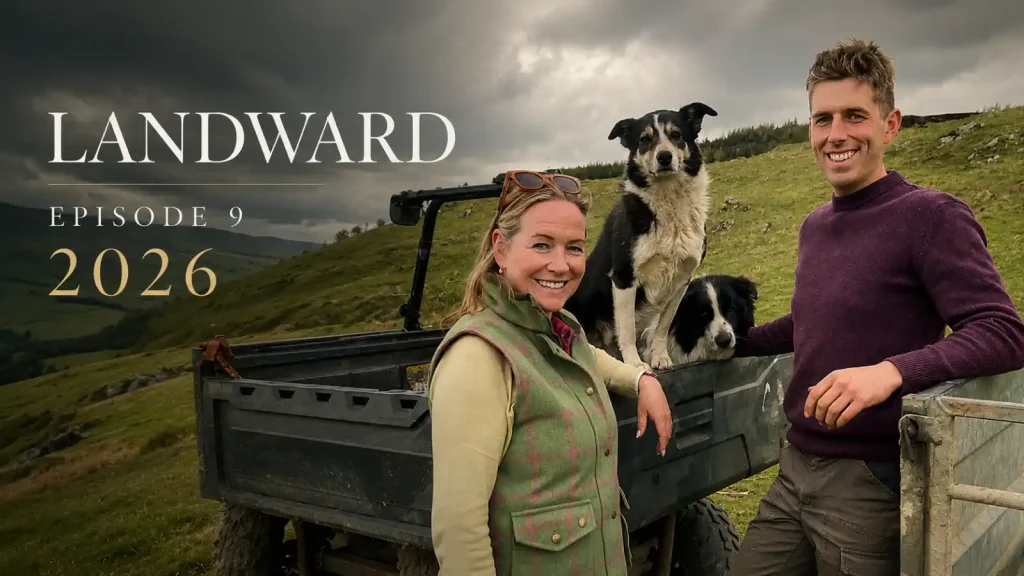
Landward episode 9 2026 carries a quiet weight that most farming programmes never attempt, because it marks fifty years of the show while tracing the human stories that hold Scotland’s countryside together. As the summer tourist season gets under way, Dougie heads into Glencoe to meet Scotland’s longest-serving hostel manager, a man who arrived three decades ago and never left.
The episode threads together a Belgian family chasing a sheep-farming dream in Perthshire, a poet’s farm preserved on the banks of the River Nith, and a search for Scotland’s rarest amphibian along the Solway coast. Each story circles the same idea: what it takes to build something on the land, and what it takes to protect it.
That theme of continuity gives Landward episode 9 2026 its backbone. The programme moves between past and present with real purpose, returning to people and places it filmed decades ago to ask whether anything has changed. The answer, more often than not, is complicated. Tenancy farming remains brutally hard. Rare species cling to a handful of strongholds. Historic buildings survive only through stubborn care and unexpected generosity.
What follows is a journey across some of Scotland’s most striking landscapes, told through the people who refuse to let these places fade. From a wooden hostel that creaks in the Glencoe wind to a working mill brought back to life after decades of silence, the episode finds beauty in persistence.
In 1979, Landward visited the Highlands to investigate a problem that already felt entrenched: the disappearing supply of farm tenancies. Under the tax rules of the time, let farms made poor investments for landowners. Grouse, red deer and tourism delivered far better returns than beef or lamb, and the consequence was simple. Farmers who wanted land struggled to find any.
One of those farmers was Alex Murray. Unable to secure a tenancy in the Highlands, he moved south and took on Lurgan Farm near Aberfeldy in Perthshire. The holding stretched across nearly 3,000 hectares of hill ground, ideal terrain for the blackface sheep flock he would spend his life building alongside his son, Dave.
Fifty years later, Arlene returns to Perthshire to find out what became of the family. The verdict on tenancy farming is sobering. Dave believes it is as hard now as it has ever been, and possibly harder. Getting a farm is only the first hurdle. The capital cost of stocking the land and buying machinery puts the dream out of reach for most young families.
Landward episode 9 2026
How One Belgian Couple Turned a Sheep Farm Dream Into Reality
Alex died in 2022, and by then the family’s relationship with the land had changed entirely. Lurgan Farm was bought outright in 2013, so Dave became an owner rather than a tenant. Ownership brought its own pressures, especially as retirement approached. None of his children wanted to take the farm on, and selling on the open market risked everything he and his father had created.
Dave feared the worst outcome of all. Sold without control, the land could be put under trees, erasing decades of careful work. So things came full circle. Half a century after his father first rented Lurgan Farm, Dave decided to look for a tenant of his own, hoping the right young couple might come along.
That couple turned out to be Gert Van Dyck and his wife Ann. Gert trained as an engineer and worked as a project manager in Belgium, holding a master’s degree, but money was never the point. The pair moved to Scotland in 2020 chasing a life on the land. Ann became a vet, Gert became a farmer, and together they gained experience on another farm before taking the tenancy at Lurgan in 2025.
Why the Future of Agricultural Life Depends on Protecting Hard-Won Legacies
Gert understands exactly what he has inherited. Building a blackface flock to this standard took Alex and Dave decades of work, and recreating it from scratch would consume an entire farming lifetime. Taking it on feels, in Gert’s words, like a rare and amazing opportunity, one he meets with gratitude rather than entitlement.
The arrangement solves a problem that runs through all of agricultural life in Scotland. Skilled flocks and well-managed farms represent generations of accumulated knowledge, yet that knowledge can vanish in a single sale. By choosing a tenant over the open market, Dave protected not just the land but the living system of breeding and stockmanship layered into it.
For Dave, the outcome could not have been better. He created a legacy with his father, and that legacy now has the chance to continue. Watching Gert settle his ewes and lambs back on the hill, making sure mothers bond with their young, the handover looks less like an ending and more like a renewal. It is farming, livestock and country life passing intact from one careful pair of hands to another.
Scotland’s Longest-Serving Hostel Manager Has Spent 30 Years Welcoming the World
From Perthshire, Landward episode 9 2026 climbs into the heart of Glencoe, an area famous for its towering mountains and dark history. The glen draws walkers, photographers and the occasional film crew, and high above it sits Glencoe Youth Hostel, a wooden building at 742 metres with views across the whole landscape. Its warden, Thomas Janzen, is originally from Germany but has lived and worked in Scotland for three decades.
Thomas first encountered Scottish hostelling on his honeymoon in 1992, staying at Loch Ossian Youth Hostel. He fell in love with the ethos of the place, its social warmth and openness, and that feeling never left him. He and his wife Marion eventually uprooted their lives and moved north, drawn by an experience that promised something money could not buy.
The Scottish Youth Hostels Association, now called Hostelling Scotland, opened its first hostel in 1931 to give anyone affordable access to the countryside. The charity runs 28 hostels across the country today. Thomas has managed hostels for 30 years, working in five others before arriving in Glencoe in 2008, which makes him Scotland’s longest-serving manager.
Inside a Glencoe Hostel Where Community and Country Life Shape a Family
For Thomas, the job is built on giving something back. He treasures the idea that guests spend their most precious time, their holidays, in his care, and he wants to make every stay as good as the welcome he once received. The reward arrives daily in the form of visitors from every corner of the world, turning the hostel into a small crossroads of cultures.
Raising a family here shaped his daughters in ways he clearly values. Growing up in the hostel meant meeting people from countless countries, an upbringing he considers a genuine gift. The proof of its appeal is striking. Both daughters now work for Hostelling Scotland, and one of them works at Loch Ossian, the very hostel that started the family’s Scottish story.
Thomas describes Glencoe as home in the fullest sense. He loves the wooden building that creaks and moans in the wind, the spectacular location at his doorstep, and a close-knit village community that welcomed his family without hesitation. After 30 years, he cannot imagine living anywhere else. His story captures the heart of country life in the Highlands, where belonging is earned slowly and held tightly.
How Robert Burns Found His Greatest Poems on a Dumfriesshire Farm
Landward episode 9 2026 then travels from one home to another, swapping a Highland hostel for the home of Scotland’s national bard. Burns fan Cammy makes a pilgrimage to Ellisland Farm in Dumfriesshire, the place where Robert Burns farmed for three years from 1788, when he was 29. Burns described the ground on the banks of the River Nith as sweet, poetic ground, and his time there proved one of the most creative periods of his life.
The creative output was extraordinary. At Ellisland, Burns wrote his masterpiece Tam o’ Shanter, along with Ae Fond Kiss and Auld Lang Syne. Curator Adam Dixon explains that Burns arrived as more than a poet. The land in Dumfriesshire was what historians call pre-improved, inefficient and low-yielding, so his landlord commissioned him to improve the farmstead. Burns laid out 170 acres exactly as they remain today and became the first person to introduce Ayrshire cattle into Dumfriesshire.
Burns was also given £300 by his landlord to build a farmhouse, barn and byre, arranged in a U-shaped courtyard. What he saw in those fields fuelled what he wrote indoors. One surviving poem in his own handwriting, titled around the sight of a fellow wounding a hare with a shot in April 1789, is regarded as one of the first anti-blood-sports poems ever written. Burns saw a neighbouring farmer’s son injure a hare and was left not just devastated but raging.
Protecting Ellisland Farm for Future Generations of Burns Pilgrims
Adam frames Burns as a champion of something modern farming increasingly embraces: agriculture and nature working hand in hand. Burns was connected to the natural world not through a touristic gaze but through a life ingrained in it. That intimacy with land and livestock runs straight through his poems, making Ellisland far more than a literary footnote.
Burns left Ellisland in 1791 because of rising agricultural rents, a pressure that still squeezes farmers today. In the early 1920s, a devoted Burns enthusiast bought the farm for the nation. The arrangement that followed was unusual, even strange. The tenant lived in the house but was expected to open the doors to a constant stream of Burns pilgrims, many of them unannounced.
Eventually Ellisland ceased to be a home and became a museum. Joan McAlpine now leads the effort to preserve it for future generations, raising funds to restore the farm buildings. The challenge is technical as well as financial. Modern 20th-century paints and mortars trapped dampness in the walls, causing the timbers to rot. The restoration aims to look almost identical to what stands now, so the glimpse of Burns’s farm that visitors catch on approach will match what the poet himself saw over 200 years ago. As a national heritage site, its survival matters for everyone who returns, for auld lang syne.
The Race to Save Scotland’s Rarest Amphibian From Climate Change
A few miles south of Cammy, on the banks of the Solway Firth, Leanna hunts for one of Scotland’s most overlooked creatures. The natterjack toad is the rarest amphibian in the UK, and Leanna makes a spirited case that rarity alone earns it a little affection. In Scotland, natterjacks survive in only a few locations along the Solway coast, and she heads to Mersehead Nature Reserve to meet Liam Templeton from Species On The Edge.
The numbers explain the urgency. The natterjack was classified as endangered in the United Kingdom around five years ago and has since retreated to a handful of strongholds, with Mersehead among the most important. Living on the coast leaves the toads exposed to climate change, and the threats are stacking up. Rising sea levels, extreme weather events and erosion are steadily eroding the very habitats they depend on.
The clock is ticking, and Liam’s partnership of charities is fighting back. The group runs the National Natterjack Monitoring Programme and works closely with landowners and land managers to prescribe sustainable land management and habitat restoration across the Scottish Solway coast. At Mersehead, a combination of dunes, salt marshes and shallow pools creates the ideal home, the kind of fragile mosaic that disappears fast once the sea moves in.
Inside the Night-Time Mission to Monitor Mersehead’s Natterjack Toads
Reserve Ranger Rowena Chambers shows Leanna how to read the signs of natterjacks, starting with toad spawn laid in warm, shallow water along the pool edges. Each spawn string can hold around 7,000 eggs, and the toads produce them in vast numbers for a stark reason. Only about 1% of eggs survive to become adult toads, so safety lies entirely in numbers.
Populations swing dramatically year to year. In 2018, the team counted more than 300 adult toads at Mersehead. Last year, only 72 remained. Yet the figure rebounded to 157 in 2026, a fragile but real recovery. Because natterjacks are mainly nocturnal, the best chance of seeing them comes after dark, and the toads and their habitats are legally protected against disturbance, so Rowena needs a special licence to monitor them.
As daylight dims and bats emerge, so do the natterjacks, and the sound is unforgettable. They are not only the rarest amphibian in the UK but also the loudest, with a rasping breeding call said to carry a mile on still nights. Rowena handles one gently, pointing out the unique pattern of dorsal warts on its back, as individual as a fingerprint.
A blue, bruised throat marks a male’s deflated vocal sac, while females show brilliant white with little black dots. Careful measurements track the age demographics and confirm the toads are breeding successfully. Thanks to this work, Mersehead now holds one of the most sustainable natterjack populations in the UK, and that magical chorus is one Scotland does not want to lose.
How Outlander Fame Brought Preston Mill Roaring Back to Life
The final story in Landward episode 9 2026 takes Rosie to East Lothian, where Preston Mill sits on the banks of the River Tyne near East Linton, as pretty as a picture. A mill has stood here for at least 400 years, perhaps even 800. It ground grain regularly until 1987, then fell silent for decades. Now, after years of stillness, the mill is milling once more.
Part of its modern fame comes from the screen. The mill’s local stone and conical pantile roof made it a perfect backdrop, most famously as a location in the worldwide streaming hit Outlander, where Jamie Fraser waded beneath the sluice. Visitors arrive to recreate selfies on the same spot, and the National Trust for Scotland’s Fraser MacDonald has become an expert on the property since the series aired. The BBC also filmed an Agatha Christie adaptation here, but Outlander tours now move steadily from location to location through the site.
That fame proved worth its weight in gold. Fans funded essential repairs, and a generous anonymous donation alongside a grant restored the mill to full working order. Much of the structure is genuinely ancient. While most surviving Scottish watermills date to the 19th century, parts of Preston Mill go back hundreds of years, and the cowl and kiln are thought to date to the 1500s.
Why Reviving a Working Mill Preserves a Lost Piece of Country Life
Inside, the revived machinery is a sensory experience. Recent repairs to the bearings and millstone finally allowed flour and meal to be produced again. Barley pours into the hopper, flows over a vibrating plate called a shoe, and trickles down through the French burr millstones. Preston Mill is predominantly an oat mill, complete with a distinctive oat drying kiln, though a skilled miller could adjust the machinery to grind barley, wheat or any other grain a farmer brought.
The detail reveals how central a mill once was to country life. It stood at the centre of the community, providing employment and processing the grain grown on local farms. Without it, that grain could never reach market, and the farmer could never sell it on. Each mill even had its own distinct sound, and an experienced miller could diagnose a fault simply by listening. The friction of the stones toasts the grain, and a careless miller risks burning it, which is the literal origin of keeping your nose to the grindstone, sniffing for scorched grain. The phrase rule of thumb comes from the same craft, as millers judged coarseness by rubbing grain between thumb and forefinger.
Seeing the mill running again is, in every sense, history in motion. For years, visitors could watch the machinery turn, but now they can smell the grain processing, hear the shifting sounds and feel the fine powder for themselves. It is a building brought back to life, and a reminder that the stories running through Landward episode 9 2026, from a Highland hostel to a Belgian family’s flock, from a poet’s farm to a chorus of rare toads, all share one stubborn refusal to let Scotland’s living heritage slip quietly away.
FAQ Landward episode 9 2026
Q: Why is it so hard to get a tenant farm in the Scottish Highlands?
A: Tenant farms have long been scarce because tax rules made let land an unattractive investment for landowners. Grouse, red deer and tourism deliver far better financial returns than beef or lamb. Even when a tenancy appears, the capital cost of stocking the land and buying machinery puts it out of reach for most young families.
Q: Who are the Belgian family running a sheep farm in Perthshire?
A: Gert Van Dyck and his wife Ann moved from Belgium in 2020 to chase a sheep-farming dream. Gert trained as an engineer with a master’s degree and worked as a project manager, while Ann is a vet. After gaining experience on another farm, the couple took on the tenancy at Lurgan Farm near Aberfeldy in 2025.
Q: Why did Dave choose a tenant instead of selling Lurgan Farm?
A: None of Dave’s children wanted to take the farm on, and selling on the open market risked losing control of what he and his father built over decades. He feared the land could be planted with trees. Choosing the right young couple as tenants protected the legacy and gave a new family a rare chance.
Q: Why is a well-bred blackface sheep flock so valuable to a farmer?
A: Building a blackface flock to a high standard takes decades of careful breeding and stockmanship. Alex and Dave Murray spent their lives developing theirs. Starting from scratch would consume an entire farming lifetime, which is why inheriting an established flock represents accumulated knowledge that cannot be replaced quickly or cheaply.
Q: Who is Scotland’s longest-serving youth hostel manager?
A: Thomas Janzen, warden of Glencoe Youth Hostel, has managed hostels for 30 years, making him Scotland’s longest-serving. Originally from Germany, he first experienced Scottish hostelling on his honeymoon at Loch Ossian in 1992. He worked in five other hostels before arriving in Glencoe in 2008.
Q: When did youth hostelling start in Scotland?
A: The Scottish Youth Hostels Association opened its first hostel in 1931 to give anyone affordable access to the countryside. Now called Hostelling Scotland, the charity runs 28 hostels across the country. The organisation’s social ethos and openness drew Thomas Janzen to build his life and raise his family within it.
Q: Which famous poems did Robert Burns write at Ellisland Farm?
A: Burns wrote his masterpiece Tam o’ Shanter at Ellisland, along with Ae Fond Kiss and Auld Lang Syne. He farmed there for three years from 1788, calling the ground on the banks of the River Nith “sweet, poetic ground.” The period proved one of the most creative of his life.
Q: Why does Ellisland Farm need restoration?
A: Modern 20th-century paints and mortars trapped dampness in the walls, causing the timbers to rot. Joan McAlpine is raising funds to repair the buildings using traditional methods. The restoration aims to look almost unchanged, so the glimpse of Burns’s farm visitors catch on approach will match what the poet saw over 200 years ago.
Q: Why is the natterjack toad Scotland’s rarest amphibian?
A: The natterjack was classified as endangered in the UK around five years ago and has retreated to a handful of coastal strongholds. Living on the coast, it faces rising sea levels, extreme weather and erosion driven by climate change. These pressures steadily destroy the dunes, salt marshes and shallow pools the toads depend on for breeding.
Q: How did Outlander help restore Preston Mill?
A: Preston Mill featured in Outlander as the spot where Jamie Fraser waded beneath the sluice, drawing fans from around the world. Their interest funded essential repairs, and a generous anonymous donation alongside a grant restored the mill to full working order. After falling silent in 1987, it now grinds grain once more.