Springwatch 2026 episode 4 closed the show’s opening week with a run of wildlife stories that swung from tender to brutal in a matter of minutes. Broadcasting live from the National Trust’s Crom Estate in County Fermanagh, Northern Ireland, Chris Packham and Michaela Strachan tracked the fortunes of a bullied buzzard chick, a newly hatched little grebe, and a starling defending its eggs from an intruding swift. Away in West Sussex, Iolo Williams reported from the Knepp wildland estate, where a white stork colony has become one of Britain’s most remarkable rewilding success stories.
The episode arrived after a dramatic Thursday that saw robins predated by a pine marten and chaos in the jackdaw nest. By contrast, Friday at Crom felt calmer, though the stakes for several nests remained high heading into the weekend. Cooler weather and rain swept in, forcing the presenters into fleeces and back inside the teepee.
What followed in Springwatch 2026 episode 4 was a masterclass in how nature refuses to behave sentimentally. Swifts revealed themselves as serial cheats. Basking sharks gathered off Ireland in numbers that hint at hidden intelligence. And three British butterflies showed off the extraordinary survival tricks that carry them through winter. Each story carried real consequences, real conflict, and a reminder that wildlife operates on its own uncompromising terms.
The buzzard nest delivered the episode’s most uncomfortable viewing. Two chicks remained, down from three, after one was pecked to death by a sibling earlier in the week. The question facing the Springwatch team was simple and grim: had the bullying stopped, or would the colony lose another chick before Monday?
It had not stopped. The footage showed the dominant chick continuing to assert itself, standing tall and forceful while its sibling cowered in submission. The aggression had eased slightly in frequency and intensity, but it persisted. Crucially, this was not a fight over scarcity. A close look at the dominant chick’s crop showed it was nearly full, which meant the bullying was not driven by hunger. Instead, this was raw survival instinct, hardwired and indifferent to fairness.
Food deliveries underscored the imbalance. An adult arrived with a frog, and the dominant chick tried to swallow it whole, with limited success. Moments later came a mouse, gone in a single gulp by the same chick. The submissive sibling received nothing, not even a morsel. Chris Packham voiced clear concern for the weaker bird, hoping it could become assertive enough to feed itself through Friday, Saturday and Sunday. The fear was explicit: that the smaller chick might go the same way as its dead sibling and end up as food. Viewers were asked to keep watch across the weekend, with an update promised for Monday.
Springwatch 2026 episode 4
A Joyful Little Grebe Chick Steals the Show at Crom
After the tension of the buzzard nest, the little grebe offered pure relief. Chris Packham made no secret of his affection, calling it a nest of joy and admitting he adored the tiny chick. It was a bird Springwatch had never featured before, which made the access a genuine treat, because little grebes are notoriously shy and typically slip off their nests and vanish underwater the moment they sense observation.
The chick had taken its first deliberate swim. The previous day it had tumbled into the water by accident, but now it paddled on purpose before nestling back onto its mother’s back. The male arrived with food, gently feeding the chick an aquatic invertebrate, probably a larva. It was the kind of intimate moment that justifies the show’s reliance on patient remote cameras.
Two eggs remained unhatched, with one already showing a crack the day before. Hatching can take up to 48 hours, and the cool, wet weather was not ideal for it. The presenters acknowledged the timing problem honestly. Once little grebe chicks hatch, they swim off, so by the time the team returned on Monday the eggs might have hatched without anyone seeing it happen. It was, as they put it, a very good reason to keep watching the live cameras over the weekend.
Knepp’s White Stork Colony Marks a Rewilding Triumph in Sussex
Iolo Williams reported from the Knepp wildland estate in West Sussex, where the white stork project has turned the landscape into something the volunteers affectionately call Stork Central. Nearly every large tree in the area held at least one stork nest, with one tree carrying four. Birds wheeled overhead all day. A camera trained on one nest revealed two chicks roughly five and a half weeks old, still with time left before fledging, and likely grateful for the cooler weather.
The storks proved to be bold opportunists. During the dry spell they fed in wetland areas on invertebrates, amphibians and small fish, but the footage caught one bird eating a young rabbit before flying back to regurgitate the meal for its chicks. Because storks cannot digest fur and bone, they produce pellets, and Laura, who leads the white stork project, dissected one on air. Inside were fragments of violet ground beetle carapace, the remains of a grasshopper or cricket, and assorted beetle head parts, all reflecting the rich diet available across Knepp’s wild grassland.
This abundance is the whole point. After years of rewilding, Knepp now supports a diversity of prey that helps storks and countless other species thrive. The project began by bringing over wild birds that had been injured in Poland and rehabilitated, many left with only one functional wing. Kept safe inside a six-acre predator-proof pen, these grounded birds breed successfully and act as a magnetic nucleus, drawing in wild storks because the species is intensely social.
Three Butterflies, Three Strategies for Surviving the British Winter
One of the episode’s standout segments answered a deceptively simple question: where do butterflies go in winter? The answer revealed three radically different survival strategies, each a small evolutionary marvel. As days lengthen and temperatures climb, peacocks are among the first butterflies to appear, followed by orange tips whose markings signal spring, and finally the rarely seen brown hairstreak.
The peacock survives as a dormant adult. Concealed in a garden shed among the tools, it spends the entire winter motionless, having replaced some of the water in its body with glycerol, a natural antifreeze that lets it endure freezing temperatures. It effectively puts its life on pause. The brown hairstreak takes a different route entirely, overwintering as a minuscule egg no bigger than a pinhead, fixed to a blackthorn branch. Sealed inside for eight months, the tiny caterpillar within neither grows nor ages, protected by pores so small they admit oxygen while keeping winter out.
The orange tip overwinters as a chrysalis, tucked among brambles and disguised as a thorn. Inside, a fully grown caterpillar waits in suspended animation. All three are biological time capsules waiting for the same trigger. When warmth returns for several days, the peacock reboots first, its eyes and antennae detecting rising light levels before its metabolism, muscles and reproductive system slowly wake.
For the brown hairstreak, spring triggers hatching timed precisely to the new shoots of blackthorn, and the caterpillar must shed its skin four times before its final transformation. In the orange tip’s chrysalis, powerful enzymes dissolve the caterpillar’s body into a liquid matrix, from which a tightly regulated genetic programme rebuilds an entirely new creature that inflates its wings to full glory.
Fifty Years of Butterfly Data Reveals a Mixed Picture for UK Wildlife
The butterfly story carried a serious conservation message. The year marks the 50th birthday of the UK Butterfly Monitoring Scheme, which has gathered data since 1976. In that time volunteers have recorded 41 million butterflies across more than 7,000 sites, an extraordinary citizen-science achievement that underpins much of what Britain knows about its butterfly populations.
The latest results were sobering but not hopeless. In 2025 the scheme gathered data on 59 regularly reported species. While many butterflies are in decline, driven by the combined pressures of habitat loss, pesticide use, nitrogen pollution and climate change, 25 species saw an increase in sightings. One species, the mountain ringlet, is classed as data deficient. As the UK’s only mountainous butterfly, found in Scotland and the Lake District at altitudes around 900 metres, it survives in cooler conditions and is insulated by hairs covering its body and wings. Its adults fly at the end of June, and Butterfly Conservation is keen for sightings.
The segment also flagged a public campaign to find the UK’s favourite butterfly. Butterfly Conservation set up the vote partly to inspire people to look more closely at the species around them, from showy favourites like the peacock and red admiral to rarer ones like the large blue and unfairly overlooked species like the small heath and meadow brown. Voting runs until 7 June, with the winner due to be revealed on the final Springwatch programme of the run on 11 June.
Swift Colony Cameras Expose Affairs, Divorce and Infanticide
A new nest at Crom introduced one of the episode’s most surprising stories. Hidden in a crevice about 40 centimetres deep in the old courtyard wall sat a swift’s nest, and the cameras captured the pair preening and behaving with apparent tenderness. Swifts have long enjoyed a reputation for being monogamous, gentle and loving. That reputation took a battering.
Ornithologist James O’Neill has spent about 12 years studying a colony based in a friend’s house fitted with 50 nest boxes and 80 cameras, a setup he runs from a control room where nothing happens without his knowledge. His observations have dismantled the myth of swift loyalty. He has documented cheating, secret affairs, high rates of divorce, jealous neighbours throwing eggs from nests, and even infanticide. The colony, he says, behaves like a soap opera.
The standout case involves a bird named CJ. In 2025 his partner laid two eggs, but halfway through incubation an intruding female entered the nest while CJ was sitting and spent two hours cuddling up to him. When the rightful mother returned, the two females launched into a vicious fight that moved toward the box entrance, the typical swift tactic of trying to eject a rival.
The commotion alerted a local sparrowhawk, which flew in and seized the mother of the eggs, ending CJ’s breeding season in failure. CJ has returned in 2026 with a new mate, raising hopes for a happier outcome. Across the colony, O’Neill has found that 29 percent of returning birds are not monogamous at all, confirming a world of infidelity hiding behind the species’ gentle image.
Starlings, Pike and a New Underwater Camera at Crom
Swift drama spilled into the courtyard’s starling nest, where a swift forced its way in and triggered a prolonged battle. Both starlings and swifts nest in wall crevices, and this swift was determined to claim the spot despite the starling having arrived first. The fight risked trampling the eggs, but the starling eventually drove the intruder off and returned to brood its five blue eggs. The team hoped these would hatch over the weekend, cramming five chicks into the narrow crack in the wall.
The episode also debuted a new underwater camera, the show’s first since strong results at Minsmere in 2015. Positioned on the jetty by the boathouse, it revealed juvenile perch with faint side stripes alongside an adult sporting an impressive dorsal fin. The calm was broken by the arrival of a pike, an ambush predator that is hard to spot, creating danger from below to match the threat of a heron from above. Anything, the presenters suggested, could happen on the fish camera.
Anything, it turned out, except a live broadcast. The camera went down before they could cut to it, the brown, nutrient-rich and sediment-heavy lake water adding a comic note to the technical failure. The presenters promised the underwater feed would return soon.
Viewer Clips Capture Moles, Adder Dances and a Bold Buzzard Heist
Digital presenter Hannah Stitfall joined the show to share standout viewer content, and the volume has been staggering, with more than 300 videos arriving every day. The first clip showed a mole above ground, a genuinely rare sight that drew more than 2 million views on the BBC Springwatch Instagram page. The reasons a mole might surface include a young animal dispersing from its mother, foraging during drought when underground food is scarce, or a territorial male expanding his range in search of a female during the breeding season.
Another clip captured the famous adder dance, in which two males wrestle each other in spring to compete for a female. Even the victorious male must stay vigilant, guarding the female ferociously, because if she mates with rivals he will not father all of her young. A third clip delivered the episode’s best piece of opportunism: a heron predating an eel, only for a buzzard to swoop in and steal the catch. This kleptoparasitism prompted a neat piece of science. Research has shown that the success of such thefts depends not on body size but on brain size. The smaller buzzard can outwit the larger heron because the heron has the smaller brain.
These viewer contributions reinforce a recurring Springwatch theme, that the public are the show’s eyes and ears across the country. The team encouraged more submissions through the website, with a tantalising mention of polecats crossing a road still to come on social media.
Basking Sharks and an Algal Bloom Visible From Space Off Ireland
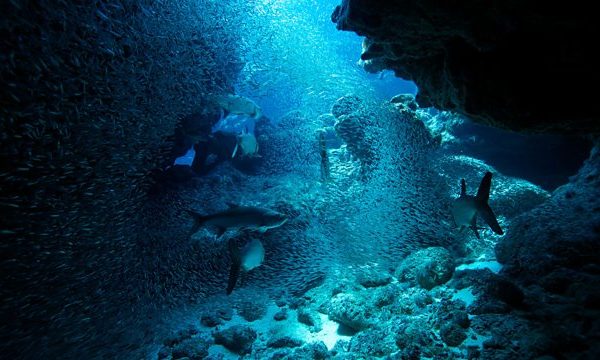
The episode’s spectacular finale turned to the sea off the west coast of Ireland, filmed by camera operator Jack Kelly. The west coast is thought to hold around 20 percent of the world’s basking shark population, making it a genuine hotspot for this endangered, plankton-feeding giant. Kelly captured their extraordinary courtship ritual, in which the sharks form a column on the surface and follow one another for hours, occasionally punctuated by a breach that is remarkable for such a slow-moving animal.
Genetic research is now challenging old assumptions about these gentle giants. Long thought to be solitary wanderers gathering at random to feed, the sharks may be far more connected than anyone realised. Pioneered by the Irish Whale and Dolphin Group’s Simon Berrow, researchers across Ireland, Scotland and Norway have used slime sampling, gently wiping mucus from the dorsal fin with a cloth-covered pole.
The findings showed that sharks in a group are more closely related than expected and return to the same feeding grounds. This raises profound questions about whether younger sharks learn migration routes from older relatives, and whether the loss of that inherited knowledge, not just numbers, explains why basking sharks have been slow to return to former haunts.
The reason they gather there at all lies in a natural phenomenon so vast it can be seen from space. A milky algal bloom forms along the west coast every summer, driven by topography and ocean currents. Off Ireland the shallow continental shelf gives way to the Rockall Trough, a steep drop that can reach 3,500 metres deep. The Gulf Stream brings warm, salty water north, where it meets colder, fresher summer water. Trapped in the channel, these contrasting densities generate enormous turbulence that stirs nitrates, silicates and phosphates up from the seabed, acting as a biological pump that fertilises the sunlit surface.
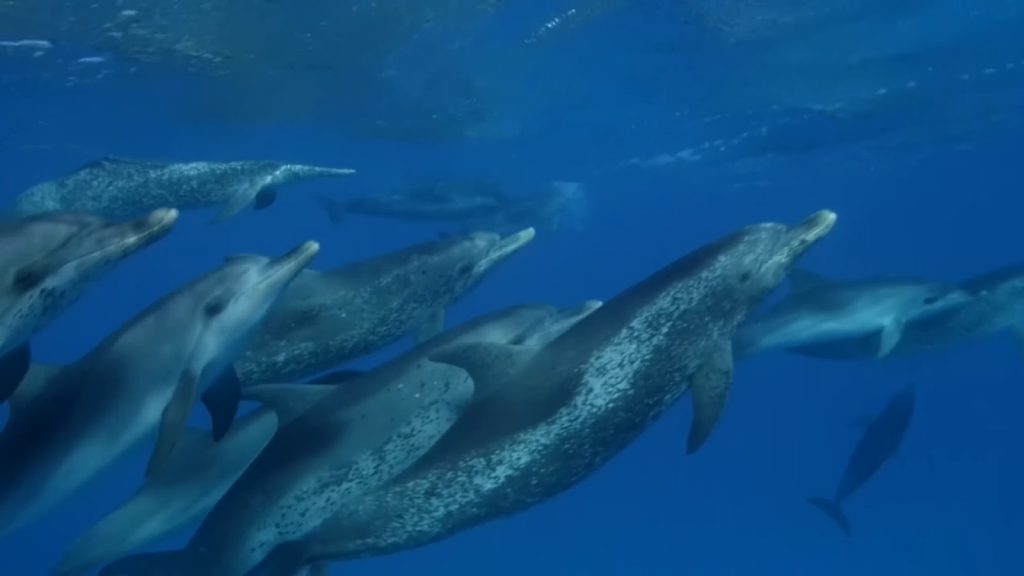
That fertiliser triggers an entire food chain, from phytoplankton and zooplankton up through small and large fish to the predators that follow. Dolphins, blue sharks, orca, humpbacks and fin whales all arrive to feed, and remarkably about a third of the world’s cetacean species have been recorded in this area. The cycle sustains itself as marine snow, the constant fall of dead plankton and organic debris, drifts into the deep to feed cold-water corals and an enormous blackmouth catshark nursery filmed 750 metres down and 200 miles offshore, the largest yet discovered. It is one of the most productive marine environments on the planet, hidden in plain sight off the coasts of Ireland and Scotland.
As Springwatch 2026 episode 4 brought the first week to a close, the show looked ahead to fox cubs, a cryptic bark-dwelling bird, and a shift in location to the urban wildlife of the City of London. The week at Knepp had, by the team’s own account, delivered beyond their wildest expectations, while Crom continued to balance moments of joy against the harder realities of survival. If the opening week proved anything, it is that the natural world keeps writing its own scripts, and Springwatch is at its best when it simply watches them unfold.
FAQ Springwatch 2026 episode 4
Q: Why does one buzzard chick bully its sibling at Crom?
A: The bullying stems from raw survival instinct rather than hunger. Footage showed the dominant chick had a nearly full crop, so food scarcity was not the cause. One chick was already pecked to death earlier in the week. The remaining dominant bird stands tall and forceful while its sibling cowers, continuing the aggression at reduced frequency.
Q: How soon do little grebe chicks start swimming after hatching?
A: Little grebe chicks swim within their first days, riding on a parent’s back between attempts. The Crom chick fell into the water accidentally one day, then swam deliberately the next. The male fed it aquatic invertebrates, likely larvae. Little grebes are shy birds that usually slip off their nests and vanish underwater when disturbed.
Q: What do white storks at Knepp eat?
A: Knepp’s storks are bold opportunists feeding mainly on invertebrates, amphibians and small fish. During dry spells they hunt across wetland areas. One bird was filmed eating a young rabbit before regurgitating it for chicks. Dissected pellets revealed violet ground beetle carapace, grasshopper or cricket remains, and assorted beetle head parts from the wild grassland.
Q: How did rewilding bring white storks back to Knepp?
A: Years of rewilding created an abundance of diverse prey that lets storks thrive. The project began by rehabilitating injured wild birds from Poland, many left with only one working wing. Kept safe in a six-acre predator-proof pen, these grounded storks breed successfully. Because the species is intensely social, they act as a magnetic nucleus drawing in wild birds.
Q: How do British butterflies survive the winter?
A: Different species use entirely different strategies. The peacock overwinters as a dormant adult, replacing some body water with glycerol, a natural antifreeze. The brown hairstreak survives as a pinhead-sized egg sealed on blackthorn for eight months. The orange tip waits as a chrysalis disguised as a thorn. All three pause development until spring warmth restarts their biological clocks.
Q: What happens inside a butterfly chrysalis during transformation?
A: Powerful enzymes dissolve the caterpillar’s body into a liquid matrix. Cells then use the broken-down protein as raw material, following a tightly regulated genetic programme to rebuild a butterfly. The emerging insect pumps a blood-like fluid through its body to restore each organ with nutrients, then inflates its wings to full glory.
Q: Are UK butterfly numbers declining?
A: Many UK butterflies are declining due to habitat loss, pesticide use, nitrogen pollution and climate change. However, the picture is mixed. In 2025 the UK Butterfly Monitoring Scheme tracked 59 regularly reported species, and 25 saw increased sightings. The scheme has recorded 41 million butterflies across more than 7,000 sites since 1976, all logged by volunteers.
Q: Are swifts really monogamous birds?
A: Traditional belief holds that swifts pair for life, but new research disputes this. Ornithologist James O’Neill found that 29 percent of returning birds in his studied colony were not monogamous. His cameras documented cheating, secret affairs, frequent divorce, jealous neighbours throwing out eggs, and even infanticide. The colony behaves, in his words, like a soap opera.
Q: Why can a smaller buzzard steal food from a larger heron?
A: Success in food theft depends on brain size, not body size. Research into these cases found the outcome relates to intelligence rather than bulk. A buzzard was filmed swooping in to snatch an eel from a heron. Although smaller, the buzzard can outwit the heron because the heron has the smaller brain.
Q: Why do basking sharks gather off the west coast of Ireland?
A: They come to feed on a massive annual algal bloom visible from space. The steep drop from the continental shelf into the Rockall Trough, combined with Gulf Stream currents, creates turbulence that pumps nitrates, silicates and phosphates to the sunlit surface. This fertiliser triggers a food chain supporting plankton, fish, dolphins and roughly a third of the world’s cetacean species.