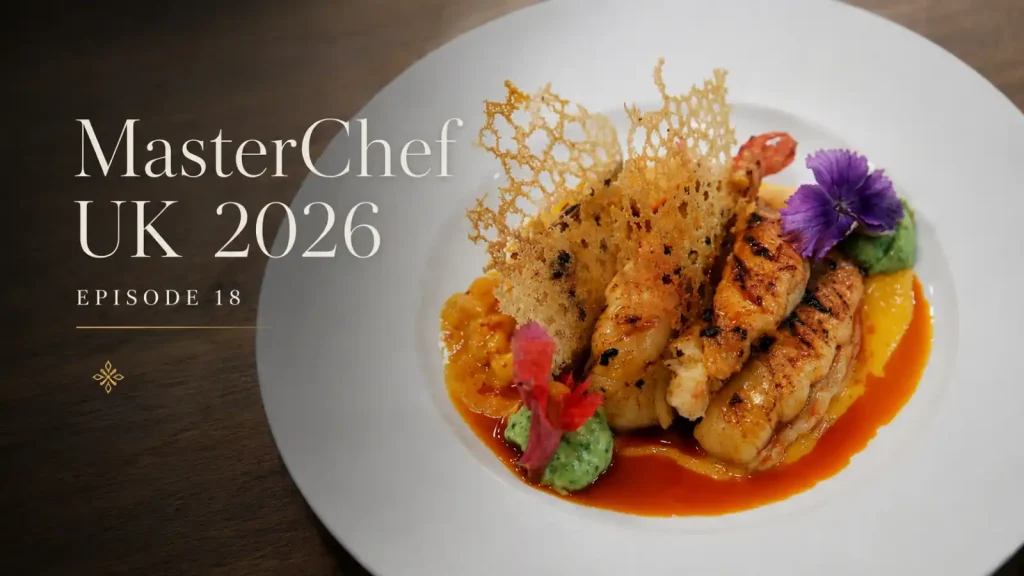
MasterChef UK 2026 episode 18: The last of the MasterChef UK 2026 semifinals arrived with four places in Finals Week and five amateur cooks competing for them. Two challenges separated the contestants from the ultimate prize: a complex masterclass in plant-based patisserie followed by a 90-minute invention test judged by three of the country’s sharpest food critics. One cook would be going home. The pressure inside the Birmingham kitchen was unlike anything the series had produced before.
The first challenge introduced the semifinalists to Philip Khoury, one of the most exciting pastry chefs working in Britain today. Born and raised in Australia to a Lebanese family, Khoury grew up surrounded by food at the centre of every occasion. His grandfather would order huge platters of Lebanese sweets, and Khoury developed a formidable sweet tooth from as early as he can remember. At 21, he started culinary college and went on to work in celebrated Australian kitchens, including a stint under pastry chef Adriano Zumbo, whose protege he became.
In 2018, Khoury moved to London to take on the role of head pastry chef at the luxury food hall inside Harrods. There he embarked on a project that would define his career: redefining the technique of baking without eggs or dairy. His philosophy is not that plant-based baking is a radical departure, but that it is an evolution. “We’ve developed an overreliance on eggs and dairy,” he told the contestants. “We’re taking ingredients that we’ve always had and extracting their functions through new recipes.”
The dish he set the semifinalists was his signature creation, The Dawn of a Tropical New Day. A frozen coconut cremeux casing filled with mango and lime compote, topped with coconut sponge, the whole base dipped into a white-chocolate coconut crunch. Above that, a whipped coconut Chantilly cream shaped into a small dome, glazed in passion fruit gel to resemble the sun, finished with tempered chocolate sun ray decorations and a fine gold mist. Khoury told the contestants it was straightforward on paper. The kitchen reacted with laughter.
With two and a half hours on the clock, the semifinalists faced a recipe that demanded precision at every stage. As the judges made clear from the start, pastry is defined by exact amounts and precise timing on every ingredient.
The first obstacle was the mango and lime compote. Because the recipe contains no setting agent, the structure of the compote depended entirely on the uniformity of the dice. Khoury’s recipe called for a specific eight-millimetre cut. Too fine and the compote would turn mushy; too large and it would be too loose to hold its shape inside the mould. Several contestants reached for rulers at their benches. Thirty grams of compote then went into the mould and needed to be frozen solid before assembly could continue.
The coconut cremeux posed a different kind of challenge. Traditionally made with eggs and cream, this version used coconut milk thickened with cornstarch, with coconut oil added for texture. The judges urged the cooks to whisk out all dry pockets and bring the mixture to a proper boil to fully activate the thickening. Too light and it would fail to support the dessert; too thick and it would be, in Khoury’s word, claggy and cloying.
The coconut sponge removed eggs from the equation entirely, relying on baking powder for leavening. A critical step required grinding desiccated coconut to a super-fine crumb to release its natural oils. If the coconut was not blended sufficiently, there would not be enough fat in the recipe and the sponge would turn dry and dense rather than moist and light. The finished batter incorporated soya milk, sugar and vanilla. Maintaining an even thickness when spreading the batter was also important: a sponge cut too thick would pop out of the assembled base.
As the challenge moved into its second hour, attention shifted to the coconut Chantilly cream. This needed to be whipped to stiff peaks before being piped into small dome moulds and placed in the blast chiller. If under-whipped, Khoury warned, it would ooze out from beneath its passion fruit glaze once defrosted, collapsing the clean silhouette of the finished dessert. Philip observed that both Jhane’s and Matt’s cream went into the moulds looking far too liquid, signalling problems ahead.
The decoration stage brought the chocolate tempering challenge. The dairy-free chocolate used in the recipe contains no milk solids and so behaves like dark chocolate, requiring warmer working temperatures. The process involved melting the chocolate to around 45 to 50 degrees, pouring it onto a marble board to cool down to approximately 26 degrees, then warming it slightly again to control crystallisation. Once spread over the sun ray stencil, the chocolate had to be smoothed in one or two strokes before it set. Overworking it, or allowing body heat from the fingers to reach it, caused immediate melting and fracturing.
With ten minutes remaining, the kitchen was fully stretched. The bases needed to be skewered and pressed into the white chocolate and coconut crunch dip while still frozen solid. Any give in the internal layers and the whole structure would slip off the skewer. Philip acknowledged that all five cooks had completely underestimated how long the plating stage would take.
MasterChef UK 2026 episode 18
Judging the Masterclass
When time was called, Philip said he was genuinely amazed that all five contestants produced a finished plate. Squinting slightly, he observed, two or three of them looked really similar to his.
Kristen was the first to be judged, and her result drew immediate praise. Her tempered chocolate sun rays were super fine with an almost translucent quality, precisely what Khoury was looking for. When cut open, the layers were cleanly defined and gave the impression of a fresh sunrise. Her compote had a beautiful balance of fresh mango and lime zest, her sponge was moist, and her chocolate crunch shell was well-calibrated. Her only technical shortfall was a slightly soft cremeux, which the judges noted but did not dwell on. For an amateur attempting this level of patisserie for the first time, they called it a really, really good result.
Tony’s performance also impressed, particularly given that he had been the last contestant to get his sponge into the oven. His chocolate stencils were sharp and his cream was well-whipped, while his passion fruit glaze was applied in a thin, professional layer. His outer chocolate casing was slightly thick, but the judges acknowledged the quality of his components across the board.
Antos delivered a visually striking cut, and the judges praised how far he had come over the course of the competition. His cream had a nice set and his chocolate decoration, despite a couple of tempering disasters, came through as super fine. The criticisms were technical: his compote was a little soft due to inconsistent dicing, his sponge had a slight texture from coconut that had not been ground finely enough, and his cremeux carried a slightly undercooked flour note on the palate. One judge marked the occasion by declaring it “the dawn of a new Antos.”
Jhane’s biggest problem was the Chantilly cream. It had gone into the moulds looking too liquid and defrosted as feared, spreading away from the base rather than sitting proud above it. Jhane described her dessert as representing global warming rather than a sunrise, to knowing laughter from the room. The flavour underneath, however, was sound: a bright, juicy compote, a good sponge thickness, and a cremeux with a beautiful creamy consistency. The judges also noted that her chocolate shell, though thicker than ideal, had a wonderful crunch and that the finished dessert, however rustic it looked, ate beautifully.
Matt faced a similar fate to Jhane with under-whipped cream that defrosted into a soft, melted pool. The judges also found his mango compote had remained frozen in the centre, masking its sweetness and flattening the overall flavour of the dish.
The Invention Test and the Food Critics
After a brief break, the kitchen was reconfigured for the decisive round. The judges set a 90-minute invention test and brought in three of Britain’s most respected food writers to join them at the table: Jimi Famurewa, William Sitwell and Xanthe Clay. The message to the contestants was unambiguous. Average, uninventive or safe cooking was not acceptable at this stage. “I don’t want fancy-pants, showy foams and nonsense,” one judge told the room. “I want it to be all about the flavour.”
Tony moved to reclaim his momentum with a dish rooted in the Southeast Asian flavour profiles that define his cooking. His centrepiece was a Thai-inspired chicken and prawn ballotine: a prawn mousse flavoured with coconut milk, lemongrass and galangal, rolled inside chicken skin. He paired it with a Japanese ginger mirror-glazed turnip on a peanut and Szechuan pepper crumb, a miso and parsnip puree, black garlic and sake pak choi, and a prawn and lemongrass sauce served in a jug. Tony knew the structural integrity of the ballotine was critical: any tear would allow the filling to escape and destroy the presentation.
Antos arrived at the final challenge with a clear intention to channel personal family history into something refined. His grandfather, who passed away before Antos was born, had worked for Air India for 30 years and introduced the family to Indian cuisine. That love of Indian food had passed through the generations, and Antos wanted to pay tribute with his dish.
He took the classical British combination of lamb, peas and mint and executed it through an Indian lens: a roasted lamb rump in a spiced butter, curried pea puree, tadka peas dressed with sizzling oil and spices, a mint pakora made from grated potato, spiced poppadoms, and a mint and chilli chutney. In a previous semifinal round, his first attempt at pakora had ended in disaster. This time, he was determined to do it properly.
Jhane conjured a Mexican beachside atmosphere with large char-grilled tiger prawns marinated in smoked chilli oil, paired with a mango habanero sauce, a silky avocado cream, a mango and tahini salsa seasoned with Tajin, and tostada tuiles fried from flour and oil. She had visited Mexico before and described how the food there looked unassuming but delivered powerful, complex flavours on every bite. That was the quality she was trying to bring to Birmingham. Her main concern during the cook was the tuiles: too tough or chewy and they would dominate the plate and overwhelm the delicate prawns.
Matt built his most ambitious and wide-ranging plate of the competition. Veal sweetbreads poached in dashi stock served with a peppercorn sauce, sour onions cooked down in beer, vinegar, miso and brown sugar, pickled daikon, a red pepper and kombu puree with honey and dashi, polenta cooked in dashi with toasted pine nuts, and a North African lamb merguez sausage heavily spiced with harissa, chilli and cumin, wrapped in a lolot leaf and served inside a shiso leaf.
Asked to describe the dish as he was cooking, one of the judges observed they were in Italy, France and Korea simultaneously. Matt’s own assessment was that the flavours tasted good and went well together, even if, on paper, the combination sounded really out there.
Kristen pushed the technical ceiling of the invention test with a wild game feast inspired by venison cooking techniques she had encountered earlier in the competition. A macadamia nut-crusted venison tenderloin cooked in a water bath, paired with braised venison shank stuffed into fried Jerusalem artichoke skins, a smoked artichoke puree, a massaman curry sauce with finger lime, pickled carrot, cucumber, apple and fried basil salad, and a tamarind gel. Cooking a tamarind gel well enough was something, as one judge noted, it would take weeks to master properly. Kristen had about 90 minutes.
The Critics’ Verdicts and the Road to Finals Week
The food critics tasted each dish in turn and delivered sharp assessments. Jhane’s prawn plate was the standout of the day. The char on the grilled prawns was described as lovely, her mango habanero sauce delivered the right level of sweetness without tipping over, her avocado cream was silky smooth, and the mango salsa had a bright, fruity heat from the tahini and Tajin. The overall plate was described as full of character, full of fun, full of texture and, simply, purely heavenly. One judge declared it an absolute favourite of the day.
Antos produced what the judges considered his best performance of the series. His lamb rump was cooked and rested really well. The tadka peas were described as fabulous, with their sweet English peas contrasting beautifully against the sizzling spiced oil. The pakora came out with a feisty hit of chilli and excellent crunch. His mint and chilli chutney was singled out as gorgeous, taking the traditional idea of mint sauce and blowing it out of the water with the addition of chilli. One judge remarked it might be one of his favourite things Antos had ever cooked, and confirmed that this was the moment Antos stopped being a wild card and became a serious contender.
Kristen’s venison dish drew widespread praise. The venison loin itself was perfectly rested and well seasoned, and the macadamia crumb added a sweetness that worked alongside the meat. The star element, the judges agreed, was the stuffed artichoke skin: the braised shank was so tender it was almost buttery, and the tamarind gel contributed a lovely salty sourness that went beautifully with the meat. The massaman sauce was described as delicious, getting to the back of the throat with real robust spice, while the pickles provided the sharp, acidic refreshment the heavier elements needed. The overall verdict was that it was tremendous.
The final deliberation came down to Tony and Matt. Matt’s sweetbreads were regarded as beautifully cooked, and his merguez sausage in the lolot leaf was fiery and well-received. However, the critics found his dish all over the place: the sour onions and kombu sauce had no business sharing a plate, the red pepper and kombu puree added little, and the polenta had hardened into a pancake. There were nearly two separate dishes on the plate, and they were not singing together.
Tony’s chicken ballotine told a different story of failure. Adding liquid coconut milk directly to the prawn mousse at the centre had caused it to turn wet and mushy, unpleasant to eat. The chicken itself was not fully cooked. His seasoning throughout was too timid: the pak choi was under-powered, the peanut crumb was not delivering its expected Szechuan heat, and while the lemongrass sauce had some power, it fell flat. His ginger-glazed turnip was unanimously praised as a delicate, beautiful element, but the structural and seasoning failures of the main component were too significant to overlook.
Tony Departs and the Finals Head to the Caribbean
In the elimination room, the judges announced Jhane, Antos and Kristen safe first, confirming their places in Finals Week. After a final review of Matt’s disjointed plate against Tony’s undercooked and under-seasoned ballotine, they gave the fourth spot to Matt. Tony was eliminated.
Tony left with his head held high. “It’s been one heck of an experience,” he said. “I’ll never regret this.”
The remaining four had little time to take it in. The judges announced that Finals Week would take place not in the studio but on the Caribbean islands of Antigua and Barbuda. The reaction was disbelief and joy in equal measure. Only one of the four can go on to win MasterChef 2026.
FAQ MasterChef UK 2026 episode 18
Q: Who is Philip Khoury and why was he invited to MasterChef UK 2026?
A: Philip Khoury is the head pastry chef at the luxury food hall inside Harrods, widely regarded as one of the most exciting pastry chefs working in Britain today. Born in Australia to a Lebanese family, he trained under celebrated pastry chef Adriano Zumbo before moving to London in 2018. He was invited to MasterChef UK 2026 because of his pioneering work redefining classical baking techniques without eggs or dairy.
Q: What is the Dawn of a Tropical New Day dessert made of?
A: The dessert consists of a frozen coconut cremeux casing filled with mango and lime compote, topped with a coconut sponge, then dipped into a white-chocolate coconut crunch. Above that sits a whipped coconut Chantilly cream dome glazed in passion fruit gel to resemble the sun, finished with tempered chocolate sun ray decorations and a fine gold mist. Every component is entirely plant-based, containing no eggs, no dairy and no gelatine.
Q: Why does the mango dice size matter so much in plant-based patisserie?
A: Because the mango and lime compote contains no setting agent, the uniformity of the dice is the only factor holding the filling together inside the mould. Philip Khoury’s recipe specifies an exact eight-millimetre cut. Too fine and the compote turns mushy; too large and it becomes too loose to retain its shape during assembly. Several contestants used rulers at their benches to verify their dimensions under time pressure.
Q: How does coconut cremeux work without eggs or cream?
A: The plant-based version replaces eggs and cream with coconut milk thickened by cornstarch, with coconut oil added to achieve a smooth, creamy texture. Cooks must whisk out all dry starch pockets and bring the mixture to a full boil to activate the thickening properly. If the cremeux sets too light it will not support the dessert’s layers; if overcooked it turns claggy and unpleasant on the palate.
Q: Why is tempering dairy-free chocolate harder than tempering regular chocolate?
A: Dairy-free chocolate contains no milk solids, so it behaves like dark chocolate and requires warmer working temperatures throughout the process. The chocolate must be melted to around 45 to 50 degrees, poured onto a marble board to cool to approximately 26 degrees, then gently rewarmed to control crystallisation. Once spread over the sun ray stencil, it must be smoothed in one or two strokes before it sets. Body heat from the fingers alone is enough to cause immediate melting and fracturing.
Q: Which contestant performed best in the MasterChef UK 2026 Episode 18 patisserie challenge?
A: Kristen produced the strongest result, earning immediate praise for her super-fine, almost translucent chocolate sun rays, cleanly defined internal layers, and a well-balanced mango and lime compote. Her only technical shortfall was a slightly soft cremeux. Tony also impressed despite being the last to get his sponge into the oven, delivering sharp chocolate stencils, a well-whipped cream and a thinly applied passion fruit glaze.
Q: What inspired Antos to cook an Indian-themed dish in the MasterChef 2026 semifinal?
A: Antos dedicated his invention test dish to his grandfather, who passed away before Antos was born. His grandfather worked for Air India for 30 years and introduced the family to Indian cuisine, a love that passed through the generations. Antos wanted to pay tribute by reinventing the classic British combination of lamb, peas and mint through an Indian lens, incorporating spiced butter, tadka peas, a mint pakora, spiced poppadoms and a mint and chilli chutney.
Q: What went wrong with Tony’s chicken ballotine in MasterChef UK Series 22 Episode 18?
A: Adding liquid coconut milk directly to the raw prawn mousse at the centre of the ballotine caused it to turn wet, mushy and unpleasant to eat. The chicken itself was not fully cooked through. The critics also found his overall seasoning far too timid: the pak choi lacked power, the peanut crumb delivered no Szechuan heat, and both the lemongrass sauce and the dish as a whole fell flat despite his ginger-glazed turnip receiving universal praise.
Q: Why did Matt’s invention test dish fail to impress the critics?
A: Matt’s plate was criticised for feeling like two separate dishes that had no business sharing a plate. His veal sweetbreads and lamb merguez sausage were individually praised, but the sour onions and kombu puree clashed without cohesion, the red pepper and kombu puree added little, and the polenta had hardened into an unappealing pancake. The critics acknowledged he could clearly cook but agreed the flavours were not singing together.
Q: Where are the MasterChef UK 2026 finals taking place?
A: The MasterChef UK 2026 finals will take place on the Caribbean islands of Antigua and Barbuda. The announcement came immediately after the semifinal elimination, with the judges telling the four remaining finalists—Jhane, Antos, Kristen and Matt—to prepare for a culinary adventure of a lifetime. The revelation triggered genuine shock and delight among the contestants, setting up a spectacular tropical conclusion to the series.


