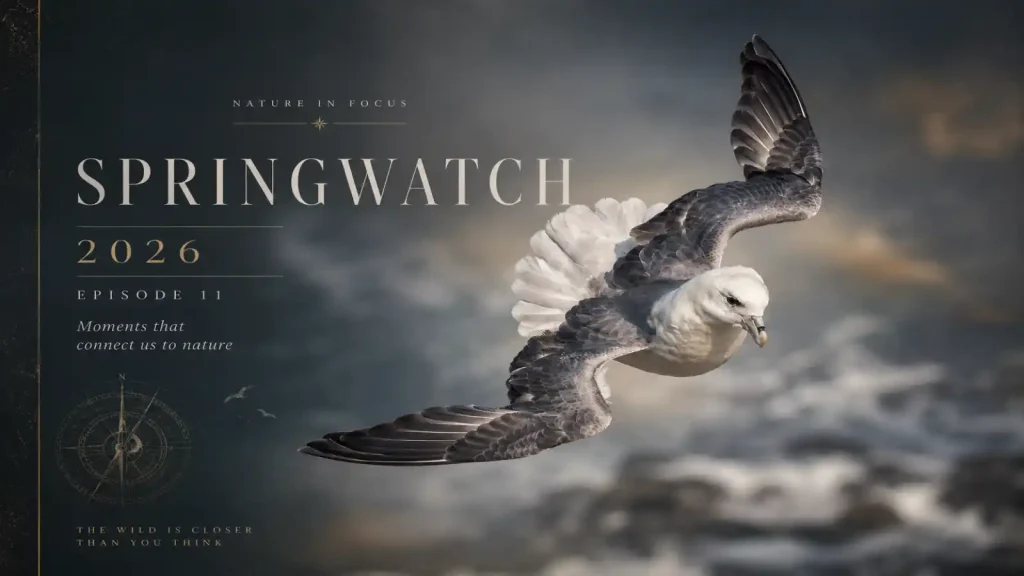
Springwatch 2026 episode 11 delivered the moment the entire season had been building towards, broadcasting a live honey buzzard nest for the first time in the programme’s history. Chris Packham and Michaela Strachan presented the penultimate show from the National Trust’s Crom estate in Northern Ireland, where they stripped away the theme tune and let natural sound carry the evening. The result felt rawer and more intimate than usual. Wasps, sand eels, pine martens and a single russet-red egg shaped a programme that balanced triumph against loss with unusual honesty.
This was the big night, and the hosts said so plainly. Springwatch 2026 episode 11 promised honey buzzards above everything else, with pine marten kits, great crested grebes and a flock of barn swallows filling the spaces between. Iolo Williams reported live from the towering seabird colonies at Bempton Cliffs on the Yorkshire coast, turning his attention away from the gannets and puffins to the smaller, quieter dramas unfolding inland.
What gave the episode its weight was not spectacle alone. It was the way each animal story connected to a wider question about decline, survival and the choices people make in their own gardens. Nature here was never decorative. It was urgent, and the presenters refused to soften that fact.
For weeks the honey buzzards had been teased as the season’s grand finale, and Springwatch 2026 episode 11 finally went live to the nest. The first image was almost comic. The bird was fast asleep. Packham laughed that you can always rely on birds to let you down, but the patience paid off within minutes.
Honey buzzards look radically different from the common buzzards more familiar across the UK countryside. They lack the heavy brow ridge, carry a noticeably longer tail, and fly on narrower wings. Field guides describe them as tricky to separate from common buzzards, yet seen side by side the differences are obvious. These are migrants, returning late in the season, which is why this pair were only now laying their eggs.
The name misleads. Honey buzzards do not eat honey. Roughly 81% of their diet consists of wasps, which they track back to underground nests and then dig out. To survive the assault, they rely on dense, stiff plumage that contracts into a tough armour, with around 60 feathers packed into every square centimetre around the eyes. Some birds even appear to carry a natural wasp repellent on their feathers.
The payoff arrived at the end of the segment. The male, identified by markings on the right side, brought a section of wasp comb back to the female. Wasp grubs are nutritional gold, dense with amino acids, fatty acids, vitamin B2, minerals and protein, and the comb delivers them in a perfectly packaged meal. Then the camera found it: a single egg, glowing with the distinctive russet-red of a honey buzzard clutch. Packham had kept a bucket of cold water on standby in case the excitement overwhelmed him. In the end he did not need it.
Springwatch 2026 episode 11
Why the Sussex Honey Buzzards Mark a Historic Broadcasting First
The honey buzzard footage carried a credit that mattered. It came courtesy of the Sussex Ornithological Society, the conservators of Ashdown Forest, and a remote camera specialist from Dorset. This collaboration delivered what the presenters called a live honey buzzard nest for the first time in the known universe, and the Sussex connection sat at the heart of it.
Honey buzzards remain one of Britain’s most elusive breeding raptors. They nest in small numbers, return late, and conceal their activity well, which makes a live camera feed extraordinarily difficult to secure. Iolo Williams, who worked on honey buzzards in Wales between the 1990s and 2000, spoke about how hard they are to pin down. That history gave the Sussex broadcast its sense of occasion.
The behaviour on screen confirmed the pair were actively breeding. The female kept appearing with a frog in her mouth, unbothered, while the two birds mated repeatedly. Frequent mating during egg-laying is normal, and the male reinforced the nest with sticks and fresh greenery in the manner of many raptors. Every detail pointed to a successful, established pair, which is precisely why the Sussex footage felt so significant. A first sighting of laying, broadcast live, is the kind of moment that rarely arrives twice.
Pine Martens, Predation and the Hard Mathematics of a Crom Woodland
The Crom estate has become a pine marten stronghold, and Springwatch 2026 episode 11 did not flinch from what that means. Bridge cameras captured the animals crossing repeatedly through the evening, often with a fledgling clamped in the mouth, carrying prey back to hidden young. As darkness fell, the crossings grew more frequent.
Counting them proved difficult. Each pine marten carries a unique bib pattern, but identification depends on the animal’s angle and the available light. The team tentatively identified seven or eight individuals, yet a 2019 National Trust survey using dung and DNA found a population of 25, probably an underestimate. That density may rank among the highest anywhere in Europe, sustained by ancient oak woodland rich in nesting holes and surrounded by uncut meadows teeming with insects and birds.
The cost fell hard on a robin nest the audience had grown attached to. Both adults had been feeding five chicks, and the presenters openly hoped these would be the first open-nest birds to fledge this season. Instead a pine marten returned in the early hours of Tuesday and ate three chicks in eight minutes, carrying others away. Packham, who had predicted success, accepted the blame with dark humour about his own kiss of death.
Yet the programme insisted on context rather than grief. Predation is the engine of a functioning ecosystem, and many nests fail every year, sometimes 40% or 50%. Birds endure because they raise multiple broods across multiple attempts. The presenters asked viewers to celebrate the pine martens rather than mourn the robins, screening footage of a family of kits filmed in Ireland by Dan Bagur. Born in spring with litters of five to seven, scoring a memorable 5.9 on the cute scale, these young predators are simply learning their trade.
The White-Tailed Eagle That Raised a Buzzard
One of the strangest stories of the night arrived through a viewer photograph. Justin Grant and Daniel Plunkett had captured an image that stopped the presenters in their tracks. In a single nest sat a young white-tailed eagle alongside a young common buzzard, an arrangement that should not exist.
The explanation pointed to interspecific adoption. When researchers examined the nest, they found the legs of young buzzards, meaning the eagles had been raiding buzzard nests and eating the chicks. One buzzard, however, had survived. The adults appear to have suffered what biologists call parental recognition failure, failing to identify the buzzard as prey and instead caring for it as one of their own.
The outcome may be remarkable but it is not unprecedented. A study in central Europe documented six white-tailed eagle nests, each holding a buzzard youngster, and every one of those buzzards survived to fledge successfully. The eagles, in effect, did a faultless job of raising the wrong species. The presenters compared it to the old stories of children raised by wolves, and they hoped the photographers would return to discover how this unlikely family ended up.
Iolo Williams and the Quiet Crisis Facing Britain’s Sparrows
At Bempton, Iolo Williams stepped back from the cliff edge to make a point about what surrounds the famous seabirds. Flower-rich meadows, dominated by hogweed and red campion, run behind the colony towards a scruffy hawthorn hedgerow and woodland beyond. That mix of habitats supports a bird in serious trouble across the country: the tree sparrow.
The decline is staggering. Between 1917 and the early 2000s, tree sparrows fell by 93%. They are farmland birds, dependent on seeds and mixed arable land, and they have been hammered by pesticides and the loss of nest sites as trees and hedgerows disappear. Williams spoke movingly about colonies that filled Montgomeryshire in his youth, places where today he cannot find a single bird. Bempton, by contrast, gave him more tree sparrows in a day than he had seen in twenty years in Wales.
The reserve earns that abundance through deliberate management. Varied habitats, wet features, three hectares of sacrificial crop and dozens of nest boxes combine to create a stronghold. Williams joined Poppy from the RSPB to ring a group of birds, each fitted with an individually numbered ring that feeds vital monitoring data. The contrast with the urban house sparrow, down 60% since the 1970s and once virtually gone from London, underlined a simple truth. Manage the habitat well, and the birds respond.
The Bird Feeder Warning Every Garden Owner Needs to Hear
Perhaps the most practical segment of Springwatch 2026 episode 11 asked viewers to change a habit many have held for decades. Following earlier discussion about the risks of feeding wild birds, the RSPB’s Jack arrived with new guidelines centred on a disease called trichomonosis.
The science is grim. Trichomonosis spreads through saliva when birds gather in high numbers, caused by a microscopic parasite that swells the throat until a bird can no longer swallow food or water. Finches have suffered most. Greenfinches have lost 65% of their population over thirty years, around 2.2 million birds, with the disease identified as a primary driver. Chaffinches have fallen 38% in a decade, and bullfinches by 27%.
The advice is specific rather than absolute. Feeders should not dispense nuts and seeds between May and October, the warm months when the parasite survives longest outside the body and natural food is abundant. Fat and mealworms remain safe, because finches avoid them and birds take mealworms one at a time without pooling saliva. Flat surfaces are the real danger, so bird tables and window feeders pose a higher risk than the smart camera feeders now everywhere.
Birdbaths drew particular concern, having been widely overlooked. An infected bird spits the parasite straight back into standing water for others to drink. The RSPB now advises changing birdbath water every single day, ideally with chlorinated tap water that helps kill the disease. Better still, the presenters suggested a garden pond, alive with microscopic organisms that break down pathogens naturally. Chris Packham described removing his own feeders on the first of May, watching a woodpecker promptly raid his bee hotel, and resolving to build a bigger one rather than reverse course. Change, he argued, is simply part of living responsibly alongside wildlife.
Kittiwakes, Sand Eels and the Warming Seas Off the Yorkshire Coast
Back on the Bempton cliffs, Iolo Williams turned to the kittiwake, the smallest gull nesting on the reserve. Around 44,000 breeding pairs gather here, roughly 20% of the entire UK population, though they occupy the cliffs for only a few months before spending most of the year far out on the open sea.
These birds are failing, and the reason runs deep into the food chain. Kittiwakes have declined by 43% in the UK over the last 25 years, and their fortunes are bound to a single small fish: the sand eel. Overfishing has stripped the seas of this prey, but warming waters have inflicted a subtler damage. Plankton blooms now arrive earlier each year, creating a mismatch. By the time sand eels need that plankton, the bloom has already passed, leaving fewer fish of poorer quality.
The consequences reach the cliff ledges directly. To replace themselves, adult kittiwakes need to raise roughly one chick per nest. At Bempton they are managing just 0.4, far below the level required for a stable population. Terns are suffering alongside them. Williams framed it as a problem demanding urgent solutions, a reminder that even a colony as vast as Bempton sits on fragile foundations.
The Small Creatures That Carry the Season’s Biggest Lessons
For all the raptors and predators, Springwatch 2026 episode 11 reserved real tenderness for the overlooked. Butterfly enthusiast Lois Clements explored Lagan Meadows in the heart of Belfast, an urban oasis where the river runs through the city. She described butterflies and moths as the group that first taught her nature is not somewhere distant but everywhere underfoot.
The meadows shelter the cryptic wood white, a butterfly found in Northern Ireland and nowhere else in the UK. Its courtship is mesmerising. The male extends his long proboscis fully and sways it from side to side across the female’s head, possibly to prove himself a worthy mate. Clements also tracked small tortoiseshells warming on nettles and the cuckoo flower that feeds the orange-tipped butterfly. Her message was disarmingly simple. Learn to know one butterfly, and you invite mindfulness and joy into an ordinary day.
The house martins offered another first. For the first time, a camera filmed live inside a house martin nest, revealing chicks fed by regurgitation and a baffling moment when an adult ate a white feather it had carried in. These birds live on a knife edge, flying up to 14.5 hours a day and catching insects for 93% of that time to feed themselves and their brood. Scientists call it optimal foraging, the constant calculation between energy spent and reward gained. Any shift in weather, and the insects vanish.
Wildlife artist Vanna Bartlett closed the natural-history thread with a plea for the microfauna most people walk past. Sketching bee flies and solitary bees in her own garden, she compared knowing each insect by name to walking into a familiar pub. The Springwatch presenters drew the lesson together. Focusing closely on a single small creature, they noted, reduces anxiety and deepens calm, a genuine benefit backed by research. From shield bug eggs that the team had waited the entire season to film, to the common green shield bug that earns its stink-bug nickname, the message held firm.
With the honey buzzard egg revealed, the pine martens thriving and the warnings about feeders and warming seas still ringing, Springwatch 2026 episode 11 set the stage for a finale built on the same unflinching honesty. One more day of live cameras remained, with Hannah Stitfall chasing her own pine marten sightings and the apex predators of Bempton still to come. The season had earned its closing night.
FAQ Springwatch 2026 episode 11
Q: Why was the honey buzzard nest on Springwatch 2026 episode 11 such a big deal?
A: It was billed as a live honey buzzard nest broadcast for the first time in the programme’s history. Honey buzzards are elusive breeding raptors that return late and conceal their activity well, making a live feed extremely hard to secure. The segment ended with a single russet-red egg revealed on camera.
Q: Do honey buzzards actually eat honey?
A: No, the name is misleading. Roughly 81% of a honey buzzard’s diet is wasps, which they track back to underground nests and dig out. They also bring sections of wasp comb back to the nest, since the grubs are dense with amino acids, fatty acids, vitamin B2, minerals and protein.
Q: How do honey buzzards avoid getting stung when raiding wasp nests?
A: They rely on dense, stiff plumage that contracts into a tough armour, plus around 60 feathers packed into every square centimetre near the eyes. Some birds even appear to carry a natural wasp repellent on their feathers, which may calm the insects during a raid.
Q: How many pine martens live at the Crom estate?
A: The team identified roughly seven or eight by their unique bib patterns, but a 2019 National Trust survey using dung and DNA found 25 individuals, probably an underestimate. The ancient oak woodland and uncut meadows may support one of the densest pine marten populations anywhere in Europe.
Q: What happened to the robin chicks on Springwatch 2026?
A: A pine marten raided the nest in the early hours of Tuesday and ate three chicks within eight minutes, carrying others away to feed its young. The presenters framed it as natural rather than tragic, noting that 40% to 50% of nests can fail each year, with birds surviving through multiple broods.
Q: Why was a buzzard chick found in a white-tailed eagle nest?
A: A viewer photograph showed interspecific adoption. The eagles had raided buzzard nests for food, but failed to recognise one buzzard as prey and raised it instead. This parental recognition failure is rare but recorded; a central European study found six buzzard youngsters in eagle nests, and all fledged successfully.
Q: Why are tree sparrows so rare in the UK now?
A: Tree sparrows declined by 93% between 1917 and the early 2000s. As farmland birds dependent on seeds and mixed arable land, they have been hit by pesticides and the loss of nest sites as trees and hedgerows disappear. Bempton bucks the trend through varied habitats, sacrificial crops and dozens of nest boxes.
Q: Should I stop using bird feeders in summer?
A: The RSPB advises not putting out nuts and seeds between May and October, when the parasite behind trichomonosis survives longest and natural food is plentiful. Fat and mealworms stay safe. Flat surfaces like bird tables carry the most risk, and birdbath water should be changed daily using chlorinated tap water.
Q: Why are kittiwakes declining at Bempton Cliffs?
A: Kittiwakes have fallen 43% in the UK over 25 years, driven by collapsing sand eel stocks. Overfishing and warming seas have shifted plankton blooms earlier, creating a mismatch that leaves fewer, poorer-quality fish. At Bempton, adults raise just 0.4 chicks per nest, well below the one needed to sustain the population.
Q: Where was Springwatch 2026 episode 11 filmed?
A: Chris Packham and Michaela Strachan presented from the National Trust’s Crom estate in Northern Ireland, while Iolo Williams reported live from the seabird colonies at Bempton Cliffs on the Yorkshire coast. The honey buzzard footage came from Sussex, supplied by the Sussex Ornithological Society and Ashdown Forest’s conservators.