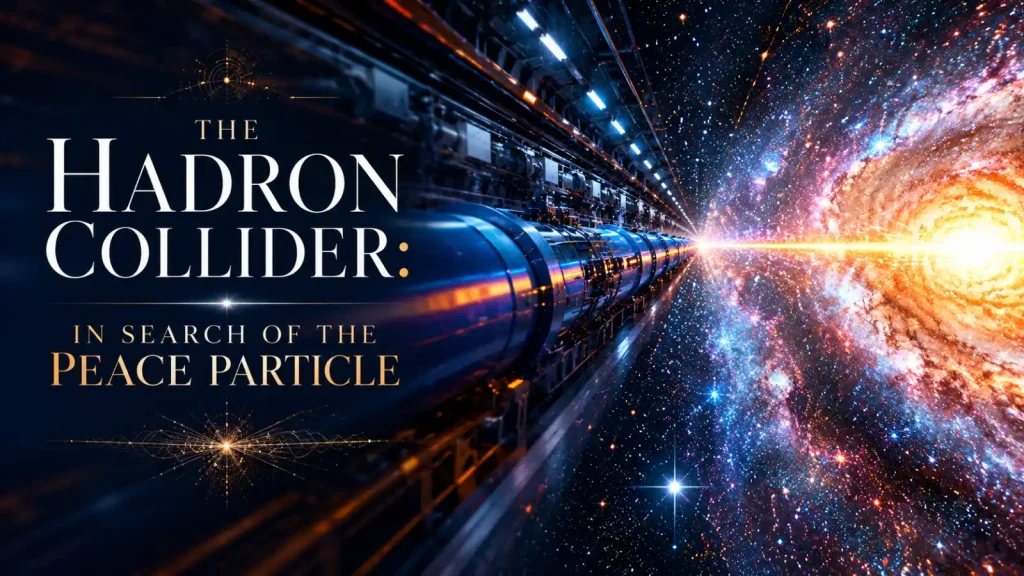
The Hadron Collider: In Search of the Peace Particle tells the story of CERN, the laboratory born from the ashes of Hiroshima, where scientists from warring nations have worked side by side for 70 years. The documentary blends rare archival footage of Robert Oppenheimer with extraordinary access to the Large Hadron Collider, the most powerful and complex machine ever built by humankind. It follows the physicists who hunted the Higgs boson, the engineers who tamed a 27-kilometre ring of superconducting magnets, and the elders who remember why the laboratory exists at all.
The timing could hardly feel more urgent. Russia’s full-scale invasion of Ukraine has forced CERN’s council to end cooperation with up to 500 scientists from Russian institutions, the first time in seven decades that politics has essentially determined a council decision. The Hadron Collider: In Search of the Peace Particle asks whether an institution founded on the promise of “peaceful application only” can survive a world sliding back towards confrontation.
What emerges is both a history of modern physics and a portrait of fragile hope. Israelis work alongside Palestinians here. Indians collaborate with Pakistanis. A community of more than 17,000 people from over 110 nationalities shares one goal: understanding why anything exists at all. As one physicist puts it, this is a truly precious gift which cannot be taken for granted.
The story begins with the bomb. Archive footage shows Oppenheimer delivering his famous confession: “Now I am become death, destroyer of worlds.” Pressed by an interviewer about whether the scientists who built the weapon suffered from a bad conscience, he admits the work left a mark on many of those responsibly engaged. Building bombs, he says, is not the natural business of a scientist.
President Truman’s announcement lands with chilling pride. One American aircraft dropped a single bomb on Hiroshima carrying more power than 20,000 tons of TNT. He called it the greatest achievement of organised science in history, a two-billion-dollar gamble that had paid off. Oppenheimer saw it differently. Playing a meaningful part in the deaths of over 100,000 people, he reflects, is not something you think of with ease. “We had known the sin of pride.”
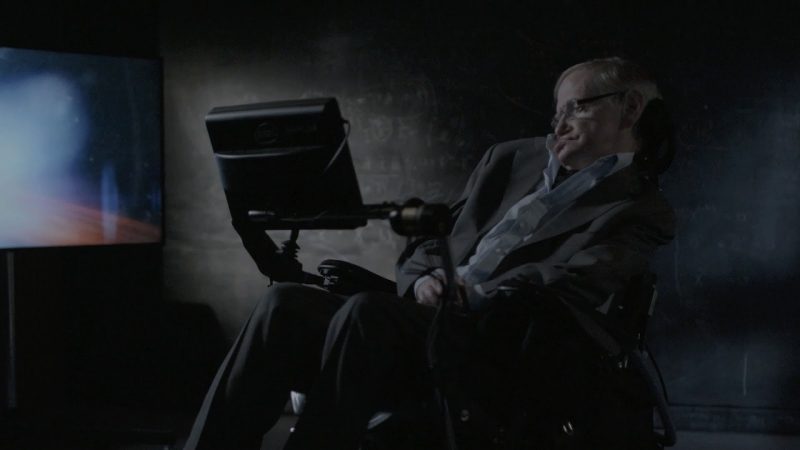
One of the documentary’s most remarkable witnesses lived through that era from the other side. A centenarian former Director-General of CERN, still coming into the laboratory decades after stepping down in 1990, recalls fighting against Russia and the British as a German soldier. He was at Dresden, by chance, when 10,000 people died in a single night of bombing. He knew real war. He also knew Werner Heisenberg, who led Germany’s nuclear effort and who had calculated, mistakenly, that an atomic bomb could not work. When told it had, Heisenberg sat down, redid the mathematics and found his own error.
The Hadron Collider: In Search of the Peace Particle
The Founding Promise That Made CERN a Laboratory for Peace
Out of this devastation came an idea that seems almost unimaginable today. Shortly after the Second World War, a handful of visionary scientists and diplomats gathered to lift Europe out of the ruins. Within only a few years, they created CERN. Its founding convention contains a sentence that defines everything that followed: the organisation exists for collaboration in nuclear research of a pure scientific and fundamental character, with peaceful application only.
The scientists who survived the bomb era understood exactly what they were promising. After the first few minutes of elation following the atomic test, one recalls realising what had happened to the world. The great task became eliminating that danger, explaining to governments that this new knowledge must never again be associated with war. Men like Oppenheimer and Heisenberg, who had worked on opposite sides of the conflict, set aside political differences and concentrated on science.
The warning that accompanied CERN’s birth still resonates. An atomic war would end civilisation, and with it any science at all. Mankind, the founders argued, has to learn to control itself, because it now holds the power to destroy itself very cheaply. Every technology cuts both ways. A typewriter can serve war, or it can serve peaceful poetry. The responsibility of the scientist is to ensure new technologies are used in the proper way.
That double mission, promoting science while improving relations between countries, makes CERN unique among world institutions. No other organisation carries both roles in its foundation.
The Machine That Breathes With the Moon
Deep beneath the Franco-Swiss border, roughly 100 metres underground, the Large Hadron Collider recreates the first instants of the Big Bang. Protons race around the 27-kilometre ring from opposite directions and slam together in head-on collisions. Each impact concentrates enormous energy into a single point, briefly producing conditions the universe has not seen since a fraction of a fraction of a second after its birth, around 10 to the power of minus 35 seconds.
The engineering tolerances defy belief. The entire circumference is aligned to better than a tenth of a millimetre. Movements far smaller than that can corrupt the data, because the experiments hunt particles with lifetimes of 10 to the power of minus 22 seconds. Even the moon affects the machine. Like the ocean tides, gravitational shifts make the ring breathe, and engineers must track every tiny movement of matter around the Earth.
The man who made the plans tells his story with disarming humour. He arrived at CERN in 1969, took over the LHC project in 1993, and steered it to approval by the end of 1994. Fifty-five of CERN’s seventy years belong to him. The tunnel itself was inherited from a previous machine, but everything inside it had to be invented. A dedicated pit allows the colossal magnets to be lowered onto transport vehicles and carried into the ring, piece by painstaking piece.
The Atlas detector, the biggest experiment ever built in particle physics, inspires something close to devotion. One physicist remembers visiting before deciding whether to join CERN at all. Seeing the detector settled the question instantly. The precision, the scale, the human effort poured into every component, she says, made it feel like love. Atlas captures 40 million three-dimensional pictures per second across roughly 150 million channels.
Switch-On Day 2008 and the Disaster That Followed
Ironically, an apocalyptic scare gave the LHC its global debut. A professor went to court to stop the experiment, warning the Earth could be eaten from the inside out, and told broadcasters his next appearance might be his last because tomorrow could be the end of the world. CERN’s scientists found the panic absurd, but the publicity proved priceless. The story attracted public and media attention the laboratory had never enjoyed before.
Normally CERN would never publish a switch-on day. Forced into it, the team picked a date and went flat out to make it. On the morning of 10 September 2008, staff arrived to find satellite dishes, lorries and mobile studios crowding the site. The Google logo that day was the LHC. The accelerator chief gave a running commentary as the countdown began, unaware his wife was watching at home. He had barely slept, his mind cycling through voltages and checklists, certain something would fail.
Nothing did. The beam circulated on the first attempt, and the control room erupted in cheering and applause. Physics, one researcher observes, usually has a garage feel, a craft of hacking and tweaking and getting it wrong until you get it right. This time it worked immediately. The success, the team insisted, only looked easy because of the quality of the equipment, the software and, above all, the people.
Nine days later, every screen in the control room turned red. A catastrophic fault destroyed around 50 magnets in one sector and released the helium that kept the ring superconducting. Initial estimates of a two-month delay stretched into a full year. The emotional recovery took just as long. Yet the project’s architect kept perspective. He had waited 24 years since first imagining the physics of the LHC. Another year or two, he decided, was bearable. The teams rolled up their sleeves and rebuilt.
From Melted Shell Casings to a Superpower Summit: CERN’s Quiet Diplomacy
The peace mission runs through the machine’s very metal. When engineers needed exceptionally high-purity brass for a calorimeter, the material proved expensive and scarce. Russian colleagues realised they possessed vast stocks of Second World War shell casings made from exactly the right alloy. More than a million wartime shell casings were collected, melted down and transformed into a scientific instrument. Ammunition built for killing now measures the building blocks of matter.
Throughout the Cold War, CERN functioned as one of the few holes in the Iron Curtain. Scientists from the Soviet bloc could come to Geneva, and Western researchers could travel the other way, when almost no one else could cross. That openness positioned the laboratory for an extraordinary moment of statecraft in November 1985, when Ronald Reagan met Mikhail Gorbachev near Geneva, the first summit between the superpowers’ leaders in more than six years.
Behind the scenes, CERN played host. The head of the American delegation asked the laboratory’s leadership to help prepare the ground, seeking a place respected by both sides where problems could be discussed freely and informally. A small group of Russians and Americans gathered for dinner at CERN. After the first toast, their host discreetly left them alone. Reagan later declared that the two sides understood each other better, calling that understanding a key to peace. When Gorbachev eventually signed the first disarmament agreement, The Hadron Collider: In Search of the Peace Particle suggests, the physicists had quietly helped make it possible.
The Day the Higgs Boson Stopped Being a Theory
The scientific summit of the story arrives on 4 July 2012. Peter Higgs had proposed his particle in 1964 to explain why elementary particles have mass at all. One theorist compares the Higgs boson to the capstone of a Roman arch: remove it and the entire elegant structure collapses. Without it, particles would fly through the universe at the speed of light, never forming composite matter, never forming the Earth, never forming us.
For decades the particle stayed hidden. Theorists could not predict its mass, so they calculated how it would reveal itself across different possibilities, suspecting it was too heavy for earlier accelerators. The LHC changed the equation. After the helium disaster, the machine restarted cautiously, climbing step by step until it reached the highest energy ever achieved by an accelerator on Earth. Then, while calibrating the detectors, analysts saw something growing in the data. Bam, bam, bam. A peak emerged. Could this be it?
People worked days and nights checking and rechecking. Particle physics enforces a strict magic limit, a statistical threshold of evidence that must be crossed before anyone may use the word discovery, and it had to be crossed independently by two separate experiments as a vital cross-check. A seminar was scheduled even before the teams knew whether they had a discovery or merely the approach to one. Half the collaboration learned the other half’s results at the same moment as the world.
When the plot appeared, one clean distribution with a single dramatic spike, the room exploded in cheering. “We have observed a new particle consistent with the Higgs boson.” The Director-General’s verdict became instantly famous: as a layman, I would now say, I think we have it. Peter Higgs, present 48 years after publishing his theory, wept. He called it incredible that the discovery had happened in his lifetime. The day ended, fittingly, in champagne and beer.
The discovery teams embodied the founding ideal. They included Russians and Americans, Chinese and Europeans, Indians and Pakistanis, Israelis and Palestinians. This is an endeavour, one leader reflects, that genuinely unifies the human race.
The World Wide Web, the Cernettes and an Accidental Cultural Revolution
CERN’s most transformative export never collided a single proton. In the 1980s, the laboratory overflowed with incompatible information systems scattered across different computers and networks. Tim Berners-Lee proposed letting them communicate by sharing information, and his fundamental contribution, the URL, made universal hypertext click into place. The name itself was born over a beer under the big tree in the CERN cafeteria, when Berners-Lee suggested “World Wide Web”. A colleague approved immediately, noting only that it was a bit long. French speakers, who found it unpronounceable, were less enthusiastic.
The web’s first brush with popular culture came from inside the laboratory. Berners-Lee belonged to a theatre crowd that included the Cernettes, a band whose signature song teased a workaholic physicist: you never spend your nights with me, you only love your Collider. Their photograph became the first picture of a band, of anything social rather than scientific, ever published on the web. CERN soon recognised that its invention had outgrown any single institution’s ability to manage it.
The cultural exchange now flows both ways. Metallica, Muse, Roger Waters, Jack White and the Pixies have all visited, setting a high bar for future rock pilgrims. Even the antimatter laboratory has acquired a pop-culture press office of sorts. Asked the science-fiction question, whether CERN could ever produce enough antimatter to be dangerous or to power a starship, one physicist laughs that the world’s best antihydrogen machine frankly isn’t up to it. Accumulating a single gram would take longer than the age of the universe. That gram, admittedly, could put a space shuttle into orbit, which is exactly why nobody wants to stand near it.
There is a warning inside the wonder, too. The web’s own pioneers believe we have not seen even the tip of the iceberg, and that the internet’s effect on society, both good and bad, remains unimaginable. One voice rejects the comforting idea that it is just a tool. No, comes the reply. It is an alien life form. Asked whether there is life on Mars, he answers that it has just landed here.
War in Ukraine Tests the Ideals at the Heart of The Hadron Collider: In Search of the Peace Particle
The film’s present-day drama unfolds during Council Week, when delegates from the member states gather in Geneva for decisions. The invasion of Ukraine has already forced the suspension of contracts with Russia and Belarus, ending cooperation with up to 500 scientists. For the laboratory’s elder statesman, the moment is painful. In 70 years, he says, this is essentially the first time politics has determined a council decision. The last world war was so terrible he believed a new one unimaginable. Humanity, he thought, should have learned the lesson.
One question remains open. A laboratory in Russia, similar in character to CERN, has been a partner since 1967. The council must decide whether to preserve that long-standing collaboration or cut every remaining tie. A Palestinian physicist from Hebron argues that sanctions contradict CERN’s foundation. The laboratory rose from the ash of Europe in 1954, he points out, and Americans, Western Europeans and Soviets worked together through the height of the Cold War. You cannot generalise the decisions of a few people in governments to entire peoples. He knows Russian colleagues who oppose the war and are paying for something that is not their fault.
The verdict arrives by letter, read aloud with visible relief: the council has decided not to terminate the agreement. CERN remains in its tradition. Had the decision gone the other way, the centenarian observes, it would have ended any relationship with the Russian Federation entirely. The reprieve is partial, the wider rupture real, but the founding principle survives the vote.
The same spirit animates daily life on the experiments. The physicist from Hebron describes a workplace where belief and background simply do not matter to the science. He is a Muslim who sees no contradiction between his faith and his research; his goal is not to contradict God but to discover the laws that govern nature. Science, colleagues agree, gives people from any religion or political system a shared basis on which to collaborate. That, in the end, is what CERN is for: science for peace.
Dark Matter, a Giant New Collider and the Questions Still Waiting Underground
The hunt is far from over. Dark matter haunts the next generation of researchers, an invisible substance that must exist in enormous quantities, roughly four times more than all the visible mass of the universe. Understanding it means understanding whether the known particles are all the pieces there are, or whether nature is hiding more. CERN’s leadership is already projecting decades ahead, running a feasibility study for a successor accelerator roughly three times the size of the current LHC, determined to keep the laboratory the number one lab in the world.
The human stories carry their own unfinished business. An Indian physicist recalls arriving as a student so lacking in confidence she felt like an impostor on another planet, with literally no other Indians at CERN and even the smell of the coffee alien to her. The confidence and the smiles came only after years of sleepless nights. A young researcher in the control room admits a different ache: watching collisions in real time and feeling haunted by all the discoveries the future will make that she may never live to know.
Perhaps the oldest voice offers the simplest wisdom. Asked how he reached 100, the former Director-General gives two rules. Always stay active. Always be curious. Curiosity, after all, built everything here. Physicists who see electrons as red and think about quarks while eating spaghetti. A theorist who hears Beethoven and Mahler in particle physics, rich symphonies built from seven notes, just as nature’s overwhelming complexity rests on three fundamental particles.
The Hadron Collider: In Search of the Peace Particle closes where physics meets poetry, with the reminder that we are pieces of the sub-nuclear universe, that every atom belonging to me as good belongs to you, and that everything we are began as a tiny dot brimming with existence. Seventy years on, the promise made in the shadow of Hiroshima still holds, renewed daily by thousands of people who refuse to let borders decide what human beings can discover together. The machine recreates the birth of the universe. The community around it, perhaps more remarkably, keeps recreating peace.
FAQ The Hadron Collider: In Search of the Peace Particle
Q: Why was CERN created after the Second World War?
A: CERN was founded in 1954 by visionary scientists and diplomats determined to lift Europe out of the ruins of war. After Hiroshima, physicists who had seen knowledge turned into weapons vowed it would never happen again. The founding convention restricts the laboratory to research of a pure scientific and fundamental character, with peaceful application only.
Q: What is the Higgs boson and why does it matter?
A: The Higgs boson explains why elementary particles have mass. Without it, particles would fly through the universe at the speed of light, never forming matter, the Earth or us. One theorist compares it to the capstone of a Roman arch: remove it and the entire structure collapses. Peter Higgs proposed the particle in 1964.
Q: When was the Higgs boson discovered at the Large Hadron Collider?
A: CERN announced the discovery in 2012, 48 years after the theory was published. Two separate experiments had to cross a strict statistical threshold of evidence as a vital cross-check before anyone could use the word discovery. Peter Higgs attended the announcement in tears, calling it incredible that it happened in his lifetime.
Q: How big is the Large Hadron Collider and how precise is it?
A: The LHC runs through a 27-kilometre tunnel roughly 100 metres underground, aligned to better than a tenth of a millimetre. Even the moon affects it, making the ring breathe like ocean tides. Engineers track every tiny movement, because the experiments hunt particles with lifetimes of just 10 to the power of minus 22 seconds.
Q: What went wrong after the LHC switch-on in 2008?
A: Nine days after a flawless first beam, every control room screen turned red. A fault destroyed around 50 magnets in one sector and released the helium keeping the ring superconducting. An expected two-month delay stretched into a full year. Teams replaced the magnets from spares and rebuilt, describing the emotional recovery as equally slow.
Q: Why did people fear the Large Hadron Collider would destroy the Earth?
A: A professor went to court to stop the 2008 start-up, warning the Earth could be eaten from the inside out. The scare proved unfounded but generated enormous publicity, drawing satellite trucks and global media to CERN. The Google logo that day featured the LHC, and the switch-on succeeded on the first attempt.
Q: How did CERN help end the Cold War?
A: CERN acted as a hole in the Iron Curtain, letting scientists from both sides collaborate when borders were closed. Before the 1985 Reagan–Gorbachev summit near Geneva, CERN hosted an informal dinner where Russians and Americans could talk freely. Physicists believe that groundwork helped Gorbachev sign the first disarmament agreement.
Q: Did CERN really invent the World Wide Web?
A: Yes. In the 1980s, Tim Berners-Lee created the web at CERN to connect incompatible information systems, with the URL as his fundamental contribution. The name was coined over a beer under the big tree in the CERN cafeteria. The first non-physics picture published on the web showed the Cernettes, a band from the laboratory’s theatre scene.
Q: How has the war in Ukraine affected CERN?
A: CERN ended cooperation with up to 500 scientists from Russian institutions, the first time in 70 years that politics essentially determined a council decision. However, the council voted not to terminate one long-standing partnership with a Russian laboratory dating back to 1967, preserving a fragment of the founding tradition of science for peace.
Q: What will CERN search for after the Higgs boson?
A: Dark matter tops the list, an invisible substance roughly four times more abundant than all the visible mass of the universe. CERN is also running a feasibility study for a future accelerator about three times the size of the current LHC, projecting the laboratory decades ahead to remain the world’s number one lab.