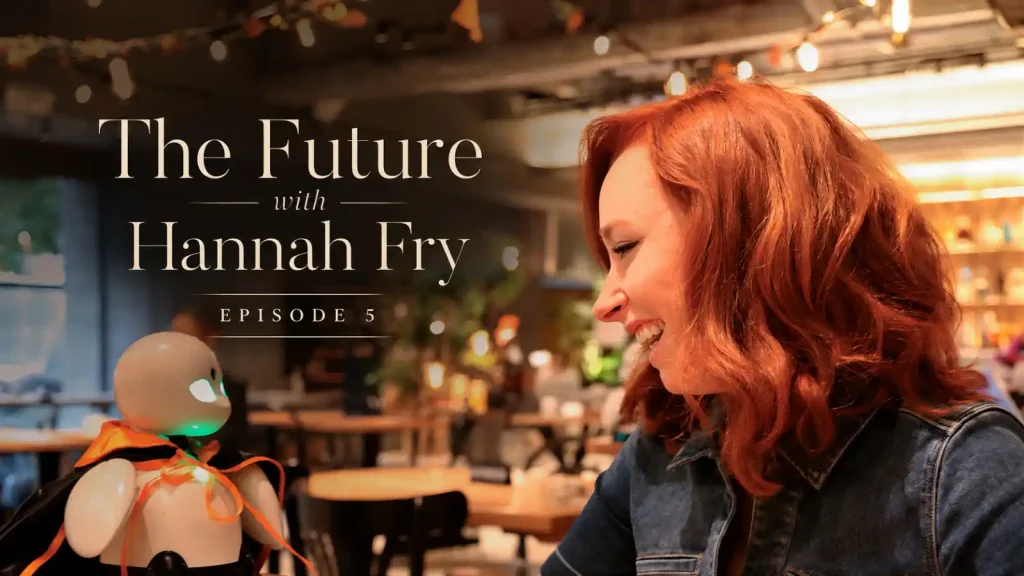
The Future with Hannah Fry episode 5 takes viewers from a Tokyo café staffed by robots to a New York lab building bionic hands, asking whether revolutionary technology can finally transform the lives of more than a billion disabled people. Mathematician Professor Hannah Fry investigates how advances in computing, telecoms and robotics could dismantle the everyday barriers — inaccessible transport, unnavigable workplaces, isolating environments — that lock disabled people out of full participation in society. The answer she uncovers is more surprising and more human than the gleaming gadgets suggest.
The episode threads together coffee-making robot avatars, mind-controlled prosthetic limbs, live-subtitling smart glasses, and buildings designed around the experience of blindness. Each story carries the same emotional charge: the difference between being included and being left behind. Across Japan, Ukraine, London and California, the people Fry meets share one message that cuts through the hype.
Technology can open doors, but it cannot be relied on as a saviour. The simplest interventions — a strip of carpet, a dropped kerb, a Braille sign — often matter more than the most expensive innovation on the market. The Future with Hannah Fry episode 5 makes that case with rare clarity, and it does so through the voices of disabled people themselves.
At the Dawn Cafe in Tokyo, the waiting staff are robots, and on this particular Halloween they greet customers with a warmth that feels entirely human. That warmth is real. Each robot is piloted remotely by a disabled person, many of them housebound, some operating their avatar from a hospital bed hundreds of miles away. The robots are not a novelty. They are a workforce.
The founders built the café around a radical ambition: eliminating loneliness from the human race. They created a new form of social participation, one that lets people work and socialise without leaving their homes. Seventy disabled people are employed to pilot the robot workers remotely, turning physical isolation into genuine connection. It reframes what a job can be when the commute and the building itself are no longer obstacles.
One of those pilots is Kiyo, who has lived with cerebrospinal fluid leaks for twenty years. The condition makes sitting upright painful, so she spends most of her day lying down, controlling her robot avatar from a tablet while reclined. Through the robot she takes orders, chats with strangers, and shares an energy that visitors immediately feel. When Fry observes that the technology really is helping her feel more included, the point lands without need for embellishment.
What makes the café so striking is how unremarkable the underlying technology is. Operating a robot avatar from 300 miles away is not cutting-edge engineering. The hardware is ordinary; the impact is extraordinary. That gap between simple tools and life-changing outcomes becomes the central thread running through The Future with Hannah Fry episode 5.
The Future with Hannah Fry episode 5
The Bionic Hand That Learns From Its Wearer in Ukraine
Half a world away, Ukrainian medical doctor Dima Gazda has built something that pushes prosthetics toward a future once confined to science fiction. As founder of Esper Bionics, he has developed a robotic arm controlled by the wearer’s own muscle signals — a limb you can move with your mind. Its cuff is covered in sensors that read incredibly fine signals of muscle activation straight through the skin.
The science behind it is elegant. When anyone wants to move a hand, the brain fires an electrical impulse down the nerves toward the muscles. For an amputee, that process is identical; it simply stops slightly earlier along the arm. By placing sensors on the skin, the device picks up those tiny electrical signals and translates them into mechanical motion. Fry explains the mechanism with characteristic precision, then shows why this particular arm is different.
Basic myoelectric prosthetics read intention from just two muscles — imagine pushing your fist forward to open the grip, backward to close it. Gazda’s new generation senses signals from sixteen different muscles at once. That leap means the wearer can imagine a whole range of gestures and the arm translates each one into the correct grip. Integrated AI and machine learning let the hand learn from its owner, growing faster and more accurate the more it is used.
Fry calls it the Rolls-Royce of prosthetics, a piece of kit worth tens of thousands of dollars. The vision is a noninvasive limb that mimics every nuance of a human hand, eventually matching the proprioception — the body’s innate sense of where it is in space — that takes able-bodied people a lifetime to develop. Gazda believes that in less than twenty years we will control prosthetic limbs seamlessly with our minds. The promise is dazzling, but the price tag foreshadows a problem the episode refuses to ignore.
Why Smart Glasses That Subtitle the World Moved a Deaf User to Tears
Hearing loss is the second most common disability in the world, and one team has found a strikingly simple way to augment the deaf experience. Voice-to-text has grown sophisticated in recent years, so they projected live transcription onto the inside of a pair of glasses. The result is effectively live subtitling of the world, displayed in the wearer’s field of vision as people speak.
The technology, XRAI Glass, was shaped by people who needed it. Brand ambassador Jacqui Press, born profoundly deaf, helped focus its development. She describes the relentless strain of lip reading: you cannot watch two things at once, so conversation at a dinner table or a professional meeting becomes a constant series of missed moments. Reading a translation on her phone means losing everything happening in front of her. The glasses promise to close that gap.
Press remembers crying the first time she wore them. Putting them on and instantly being able to see what her daughter and husband were saying blew her away — an opportunity she had never had. That raw reaction captures the emotional stakes far better than any specification sheet. For someone who has spent a lifetime piecing speech together from fragments, instant clarity is overwhelming.
David, access coordinator at London’s Park Theatre, offers a more measured verdict. He is one of a hundred deaf people who applied to trial the glasses in the real world. Removing his cochlear implant and interpreter, he found the subtitles clear despite a slight delay, and saw obvious value in meeting rooms, theatres and cinemas. Yet he is wary of becoming too reliant on technology, noting that with tech there always seems to be a barrier. The glasses are not perfect — they falter in noisy rooms and are not fully accurate — but this is only a trial phase, and the direction of travel is unmistakable.
The Disability Rights Argument Against Technology as a Saviour
The most important challenge in The Future with Hannah Fry episode 5 comes not from a gadget but from a person. Campaigner and engineer Aubrie Lee, living in the tech Mecca of San Francisco, refuses to believe technology holds all the answers. Her perspective reframes the entire investigation, shifting it from what machines can do to what society should already be doing.
Her warning is grounded in economics as much as principle. The latest assistive technology does not come cheap. Tools that help people commute, socialise or spend time outdoors carry price tags that become a barrier in their own right. A bionic arm worth tens of thousands of dollars solves nothing for the person who cannot afford it. When the solution to exclusion is itself out of reach, the inequality simply moves rather than disappears.
Lee’s message could not be clearer: we cannot rely on expensive technology to overcome barriers, because we should be removing those barriers in the first place. Living life to the full is a basic that everyone should be able to expect, not a premium feature unlocked by purchasing power. The point reframes inclusion as a question of design and responsibility rather than consumer spending.
That argument matters because it resists the seductive logic of the gadget. It is easy to get excited about shiny new tech, harder to confront the social choices that made the tech necessary. By placing a disabled engineer’s critique at the heart of the episode, Fry ensures the conversation stays honest about who benefits from innovation and who gets left out when the only solutions cost a fortune.
Universal Design and the Architect Who Builds for Blindness
If technology is not the whole answer, what is? The episode turns to an architectural philosophy called universal design — the practice of creating spaces accessible to everyone who wishes to use them, built in from the start rather than retrofitted as an afterthought. It is a quiet revolution, and one of its most compelling advocates is a man who learned its value the hardest way.
Architect Chris Downey lost his sight in 2008 and turned that loss into expertise. He observes that architects often design only for the eyes, forgetting the rest of the body that comes along with them. The building he designed is engineered so blind people feel as at home as everyone else, with three floors devoted specifically to the blind experience. The design works through acoustics, sound and touch rather than spectacle.
The features are deliberately uncomplicated. Hard surfaces on the main circulation routes let people hear exactly where they are, while the acoustic shift from a reverberant elevator lobby to an open space tells the body the room has changed. Carpet by the reception desk and seating areas calms the noise and defines the space. There is even a small notch where a visitor can rest their cane instead of constantly battling with it. High-contrast colours guide people around furniture, and handrails are designed to feel beautiful, adding a sense of care.
The genius lies in how invisible it all is. The building looks surprisingly normal, with most of its accessibility woven in so subtly that an able-bodied visitor barely notices. Much of it is low tech and simple, which is precisely the point. Thoughtful design does not announce itself — it just works, making a space functional and quietly delightful at the same time.
What Inaccessible Buildings Feel Like for Visually Impaired People
To understand why universal design matters, the episode listens to those who navigate hostile spaces every day. Bobbi and Lee both work at The LightHouse, an organisation supporting blind and visually impaired people, and their descriptions of badly designed buildings are vivid and sobering. Their testimony turns an abstract principle into lived reality.
Walking into a space designed without visually impaired people in mind, one of them explains, is like hitting a wall of sound, noise and echo over hard floors — a disorientation so complete that the only option is to stand still and wait for someone to help. The other describes feeling lost at sea, asked to find a single buoy in a vast ocean. Locating a small target across an enormous, featureless space is doable, but it drains far more mental brainpower than it should.
The remedy, they stress, is often almost laughably simple. It is easy to lay a strip of carpet that leads straight to a reception desk. These tiny things cost nothing close to millions, and if the people who build these spaces would only talk to disabled users, they could be designed in from the ground up. The failure is rarely technical; it is a failure to ask and to listen.
That insight fuels one of Fry’s most optimistic conclusions. Over and over, it is the simple stuff that makes the biggest difference — drop kerbs, Braille signs, ramps, carpets leading to reception desks. We do not need to wait for a fresh round of human ingenuity or for some future technology to mature. We already have everything we need to make the world dramatically more inclusive right now.
The Hidden Cost of Excluding Disabled People From Work
Returning to the Tokyo café in its closing stretch, The Future with Hannah Fry episode 5 sharpens its focus on employment, where exclusion carries one of its heaviest tolls. Less than one third of disabled adults hold paid jobs, a statistic that exposes how much human potential goes unused. Against that backdrop, the café’s robot-piloting model looks less like a curiosity and more like a blueprint.
The emotional weight of that gap becomes personal. Fry reflects on how silly it seems that this kind of inclusive working is not happening everywhere, given how ordinary the technology behind it is. She thinks of all the people who lack anything like it in their lives — and the sheer scale of the difference such a ubiquitous tool could make if it were rolled out widely rather than confined to one café.
The point hits hardest through a single story. Fry recalls a sister who works in a school for people with special needs, and the sadness of what happens when those students leave at eighteen and find there is nothing waiting for them. A model like the Dawn Cafe could give exactly those people a place, a purpose and a community. It is a reminder that inclusion is measured in individual lives, not abstractions.
Kiyo’s gratitude closes the loop. Despite the pain of sitting, she gives her time generously, and the exchange underscores what the technology actually delivers: not novelty, but belonging. Remote working is easy to take for granted, yet for those otherwise denied social connection, its impact is profound. The café proves the tools to include people already exist — what is missing is the will to use them everywhere.
Why Inclusion Is a Collective Responsibility, Not a Technical Fix
The Future with Hannah Fry episode 5 arrives at a conclusion that balances hope against realism, and it is all the more powerful for refusing easy answers. The technology now emerging has undeniable potential to change the lives of millions living with disabilities. Mind-controlled limbs, subtitling glasses and robot avatars are not fantasies; they are arriving. But potential is not the same as delivery.
The danger, Fry warns, is treating technology as the saviour. Doing so makes it tempting to decide that inclusion is somebody else’s problem to solve — a job for engineers, start-ups and future breakthroughs rather than for all of us. That mindset quietly absolves society of responsibility while disabled people keep waiting for solutions that may never become affordable or universal.
The truth that emerges is sharper. Technology will only have far greater power to enhance inclusion once society itself agrees on a collective responsibility to make the world accessible. The carpet leading to the desk, the dropped kerb, the building designed around blindness, the job that does not require leaving a hospital bed — these come from shared commitment, not from waiting for the next gadget.
That is the lasting message of The Future with Hannah Fry episode 5. The future of inclusion will not be bought; it will be built, together, from tools we already hold in our hands. From a coffee-making robot in Tokyo to a bionic limb in New York, the revolution depends less on what technology can do and more on what we collectively decide everyone deserves.
FAQ The Future with Hannah Fry episode 5
Q: How does the Dawn Cafe in Tokyo use robots run by disabled people?
A: The Dawn Cafe employs disabled people to pilot its robot waiting staff remotely, often from home or a hospital bed. Around 70 workers control the avatars, taking orders and chatting with customers. The setup turns physical isolation into paid work and social connection, built around the founders’ ambition of eliminating loneliness from the human race.
Q: How does a mind-controlled bionic arm actually work?
A: Sensors placed on the skin detect the tiny electrical impulses the brain sends down the arm’s nerves toward the muscles. For an amputee, that signal travels the same way but stops earlier. The device reads those signals through the skin and translates them into mechanical motion, letting the wearer move the hand by intention rather than switches.
Q: What makes the Esper Bionics hand different from traditional prosthetics?
A: Basic myoelectric arms read just two muscles, so they only open and close the grip. The Esper Bionics arm, built by Ukrainian doctor Dima Gazda, senses signals from 16 different muscles. Wearers can imagine a range of gestures and the hand picks the right grip. Integrated AI lets it learn, becoming faster and more accurate with use.
Q: How do XRAI subtitle glasses help deaf and hard of hearing people?
A: XRAI Glass converts speech to text and projects it onto the inside of the lenses, giving the wearer live subtitling of conversations. This frees deaf users from constant lip reading, which forces them to watch one thing at a time and miss everything else. Brand ambassador Jacqui Press, born profoundly deaf, helped shape the development.
Q: What are the main limitations of live-subtitle smart glasses?
A: The glasses are not fully accurate and struggle in noisy environments. There is also a slight delay, so wearers read slightly behind the conversation. The technology remains in a trial phase, with around 100 deaf people testing it in real settings. Users caution against becoming too reliant, since technology often introduces a barrier of its own.
Q: Why shouldn’t technology be treated as the saviour for disability inclusion?
A: Treating technology as the answer makes it tempting to decide inclusion is someone else’s problem to solve. Campaigner and engineer Aubrie Lee argues that expensive assistive tech often moves inequality rather than removing it. The latest devices, including bionic arms worth tens of thousands of dollars, stay out of reach for many who need them most.
Q: What is universal design in architecture and why does it matter?
A: Universal design creates spaces accessible to everyone who wishes to use them, built in from the start rather than added later. Architect Chris Downey, who lost his sight in 2008, points out that architects often design only for the eyes. His approach uses acoustics, touch and sound so blind people feel as at home as anyone else.
A: Hard floors on main routes let people hear exactly where they are, while carpet near desks calms the space and defines it. High-contrast colours guide visitors around furniture, and handrails are made to feel beautiful. Small touches help too, like a notch where someone can rest a cane instead of constantly battling with it.
Q: What does an inaccessible building feel like for someone visually impaired?
A: Workers at The LightHouse describe it as walking into a wall of sound, echo and hard floors, leaving them standing still until someone helps. One compares it to feeling lost at sea, asked to find a single buoy in a vast ocean. Navigating such spaces is possible but drains far more mental energy.
Q: How many disabled adults have paid jobs, and why does it matter?
A: Fewer than one third of disabled adults hold paid work, exposing how much potential goes unused. Models like Tokyo’s robot cafe show how remote piloting can open employment to people who cannot easily leave home. Importantly, the simplest fixes, such as carpets, dropped kerbs and Braille signs, often make the biggest difference and already exist.