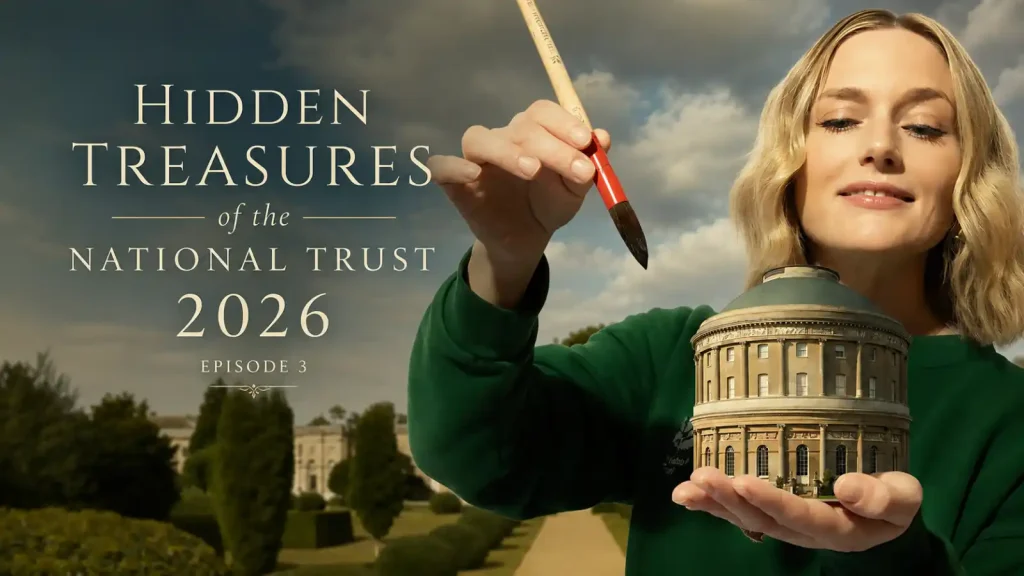
Two of the National Trust’s most remote and atmospheric properties take centre stage in Hidden Treasures of the National Trust 2026 episode 3, a journey that links a windswept island chapel battered by the North Sea with a modest Welsh farmhouse that helped save an entire language. One is Inner Farne, the largest of the Farne Islands off the Northumberland coast, where the seventh-century hermit St Cuthbert founded a religious presence that still draws pilgrims today.
The other is Ty Mawr Wybrnant, the birthplace of William Morgan, the man who translated the Bible into Welsh and, in doing so, may have rescued the Welsh language from extinction. Both sites are fragile, exposed and under threat from the elements, and Hidden Treasures of the National Trust 2026 episode 3 follows the conservators, archaeologists and rangers fighting to protect them.
What connects these two windswept locations is the idea of pilgrimage. For more than a thousand years, people have braved the crossing to Inner Farne to walk in Cuthbert’s footsteps. For decades, visitors have sought out Ty Mawr to stand in the room where Morgan’s story began. Both places hold a single object of enormous cultural weight, a stained glass window glowing with northern saints in one, a 450-year-old Welsh Bible in the other, and both objects are showing the strain of age and weather.
The stakes are urgent. On Inner Farne, a priceless Victorian window facing the open sea has been hammered for 170 years and risks total collapse. At Ty Mawr, water is driving through the gable wall fast enough to saturate a beam above the fireplace, threatening to reduce a building of national importance to a ruin. Against these threats, the teams deploy everything from purified water and cotton buds to drones carrying magnetic sensors, all in the service of stories that refuse to be forgotten.
Two miles out into the North Sea, the Farne archipelago scatters across the water in 28 tiny islands. Early on a midsummer morning, collections and house manager Nick makes the crossing he describes as a commute that never quite feels normal, scanning the swell for dolphins. The islands feel separate from the mainland yet just within reach, and that quality of being both remote and accessible gives them what he calls a heavenly feel.
Only a handful of the islands are open to the public, and even then under tight restrictions, because the Farnes are an internationally important seabird colony. Hundreds of thousands of birds arrive every breeding season. Yet the cultural heritage here is arguably of equal significance, and it begins with one man who first set foot on the largest island, Inner Farne, more than 1,400 years ago.
St Cuthbert was prior of the monastery on nearby Lindisfarne, Holy Island, one of the most significant centres of Christianity in the early medieval British Isles. Seeking solitude and a place to worship in peace, he came to live on the Farnes. His particular form of faith required that he be alone, and there are few places on earth better suited to solitude than a rock surrounded by endless sky and sea. Although nothing tangible of Cuthbert’s own world survives on the island today, his presence remains the defining force of the place, the reason pilgrims still cross the water to reach it.
Hidden Treasures of the National Trust 2026 episode 3
The Stained Glass Window Facing The Full Force Of The North Sea
The island’s 14th-century chapel has long been the first port of call for pilgrims following in Cuthbert’s footsteps, and its crowning glory is a 19th-century stained glass window. It depicts Cuthbert alongside two fellow Northumbrian saints, Aidan and Aethelwold, in vivid colour that wows visitors the moment they step through the door. People walk in expecting stone and shadow, and instead they get a wall of light.
That beauty comes at a cost. The window sits on the east side of a chapel in the middle of the sea, which means it takes the full brunt of the weather. Over roughly 170 years it has been hammered, and despite a comprehensive repair in the 1990s, when it was removed entirely and taken to the mainland, the damage has crept back. The masonry around the panes has loosened to the point where daylight shows through the gaps and the mullions visibly shift when touched.
A team of stained glass conservators led by Alison arrives on Inner Farne to bring the window back to life. The plan is to remove all six panes, then clean and repair the intricate glasswork at ground level. Lifting historic glass from height is nerve-racking work, and the team treats every pane as priceless. The windows were made by William Wailes of Gateshead, one of England’s most prolific 19th-century stained glass manufacturers, renowned for ornate patterns and bold colour combinations. For the conservators, several of them women in what was long a male-dominated craft, the chance to preserve something that will stay in place for the next century or two feels like a privilege worth the risk.
Inside The Delicate Art Of Cleaning Priceless Victorian Glass
Once the panes are out, the painstaking work begins. The team cleans the glass with nothing more aggressive than soft cloths, cotton buds and purified water, removing 30 years of accumulated grime a fragment at a time. The caution is deliberate. Victorian paint was not always fired at high temperatures, which means it can lift straight off the surface if handled carelessly. Every stroke has to be gentle enough to take the dirt without taking the image.
Before the last panes can come out, stonemason John has to stabilise the loose masonry around the openings. He wedges slate packers into the gaps to hold the stonework steady, a temporary fix that prevents the whole window from being lost during the repair. The team then repoints the loose stone, because unaddressed gaps let rain in, and once water freezes inside the joints it expands and bursts the stone apart. On an island this exposed, the difference between repair and ruin is measured in millimetres.
The payoff arrives when the cleaned and repaired window goes back into the chapel. Cuthbert and his fellow saints return looking cleaner, brighter and richer than before, with details emerging that even people who have stared at the glass for over a decade had never noticed, including a soldier shielding his eyes that nobody on the team had registered.
After Cuthbert died on the island, his body was buried at Lindisfarne, where it remained for nearly 200 years until the monks fled the invading Vikings in 875, carrying his remains with them. His shrine eventually reached Durham Cathedral, which became a place of pilgrimage in its own right, extending a story that the chapel window now helps to keep alive.
Counting Puffins On A Disappearing Coastline
Cuthbert is not the only draw for visitors from across the world. Inner Farne shares its ground with around 200,000 seabirds, and one of twelve National Trust rangers, Sophia, leads the work of monitoring them. The Arctic tern colony alone makes the walk loud and occasionally combative, as the birds dive at anyone passing through their nesting ground.
The puffins are the islands’ headline residents, and the rangers count them one burrow at a time. When a burrow turns out to be occupied, the team follows standard handling procedure, slipping a bag over the bird to keep it calm before tagging it, weighing it and measuring its beak. Any puffin seen carrying a blue colour ring has come from the Farne Islands. Because puffins only spend about three months of the year on land while raising a single chick, the rangers must gather as much data as possible in a narrow window before the birds vanish back out to sea for another nine months.
The pressures on these birds are mounting. Climate change is warming the sea and pushing their food further from the colony, leaving them with serious challenges ahead. The numbers reflect that strain. This year’s census recorded 38,500 pairs of puffins across the islands, down from 50,000 pairs the previous year.
The rangers are careful not to panic, noting that the figure does not automatically signal decline, since seals compacting the soil and storms washing away the burrow cap can both force the birds to shift where they nest before that fresh map has been recorded. Other species offer brighter news, with Arctic terns up 24 percent and shags rising from 30 pairs to 58. Across 25 breeding species, the Farnes remain a vital hub, and the team does everything it can to keep the ground safe for the birds’ brief return.
Hunting For Cuthbert’s Lost Hermitage With Cutting-Edge Technology
Despite Inner Farne being only a few hundred metres wide, no evidence of where Cuthbert actually lived and worshipped 1,400 years ago has ever been found. The location of his cell remains uncertain, pieced together from educated guesses and the surviving historical sources. Chief among those is the vivid account of Cuthbert’s life written by the monk and early medieval historian Bede, just 30 years after the saint’s death. Bede describes a structure almost round in plan, measuring four or five poles, roughly 60 to 80 feet across, made higher inside by cutting away the living rock. That is not a humble hut, but something substantial.
To find it, a team of archaeologists from the University of Bradford brings a deliberately non-invasive approach, because the island is too important and too fragile to dig. The ground is riddled with delicate puffin burrows that collapse under the lightest footstep, so trowels and trenches are out of the question. Instead, the team waits until the breeding season ends and the skies clear, then uses a drone to capture 3D imagery of the whole island in about 25 minutes, with magnetic sensors slung beneath larger drones to detect buried features. On more stable ground, researchers run ground-penetrating radar, sending radio pulses into the soil to map what lies beneath.
When the data resolves, something intriguing appears. The survey reveals a series of potential walls and a distinctive flask-shaped feature near the tower that immediately grabs the eye. To archaeologist Mark, it has the feel of something early medieval, possibly a roundhouse with an entrance passage, and it was very likely there 1,400 years ago.
It is not yet a definitive match for Bede’s description, and the radar can only reach so deep. But it confirms the team is searching the right part of the island, and it establishes the extraordinary archaeological potential of a site nobody had ever properly investigated. As the researchers put it, this is a case of scan this space, with future non-invasive techniques perhaps one day proving the link to Cuthbert’s age beyond doubt.
A Tiny Puffling’s Race To Reach The Sea
As the breeding season closes and the adult puffins prepare to leave for nine months at sea, one young bird is left behind. A puffling has become stuck in the lighthouse compound at the top of the island, unable to make its own way to the water. Left there, it would either grow increasingly stressed and ill or be picked off by a large gull.
Sophia steps in to give the bird its chance. These pufflings have never touched water or even seen the sea before, so the moment marks the start of everything. She carries it down to the shore and lets it find its bearings, watching it stand tall on those small legs, take in the open water for the first time, and look slightly shellshocked by the sheer scale of what lies ahead.
Then it goes. The puffling takes to the sea, and the rescue becomes the kind of happy ending that makes the work worthwhile. The rangers cannot always intervene, and being unable to help is the hardest part of the job. But when a rescue lands like this one, it carries a weight far beyond a single small bird, a reminder of why the conservation effort on these islands matters at all.
Ty Mawr, William Morgan And The Bible That Saved A Language
The episode’s second story unfolds in a hidden Welsh valley, where Ty Mawr Wybrnant sits so remote that arriving visitors are sometimes surprised to find anyone there at all. There has been a property on the site since at least the 15th century. Although the name translates as big house, the current building has just two storeys and a handful of rooms, restored to reflect how it would have looked in the 16th century. Fflur now cares for the building and the stories it holds, greeting the space each morning with a moment of silence before the day begins.
Within these four walls sits an object that draws people from all around the world: the first translation of the complete Bible into the Welsh language. It is forever linked to Ty Mawr because it was the work of William Morgan, born and raised here as the son of tenant farmers on the estate. In the mid-16th century the building was a busy inn, a place of culture, language, song and poetry that sheltered passing cattle and sheep drovers. Surrounded by that richness of conversation and storytelling, the young Morgan absorbed a vocabulary and a lyricism that would later flow into his text.
Morgan’s gift with words was spotted early. He was sent away to be educated by a local chaplain and later ordained, and when Elizabeth I commissioned a Welsh Bible to help secure the Protestant Church in Wales, he was chosen to translate it. The work took him ten years. When it was completed in 1588, a thousand copies were printed and distributed to every church in Wales. It is often said that Morgan’s translation saved the Welsh language, preserving it and stopping it from dying out, because without a Bible in Welsh the language and all its culture might have vanished, never to be seen again.
Conserving The Fragile 1588 Bible For The People Of Wales
Only around 60 copies of the original 1588 Bible survive, and the one at Ty Mawr is showing its age. The National Trust owns roughly half a million books, yet this copy ranks among its most important. Across 450 years this well-thumbed volume has been patched up many times, with missing pages replaced by crude copies that have since browned and grown brittle. The original text block remains, but the later binding is starting to fail.
Specialist book conservator Sharon is called in to make the Bible stable enough to travel, because in a few months it is due to go on display at the Senedd, the Welsh Parliament in Cardiff. As Fflur frames it, the copy will visit the people of Wales rather than the other way round. Sharon begins by surface-cleaning the binding with a soft brush, then works through a text block of more than 500 leaves, lifting dirt page by page while keeping the book’s value firmly set to one side so she can focus on the task.
The repairs are meticulous. Where tears open up as the pages turn, Sharon lays acid-free blotter beneath them and covers each tear with tiny squares of fine Japanese tissue paper, fixing them in place with a gentle adhesive of wheat starch and water before drawing out the moisture with more blotter and trimming away the excess. The result is a seamless, almost invisible repair that lets the page move as a single body, eliminating the risk of further tearing. Each book, she notes, has its own journey, and this one carries the weight of a nation’s history.
Weatherproofing A 16th-Century Home Against The Storms
Preserving Morgan’s story means preserving the building itself, and Ty Mawr is not an easy place to keep dry. The valley’s weather can be extreme, and the exposed gable end wall takes the full force of it. Water was coming in at a rate the team simply could not stop, saturating the beam above the fireplace. Left to nature, the building would only get wetter and wetter until it became a ruin.
Builder Ned and his team set out to make the house watertight using traditional methods that would have been familiar in Morgan’s own day. The approach centres on lime. When Ty Mawr was built, materials came straight from the surrounding land, with river gravel sieved and combined with burnt limestone to create a hot mix that heats dramatically the moment water is added. Modern rules forbid river gravel, so the team substitutes aggregate from a builders’ merchant, but lime remains the magic ingredient, drawing moisture out of the wall and keeping it breathable.
After repointing the gable to a flush finish, Ned builds up seven or eight coats of lime wash, comparing the process to dressing a house that has stood naked too long in a punishingly wet climate, giving it the equivalent of a light waterproof jacket. The test comes with the weather itself. After Storm Amy battered the valley, Ned returns to find the lime wash has adhered well and held firm. As long as the limewashing is renewed year on year, the rain should no longer drive through the wall, and a building steeped in history has been made resilient again, ready to shelter its greatest treasure.
A Growing Library And A Bible’s Homecoming
Ever since the 1588 Bible went on display, Ty Mawr has quietly become a place of pilgrimage, and visitors from across the globe have started paying tribute in an unexpected way, by donating Bibles in other languages. Bibles have arrived from Africa, from the many dialects of Kenya and India, alongside a Gospels in Scouse and a Japanese edition, each one extending in its own way the very thing Morgan did, making scripture accessible in a language people actually speak. The collection has grown to some 300 volumes, and a new library finally gives them a home that is safer and better for their conservation, opened by Trystan and curated with help from the Trust’s national curator for libraries.
While Ty Mawr gains hundreds of new Bibles, its Welsh original sets off on its own pilgrimage, a 170-mile journey to the Senedd in Cardiff. There it becomes the centrepiece of a new exhibition celebrating Bishop Morgan’s legacy and his Bible’s pivotal role in Welsh language and culture. Morgan’s translation is described not simply as a religious act but as a revolutionary act of preservation, one that gave the Welsh people access to scripture in their own tongue.
For the Senedd members who speak about what its presence means, bringing an object of this nature into the heart of Welsh democracy carries real emotional charge. William Morgan himself rose to become a priest and then a bishop, and although he died in relative poverty in 1604, he left the nation a priceless treasure.
After two months in Cardiff, the Bible returns to its modest but newly watertight home in the valley, its rightful place secured for visitors to enjoy for generations. That sense of continuity runs through both halves of Hidden Treasures of the National Trust 2026 episode 3. On Inner Farne, the restored chapel window glows once more above an island where archaeologists have only begun to scratch the surface of Cuthbert’s lost world, and where a single rescued puffling carries the hopes of an entire colony.
In a quiet Welsh farmhouse, a 450-year-old book that once saved a language has been steadied for the future, and the building that bore it has been given the protection it needs to survive the next storm. Everyone who works at these sites becomes, in the end, just one more line in a story that stretches back a millennium and a half, and Hidden Treasures of the National Trust 2026 episode 3 makes the case that such stories are worth every ounce of care it takes to keep them alive.
FAQ Hidden Treasures of the National Trust 2026 episode 3
Q: Who was St Cuthbert and why is he linked to Inner Farne?
A: St Cuthbert was a seventh-century prior of the monastery on Lindisfarne, one of the most significant centres of early medieval Christianity in the British Isles. Seeking solitude, he came to live on Inner Farne, the largest of the Farne Islands, more than 1,400 years ago. His form of faith required that he be alone, and he founded the religious presence that still draws pilgrims to the island today.
Q: Why is the Inner Farne chapel window so badly damaged?
A: The 19th-century stained glass window sits on the east side of a chapel surrounded by sea, so it takes the full brunt of North Sea weather. Over roughly 170 years it has been steadily hammered by storms. Despite a complete repair in the 1990s, when it was removed and taken to the mainland, the masonry around the panes loosened again to the point where daylight showed through the gaps.
Q: How do conservators clean priceless Victorian stained glass safely?
A: They use only soft cloths, cotton buds and purified water, lifting decades of grime a fragment at a time. The caution matters because Victorian paint was not always fired at high temperatures, so it can lift straight off the surface if handled roughly. Every stroke has to be gentle enough to remove the dirt without taking the painted image with it.
Q: Are puffin numbers declining on the Farne Islands?
A: This year’s census recorded 38,500 pairs of puffins, down from 50,000 pairs the previous year. However, rangers caution that the figure does not automatically signal decline. Seals compacting the soil and storms washing away the burrow cap can force puffins to move where they nest before that fresh distribution has been mapped. Climate change also pushes their food further from the colony.
Q: How are archaeologists searching for Cuthbert’s cell without digging?
A: The island is riddled with fragile puffin burrows that collapse under the lightest footstep, so trenching is impossible. Instead, a team from the University of Bradford uses non-invasive geophysical methods. Drones capture 3D imagery and carry magnetic sensors, while ground-penetrating radar sends radio pulses into the soil to map buried features without disturbing a single burrow.
Q: What did the Inner Farne survey actually find?
A: The radar data revealed a series of potential walls and a distinctive flask-shaped feature near the tower. To archaeologists it has the feel of something early medieval, possibly a roundhouse with an entrance passage, and was very likely present 1,400 years ago. It is not yet a confirmed match for Cuthbert’s hermitage, but it shows the team is searching the right part of the island.
Q: How did William Morgan’s Bible save the Welsh language?
A: Morgan produced the first complete translation of the Bible into Welsh in 1588, after Elizabeth I commissioned it to secure the Protestant Church in Wales. A thousand copies were printed and distributed to every church in Wales. By giving people scripture in their own tongue, the translation preserved the language and its culture, which might otherwise have died out entirely.
Q: Why is Ty Mawr Wybrnant important to Wales?
A: Ty Mawr Wybrnant is the birthplace of William Morgan, the man who translated the Bible into Welsh. He grew up here as the son of tenant farmers when the building was a busy inn full of culture, song and poetry. That rich environment shaped the vocabulary and lyricism that later flowed into his text, making the modest farmhouse a site of national pilgrimage.
Q: How is the fragile 1588 Welsh Bible being conserved?
A: A specialist book conservator first surface-cleans the binding with a soft brush, then works through more than 500 leaves removing dirt. Where tears open as pages turn, she covers each one with tiny squares of fine Japanese tissue paper, fixed with a gentle adhesive of wheat starch and water. The result is a seamless, almost invisible repair. Only around 60 copies of the original survive.
Q: How was the Ty Mawr farmhouse made watertight against storms?
A: Builders used traditional lime methods that would have been familiar in Morgan’s day. After repointing the exposed gable to a flush finish, they applied seven or eight coats of lime wash, which draws moisture out of the wall while keeping it breathable. Lime is the key ingredient, acting like a waterproof jacket. After Storm Amy battered the valley, the new surface held firm.