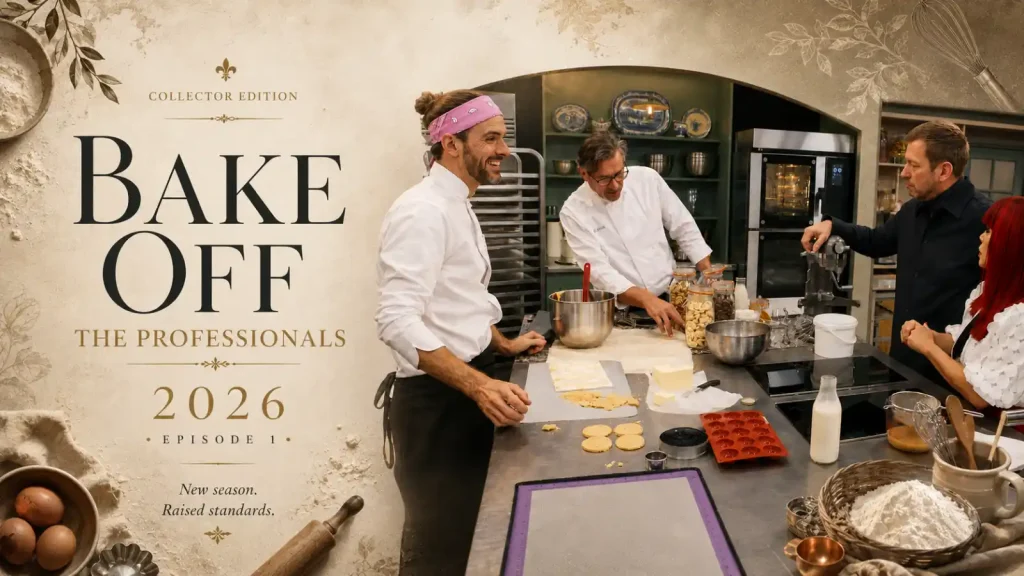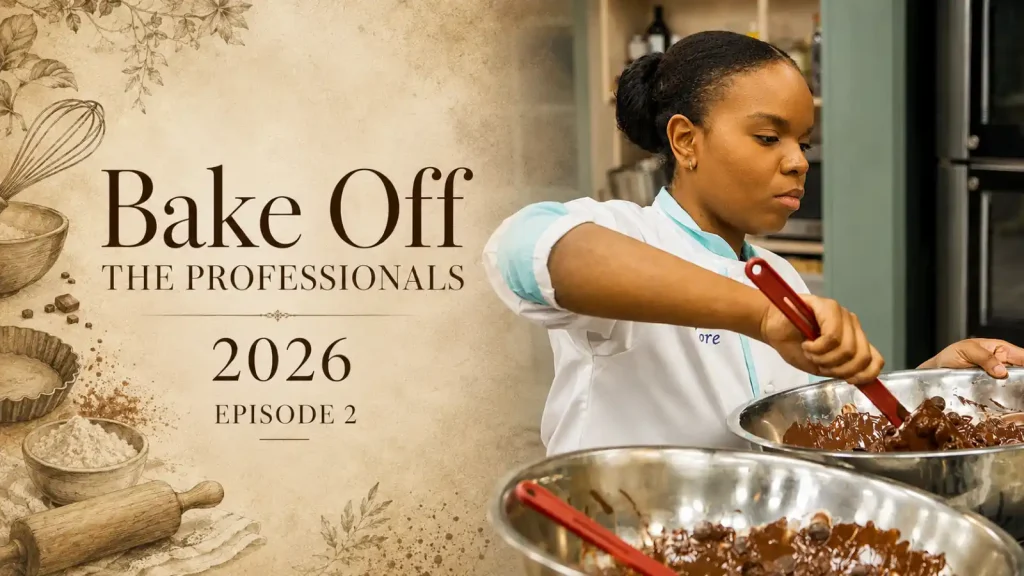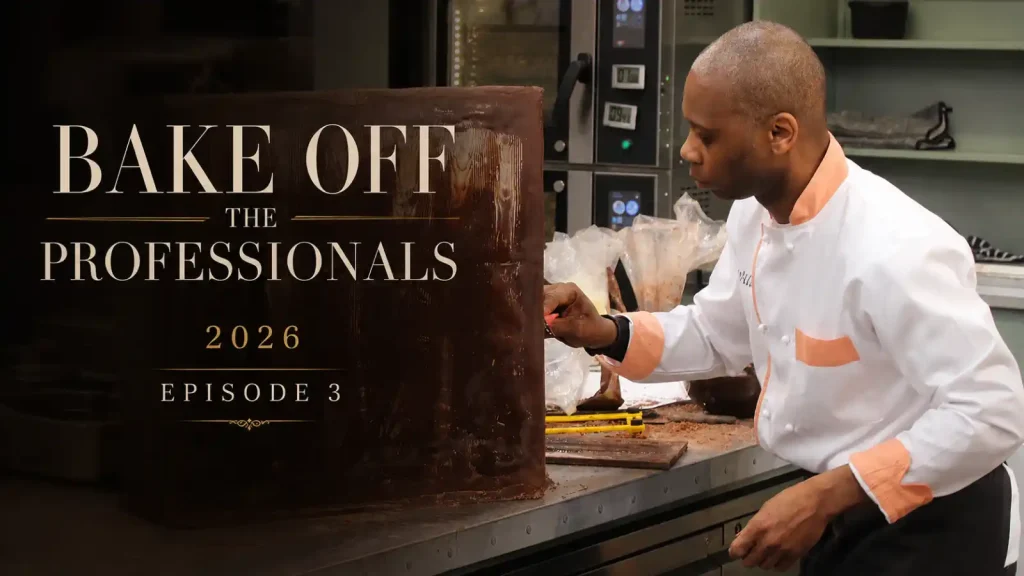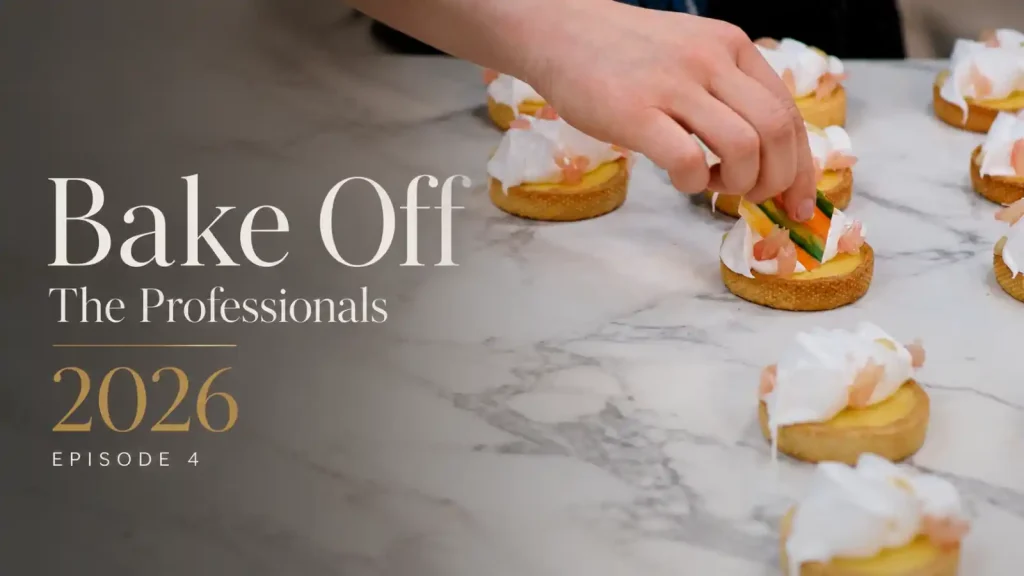
Bake Off The Professionals 2026 Episode 9 delivered the cruellest twist of the series so far: a semi-final that stripped four elite pastry teams down to a single pair of hands each. Cherish Finden and Benoit Blin opened proceedings by announcing that only one chef per team could touch an ingredient. The other had to stand back, watch, and talk. What followed was an hour of pure technical exposure, built around île flottante — the simplest French dessert in the canon, and the one most likely to humiliate anyone who has never actually made it.
The stakes could not have been higher. Four teams remained, three places in the final were available, and the second challenge demanded something no previous series had asked for: entirely edible summer holiday scenes with floating structures, plus two dozen choux buns split across two flavours. Seven hours of build time. Water in play. Physics as an unforgiving co-judge.
By the end of Bake Off The Professionals 2026 Episode 9, one team had watched their flamingos capsize, another had rebuilt a collapsed turtle from scratch before dawn, and Emma and Flor of Lexington Catering had gone home after a showpiece the judges called incomplete. Ellie Taylor and Liam Charles kept the mood buoyant. The kitchen did not.
Only one chef could bake. The other could speak, gesture, and suffer. Every team captain volunteered, which told its own story about where confidence sat in that room. Teams were staggered at ten-minute intervals, so nobody could learn by watching a rival’s mistakes.
The brief was deceptively plain. Two identical plates of île flottante: poached meringue quenelles floating on crème anglaise, drizzled with caramel, finished with toasted almonds and spun sugar. No recipes. No reference. One hour.
Benoit defended the difficulty without hesitation, calling it the simplest French dessert there is and arguing that any professional should be able to assemble those three elements inside sixty minutes. Cherish framed it as a test of whether the chefs carried the core recipes in their heads rather than in a folder. That distinction — memorised versus looked-up — became the spine of the entire round.
Emma of Lexington Catering carried an extra weight. She is French. Her mother made this dessert for Sunday lunch when she was a child. Flor put it bluntly from the sidelines: mess this up and France disowns you.
Bake Off The Professionals 2026 Episode 9
Why Île Flottante Punished Teams Who Had Never Made It Before
Crème anglaise sits at the heart of the dish, and it is unforgiving. Keep the temperature below boiling or the yolks scramble and the texture dies. Emma worked from memory, guessing at four yolks, hunting for a temperature she could almost picture. Loki and Ashish debated 81 against 83.5 degrees like a pair of engineers.
The consistency mattered as much as the cooking. The custard needs to stay loose enough for the meringue islands to actually float. Benoit warned that if an island sank, the chef was in deep trouble.
Meringue technique split the field. Ashish reached for Italian meringue, cooking the whites with boiling sugar syrup — a denser, sturdier cousin of the French version the dish traditionally uses. Benoit noticed something else entirely: every team had missed the classical order of operations, which is to make the meringue first, poach it in the milk, then build the custard from that same infused milk.
Two teams had never encountered the dessert at all. Loki admitted flatly that they had never done it. Valentina and Aurora went further — they did not know what île flottante was, and Valentina had never even poached a meringue. Ellie’s reassurance that they were not alone was accurate, and only slightly comforting.
Poached Versus Baked: The Translation Error That Cost Lexington Catering
Meringue quenelles are supposed to be poached in gently simmering milk or water. Emma put hers in the oven. Flor watched from the sidelines and said nothing that could stop it.
For Loki, the confusion was linguistic. Poaching, in his language, meant baking. So into the oven they went. Small mistranslations become large penalties in a semi-final.
The judging was more generous than expected. Benoit noted that Emma had clearly baked rather than poached, then conceded the texture had barely suffered. Cherish praised the pinch of salt and squeeze of lemon juice used to stabilise the meringue. The toasted almonds ran slightly bitter from overcooking, but the verdict was that a floating island had genuinely been produced.
Ashish and Loki drew sharper criticism. Their meringue read dense and too sweet, and Benoit traced the density directly back to the Italian meringue decision. The anglaise showed visible dots of overcooking. Poaching in water rather than milk had cost them flavour depth. Given they had never attempted the dish, Benoit still rated it a good job.
Oban and Avneet’s Caramel Basket and the Toughest Judging of the Competition
Oban had made floating island before. That admission raised the bar, and the plate could not clear it. Instead of the fine, airborne threads of caramel the dish calls for, Benoit saw a basket — a thick, structural cage that dominated everything beneath it.
His disappointment was unusually direct. He was not enjoying eating it. The caramel glued itself to his palate and buried the toasted almonds entirely. The custard was seasoned to perfection but ran too loose, and for the first time in the challenge he reached for a knife.
Cherish salvaged something from the wreckage, praising the poached meringue as clean and light while flagging the heavy hand with sugar. Ellie urged them not to spiral over a secret challenge. Oban’s own post-mortem was brutally short: he had made the wrong choice on the design and his brain had simply not worked properly.
Benoit later explained the severity backstage. This is the simplest French dessert there is, delivered by a Frenchman. His expectations were correspondingly high.
Valentina and Aurora’s Accidental Triumph in the Bake Off: The Professionals 2026 Episode 9 Technical
The team who knew least about île flottante produced the plate closest to the original. Benoit’s opening remark was about the sugar work — very airy, visually convincing, exactly the delicate quality the caramel basket had missed.
Not everything landed. The poached meringue read heavy and dense, though correctly cooked. The custard came out too thick and too rich in yolks, tipping toward sickly, even as the sweetness itself was judged perfect. But the meringue was poached as it should be, and that alone separated them from most of the field.
Benoit’s summary was the most valuable sentence of the round: this was one of the closest plates that day to a true floating island, with only small technical faults inside it. Cherish confirmed the ranking afterwards, placing Valentina and Aurora a fraction ahead of everybody else and Oban and Avneet at the bottom.
The lesson cut against instinct. Familiarity did not predict performance. The two teams who arrived with prior knowledge — Emma through childhood, Oban through practice — finished middling and last respectively. The chefs who improvised from first principles read the dish more accurately than those who thought they already knew it.
Seven Hours, Floating Structures and Twenty-Four Choux Buns: The Biggest Showpiece Brief Yet
The main challenge dwarfed anything the series had attempted. Benoit described a test of stamina, engineering and culinary skill: an entirely edible scene built around impressive floating structures, themed on the summer holidays. Cherish added the second layer — two different types of choux bun, a dozen of each, with flavours that reflected the chosen holiday and that had to be physically integrated into the scene.
Three hours of golden time the previous day, four hours on the day itself. Seven hours in total, the longest semi-final challenge in the show’s history, deliberately granted so the chefs could be ambitious. Liam’s brief was less technical: think big, think bold, think White Lotus without the murders.
Floating changed everything. A showpiece that merely stands still forgives weight distribution errors. A showpiece that must sit on water punishes them instantly and publicly. Benoit noted that staying afloat takes serious engineering, not decoration.
Choux pastry compounded the pressure. Multiple chefs described it as the element that frightens them regardless of experience — too many variables in how the eggs go in, how the paste is cooked at the start. To stop the buns spreading, most teams piped into moulds and chilled or blast-froze them before baking.
Turtle Island, Water Parks and Tiki Bars: How Four Teams Interpreted the Summer Holiday Brief
Oban and Avneet went wide. Nine islands, two large, two medium, one small and four tiny, populated by yuzu and mint choux shaped as flamingos, anchored by a tiki bar beach scene scattered with choux flowers, coconut cream and tropical fruit compote. Benoit challenged them directly on their historical weakness — a lack of pizzazz and focal point. Their answer, that the whole scene was the focal point, visibly worried him.
Ashish and Loki gambled the opposite way. One statement piece: a large turtle named Lucky, perched on coral, chosen because turtles signify good fortune in India. Lucky collapsed overnight during golden time, forcing Loki to rebuild the entire animal in the morning while base structures went unbuilt. Ashish’s choux carried champagne-macerated strawberries with champagne whipped ganache in one, bitter orange gel and prosecco crème pâtissière in the other.
Emma and Flor built a beach water park complete with a chocolate man named Fred to ride the slide, two floating flamingos and several floating islands carrying strawberry and sweet basil pesto choux alongside pear, grapefruit and Earl Grey. Emma cheerfully admitted she cannot swim.
Valentina and Aurora produced a coastal scene anchored by a lighthouse, attempting their own flamingo choux plus an inventive beach ball bun made from two-tone pastry rolled and sliced like salami, so the triangular segments read as panels on a ball.
Oven Failures, Sinking Flamingos and the Engineering Reality of a Floating Showpiece
Disaster arrived through the equipment. One team’s oven surged, the temperature climbing when it should have held, and a tray of choux burned. Something is burning, one chef said. They were right. With limited time left, the question became whether there was enough paste to bake again.
Weight distribution decided the rest. Ashish and Loki worked deliberately to balance their island, hauling the coconut tree into position and testing stability before committing. Emma and Flor could not solve the same problem — the chocolate man was too heavy to float, and Fred never made it down the slide.
Then the flamingos went for a swim. Both Oban and Avneet’s and Emma and Flor’s floating birds failed the water test, capsizing in front of the judges. Benoit called it a daring design that backfired, and expressed genuine disappointment when the second set sank too. Flor’s summary was devastating in its simplicity: she could not hear the feedback because all she could see was her choux floating in the water.
How the Judges Ranked the Final Four Teams in the Bake Off: The Professionals 2026 Episode 9 Verdict
Ashish and Loki’s Turtle Island won the room. Cherish loved the turtle’s cartoonish facial expression and the density of small details. Benoit declared himself visually transported and called it exactly what the competition is about. Their rebuilt choux earned praise for the champagne and strawberry pairing, with a note that more cream would have improved the fill, while the bitter orange ran a fraction too bitter.
Oban and Avneet redeemed the previous day comprehensively through flavour. The flamingo choux drew comparisons to a raspberry mojito, with mint that Benoit genuinely liked and a bun baked beautifully. The coconut cream and exotic compote version won even higher marks for the interplay of creaminess, mango acidity and a choux baked to perfection. Benoit’s verdict — shoe-tastic — was the warmest of the episode.
Valentina and Aurora’s lighthouse was singled out as an effective focal point that worked, though some boats sat unfinished. Their beach ball bun divided the judges: light, fluffy mascarpone and lemon cream, undermined by a strawberry and basil element that offered gel and nothing else texturally, prompting Benoit to say he was bored by it. The flamingo bun fared better, with toasted coconut and lime cheesecake cream that ate beautifully.
Emma and Flor were told plainly they had bitten off more than they could chew and that attention to detail had suffered. The Greek yogurt, basil pesto and strawberry bun came with dry choux and an overly thick chocolate coating. Inside the second bun, Benoit found a messy build, and the grapefruit and Earl Grey pairing simply did not marry.
The Elimination That Sent Lexington Catering Home One Round From the Final
Cherish and Benoit ranked the teams across both challenges. Ashish and Loki took first place, the judges citing a showpiece that brought the summer holidays into the kitchen and engineering skill they rated the best by a distance. Oban and Avneet placed second on the strength of flavour, having produced what Cherish considered the best choux buns of the round.
That left Valentina and Aurora against Emma and Flor. The lighthouse survived. The water park did not. The judges’ assessment was that Emma and Flor had tried hard and put real effort into the table, but the display was not complete at all.
Emma and Flor left the competition at the semi-final stage. Flor’s reflection carried no bitterness — reaching that point was, in her repeated word, beyond. Cherish’s parting advice was to take classes and come back stronger.
Ashish and Loki, having rebuilt a collapsed turtle overnight and watched their gamble pay off, framed the final in the only terms that matter at this stage: they are not going to play the final, they are going to win it. The competition now narrows to a contest against themselves rather than the field, with one last push separating three teams from the title.
FAQ Bake Off The Professionals 2026 Episode 9
Q: What happened in Bake Off: The Professionals 2026 Episode 9?
A: The semi-final combined a solo secret challenge built around île flottante with a seven-hour floating showpiece themed on summer holidays. Only one chef per team could bake during the technical. Ashish and Loki finished first, Oban and Avneet second, and Emma and Flor of Lexington Catering left the competition one round from the final.
Q: Why did only one chef per team compete in the secret challenge?
A: Cherish Finden and Benoit Blin wanted to strip away the safety net of teamwork. One chef handled every element alone while their partner watched from the sidelines and offered verbal advice only. Teams were also staggered at ten-minute intervals, so nobody could learn by observing a rival’s technique first.
Q: What is île flottante and why is it so difficult to get right?
A: Île flottante, or floating island, is poached meringue quenelles sitting on crème anglaise, finished with caramel drizzle, toasted almonds and spun sugar. Its difficulty lies in balance. The custard must stay loose enough for the meringue to float, yet cooked enough to avoid a thin, raw texture.
Q: Why does crème anglaise split or scramble during cooking?
A: Heat is the enemy. Keeping the mixture below boiling point is vital, because egg yolks scramble the moment the temperature climbs too high. Overcooking leaves visible dots throughout the custard and ruins the silky texture. Chefs in the semi-final debated holding it between 81 and 83.5 degrees.
Q: What is the difference between poached and baked meringue in floating island?
A: Traditionally the quenelles are poached in gently simmering milk or water, which keeps them light and lets the milk carry flavour into the dish. Baking them in the oven is a shortcut. Two teams baked rather than poached, one because the word translates differently in his language.
Q: Why did the Italian meringue choice cost marks in the technical?
A: Italian meringue requires boiling sugar syrup to cook out the egg whites, producing a sturdier, heavier result than the French version the dish traditionally uses. Benoit traced the dense, oversweet texture directly back to that decision. Poaching in water rather than milk also stripped away flavour depth.
Q: Why were the judges so harsh on Oban and Avneet’s caramel?
A: The dish calls for fine, airborne threads of caramel. Instead the team built a thick basket structure that stuck to the palate and completely masked the toasted almonds. Benoit needed a knife for the first time all challenge. Expectations were raised further because Oban had made the dessert before.
Q: What did the floating showpiece challenge actually require?
A: Teams built an entirely edible summer holiday scene containing genuine floating structures, plus two different choux buns, twelve of each. Flavours had to reflect the chosen holiday and the buns had to sit within the display itself. Seven hours total made it the longest semi-final challenge in the show’s history.
Q: Why did the flamingo showpieces sink in the water?
A: Weight distribution decides everything on water. Benoit noted that staying afloat takes serious engineering rather than decoration, and both teams attempting flamingos watched them capsize. A chocolate figure built to ride a water slide proved too heavy to float at all, leaving its slide unused.
Q: Who reached the Bake Off: The Professionals 2026 final?
A: Ashish and Loki topped the round with their Turtle Island scene, rebuilt overnight after the centrepiece collapsed, and the judges rated their engineering the best by a distance. Oban and Avneet placed second on flavour, producing what Cherish considered the round’s finest choux buns. Valentina and Aurora also survived.