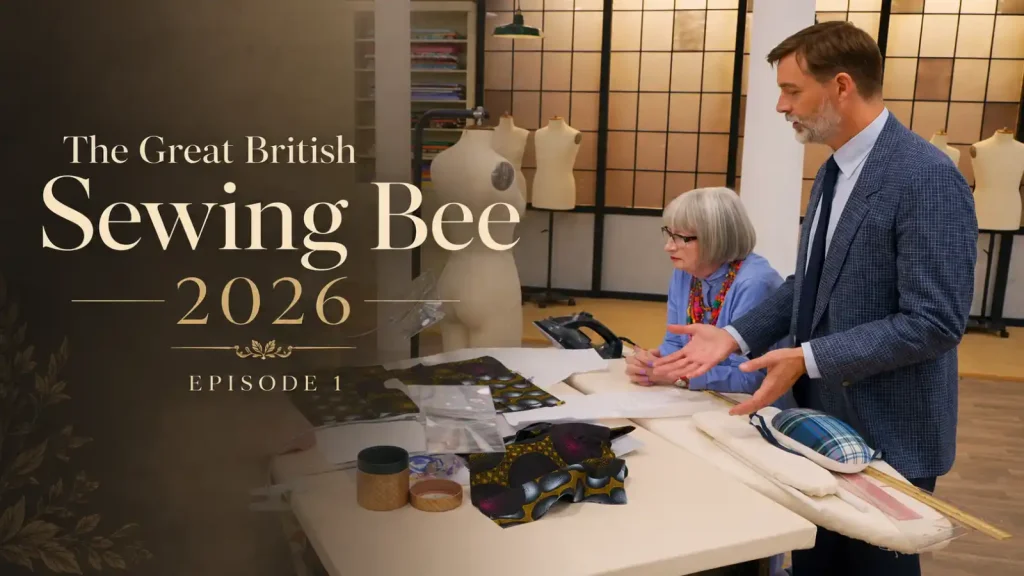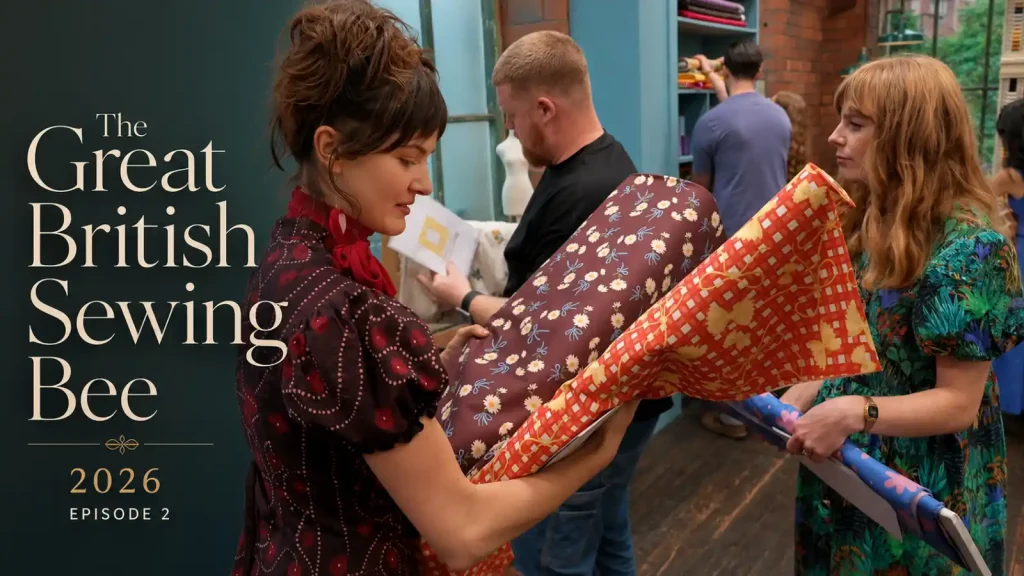
The Great British Sewing Bee 2026 episode 2 threw its 11 remaining sewers headfirst into prints and colours week, a triple test that demanded pattern-matched adaptive tops, purple-and-brown transformations, and eye-catching single-colour outfits made for real models. Judges Patrick Grant and Esme Young raised the technical bar sharply, and by the end of a bruising day, gas engineer Sam had sewn his last stitch in the competition while Adele’s flawless green culottes claimed Garment of the Week.
The episode delivered everything that makes The Great British Sewing Bee essential viewing: invisible zips inserted upside down by design, a returning adaptive fashion designer with a personal mission, judges forced to confront their own colour prejudices, and a made-to-measure round that asked contestants to dress someone other than themselves for the very first time this series.
Week one had already claimed Dawn, whose gamble on simplicity backfired, while Emma soared and Tim struggled. Week two reshuffled everything. Rebecca surged, Emma converted the judges to purple, and Adele staged one of the great single-episode comebacks the sewing competition has produced. Meanwhile, the pressure of three ranked challenges in one day exposed exactly who could hold their nerve when the clock ran down.
The Pattern Challenge opened The Great British Sewing Bee 2026 episode 2 with a brief that carried genuine purpose beyond the sewing room. Adaptive fashion designer Victoria Jenkins returned to set the task: an adaptive shell top with a high-low hem, invisible zips in both side seams, and a widened neckline, all completed in three and a half hours.
Jenkins explained the reasoning behind every element. Adaptive fashion covers garments designed for a wider range of disabilities and conditions. The side zips allow easier access for anyone using medical devices. The wider neck helps people with cochlear implants or limited mobility pull the top over their heads without a struggle. Her model, Alice, singled out the high-low hem as a personal favourite, describing excess fabric pooling at the front as one of her biggest frustrations with conventional clothing.
The brief came with a sting, however. Because the episode celebrated print, every top had to be pattern matched across the patch pocket and across both side zips. Done correctly, those adaptive features would become virtually invisible. Done badly, every misaligned motif would advertise the error.
Jenkins predicted exactly where the sewers would stumble. Invisible zips are always tricky, she warned, and the bias binding facing the neckline and armholes demanded real neatness. Geometric prints would be forgiving; hand-drawn florals could sit slightly off and betray their maker. Fabric choice, she noted, would make a big difference before a single stitch was sewn.
For several contestants, the challenge landed close to home. Beth, a PhD engineering student, sews adaptive clothing for her dad, Paul, who lost feeling in his hands after breaking his neck in a motorbike accident. She builds his shirts with oversized buttons and large buttonholes so he can dress independently. Beth also lives with scoliosis, and she described making tops that celebrate her back as genuinely empowering. Rebecca, who manages chronic stomach pain, revealed that almost everything she makes for herself is adaptive, designed to avoid any tightness around her middle. Adele connected the task to her late grandma, an amputee who struggled to find trousers that worked for her.
The Great British Sewing Bee 2026 episode 2
Pattern Matching Pushes the Sewers to Breaking Point
The technical reality of pattern matching hit hard and early. Joining patterned fabric so the design continues unbroken across a seam sounds simple. In practice, the one-centimetre seam allowance changes everything. Ignore it, and hours of careful cutting collapse into mismatched chaos.
Beth discovered this immediately. She had chosen her fabric because its colour blocks made the matching feel worthwhile, then found herself lost in a print whose repeats were far larger than she had assumed. What looked easy became, in her words, mind-boggling. Anna faced the same trap with her daisy fabric, where each cluster differed slightly from its neighbours. The York barista, who describes her style as chaotic and rarely uses patterns at all, briefly forgot to switch her machine on.
Adele arrived with unexpected confidence. Three months earlier, invisible zips would have terrified her. After relentless recent practice, she declared the challenge could hardly have suited her better. That optimism would be tested. Lewis, a 29-year-old taught to sew by his mum, brought animal print from a family of self-confessed jungle-cat dressers and shared his tidiest trick: knotting darts by hand rather than finishing them on the machine.
Sam’s morning unravelled fastest. The heating engineer, who took up sewing 2.5 years ago and favours streetwear, cut his patch pocket slightly too small. Then he stitched along its top edge, sealing it shut and rendering it decorative rather than functional. His frustration deepened at the neckline, where he used the bias binding to edge the fabric instead of enclosing it inside, departing from the set method entirely.
Minnie, meanwhile, delivered one of the episode’s most disarming interludes, chatting about her one-legged childhood chicken, her nan’s budgies, and her beloved cat Dusty, who lounges at home in Bedfordshire while Minnie produces fitted ladieswear in striking fabrics. She confessed she loves prints, provided nobody asks her to match them.
The zips proved decisive, exactly as Jenkins predicted. These fastenings went in upside down deliberately, making the tops easier to step into, and only at insertion did the sewers learn whether their cutting had preserved the match. Emma tore a hole testing hers. One sewer stitched a pleat into an armhole by accident. As the final minute evaporated, unfinished hems and unpressed seams littered the room.
Rebecca Wins the Pattern Challenge as Rankings Expose the Field
Judging brought Patrick Grant and Esme Young into forensic mode, with Victoria Jenkins joining them to rank all 11 adaptive tops. The verdicts ranged from rapturous to brutal, and the margins at the top were remarkably fine.
Rebecca took first place. Her fabric choice earned specific praise, the sewing was clean throughout, and the judges called it a fantastic sew. Anna claimed second after producing super clean, precise work everywhere the judges looked. Her pocket matching drew the word incredible, her zip was declared pure invisible, and her finished hem sealed a flawless result. Beth landed third despite her fabric struggles, her side-seam matching described as absolutely on point.
The bottom of the table told a harsher story. Sam finished eleventh, told bluntly that he simply had not followed the pattern. The judges acknowledged it could have been several sewers, but his haphazard binding and unmatched sides settled it. Adele took tenth after her zip went in the wrong way up, a mistake Patrick labelled a big boo-boo. She later admitted that assessment felt quite polite under the circumstances. Angie placed ninth, her bold print disguising side seams that sat miles out of alignment.
Heather came eighth with a puckered zip, a stretched neckline, and an unfinished back hem creating a visible step at the side. Emma’s seventh place stung after she ran out of time for her front hem, leaving otherwise strong work incomplete. Lewis took sixth, Tim fifth with solid pocket matching undermined by a slight tuck under the armhole, and Minnie fourth despite fabric caught in her zip during testing.
Rebecca’s reaction gave the result extra weight. As an invisibly disabled person, she said, winning the adaptive fashion challenge specifically meant something profound. Jenkins closed the round by stressing how important it remains to keep talking about adaptive fashion, a message the challenge itself had made tangible.
Purple and Brown Collide in a Transformation Challenge Built on Prejudice
The Transformation Challenge in The Great British Sewing Bee 2026 episode 2 turned the judges’ own tastes into the brief. Patrick loves brown; Esme can’t stand it. Esme loves purple; Patrick has never warmed to it. The sewers received 90 minutes and a heap of second-hand clothes in both colours, with one instruction: create an interplay so interesting that both judges fall for the combination.
The reveal of the garment rail drew laughter and mild horror. Shiny purple sparkle sat beside earthy brown suiting, and one sewer branded the whole pile absolutely terrifying. Adele, a devoted purple wearer, flatly refused to accept brown suited anyone. Tim disagreed, defending brown as pleasingly earthy for a man who spends his time around soil. Two years of sewing, he explained, had transformed him from a grey-and-blue dresser into someone who now looks good in everything, darling.
Strategy split the room quickly. Tim planned a halter-neck with fabric strips draping down in alternating stripes. Emma, the self-described dopamine dresser who boulders with her family, sketched an asymmetric top with a ruched purple side sweeping into brown, cheerfully noting it would flatter anyone with uneven proportions. Adele stripped sleeves from jackets to build an alternating mini skirt, one panel brown, one panel purple.
Angie flipped a purple denim-style jacket upside down and reworked it into a skirt with flared side panels and an oversized brown belt bow. The retired lecturer, who sews for her daughters Kate and Rosa, admitted her pre-sewing wardrobe was entirely black for convenience. Colour, she said, arrived with creativity. Rebecca chased ambition with a corset-style bodice, purple across the bust, and hand-made lacing to rescue two evening dresses whose removed zips had left things a little risqué. Heather, who drags boyfriend Seano around fabric shops from Hong Kong to Thailand, built cut-outs edged in plaited fabric with a purple flounce below, openly courting Esme’s love of cheekiness.
The politics of the room turned playful. Asked which judge they feared irritating, both Anna and another sewer picked Esme without hesitation, one joking she wouldn’t want to meet her in a dark alley. Elsewhere, a mock rebellion broke out demanding justice for purple and an end to Patrick’s slander of the colour.
Emma’s Asymmetric Floral Top Converts the Judges’ Least-Favourite Colours
Blind judging kept the transformation verdicts honest. Patrick and Esme walked the mannequins with no idea whose garment was whose, and despite some brilliant efforts, Esme opened by admitting she remained unconvinced about purple. The individual critiques, however, told a warmer story.
The winning garment stopped both judges. Emma’s asymmetric top, built around what Patrick called a horrible purple floral against wonderful dark chocolate brown, jumped out immediately. The asymmetry ran through both the silhouette and the fabric placement, and a rosette twisted from the overlaid reverse of the fabric drew particular admiration. Who would have thought, the judges marvelled, that those two fabrics could look so great together. Emma called the win a real boon after her seventh-place morning.
Tim took second with his halter-neck and drape, the judges praising strips that felt balanced front to back. Rebecca’s clever woven purple strips over lamé carried her to third, her full-length gown skimming the body with a back detail described as incredibly clever. Anna placed fourth, Heather fifth with her saucy cut-outs, and Minnie sixth with her brown leatherette and ditzy purple print set that weirdly worked.
The bottom placements repeated the morning’s pattern with uncomfortable precision. Sam finished eleventh again. His wrap skirt with purple buttons amounted to simple colour blocking, alternating panels without genuine interplay. Angie took tenth, told her upside-down jacket skirt needed a more interesting shape beyond a block of brown and a belted trim. Lewis placed ninth, Adele eighth, and Beth seventh.
Two consecutive last places left Sam facing the day’s arithmetic squarely. He acknowledged the back-to-back results but insisted he had fight left in him. Everything now rested on five hours and one colour.
One Colour, Five Hours: The Made-to-Measure Test in The Great British Sewing Bee 2026 Episode 2
The Made-to-Measure round introduced a first for the series: models. Until now, every sewer had fitted garments on themselves. Suddenly they were measuring strangers, and Patrick identified the hidden difficulty immediately. Working on another body meant time management, fit, and finish all became harder at once.
The brief itself sounded liberating. Create any outfit in a single colour, using unlimited shades, hues, and textures of that colour. Patrick framed the real test precisely: visual impact through one dominant colour, with fascination reserved for where each sewer placed their different shades. The room promptly abandoned purple and brown entirely. Not a scrap of either colour appeared, and Emma predicted the judges would be thoroughly disappointed.
Ambition varied wildly, and that variance decided the day. Rebecca committed to the most extravagant build in the room: a cotton dress in three shades of her trademark pink featuring 16 godets, curved panels set godet-within-godet to create dramatic volume, plus double tulip sleeves and an invisible zip down the centre back. Patrick, laughing at godets squared, promised she would never be marked down for under-ambition. Halfway through, she declared herself absolutely sick of godets.
Emma matched that workload with a plain green waistcoat carrying welt pockets, buttons, a collar and revere, and back straps, paired with a green-on-green drop-waist skirt with concealed zip. The judges rated it among the most technical outfits in the sewing room. Anna reached back to the 1880s, adapting a museum dress into a sleeveless cheongsam-inspired design with a fitted bodice, colour-blocked ruffle, bow, and elaborate tasselled braids, her modern take on Victoriana.
At the other end of the spectrum sat danger. Minnie’s blue velvet bodycon maxi used two shades with exposed seam allowances as decoration, but with no fastenings, its three long tubes had to fit perfectly or bunch. Sam’s green kaftan carried pockets, an inverted box pleat, and two hues of green, one saturated and one muted. Patrick and Esme spotted the risk instantly: simple garments demand flawless execution, and both Sam and Minnie now needed exactly that.
Grandmothers, Barbie Brunches and Batik: The Personal Stories Behind the Single-Colour Outfits
The most affecting design in the room belonged to Beth. Her blue cotton beach maxi dress recreated an ombré effect through patchworked scraps running dark to light, inspired by a dress her stylish grandma wore on holiday, an ombré that made her look as if she had just walked out of the water like a goddess. Beth showed a photograph, called her grandma a bit of an icon, and hoped simply to do her justice.
Heather leaned into pure joy. Four shades of pink powered her wide-stripe cotton trousers and light pink satin halter top with flared peplum, a look she traced to dressing head-to-toe in pink with friends for the Barbie film and dubbed perfect for brunch with the girls. She happily admitted the whole outfit gave Legally Blonde energy. Tim built a relaxed beach two-piece from indigo-dyed fabric carrying four different batik prints, panelled across a camp-collar shirt and elasticated shorts, with his model Devon arriving mid-sew for a length check that revealed things were a little on the snug side.
Angie’s resourcefulness stood out. Her marine blue wrap top with cape and fitted skirt began life as a duvet cover and a tablecloth, both hand-dyed, one carrying a small print and one large. A friendly rivalry crackled between Adele and Lewis, who realised they were building near-identical cross-back tops. North versus south, they declared, the battle of the crisscross top officially on.
The final hour compressed everything. Over half the sewers wrestled invisible zips simultaneously. Emma alarmed Patrick by only just cutting her skirt while her waistcoat still lacked buttons and buttonholes, then misaligned those buttonholes in the last-minute scramble. Anna second-guessed her trim, removed it, decided the dress needed more, and produced what she cheerfully called quite possibly her worst-ever hand sewing. Rebecca reached the deadline without a final fitting, praying her zip carried the right ease. Minnie fought a nightmare sleeve as the judges watched her stress build over a garment that should, in theory, have been simple.
Adele’s Green Culottes Deliver a Perfect Score and Garment of the Week
Judging the 11 single-colour outfits produced the widest quality spread of the day. Beth’s ombré dress earned near-total rapture. Patrick described the organic gradient, dark at the hem rising to an almost foamy spray at the shoulder, as a real treat, praised the bold decision to run the effect up just one sleeve, and admired the patchworked tie ends. It fitted beautifully. Rebecca’s godets proved equally triumphant, dramatic and organic, her three pinks working beautifully despite a slightly generous fit and an uneven zip top.
Adele’s outfit, however, achieved something rarer: an essentially faultless critique. Her two-tone green culottes with deep pleats, pockets, and invisible zip, paired with the cross-back top, drew praise for exciting colour placement, lovely shapes, and crossing back bands sitting perfectly without a pucker or gather in sight. Clean hems throughout. The whole thing, Patrick concluded, was absolutely on point. Adele called it the redemption of the invisible zip and admitted she wanted to scream with happiness.
Others fared less well. Emma’s misaligned buttonholes cascaded into misaligned pockets and points, an avalanche of consequences from one error. Minnie’s velvet clung too tightly in places, wrinkled, and rode up, its exterior seams looking untidy. Angie’s cape earned praise for balanced movement echoing her skirt, but a tuck at the bust and a poor zip dragged her down. Tim’s batik panelling impressed until Patrick noticed the central single-fabric panel lengthening the body against menswear convention, then spotted the back crotch seemingly sewn into the front. Lewis’s dark bottle-green broderie anglaise created lovely tonal variation through its holes, undermined only by untidy neckline stitching.
Sam’s kaftan received the day’s most double-edged verdict. The seam quality was absolutely first-rate, the opening perfectly sewn, yet the saturated and knocked-back greens clashed rather than conversed, and the garment remained fundamentally simple.
Sam’s Exit and the Shifting Stakes Heading Into Week Three
Garment of the Week came down to three contenders. Anna and Beth both came agonisingly close to absolutely brilliant, the judges revealed, but Adele’s culottes and top represented the perfect rendition of the one-colour brief, thoughtful in fabric placement and absolute in impact. For a sewer who began the day tenth with an upside-down zip, the turnaround was total. She called the win a life highlight and couldn’t wait to ring her mum.
The elimination carried a quiet inevitability. Sam left the competition after finishing bottom of both morning challenges. Patrick’s summary was fair and unflinching: entering the made-to-measure sitting last, Sam needed something fantastic, and although he sewed his kaftan incredibly well, its simplicity couldn’t rescue him. Sam’s exit showed the grace that defined his time in the room. He reassured his fellow sewers, acknowledged his skills were always going to be tested outside his comfort zone, and called the whole experience a journey and a pleasure.
Emma’s honest debrief captured the week’s volatility. Her up-and-down day, from a missed hem to a transformation win to buttonhole disaster, left her convinced the made-to-measure had saved her, genuinely stunned when her name wasn’t called. That fragility at every level of the leaderboard is precisely what makes this sewing competition compelling. Rebecca’s pattern-challenge win, Beth’s near-miss, and Anna’s consistent top-four finishes mark them as serious contenders, while Angie and Lewis need momentum fast.
The Great British Sewing Bee 2026 episode 2 also confirmed the show’s growing commitment to sewing creativity with substance. Victoria Jenkins’s adaptive brief connected technical skill to real lives, from Beth’s dad managing his own buttons to Rebecca’s pain-conscious waistlines. Even the purple-and-brown mischief carried a lesson about prejudice in fashion and design: the judges asked to be convinced, and Emma convinced them.
Week three promises reduce, re-use, recycle week, with tired T-shirts becoming pretty pants, potato sacks entering the sewing room, and scrap piles turning into back-view drama. The judges have already teased one of the best things they have ever seen on Sewing Bee. After a week that redeemed Adele, exposed the cost of simplicity, and sent a genuinely popular sewer to say goodbye, the ten who remain know exactly how quickly fortunes turn.
FAQ The Great British Sewing Bee 2026 episode 2
Q: What challenges did the sewers face in The Great British Sewing Bee 2026 episode 2?
A: Episode 2 was prints and colours week, built around three ranked challenges. The Pattern Challenge required a pattern-matched adaptive shell top with invisible side zips, a high-low hem, and a wider neckline in three and a half hours. The Transformation Challenge gave the sewers 90 minutes to rework purple and brown second-hand clothes, the judges’ least-favourite colours. Finally, the five-hour Made-to-Measure demanded an eye-catching outfit in just one colour, fitted to a model.
Q: Who won Garment of the Week in Sewing Bee series 12 episode 2?
A: Adele won Garment of the Week for her two-tone green split-colour culottes and matching cross-back top. Patrick Grant and Esme Young called the outfit absolutely on point, praising its deep pleats, clean hems, exciting colour placement, and crossing back bands sitting perfectly without puckering. The judges revealed three garments were in contention, with Anna and Beth agonisingly close, but Adele’s was the perfect rendition of the one-colour brief.
Q: Who left The Great British Sewing Bee in week 2 of the 2026 series?
A: Sam, a heating engineer with a streetwear-influenced sewing style, was eliminated. He finished eleventh in both the Pattern Challenge and the Transformation Challenge, so he entered the Made-to-Measure sitting bottom. Although the judges said his green kaftan was sewn incredibly well, with first-rate seams, the design was too simple to keep him in the competition.
Q: What is an adaptive shell top and why did the Sewing Bee feature one?
A: Adaptive fashion covers garments designed for a wider range of disabilities and conditions. The challenge top featured invisible zips in both side seams for easier access to medical devices, a wider neckline to help people with cochlear implants or limited mobility dress more easily, and a practical high-low hem. Adaptive fashion designer Victoria Jenkins returned to set the brief, stressing how important it is to keep talking about adaptive design.
Q: Why is pattern matching so difficult in sewing challenges?
A: Pattern matching means joining patterned fabric so the design continues unbroken across a seam, and the fabric must be cut with the one-centimetre seam allowance factored in. Ignore that allowance and the alignment is lost entirely. Print choice matters too: geometric repeats are forgiving, while hand-drawn florals can sit slightly off. Several sewers, including Beth and Anna, misjudged how large their fabric repeats actually were.
Q: Who won the Pattern Challenge in The Great British Sewing Bee 2026 episode 2?
A: Rebecca took first place with a great fabric choice and a really well sewn adaptive top. Anna finished second after super clean, precise sewing and a zip judged pure invisible, while Beth came third. Rebecca said winning the adaptive fashion challenge specifically was thrilling for her as an invisibly disabled person, since almost everything she makes for herself is adapted for chronic stomach pain.
Q: How did Emma win the purple and brown Transformation Challenge?
A: Emma created an asymmetric top combining a purple floral print with dark chocolate brown, overlaying the fabric’s reverse across the bust and twisting it into a rosette. The judges loved the asymmetry in both the silhouette and fabric placement, admitting they never expected those colours to work together. Tim took second with his halter-neck and drape, and Rebecca placed third with woven purple strips over lamé.
Q: What did the sewers make for the one-colour Made-to-Measure challenge?
A: Standouts included Rebecca’s pink cotton dress with 16 godets and tulip sleeves, Beth’s blue ombré patchwork maxi honouring her stylish grandma, and Heather’s four-shade pink trousers and satin halter top. Emma built a technical green waistcoat and skirt, Anna made an 1880s-inspired dress, Tim sewed an indigo batik beach two-piece, and Angie transformed a dyed duvet cover and tablecloth into a wrap top with cape.
Q: Why was the Made-to-Measure round harder than usual in week 2?
A: For the first time in the competition, the sewers made clothes for models rather than themselves. Patrick Grant highlighted the added pressure of managing time, achieving a perfect fit on another body, and finishing to a high standard within five hours. Minnie’s fastening-free velvet bodycon dress showed the risk, as its fit depended entirely on the stretch sitting exactly right.
Q: What happens in week 3 of The Great British Sewing Bee 2026?
A: Week three is reduce, re-use, recycle week. Tired T-shirts become pretty pants, piles of scrap turn into dramatic garments, and even potato sacks enter the sewing room. The judges teased that one creation ranks among the best things they have ever seen on Sewing Bee, as the ten remaining sewers compete to avoid being sent home.