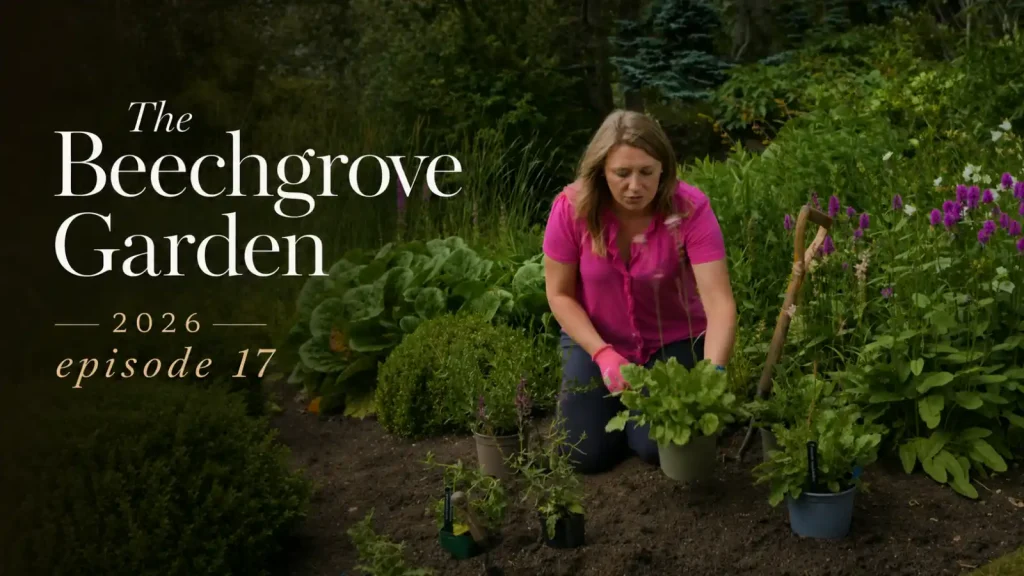
The Beechgrove Garden 2026 episode 17 puts borders at the centre of everything, as Brian Cunningham and Kirsty Wilson replant, repair and rethink the beds that hold the whole Aberdeen plot together. A hard winter killed off plants in Kirsty’s celebrated hot border. Gaps have opened behind the main pond. The calendar border, designed to deliver interest every month of the year, has drifted without attention. This week, both gardeners set out to fix all of it.
The stakes are practical and immediate. Every gardener knows the sinking feeling of a border that has lost its shape, its colour or its best plants. Rather than starting again, Kirsty and Brian demonstrate how to plug losses with smarter choices, from a rare Chilean perennial to dwarf conifers bred from forest giants. Consequently, the episode doubles as a masterclass in border recovery for any home garden.
Beyond the borders, there is a new large-scale bug hotel built against a concrete wall, a visit to a remarkable community garden on the Cowal Peninsula, and the week’s handy hints on sweet peas and wisteria pruning. Taken together, Beechgrove Garden 2026 continues to prove that an expert garden is never finished. It is constantly edited, refreshed and improved, and episode 17 shows exactly how that editing works.
Kirsty Wilson begins beside the main pond, where the border is looking very green but very quiet. The bones are good. Clipped box balls provide evergreen structure, bergenia contributes glossy foliage after flowering earlier in the year, and amsonia has already delivered its star-shaped blue flowers in early summer. However, by late summer the display fades, and that is the gap Kirsty wants to fill.
Her first choice is genuinely unusual. Francoa sonchifolia remains quite rare in cultivation, a herbaceous perennial from Chile with lovely pink flowers rising above a basal rosette of leaves. Importantly, it earns its place twice over, because that foliage turns a rich shade of red in autumn. Kirsty plants it in a group of three, easing the roots from each pot and firming the soil around them to establish a proper clump rather than a lonely specimen.
Next comes a hardy salvia called Schwellenburg, a new type with striking purple flowers and aromatic grey-green leaves. Hardy matters here. This salvia survives winter and returns the following year, so gardeners never need to worry about it dying out. It copes with dry summer conditions, flowers all season long, and responds to deadheading with a second flush. Kirsty adds that cuttings root easily, which makes it a generous plant as well as a reliable one.
The final addition is Gaura Summer Breeze, a white-flowered form with airy blooms that carry on all summer. Because gaura is not fully hardy, Kirsty uses a clever workaround: she plants it in its pot, ready to lift in autumn and shelter in a cold frame or cold glasshouse before replanting next year. The plan is simple and specific. By August, this stretch of the garden should glow with fresh late-summer flowers, and the team will return to judge the results.
The Beechgrove Garden 2026 episode 17
Dwarf Conifers Bring the Jim McColl Tribute Garden to Life
Brian Cunningham heads to one of last year’s major projects, the garden created as a tribute to Jim McColl, one of Beechgrove’s very first presenters when the programme started in 1978. It is a collection of his favourite plants, and it is settling in beautifully. A Japanese maple, Osakazuki, has taken well to its new home, its wee red stems echoing the reddish edge on the foliage. Nearby, the heather Erica EA Mitchell is quietly winning Brian over, despite his admission that he has never been a massive fan of heathers. As he puts it, Jim is still influencing how he gardens.
Today, however, Brian’s focus is conifers, and his argument for them is persuasive. Most gardeners think of conifers in extremes: fast-growing leylandii hedging that screens everything, towering giants on stately home estates, or tiny miniatures for alpine gardens. Instead, Brian champions the middle ground, dwarf cultivars derived from the world’s great forest trees, perfectly scaled for a garden border.
His first selection is Thuja plicata Whipcord, whose thin, cascading foliage looks exactly like its name suggests. The parent species can reach around 60 metres tall, yet this cultivar grows to only about 1.5 metres within ten years. On a small slope, he places a cedar called Feelin’ Blue, a prostrate form with elegant arching stems that should flop gracefully down the incline.
The plant Brian is genuinely in love with is a dwarf dawn redwood called Matthaei. He explains the fascinating origin of such cultivars: nursery growers spot witches’ brooms, patches of abnormal growth high in tree crowns caused by weather or pest damage, then propagate them into compact versions of forest giants. This dawn redwood reaches roughly two metres in ten years, yet keeps all the attributes of a parent that can exceed 25 metres. Its fern-like needles turn a lovely bronze before dropping, and Brian has positioned it deliberately so its autumn colour will reflect in the pond when viewed from the bridge.
Midsummer Planting Tricks for Bone-Dry Soil
Planting a tree in midsummer is far from ideal, and Brian does not pretend otherwise. The soil around the tribute garden is very, very dry, and the site itself is compromised. This area was once full of giant conifers, and a stubborn stump with a big root system still occupies the ground. The planting hole is smaller than Brian would like. Sometimes, he admits, you have to work with what you have got.
His first trick is one every gardener can borrow for any plant. Before planting, he plunges the entire root ball into a bucket of water. Bubbles stream out immediately, proving that even a pot looking wet on the outside can be dry deep inside. He holds it under until the bubbles stop, then notes the difference in weight. That thorough soak gives the tree a fighting chance in parched ground.
Next, he mixes a couple of shovelfuls of garden compost into the dry backfill and reaches for mycorrhizal fungi rather than conventional fertiliser. Sprinkled directly around the root ball and patted in, the fungi attach to the roots and effectively become an extension of the root system, drawing up moisture and nutrients from soil the roots could not otherwise reach. In dry conditions, that partnership can make the difference between establishment and failure.
Brian finishes with careful backfilling, working soil in by hand to eliminate air pockets, a full watering can applied in passes so nothing runs away, and a 7cm mulch of compost on top to trap moisture. He calls mulching the best thing you can do in your garden at any time of year. The aftercare plan is equally clear: a good soak roughly once a week if the dry spell continues, using pond water or a rainwater butt, and continued watering into next spring until the tree is properly established.
Winter Losses Force a Rethink in Kirsty’s Hot Border
The hot border is one of the signature features Kirsty created two years ago, hot in colour rather than temperature. It relies on herbaceous perennials and grasses that return year after year in fiery reds, oranges and yellows, peaking in late summer. Right now it is coming to life. Hemerocallis daylilies punch out orange at the front, red lilies have already performed, crocosmia is on the verge of opening bright red flowers, knautia is drawing in the bees, and Geum Totally Tangerine holds the lower level.
However, winter left scars. Gaps have appeared at the back of the border over the past few years, and the team believe excessive winter wet killed the missing plants. Rather than mourning the losses, Kirsty treats them as planting opportunities and plugs each space with new hot-coloured perennials chosen to cope better.
At the back goes Rudbeckia maxima, a really tall perennial with beautiful blue leaves and yellow daisy-like flowers, reaching between one and one and a half metres. Planted in a group of three from healthy, well-rooted square pots, it will build into a substantial clump. Alongside it, Sanguisorba officinalis Red Thunder contributes airy red flowers on metre-tall stems, with the bonus that it works well in flower arranging.
At the front edge, Kirsty adds Penstemon Garnet, a low grower with red tubular flowers and an AGM, the Award of Garden Merit that signals proven reliability, flowering freely all through summer. Completing the repairs is Geum Alabama Slammer, a punchy orange variety with purple stems that complements the existing Totally Tangerine. Geums reward gardeners twice, she explains: cut them down after the first flush and a second set of flowers should follow later in the summer. Because the ground is dry, every new plant gets a settling-in water, with the sensible caveat to follow any watering guidelines in your area. This year the perennials will establish. Next year, the border should be a riot of colour again.
Grow Food Grow Dunoon Shows What a Community Garden Can Achieve
The Beechgrove Garden 2026 episode 17 then travels to the Cowal Peninsula for one of its most affecting segments, a visit to Grow Food Grow Dunoon. The community garden sits in the grounds of Struan Lodge, a local authority-run dementia centre, and after three years it has become both a therapeutic space for residents and a highly productive garden for the whole town. The site now includes two polytunnels, one for growing and one for propagating seed, plus a tea room, a soft-fruit cage, an orchard, and beds of herbs and flowers.
The project rests on three deliberate drives. First comes food security, and the reasoning is stark. Dunoon sits on a peninsula with just one road in, and although a ferry service exists, heavy weather interrupts it regularly. The town is, in many ways, like an island, and that gives its food supply a genuine vulnerability. Growing food locally, producing it locally and making it available to people became the founding purpose. Second, the garden aims to grow real quantities as efficiently as possible. Third, and described as absolutely key, is the team itself.
That third point carries real emotional weight. Growing food is not easy. Some of it is laborious, some tedious, none of it glamorous. Yet working as a team shares the load and the burden, and because everybody brings something different, the work becomes enjoyable. It nourishes the people as much as the food nourishes the community. The seed that makes the whole thing work, the project’s founder insists, is the group of people growing it. Volunteers like Janet Kirkwood, who visits two to three times a week with her dog Daisy, and Mags in the polytunnel, embody that spirit, planting squash on their sides and pushing tomatoes and potatoes hard this season.
The growing system deserves attention from any serious vegetable gardener. Dunoon runs a ten-bed rotation built around plant families and around heavy and light feeders, crops that take more or less from the soil as they grow. One bed holds light-feeding broad beans, runner beans and lettuce; the next holds heavy-feeding onions and garlic; a third holds light-feeding peas. Every year each bed shifts down one position, so heavy and light feeders alternate through the soil in sequence. The volunteers call it a really efficient way to grow vegetables, and the results back them up.
Sustainability means money as well as compost. The volunteers are unpaid, so the garden sells its produce, running a Saturday market from midsummer through October. Customers choose from a price list, ask for 200 grams of peas, and watch them picked fresh from the row. Regulars love it, and the income buys seeds and compost and funds new infrastructure. As the team puts it, these projects have to survive economically as well as grow vegetables.
Building a Bigger, Better Bug Hotel for Beechgrove’s Pollinators
Back on the plot, Kirsty tackles an eyesore and turns it into an ecosystem. A few years ago she built a small bug hotel in the wildlife area. This year the ambition is bigger and larger: a substantial bug hotel mounted on a horrible concrete block wall, with plans to extend it all the way along the wall in future. It is a transformation with a clear ecological purpose, because the structure sits right next to the vegetable plot, exactly where pollinators are needed most.
The construction is refreshingly frugal, an ecogarden project any household can copy. The habitat uses dried material foraged from home in various sizes, nestled into the frame alongside bits of bark straight off the tree. Dried leaves fill one section, straw another. For solitary bees, canes cut to about 15cm long provide hollow stems where they can enter and lay their young. Down at the bottom, monoblocks and slate create sheltered crevices, and Kirsty notes that terracotta pots would work just as well, giving bugs places to get in, hibernate and nestle.
One feature stands out. A thick slice cut from a big tree trunk has been drilled with holes of six, seven and eight millimetres, offering solitary bees a whole range of nesting diameters in a single block. Meanwhile, pine cones tucked into the structure give spiders and ladybirds somewhere to settle, and lacewings will find room too. Every material serves a specific resident.
Placement and protection matter as much as materials. A bug hotel should face south in the garden, and this one carries a cover on top to shelter it from excessive wet and rot. Even so, the structure will naturally decay over a number of years, and that is part of the design, because the slow breakdown itself provides a wonderful habitat and ecosystem. Kirsty adds one final layer of value: planting pollinator-friendly plants such as Verbena bonariensis right beside the hotel, so residents wake up next to their food supply. It is a lovely feature and a working piece of green garden infrastructure at the same time.
Shrubs Are the Backbone of the Calendar Border in The Beechgrove Garden 2026 Episode 17
Brian’s second major task takes him to the calendar border, created so that some form of colour or interest appears every single month of the year. His argument opens with a principle worth pinning to any shed door: a good border is a mixture of plants. Bulbs and herbaceous perennials provide splashes of colour as they come and go, but the often-overlooked shrubs form the backbone of any good garden. The calendar border proves it, mixing shrubs of different shapes, sizes and coloured foliage.
The evergreens carry the winter shift. Mahonia, with its holly-like foliage, produces lovely scented yellow flowers in winter, delivering cheer just when gardeners need it most. Osmanthus follows with white flowers whose scent in April and May Brian describes as simply wonderful. Getting the best from these plants means getting pruning right, and he is blunt about the wrong approach: do not come in with a hedge cutter and hack them to death. Timing matters, and correct pruning at the correct moment is what keeps a shrub performing.
Then there is what Brian calls clever pruning, and the gardens team have delivered a superb example. An osmanthus of fifteen to twenty years’ standing had arguably outgrown its space. Instead of removing it, the team stripped away the lower branches to reveal the stems and lifted the crown. The results ripple outward. Anyone can now walk beneath it beside a path, and crucially, extra light reaches the weigela and conifer below, helping them grow properly too. One mature shrub rescued, three plants improved.
Sometimes the fix is even simpler. A stray branch from the spiraea and potentilla, two of the best low-growing border shrubs that never let you down, had crept across the path. One wee snip, traced back to a clean point, and the path is open again with both shrubs looking fantastic. Small, timely interventions like this keep a border usable and beautiful without drama.
Choosing Shrubs for Shade, Wildlife and Year-Round Impact
Brian then turns from maintenance to selection, and his advice maps neatly onto the real conditions of a home garden. Surrounding buildings and trees create pockets of sun and shade in every plot, so shrub choice should follow the light. For a shady spot, he suggests variegated foliage such as a holly, or a Chinese witch hazel. Right now it blends quietly into the border, but he guarantees that come January and February it will light up the garden with big, spidery, scented yellow flowers. You will absolutely love this plant, he promises, and the confidence is earned.
Wildlife value offers another selection route. For Brian, you cannot beat a berberis. In spring its flowers feed early-season pollinators with pollen exactly when they need it, and later in the year its little berries give the birds something to nibble. Then comes autumn, and one of the best shrubs for that season is the Persian ironwood, whose colours he calls phenomenal, running from dark crimson through orange to yellow.
For a bland little pocket in the border, Brian applies a rule every gardener should absorb: when choosing a shrub, prioritise foliage over flowers, because foliage is what you look at for the vast majority of the year. His pick is Cotinus Golden Lady, the smoke bush, whose plumes of flowers around August look like smoke drifting in autumn mist. Paired with the Persian ironwood beside it, the colour combination promises to be something special.
His final planting is the most honest moment in the whole episode. Caryopteris Dark Knight is, he admits, probably a bit of a gamble for this part of Aberdeenshire. But sometimes gardeners simply fall in love with a plant at the garden centre and try it no matter what. That impulse, he says, sums up gardeners full stop. So the caryopteris gets the best conditions available, a sheltered, south-facing spot with sun, and who knows, it might just add perfection to the shrub border. The gamble itself is the lesson: an expert garden still leaves room for love and risk.
Sweet Pea Care and the Two-and-Seven Rule for Wisteria Pruning
The week’s handy hints deliver two pieces of advice with immediate value. The first concerns the sweet pea hanging baskets planted up earlier in spring. In June they were just green; now they are covered in lovely flowers, and the job is to keep them that way. The tip is to stop them going to seed. Keep them deadheaded, keep picking the flowers, and the plants respond with lots more blooms. Keep them well watered and fed throughout the summer, and the display continues.
The second hint tackles a plant that intimidates many gardeners: wisteria. Its long clusters of fragrant flowers are one of the sights of spring, but keeping that vigorous growth in check, and ensuring good flowering next year, requires specific pruning now. Brian offers a formula anyone can remember: two and seven.
Here is how it works. Trace one of this year’s extension growths all the way back to last year’s cut, then count seven leaves. In July, the seventh month, cut back to seven leaves. Then in February, the second month of the year, repeat the process but leave only two. That February cut creates the flowering spurs that bring the touch of the tropics back to the garden the following spring. Two numbers, two cuts, and a notoriously tricky plant becomes manageable.
These small routines are where Beechgrove Garden 2026 earns the loyalty of everyday gardeners. Grand borders inspire, but a deadheading habit and a memorable pruning rule change what actually happens in people’s own plots this weekend.
Why The Beechgrove Garden 2026 Episode 17 Matters for Every Home Garden
Step back from the individual jobs and a single theme runs through The Beechgrove Garden 2026 episode 17: recovery through better choices. Winter wet killed plants in the hot border, so tougher hot-coloured perennials go in. The pond border lacked late colour, so a rare Chilean francoa, a hardy salvia and a portable gaura fill the gap. Old conifer roots compromised a planting hole, so a soaked root ball, mycorrhizal fungi and a thick mulch tilt the odds. Nothing here is torn out and started again. Everything is edited, and that mindset is transferable to any garden of any size or style.
The episode also keeps widening the definition of what a garden is for. The Dunoon project feeds a vulnerable peninsula community and, just as importantly, nourishes the volunteers who run it. The bug hotel converts an ugly wall into working habitat for solitary bees, spiders, ladybirds and lacewings beside the vegetables they will help pollinate. Even the tribute garden carries meaning beyond its plants, keeping Jim McColl’s influence alive in how his colleagues garden today. Flowers, food, wildlife and memory all share the same soil.
There is more to come. Viewers are invited to send in gardening questions, with George joining the answering session in a couple of weeks, and questions welcome through the website links or on the usual social media platforms. Next week Calum and Ruth take over the plot, with Calum in the pond and Ruth planning for January blooms, and every episode remains available any time on BBC iPlayer. For gardeners looking for practical, honest, expert guidance rooted in real conditions, The Beechgrove Garden 2026 episode 17 delivers a full season’s worth of ideas in a single visit to the plot.
FAQ The Beechgrove Garden 2026 episode 17
Q: Why did plants die in the Beechgrove hot border over winter?
A: Excess winter wet killed several perennials, leaving gaps at the back of the border. The hot border, created two years ago, uses herbaceous perennials and grasses in fiery reds, oranges and yellows. Kirsty Wilson replaced the losses with Rudbeckia maxima, Sanguisorba Red Thunder, Penstemon Garnet and Geum Alabama Slammer, planting in groups of three so clumps establish this year and flower fully next summer.
Q: How do you plant a tree in very dry summer soil?
A: Soak the root ball in a bucket of water before planting. Bubbles rising show the compost is still dry deep inside, so hold it under until they stop. Then mix garden compost into the backfill, firm soil in by hand to remove air pockets, water thoroughly in several passes, and finish with a 7cm compost mulch to trap moisture. Keep watering weekly during dry spells, even into the following spring.
Q: What does mycorrhizal fungi do when planting trees and shrubs?
A: Mycorrhizal fungi attach to the roots and effectively become an extension of the root system. Sprinkled directly onto the root ball and around the planting hole, the fungi help roots establish faster and draw up moisture and nutrients from dry soil. Brian Cunningham used it instead of standard fertiliser when planting a dwarf dawn redwood into a compromised, bone-dry spot at Beechgrove.
Q: How do you prune wisteria using the two and seven rule?
A: In July, the seventh month, trace each new extension growth back to last year’s cut, count seven leaves and prune there. In February, the second month, cut the same growth back again, leaving only two leaves. That February cut creates the flowering spurs that produce the long, fragrant flower clusters the following spring while keeping the plant’s vigorous growth under control.
Q: What materials do you need to build a bug hotel?
A: Use dried material foraged from home in different sizes, plus bark, dried leaves, straw and pine cones. Cut hollow canes about 15cm long for solitary bees, and drill a tree trunk slice with six, seven and eight millimetre holes. Monoblocks, slate or terracotta pots at the base give bugs crevices to hibernate in. Spiders, ladybirds and lacewings will all move in.
Q: Which direction should a bug hotel face in the garden?
A: A bug hotel should face south, ideally near the vegetable plot where pollinators are most useful. Add a cover on top to shelter it from rain and rot, and plant pollinator-friendly flowers such as Verbena bonariensis alongside it. The structure will naturally decay over several years, which itself provides a valuable habitat and ecosystem for garden wildlife.
Q: How does crop rotation with heavy and light feeders work?
A: Grow Food Grow Dunoon runs a ten-bed system grouping vegetables by plant family and by how much they take from the soil. Light feeders like broad beans, runner beans, lettuce and peas alternate with heavy feeders like onions and garlic. Every year each bed shifts down one position, so heavy and light feeders rotate through the soil in sequence. The volunteers describe it as a really efficient way to grow vegetables.
Q: How are dwarf conifers created from giant forest trees?
A: Nursery growers spot witches’ brooms, patches of abnormal growth high in tree crowns caused by weather or pest damage, and propagate them into compact cultivars. Thuja plicata Whipcord reaches about 1.5m in ten years despite a 60m parent, while the dwarf dawn redwood Matthaei grows to roughly 2m yet keeps the parent’s fern-like foliage, which turns bronze before its needles drop in autumn.
Q: How do you keep sweet peas flowering all summer?
A: Stop the plants going to seed. Deadhead regularly and keep picking the flowers, because harvesting triggers the plants to produce many more blooms. Additionally, keep sweet peas well watered and fed throughout the summer. Baskets planted in spring that looked purely green in June can carry a full display of flowers by midsummer with this routine.
Q: Is Gaura Summer Breeze hardy enough to leave outside over winter?
A: No, gaura is not fully hardy, so Kirsty Wilson plants it in its pot for the summer display. In autumn the whole pot is lifted and sheltered in a cold frame or cold glasshouse, then replanted the following year. The white-flowered Summer Breeze blooms all summer with airy flowers, tolerates drought and also performs well in containers.