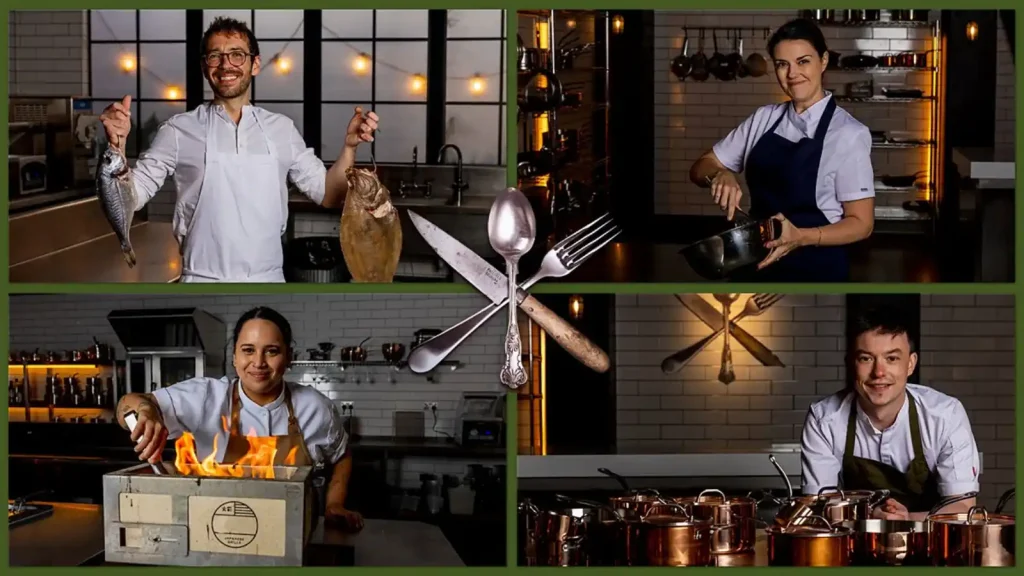
Great British Menu 2026 episode 16 brings the competition to Northern Ireland, where four ambitious chefs face the most demanding brief of the series: creating dishes that celebrate the British film industry across the canape, starter, and fish courses. The stakes are immediate and unforgiving. Only those who demonstrate genuine culinary imagination — anchored in technique and emotional resonance — will advance to the main course round.
Northern Ireland has a rich and complex relationship with cinema. From the sweeping landscapes of Game of Thrones to the intimate human dramas shot across Belfast and the surrounding counties, the region has become a genuine creative hub for British and international filmmaking. That cultural backdrop gives this week’s chefs a wealth of material to draw upon, and the best dishes on show in Great British Menu 2026 episode 16 prove that the connection between food and film is more than superficial. Both arts depend on timing, composition, surprise, and the ability to move an audience.
The four chefs competing this week are Alex Greene, Gemma Austin, Paul Cunningham, and Brian Clarke. Each arrives with a distinct culinary identity and a personal relationship to the film theme. They face judgement not only from head judge Ed Gamble but also from this week’s veteran panel: Sally Abe and Jean Delport, who won the banquet the previous year and bring sharp, experienced palates to the deliberations. The competition structure moves through canapes, starters, and fish dishes in sequence, with scores accumulated and decisions made at each stage.
What immediately distinguishes this episode of Great British Menu 2026 is the seriousness with which each chef approaches the brief. Rather than reaching for obvious cinematic references, the strongest competitors this week dig into specific films, specific directors, and specific emotional experiences associated with watching stories unfold on screen. The dishes that succeed are those that translate a cinematic feeling — nostalgia, tension, joy, darkness — into something edible and resonant on the palate.
The canape round sets the tone. With each chef presenting multiple small bites, the opening exchanges establish early hierarchies and signal who has done the creative groundwork. From a deconstructed take on cinema snacks to more elaborate constructions referencing specific films, the canapes demonstrate range, technical precision, and the ability to communicate a complex idea in a single mouthful. Cooking at this level demands that even the smallest item carry intellectual and sensory weight.
As the competition progresses through the starter and fish courses, personalities emerge more fully. Some chefs double down on bold, theatrical presentations. Others pursue refinement and subtlety. The veteran judges, drawing on their own experience of competing and winning at this level, respond most strongly to dishes where the film reference is not merely decorative but structurally embedded in the food itself — where the concept and the cooking are inseparable.
Ed Gamble, presiding over proceedings with characteristic enthusiasm, offers responses that are immediate and unfiltered. His reactions function as a reliable early indicator of how a dish lands before the veterans deliver their more measured verdicts. Throughout Great British Menu 2026 episode 16, the interplay between Gamble’s instinctive enthusiasm and the veterans’ more analytical assessments creates a layered judging dynamic that rewards different qualities in different dishes.
By the time the fish course concludes and the judges deliberate on who proceeds, the episode has already produced some of the most inventive and emotionally charged cooking seen in this series. The chefs who survive carry momentum into subsequent rounds. Those who are eliminated leave having demonstrated genuine creative ambition — which, in a competition of this calibre, is not nothing.
Great British Menu 2026 episode 16
Great British Menu 2026 Episode 16: The Canape Round and Its Opening Gambits
The canape round in Great British Menu 2026 episode 16 functions as both introduction and elimination filter. Each chef presents a selection of small bites referencing British cinema, and the judges assess not only flavour but concept clarity and execution precision. At this scale, there is nowhere to hide a technical error or a muddled idea.
Alex Greene opens with a series of canapes that draw on the sensory experience of cinema itself — the textures, flavours, and rituals associated with watching films. One of his offerings takes the form of a reworked classic cinema snack, elevated through careful seasoning and precise temperature control. Greene’s approach throughout the canape round is disciplined: he identifies a clear theme and executes it with consistency, never allowing the concept to overwhelm the food.
Gemma Austin takes a more character-driven approach. Her canapes reference specific films and specific moments within those films, aiming to trigger emotional memory as well as purely gustatory pleasure. The ambition is considerable, and in places it pays off — judges respond to the precision of her flavour matching. However, the complexity of her references occasionally creates a gap between intention and reception, particularly when the film connection requires explanation rather than arriving intuitively through eating.
Paul Cunningham’s canapes demonstrate a strong understanding of how to balance showmanship with substance. His presentations are visually striking, and the flavours beneath the surface are well-considered. Cunningham understands that at canape scale, a dish must make its impact immediately and completely — there is no second course to compensate. His strongest bite of the round references a specific Irish-set British film, grounding the theme in regional identity while maintaining technical discipline.
Brian Clarke, meanwhile, takes the most personal approach. His canapes draw on films that carry autobiographical significance, and that emotional investment is detectable in the cooking. The judges note both the ambition and the execution, with Sally Abe in particular responding to the clarity of Clarke’s flavour construction. The canape round ends with scores that establish a provisional hierarchy but leave the competition genuinely open heading into the starter course.
Starter Dishes and the Homage to The School for Good and Evil
The starter course in Great British Menu 2026 episode 16 produces one of the most visually striking and technically complex dishes of the entire week. Alex Greene’s homage to The School for Good and Evil — a fantasy film adapted from the popular novel series — centres on a red knotted brioche handkerchief that arrives at the table as a theatrical centrepiece. The visual effect is immediate and arresting: the brioche, coloured deep red and shaped to resemble a tied fabric handkerchief, sits as a direct visual quotation from the film’s imagery of duality and transformation.
The dish extends well beyond its visual concept. Beneath and around the brioche, Greene constructs a starter that works as food independently of its thematic scaffolding. The brioche itself is richly flavoured, the knot achieving both structural integrity and an appealing crust. The accompanying elements — carefully balanced in acidity, richness, and texture — complement the bread without competing with it. Ed Gamble’s reaction on receiving the dish is one of genuine delight, and the veteran judges confirm that the concept holds up under close examination.
What the School for Good and Evil starter demonstrates most clearly is Greene’s ability to find a film reference that is visually transferable to a food object without losing culinary logic. The handkerchief brioche is not merely a prop; it is a well-made piece of bread that happens to embody a cinematic idea. That integration of concept and craft is exactly what the Great British Menu 2026 brief demands, and Greene earns strong scores for achieving it with apparent confidence.
The other starters this week range across the film theme with varying degrees of success. Gemma Austin’s starter references a film with strong emotional stakes for her, and the judges respond to the sincerity of the connection. Paul Cunningham produces a starter that is technically precise but draws criticism for a film reference that feels slightly generic — competently executed but lacking the specificity that distinguishes the best dishes in the round. Brian Clarke’s starter impresses with its depth of flavour, though the plating divides the panel slightly.
Throughout the starter course, the veteran judges demonstrate consistent alignment on what they value: dishes where the film reference enhances rather than replaces culinary thinking. Jean Delport is particularly precise in his assessments, noting where a concept has been allowed to substitute for flavour development and where the two are working together effectively. By the end of the starter round, the scoring tightens considerably, and the fish course begins to carry genuine elimination weight.
Great British Menu 2026 Episode 16 and the Barbecued Monkfish Tribute
The fish course in Great British Menu 2026 episode 16 produces the week’s most discussed and debated dish: Brian Clarke’s tribute to director Lisa Barros D’Sa, delivered to the table via a teapot. The concept is rooted in D’Sa’s work — particularly her films set in and around Northern Ireland — and Clarke’s decision to use a teapot as the serving vessel is simultaneously a cultural and cinematic reference. The teapot carries associations with domestic Irish life, with ritual, with the kind of ordinary-extraordinary moments that D’Sa’s filmmaking consistently illuminates.
The fish itself is barbecued monkfish, a robust choice that stands up to the smoke and char of the barbecue process without losing its essential texture. Monkfish is a demanding fish to cook well — its dense flesh requires precise heat management, and any overcooking produces a rubbery result that no amount of conceptual sophistication can rescue. Clarke’s execution is technically sound: the fish arrives properly cooked, with good caramelisation on the exterior and a clean, yielding interior.
The teapot presentation generates discussion among the judges about the relationship between theatre and function in competitive cooking. Sally Abe, who has experience on both sides of the judging table, engages seriously with the question of whether the serving vessel enhances or distracts from the dish. Her conclusion is that it works — the teapot does not merely add spectacle but connects the food to a specific cultural and cinematic context in a way that amplifies meaning without obscuring flavour.
Ed Gamble’s response to the monkfish dish is enthusiastic, and the veteran panel’s scores reflect genuine appreciation for both the concept and the execution. Clarke’s dish stands as one of the week’s most complete achievements: a clear film reference, a culturally resonant presentation choice, and technically accomplished cooking working in concert. In a round where the pressure is greatest, he delivers his most assured performance.
Gemma Austin’s Fish Course and the Pressure of Creative Ambition
Gemma Austin’s fish course in Great British Menu 2026 episode 16 reflects the challenge of sustaining creative momentum across multiple rounds of intense competition. Having produced canapes and a starter of genuine quality, Austin arrives at the fish course under pressure to consolidate her position while continuing to push the film theme forward. Her dish references a specific British film with a strong female protagonist, and the construction attempts to echo the film’s tonal contrasts — lightness and darkness, restraint and excess — within a single plate.
The fish at the centre of Austin’s dish is carefully prepared, demonstrating her technical range. The accompanying elements are well-considered in isolation, but the judges note a slight imbalance in the overall composition — one element slightly overwhelms the delicacy of the main ingredient rather than supporting it. Jean Delport is specific in his feedback, identifying the precise point where the dish tips from complexity into excess. It is a fine margin, and the criticism is offered with recognition of the ambition involved.
Sally Abe responds more warmly to Austin’s concept, noting the clarity of the film reference and the intelligence of the thematic construction. The divergence between the two veteran judges’ assessments creates a genuinely interesting deliberative moment, one that Gamble navigates with care. Austin’s scores are solid but not exceptional, leaving her in a position where the final rankings could move in several directions depending on how the other fish courses are received.
Austin’s performance across all three rounds illustrates a recurring tension in Great British Menu 2026: the relationship between creative risk and consistent execution. The competitors who score highest are often those who find a way to take genuine creative risks without allowing ambition to exceed technique. Austin comes close to that balance at several points during the week, and her fish course, for all its minor shortcomings, demonstrates a chef of significant ability operating under considerable pressure.
Great British Menu 2026 Episode 16: Paul Cunningham’s Approach and Veteran Verdicts
Paul Cunningham enters the fish course of Great British Menu 2026 episode 16 needing to improve on a starter that drew lukewarm responses for its somewhat generic film reference. His fish dish takes a different approach: rather than referencing a single film, Cunningham draws on the broader experience of Northern Irish cinema as a cultural phenomenon, creating a dish that functions as a composite tribute. The concept is more diffuse than Clarke’s or Greene’s single-film focus, but the execution is technically accomplished.
The fish Cunningham selects is handled with precision, and the seasoning throughout the dish is well-calibrated. The veteran judges acknowledge the technical quality while continuing to push back gently on the depth of the film connection. Delport’s assessment is that Cunningham’s strongest quality — his impeccable technique — occasionally prevents him from taking the conceptual risks that would elevate his dishes from very good to genuinely memorable. It is a perceptive observation, and one that Cunningham himself seems to absorb thoughtfully.
Gamble’s response to Cunningham’s fish course is positive, appreciating the clean flavours and confident presentation. The scores place Cunningham in the middle of the field — secure enough to continue but with ground to make up if he progresses to subsequent rounds. The veteran judges’ consistency in rewarding concept alongside technique throughout this episode sends a clear message about what Great British Menu 2026 values in its competitors at this stage of the series.
Scoring, Deliberation, and the Road to Elimination
The scoring deliberations at the end of Great British Menu 2026 episode 16 draw on the accumulated impressions of three rounds of intense cooking. Ed Gamble leads the discussion, with Sally Abe and Jean Delport contributing their scored assessments and the reasoning behind them. The process is methodical: each dish is revisited, each score is contextualised, and the aggregate results are examined for what they reveal about each chef’s overall week.
Alex Greene’s consistent performance across canapes, starter, and fish courses places him strongly in the rankings. His School for Good and Evil brioche remains the week’s most talked-about dish, and his fish course further consolidates his position. The veteran judges agree that Greene has demonstrated the kind of all-round competence combined with creative specificity that the competition rewards. His scores reflect a chef who understood the brief at a fundamental level and delivered on it across all three rounds.
Brian Clarke’s fish course performance is decisive in his final ranking. The barbecued monkfish from the teapot stands as a conceptually and technically complete dish, and the scores reflect that achievement. Clarke’s week has been characterised by increasing confidence — his strongest work arriving when the pressure is highest, which is precisely the quality that separates finalists from competitors who exit in the regional heats.
The elimination decision falls at the end of the deliberations, with the chef at the bottom of the aggregate scoring departing the competition. The decision generates the kind of considered, respectful response that characterises Great British Menu 2026 at its best: acknowledgement of the eliminated chef’s genuine ability, clarity about where the gaps in performance appeared, and genuine regret about the outcome. The remaining chefs carry momentum into the subsequent rounds, knowing that the standard required to progress only increases as the competition advances.
Great British Menu 2026 Episode 16: What the Northern Ireland Heat Reveals About the Series
Great British Menu 2026 episode 16 offers a concentrated demonstration of what makes the Northern Ireland heat distinctive within the broader series. The region’s relationship with British cinema is not merely scenic — its cities, landscapes, and cultural identity have been integral to the stories told in British and Irish film for decades. The chefs who engage most seriously with that specific regional context, rather than treating the film theme as a generic brief, produce the week’s most resonant dishes.
The veteran judges’ presence throughout the episode sharpens the deliberative quality of the scoring. Sally Abe and Jean Delport, having navigated the same pressures as competitors, bring empathy as well as rigour to their assessments. Their feedback is specific, actionable, and grounded in genuine culinary expertise. It elevates the judging beyond simple scoring into something closer to a professional mentorship — one that the competing chefs visibly absorb and respond to.
The film brief itself, running through all of Great British Menu 2026, continues to generate extraordinary creative responses from chefs across the regional heats. Episode 16 confirms that the brief is working not because it provides easy answers but because it demands a level of personal and cultural engagement that pushes chefs beyond their comfort zones. The best dishes this week are not merely technically accomplished — they carry emotional weight, cultural specificity, and a genuine sense of what it means to love cinema and to cook with conviction.
As the Northern Ireland heat moves toward its conclusion, the competitors who remain standing have demonstrated not only technical mastery but creative intelligence. The cooking in Great British Menu 2026 episode 16 makes a compelling case that the competition, at its best, is as much about ideas as it is about ingredients — and that the chefs who understand that balance are the ones best positioned to reach the final banquet.
FAQ Great British Menu 2026 episode 16
Q: What is Great British Menu 2026 episode 16 about?
A: Great British Menu 2026 episode 16 features the Northern Ireland regional heat, covering the canape, starter, and fish courses. Four chefs compete using dishes that celebrate the British film industry. Veteran judges Sally Abe and Jean Delport, alongside host Ed Gamble, assess the cooking and decide who progresses.
Q: Which chefs compete in the Northern Ireland heat of Great British Menu 2026?
A: The four competing chefs in the Northern Ireland heat are Alex Greene, Gemma Austin, Paul Cunningham, and Brian Clarke. Each chef brings a distinct culinary identity to the competition. Additionally, each competitor interprets the British film industry brief in a personal and individual way, resulting in notably varied dishes across all three courses.
Q: Who are the veteran judges in Great British Menu 2026 episode 16?
A: The veteran judges this week are Sally Abe and Jean Delport, who won the Great British Menu banquet in 2025. Their first-hand experience of competing at this level gives their assessments particular authority. Furthermore, their feedback throughout the episode goes beyond simple scoring, offering chefs specific and actionable observations about concept and execution.
Q: What is the dish inspired by The School for Good and Evil in this episode?
A: Alex Greene creates a starter paying homage to the fantasy film The School for Good and Evil. Its centrepiece is a red knotted brioche handkerchief, shaped and coloured to echo the film’s visual imagery. Crucially, the brioche functions as a well-made piece of bread first and a cinematic reference second, earning strong scores from the judging panel.
Q: What is Brian Clarke’s fish course dish in Great British Menu 2026 episode 16?
A: Brian Clarke presents barbecued monkfish served dramatically from a teapot, as a tribute to Northern Irish director Lisa Barros D’Sa. The teapot references both domestic Irish cultural life and D’Sa’s filmmaking themes. The monkfish itself is technically accomplished, with precise heat management producing strong caramelisation on the exterior and a clean, properly cooked interior.
Q: How does the British film industry theme shape the cooking in this episode?
A: The film brief requires chefs to embed cinematic references structurally within their dishes, not merely use them as decoration. The strongest performers this week reference specific films or directors, grounding their food in genuine cultural and emotional meaning. Consequently, the judges reward dishes where concept and cooking are inseparable rather than dishes where a film title is loosely attached to a plate.
Q: How does Ed Gamble’s role differ from that of the veteran judges in Great British Menu 2026?
A: Ed Gamble provides immediate, instinctive reactions to each dish as it arrives, reflecting genuine enthusiasm for the food. The veteran judges, however, offer more measured and analytical assessments informed by their own competitive experience. Together, this dynamic creates a layered judging process that rewards both sensory impact and deeper conceptual intelligence in the cooking presented.
Q: What distinguishes the most successful dishes in Great British Menu 2026 episode 16?
A: The highest-scoring dishes combine precise technical execution with film references that arrive intuitively through eating rather than requiring explanation. Jean Delport consistently identifies where concept substitutes for flavour and where the two work in genuine partnership. Moreover, the dishes that earn the strongest responses carry emotional or cultural specificity connected to Northern Ireland’s unique relationship with British cinema.
Q: How does Gemma Austin perform across the three courses in this episode?
A: Gemma Austin produces canapes and a starter of genuine quality before encountering a slight imbalance in her fish course. One element of her fish dish marginally overwhelms the main ingredient, drawing specific criticism from Jean Delport. However, Sally Abe responds more warmly to Austin’s conceptual clarity, and her aggregate scores across all three rounds remain competitive, illustrating the fine margins that define Great British Menu 2026 judging.
Q: What does the Northern Ireland heat reveal about the overall Great British Menu 2026 series?
A: The Northern Ireland heat confirms that the British film industry brief consistently pushes chefs beyond comfort zones and into genuinely personal creative territory. Chefs who engage with specific films, directors, or regional cinematic culture produce the most resonant results. Furthermore, episode 16 demonstrates that the competition rewards creative intelligence alongside technical mastery, reinforcing that Great British Menu 2026 values ideas as highly as ingredients.