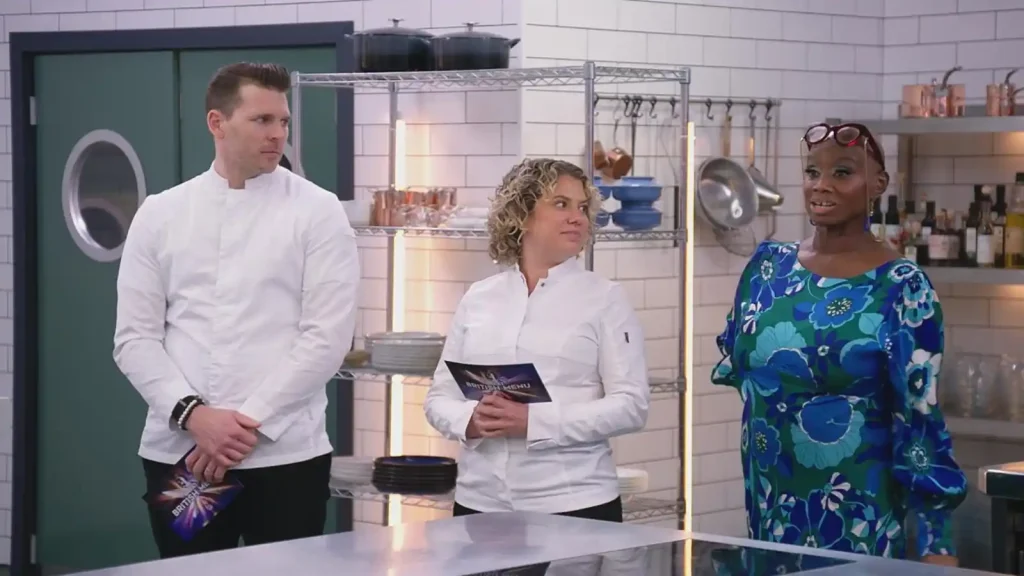
Great British Menu 2026 episode 17 arrives at a pivotal moment in the Northern Ireland heat, where the competition sharpens and every plate carries the weight of a chef’s ambition. Three chefs have made it to the midpoint of their regional contest, and the brief — celebrating British cinema and films with deep connections to Northern Ireland — demands not just technical precision but genuine creative storytelling through food. The atmosphere in the kitchen has shifted. Early nerves have settled into focused determination, and the dishes that emerge from this stage will determine who advances and who goes home.
The Great British Menu 2026 format places chefs under sustained pressure across multiple courses, and the Northern Ireland heat is no exception. By the time the main and dessert rounds arrive, the judges have already formed impressions, scored the starters and fish courses, and established expectations. Veteran judges Jean Delport and Sally Abe bring exacting standards to every tasting room appearance. Both have competed at the highest levels of British cooking, and neither offers empty encouragement. Their assessments carry real consequences, and the chefs know it.
Northern Ireland occupies a fascinating position in British cinema history. The province has served as a filming location for major productions, and local stories have inspired acclaimed films that resonate far beyond the island. The brief for this heat connects that cinematic heritage to the competition’s central challenge: translate a film’s emotional and visual world into a dish that can stand alone as exceptional cooking. It is a conceptual test as much as a culinary one, and the results reveal a great deal about each chef’s range and depth.
The three chefs competing in this stage of Great British Menu 2026 are Mark Doyle, Chris Bell, and Davide Degiovanni. Each brings a distinct background and a different approach to the brief. Doyle draws on classical training and a deep familiarity with Northern Irish produce. Bell brings a more contemporary edge, with a focus on bold flavour combinations and playful presentation. Degiovanni, the Italian-born chef with roots now firmly in the region, approaches the brief through the lens of his adopted home, finding connections between his heritage and the films he has chosen to honour.
The main course round opens with all three chefs preparing simultaneously, the kitchen filling with the aromas of roasting, braising, and reducing. The judges wait, aware that the scores from this course will significantly reshape the leaderboard. Momentum from a strong starter or fish course can evaporate with a disappointing main, and conversely a chef who has trailed can surge forward with a single exceptional plate. That volatility is precisely what makes this stage of Great British Menu 2026 so compelling to follow.
Jean Delport’s presence in the judging panel brings a particular kind of authority. As a former Great British Menu competitor herself, she understands the pressures from the inside. She knows what it costs to construct a dish that is simultaneously technically rigorous, conceptually coherent, and emotionally resonant. Sally Abe, equally experienced, applies a complementary lens — one rooted in the daily realities of running a serious kitchen and maintaining consistent excellence at the highest level. Together, they represent an ideal judging partnership: neither easily impressed, both genuinely engaged.
The film-inspired brief produces a fascinating range of responses from the three chefs. Some interpretations are literal, drawing directly on specific scenes, characters, or settings from the chosen film. Others work at a more atmospheric level, attempting to capture the feeling of a film rather than its plot. Both approaches carry risks. Too literal and the dish can feel like a novelty. Too abstract and the connection becomes invisible. The best dishes in any Great British Menu heat find the space between those extremes, where the concept enhances rather than constrains the cooking.
Throughout this stage of the competition, the scoring system applies relentless pressure. Each judge scores independently, and the numbers are unambiguous. A chef can receive warm words from both judges and still fall behind on points. The cumulative score across all courses determines who progresses, and at this midpoint in the Northern Ireland heat, the margin between the chefs is close enough that a single strong or weak performance can change everything.
Great British Menu 2026 episode 17
The Main Course Dishes in Great British Menu 2026’s Northern Ireland Heat
Mark Doyle presents his main course as a tribute to Kenneth Branagh’s adaptation of Murder on the Orient Express. The dish centres on roast chicken, a choice that initially seems understated for a competition at this level, but Doyle’s execution transforms a familiar ingredient into something with real ambition. The chicken is prepared with evident care, the skin rendered to a deep golden finish, the meat moist and well-seasoned throughout. He accompanies it with a series of garnishes that reference the film’s period setting and theatrical atmosphere.
The connection to Branagh’s film is thoughtful rather than superficial. Murder on the Orient Express is a production with strong Northern Irish ties through Branagh himself, and Doyle’s decision to honour that connection through classic British cooking makes a coherent conceptual statement. The dish speaks to a certain tradition of elegance — precise, restrained, and confident in its own quality. Jean Delport and Sally Abe engage with the concept, acknowledging that the film link is clear and that the cooking supports it.
However, the judges also probe the dish’s weaknesses. The scoring reflects both what Doyle achieves and where the dish falls short of the very highest marks. Delport notes specific elements she finds impressive while pointing to areas where greater boldness or complexity might have elevated the plate further. Abe’s response is similarly measured. The result is a solid score that keeps Doyle competitive but does not place him decisively ahead.
Chris Bell’s Approach to the Brief in Great British Menu 2026
Chris Bell’s main course takes the competition in a different direction entirely. Bell has chosen a film with a darker, more intense atmosphere, and his dish reflects that tonal choice. Where Doyle opts for warmth and familiarity, Bell reaches for something with more edge — a plate designed to unsettle comfortable expectations and reward adventurous palates. The presentation is deliberately striking, with elements arranged to create visual tension on the plate.
Bell’s technical execution is impressive throughout, and the judges recognise it. The primary component of his dish demonstrates real skill in preparation and timing. The accompanying elements are carefully chosen to build contrast and complexity. Specifically, the balance between richness and acidity in his dish draws positive comment from both Delport and Abe, who note that Bell has clearly thought deeply about how each component serves the whole.
The conceptual ambition of Bell’s dish carries both its greatest strength and its primary risk. The film reference is evident to the judges, and they engage with it seriously. However, there are moments where the concept appears to pull slightly against the cooking rather than supporting it — where a decision made for conceptual reasons produces a result that is slightly less satisfying on purely culinary terms. Bell’s score reflects that tension: strong in recognition of his skill, but not quite reaching the top of the leaderboard.
Davide Degiovanni’s Main Course and Its Cinematic Connections
Davide Degiovanni approaches his main course with the confidence of a chef who has found a genuine personal connection to his chosen film. His Italian background informs the dish without overwhelming the brief, and the result feels distinctly his own — rooted in a specific place and story while remaining fully accessible to the judges’ palates. Degiovanni works with ingredients that speak to both his training and his adopted Northern Irish home, creating a plate that occupies an interesting cultural intersection.
The judges respond to Degiovanni’s dish with evident interest. Both Delport and Abe acknowledge the personal dimension of his interpretation, and they assess whether that personal investment translates into better cooking. In this case, the consensus is largely positive. The dish is well-executed, the flavours are cohesive, and the film connection holds up to scrutiny. Degiovanni has resisted the temptation to overcomplicate, and the result benefits from that restraint.
Scoring for Degiovanni’s main places him in a strong position relative to his competitors. The cumulative leaderboard after the main course round shows a heat that remains genuinely open, with no single chef having established a commanding lead. That openness intensifies the significance of the dessert round, where the final scores before the veteran judging stage will be decided.
The Dessert Round and Good Vibrations in Great British Menu 2026
The dessert round introduces one of the most interesting conceptual patterns in this stage of Great British Menu 2026: two of the three chefs have independently chosen the same film, Good Vibrations, as their inspiration. The film — a story rooted in the Belfast music scene and the life of record shop owner Terri Hooley — carries enormous cultural weight in Northern Ireland. Its themes of resistance, community, and joy provide rich material for a chef willing to engage with them seriously.
Good Vibrations is a film about music’s power to sustain people through difficult times. Translating that into food requires a particular kind of creative leap, and both Bell and Degiovanni make the attempt with dishes that share a thematic reference point but differ substantially in execution. The coincidence creates an unusual dynamic in the judging room: Delport and Abe taste two desserts connected to the same source within the same session, which inevitably invites comparison even as each dish is scored on its individual merits.
The judges handle this situation with characteristic directness. They note the shared inspiration openly and assess each dessert on its own terms, but the implicit comparison runs through their commentary. Certain moments in the tasting room carry an additional charge — a flavour in one dish that recalls or contrasts with a flavour in the other, a presentational choice that diverges from what the previous chef attempted. For both Bell and Degiovanni, the shared brief becomes an additional pressure layer in an already demanding round.
Scoring and Leaderboard Dynamics Across Great British Menu 2026 Episode 17
The scoring dynamics across Great British Menu 2026 episode 17 reflect the tight margins that characterise competitive heats at this level. After the main course scores are recorded, the three chefs are separated by a small number of points, and the dessert round represents the final opportunity to shift the standings before the veteran judges weigh in on the full heat. Every fraction of a point matters, and the chefs are acutely aware of it.
Jean Delport and Sally Abe apply consistent standards throughout both rounds. Their scores are never arbitrary, and the reasoning they provide in the tasting room gives the chefs clear information about where they have succeeded and where they have fallen short. That transparency is one of the strengths of the judging format: the feedback is pointed enough to be genuinely useful, not merely diplomatic. Chefs who listen carefully to the judges’ comments can adjust their understanding of what the competition values.
The cumulative leaderboard at the end of episode 17 crystallises the competitive landscape. One chef has moved into a position of relative strength, another sits in the middle ground, and the third faces a more difficult path to the final. However, the scoring system’s structure means that the veteran judges’ scores can still alter the outcome significantly. Nothing is settled until the full process concludes, and the chefs must carry forward both the momentum of their successes and the weight of their missteps.
The Role of the Veteran Judges in Great British Menu 2026
The veteran judge presence looms over the Northern Ireland heat even when Delport and Abe are the active scorers in episode 17. The knowledge that an additional layer of judgement awaits — from figures whose connection to the competition and to food culture runs even deeper — shapes how the chefs approach every decision. A dish that impresses the weekly judges must also, in theory, be capable of standing up to the most exacting scrutiny.
Jean Delport brings specific expertise to her judging role that extends beyond technical assessment. Her experience as a fine dining chef — informed by South African culinary traditions adapted to the British context — gives her a perspective on ingredient use, flavour architecture, and conceptual ambition that is genuinely distinctive. When she praises a dish, the praise is specific and earned. When she identifies a weakness, the chef in question understands precisely what needs to be addressed.
Sally Abe’s judging approach complements Delport’s effectively. Her background in managing high-pressure kitchen environments at the top of the industry means she approaches a plate with an eye for both the ideal and the realistic. She understands that competition cooking involves constraints that everyday service does not, and she factors that understanding into her assessments. Together, the two judges create a tasting room dynamic that is rigorous but fair, demanding but constructive.
Film Culture and Culinary Creativity in Great British Menu 2026 Episode 17
The film-based brief at the heart of Great British Menu 2026’s current series elevates the competition beyond a straightforward cooking contest. By anchoring each dish in a cultural reference, the brief asks chefs to demonstrate intellectual engagement alongside technical skill. The Northern Ireland heat benefits particularly from this structure because the films chosen — Murder on the Orient Express, Good Vibrations, and others — have genuine connections to the region, making the brief feel meaningful rather than arbitrary.
Kenneth Branagh’s relationship with Northern Ireland runs deep, and his cinematic work carries a sense of personal history that resonates with local audiences. Doyle’s decision to honour that connection through his main course creates a dish with a specific cultural logic. The roast chicken at the centre of his tribute is not merely a technically safe choice — it is a deliberate gesture towards a kind of cooking that has meaning in this context, where tradition and craftsmanship intersect.
Good Vibrations occupies a different position in Northern Irish cultural memory. The film’s subject matter — a record shop owner in Belfast who championed punk music during a period of intense social tension — speaks to resilience and creativity under pressure. For Bell and Degiovanni, drawing on this film for their desserts means engaging with that emotional register. Sweet courses inspired by the film need to carry some trace of the story’s energy and spirit, not merely its name.
What Great British Menu 2026 Episode 17 Reveals About the Northern Ireland Chefs
By the end of Great British Menu 2026 episode 17, distinct profiles have emerged for each of the three competing chefs. Mark Doyle has demonstrated that his strength lies in the thoughtful, measured application of classical technique to a conceptual brief. His cooking is precise and assured, and when the concept genuinely connects with the food — as it does in his Branagh tribute — the result is convincing and well-scored. His vulnerability lies in occasions where greater boldness might have produced something more memorable.
Chris Bell has shown himself to be the most conceptually adventurous of the three. His willingness to engage with darker, more challenging material sets him apart, and his technical execution matches that ambition for the most part. The episodes where concept and execution pull slightly apart represent his primary challenge. Bell clearly has the skills to compete at the very highest level; the question is whether he can align his vision and his cooking consistently enough to dominate the heat.
Davide Degiovanni brings a quality that is genuinely rare in competition cooking: authentic personal investment that translates into better food. His dishes are not merely competent executions of a concept but expressions of a particular viewpoint, shaped by his unusual background and his genuine affection for his adopted home. That quality resonates with the judges, and his scores reflect it. Degiovanni enters the final phase of the Northern Ireland heat as a genuine contender, with the momentum of a chef cooking with both skill and conviction.
The three chefs together represent the depth of talent that Great British Menu 2026 continues to surface from across the regions. The Northern Ireland heat has produced cooking that engages seriously with the brief, honours the source material without being constrained by it, and demonstrates the kind of technical range that the competition at its best demands. With the veteran judging stage still to come, the outcome remains genuinely uncertain — and that uncertainty is precisely what makes this heat worth watching to its conclusion.
FAQ Great British Menu 2026 episode 17
Q: What happens in Great British Menu 2026 episode 17?
A: Great British Menu 2026 episode 17 covers the main course and dessert rounds of the Northern Ireland heat. Three chefs — Mark Doyle, Chris Bell, and Davide Degiovanni — compete under the film-inspired brief. Veteran judges Jean Delport and Sally Abe score each dish. The leaderboard remains tight throughout, leaving the outcome uncertain heading into the final judging stage.
Q: Who are the judges in Great British Menu 2026 episode 17?
A: Jean Delport and Sally Abe serve as the veteran judges in this episode. Both bring extensive professional experience to the tasting room. Delport competed on Great British Menu previously and applies a fine dining perspective informed by her South African background. Abe brings deep knowledge of high-pressure kitchen management. Together, they deliver rigorous, constructive assessments of every dish.
Q: What is the film brief in Great British Menu 2026 episode 17?
A: The brief asks chefs to create dishes celebrating the British film industry, with a specific focus on films connected to Northern Ireland. Each chef selects a film and translates its themes, atmosphere, or story into their cooking. The brief tests both conceptual creativity and technical skill. It rewards dishes where the film reference enhances the food rather than simply decorating it.
Q: Which film does Mark Doyle reference in his main course?
A: Mark Doyle pays tribute to Kenneth Branagh’s adaptation of Murder on the Orient Express. His main course centres on roast chicken, prepared with careful attention to technique and presentation. The dish connects to the film through its tone of restrained elegance. Branagh has strong Northern Irish ties, giving Doyle’s conceptual choice a clear regional logic that the judges acknowledge positively during scoring.
Q: What film inspires the desserts in Great British Menu 2026 episode 17?
A: Two chefs independently choose Good Vibrations for their desserts. The film tells the story of Belfast record shop owner Terri Hooley, who championed punk music during a period of intense social tension in Northern Ireland. Its themes of community resilience and creative joy provide rich material for sweet course interpretation. Both Chris Bell and Davide Degiovanni draw on the film, producing notably different results despite the shared inspiration.
Q: How do the judges handle two chefs choosing the same film?
A: Jean Delport and Sally Abe address the situation directly, acknowledging the shared inspiration openly. They score each dessert on its individual merits rather than ranking one against the other. However, the tasting sequence naturally invites comparison, and the judges’ commentary reflects that implicit dynamic. Both chefs face additional pressure as a result. Furthermore, the contrast in their executions highlights how differently two skilled cooks can interpret identical source material.
Q: How does Chris Bell approach the cooking brief in this episode?
A: Chris Bell brings the most conceptually adventurous approach of the three competitors. He engages with darker, more intense film material and designs dishes that reflect those tonal choices. His technical execution is consistently strong, and the judges recognise his skill. Additionally, his handling of flavour contrast — particularly the balance between richness and acidity — draws specific positive comment. His primary challenge lies in fully aligning bold concept with equally bold cooking.
Q: What distinguishes Davide Degiovanni’s cooking style in Great British Menu 2026?
A: Davide Degiovanni brings authentic personal investment that translates directly into stronger food. His Italian heritage informs his cooking without overshadowing the Northern Ireland brief. He resists overcomplication, and the judges respond positively to that restraint. His dishes occupy a distinctive cultural intersection between his background and his adopted home. Furthermore, his genuine connection to the films he chooses gives his plates an emotional coherence that scores well with both Delport and Abe.
Q: How does the scoring system work in Great British Menu 2026 episode 17?
A: Each judge scores independently after tasting every dish. The scores accumulate across all courses, and the cumulative total determines who advances. In episode 17, the main and dessert rounds follow the starter and fish courses already completed. The chefs are separated by small margins at this stage. Consequently, a single strong or weak performance can shift the leaderboard significantly. The veteran judges’ scores add a further layer that can still alter the final outcome.
Q: What does Great British Menu 2026 episode 17 reveal about the standard of cooking in the Northern Ireland heat?
A: The episode demonstrates a genuinely high standard across all three competitors. Each chef engages seriously with the film brief and produces dishes that go beyond surface-level references. Mark Doyle shows classical assurance, Chris Bell displays creative ambition, and Davide Degiovanni contributes a distinctive personal perspective. Moreover, the tight leaderboard reflects how closely matched the chefs are. The Northern Ireland heat confirms that Great British Menu 2026 continues to attract some of the most talented regional cooking talent in Britain.