Great British Menu 2026 episode 2 throws three of the North West’s most ambitious chefs into the heat of competition at a pivotal moment — the midpoint of their regional heat, where the pressure no longer allows for hesitation or half-measures. The episode centres on the main and dessert courses, the dishes that often define a competitor’s fate and reveal the true depth of their culinary vision. With the celebrated British film industry as their brief, each chef must translate cinematic history into food that speaks both to the palate and the imagination.
The Great British Menu has long operated as one of television’s most demanding cooking competitions, not simply because technical skill is required at the highest level, but because the brief demands meaning. Dishes cannot merely taste exceptional — they must tell a story, evoke an era, honour a cultural moment. This series, with its focus on British cinema, pushes that expectation further. Films are emotional experiences, tied to memory, place, and identity, and translating those qualities into a plate of food is among the most complex challenges any chef can face.
Season 21 of Great British Menu brings the North West of England into sharp focus, a region with deep roots in British cultural history and a food scene that has quietly become one of the country’s most dynamic. The chefs competing here carry the weight of that regional pride alongside their personal culinary philosophies. Each brings a distinct approach to food, and the film brief has drawn out responses that are as varied as the region itself is rich.
The judging in this heat falls to Lisa Goodwin Allen, a veteran of the competition whose palate and standards are well established. Her assessments carry authority not simply because of her experience, but because she evaluates with precision, identifying both the intention behind a dish and the degree to which the execution matches it. Her presence in the kitchen raises the standard of every plate that reaches her.
By the time the main and dessert courses arrive, the chefs have already navigated the earlier rounds, and each carries accumulated scores and momentum into this stage. The final two courses hold particular weight because they must satisfy on multiple levels simultaneously — technical accomplishment, conceptual clarity, and emotional resonance. In a competition built around the idea that food can carry cultural significance, the main and dessert are where chefs most often either fully commit to their vision or reveal the limits of their ambition.
The film brief itself is both generous and unforgiving. British cinema spans decades of extraordinary work, from gritty northern realism to globally celebrated dramas, and the chefs in this heat have each chosen films with personal or regional significance. Those choices reveal as much about the chefs themselves as they do about the films they honour. A dish inspired by a film is not simply a technical exercise — it is a declaration of what the chef believes food can communicate.
The North West connection runs through the selections in this episode with genuine depth. Films shot in the region, or films whose stories emerge from the lives of people shaped by it, provide a rich territory for culinary interpretation. The episode does not settle for superficial references. Instead, it demands that the chefs find the essential quality of a film — its mood, its cultural meaning, its specific sensory world — and render that in food.
What follows is a close examination of how each chef approached their main and dessert courses, how those dishes performed under Lisa Goodwin Allen’s scrutiny, and what the results reveal about the state of competition at this halfway point of the North West England heat in Great British Menu 2026.
Great British Menu 2026 episode 2
The Main Course Challenge in Great British Menu 2026: Setting the Stakes
The main course in any Great British Menu heat is the dish that carries the most conventional expectations. Diners understand what a main course should deliver — substance, satisfaction, technical mastery — and chefs must meet those expectations while simultaneously subverting them in service of a conceptual brief. In this episode, the film brief adds a layer of interpretive pressure that transforms every decision, from ingredient selection to plating, into a statement of intent.
The three chefs from North West England each responded to this challenge differently. Some leaned into the comfort and familiarity of British food traditions, elevating classical dishes through precision and refinement. Others pushed toward more unexpected flavour combinations, using the film brief as justification for reaching beyond the obvious. Both approaches carry risk, and the episode makes clear that neither guarantees success.
Lisa Goodwin Allen’s role in evaluating the mains required her to balance appreciation for technical achievement against the coherence of the dish’s conceptual logic. A technically flawless plate that fails to communicate its cinematic inspiration represents one kind of failure. Conversely, a dish with a clear concept that falls short in execution represents another. The best performances in this round achieved both simultaneously.
Chicken Crown, Boulangere Potatoes, and the Spirit of Withnail and I
One of the episode’s most discussed main course dishes draws its inspiration from Withnail and I, the 1987 cult film directed by Bruce Robinson. Set largely in the Lake District — firmly within the North West’s cultural geography — the film has become one of British cinema’s most beloved and frequently quoted works. Its particular atmosphere, bleak, darkly comic, and deeply English, provided a clear emotional palette for the chef to work with.
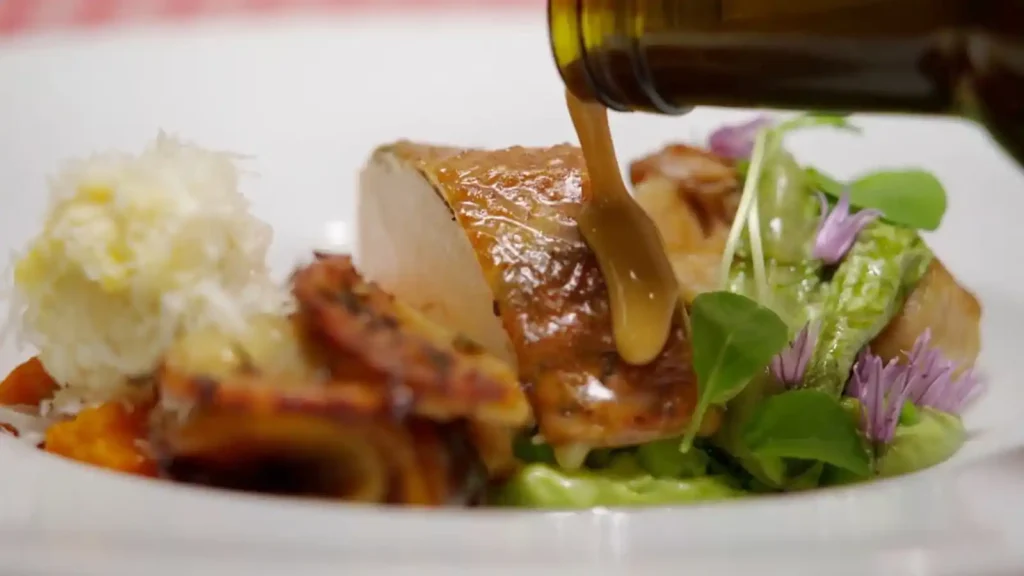
The dish takes the form of an elevated roast dinner, centred on a chicken crown served alongside boulangere potatoes and cauliflower cheese. On the surface, this reads as a classical British Sunday roast, and that familiarity is entirely deliberate. Withnail and I is a film deeply embedded in a particular vision of England — its rural retreats, its failures of warmth, its dark comedy of inadequacy — and a roast dinner sits comfortably within that world.
However, the elevation comes through technique and precision. Boulangere potatoes, a French preparation in which sliced potatoes are layered and cooked in stock with onions, represent a significant step up from the simpler roast potato. The cauliflower cheese, similarly, is not the casual side dish of a domestic Sunday lunch but a carefully constructed element that must hold its own as a component of a composed plate. The chicken crown demands precision in cookery — the breast meat must be perfectly handled to avoid the dryness that plagues less careful preparations. Together, these elements aim to capture the recognisable comfort of the film’s world while demonstrating a level of culinary sophistication the characters of Withnail and I themselves conspicuously lack.
Slumdog Millionaire and the Orange and Chilli Chocolate Cremeux
Among the dessert courses presented in Great British Menu 2026, the dish inspired by Slumdog Millionaire stands as the episode’s most conceptually ambitious. Danny Boyle’s 2008 film, which tells the story of a young man from the slums of Mumbai navigating the Indian game show Who Wants to Be a Millionaire, won eight Academy Awards and became a defining cultural moment in British cinema — despite being set almost entirely in India. Its connection to the North West comes partly through Boyle himself, who was born in Radcliffe, Greater Manchester.
The dessert is an orange and chilli chocolate cremeux, designed to evoke the tastes and aromas of Mumbai. A cremeux is a French term describing a smooth, rich, ganache-like preparation with a texture that sits between a mousse and a set cream. The combination of orange, chilli, and chocolate works to build a flavour profile that references Indian spice traditions while operating within a European dessert framework. The orange provides brightness and citric acidity. The chilli delivers a slow heat that builds at the back of the palate. The chocolate provides depth, richness, and the structural backbone of the dish.
This is ambitious cooking. The challenge of producing a dessert that genuinely evokes a specific city — its street food, its sensory intensity, its layered cultural identity — without reducing that complexity to a caricature is significant. The dish must do more than use recognisable spices. It must create a genuine sensory experience that transports. Whether it achieves that in full is one of the episode’s central questions, and Lisa Goodwin Allen’s response carries the weight of that assessment.
Lisa Goodwin Allen’s Judging Standards and Their Impact on Great British Menu 2026
Lisa Goodwin Allen brings specific authority to her role as veteran judge in this heat of Great British Menu 2026. Her career has been built on a rigorous understanding of what professional cooking demands, and her judgements in the kitchen reflect that background. She does not score generously for intention alone — execution must match ambition, and where it falls short, she identifies the gap clearly and specifically.
Her evaluations in this episode reveal a consistent set of priorities. Balance matters enormously. A dish that leads with one strong flavour at the expense of the whole receives scrutiny, regardless of how technically accomplished that single element might be. Texture is equally important — the contrast between components, the way a dish evolves as it is eaten, must feel considered rather than accidental. And the conceptual link to the chosen film must be legible, not merely declared.
Throughout the episode, her scores reflect careful discrimination rather than generosity or severity for its own sake. The chefs who score well do so because they have genuinely solved the problem the brief poses — delivering dishes that are both technically accomplished and conceptually coherent. Those who fall short generally do so by solving only part of the problem, either executing beautifully with a weak concept or conceiving boldly with imprecise execution.
The Competitive Dynamics of the North West Heat at the Halfway Point
By the midpoint of any Great British Menu regional heat, the competitive picture begins to clarify. Early rounds establish patterns — which chefs are consistent, which are volatile, which peak in certain courses. The main and dessert round in this episode allows those patterns to either consolidate or shift, and the accumulated scores from the heat begin to point toward an outcome.
The three North West chefs entered this stage of Great British Menu 2026 carrying different levels of confidence and different strategic positions. The chef whose scores had been strong through the earlier rounds could afford to take a degree of creative risk. A chef under pressure needed both a high score and, ideally, a stumble from a competitor. These dynamics shape not just the quality of the cooking but the nature of the choices made in the kitchen.
Specifically, the decision of which film to honour reveals something about each chef’s competitive approach. A safe, universally beloved film with obvious culinary touchstones provides a clearer path to a coherent dish. A more obscure or challenging film demands more from both the chef and the judge. In this episode, the range of choices spans the full spectrum, and the results reflect both the rewards and risks of different levels of ambition.
The Cultural Significance of Film-Inspired Cooking in Great British Menu 2026
The British film industry brief does more than provide a creative constraint — it connects the cooking competition to a broader cultural project. Great British Menu has always used its annual briefs to anchor the cooking in something beyond cuisine itself, and the film industry provides an unusually rich territory for that purpose. British cinema has produced works that define how the country sees itself, and many of those works are tied to specific places, communities, and periods of history.
The North West’s contribution to British cinema is substantial. The region provided the setting for some of the most important films in British social realism, and its cities — Manchester, Liverpool, the surrounding landscapes — appear throughout the history of the industry. Chefs from the region cooking in honour of that cinematic heritage are therefore not reaching for an arbitrary connection. They are drawing on a genuine relationship between place and culture that gives their dishes additional layers of meaning.
The challenge, of course, is that food and film operate through entirely different senses. Film reaches its audience through sight and sound. Food reaches its audience through taste, smell, and texture. Translating the experience of a film into the experience of a dish requires a kind of creative translation that has no established method. The chefs in this episode approach that translation differently, and the variety of their approaches illustrates both the difficulty and the possibility of the task.
Technical Execution and the Details That Define Success in Great British Menu 2026
In competition cooking at this level, the difference between success and failure often lies in small technical decisions. A boulangere potato needs precise slicing and careful timing to achieve the silky layered texture that distinguishes it from a simpler preparation. A chocolate cremeux requires exact temperature management — too warm and it will not set correctly, too cold and the texture becomes heavy rather than luxurious. These are the decisions that separate professional cooking from accomplished home cooking, and at Great British Menu 2026 standard, they are non-negotiable.
The chicken crown, as the protein at the centre of one of the main courses, must be handled with particular care. Poultry breast meat has a narrow window of optimal cookery — beyond that window, moisture is lost rapidly and irretrievably. Cooking a chicken crown to perfect juiciness while maintaining crisp skin requires both skill and attention, and in a competition kitchen, where time pressure and multi-element plating conspire against precision, it represents a genuine challenge.
Cauliflower cheese, meanwhile, carries its own demands. In its domestic form it is a forgiving dish, but in competition cooking it must be refined — the sauce rich and perfectly seasoned, the cauliflower cooked to the point of tenderness without losing structure, the overall element contributing to rather than dominating the balance of the plate. Each component of each dish must earn its place, and in this episode the judging reflects exactly that standard.
The Role of Regional Identity in Shaping the Dishes
One of the defining qualities of Great British Menu as a competition is its regional structure, and the North West heat in Great British Menu 2026 draws on a part of England with strong cultural identity. The chefs competing here are not simply representing a geographical area — they are representing a food culture, a set of culinary traditions, and a regional sensibility that has its own distinct character.
That regional identity inflects every dish, even when the inspiration is ostensibly cinematic. The choice of Withnail and I as a film brief is inherently a North West choice — the Lake District is the setting of the film’s most celebrated sequences, and the bleak beauty of that landscape is woven into the film’s identity. A chef from another region might equally have chosen it, but a North West chef choosing it feels natural, rooted, and authentic.
Similarly, the ambition of the Slumdog Millionaire dessert reflects something of the North West’s broader cultural openness. Manchester in particular has long been a city shaped by waves of immigration and cultural exchange, and a dessert that reaches toward Mumbai while drawing on Danny Boyle’s Salford roots captures something genuine about the region’s complex, outward-looking identity.
Outcomes and Departures: What Great British Menu 2026 Reveals About the North West Heat
Every episode of Great British Menu that covers a mid-heat stage carries the question of who will leave the competition. The accumulated scores from all courses determine which chef progresses and which returns home, and the main and dessert round in this episode adds critical weight to that calculation. A strong performance here can rescue a chef who struggled earlier. A weak performance can undermine an otherwise solid heat.
The structure of the judging — with Lisa Goodwin Allen scoring each dish on a numerical scale — means that outcomes are determined by specifics. A single point can separate two chefs in a tightly contested heat, and the decisions she makes about the relative quality of each plate have direct consequences. The episode builds toward its outcome with genuine tension because the cooking has been close enough throughout to keep the result genuinely uncertain.
The chef who ultimately leaves Great British Menu 2026 at this stage of the North West heat does so not necessarily because their cooking was poor in absolute terms, but because, in a field of three highly capable competitors, the margins are fine and the brief is unforgiving. The film industry is a demanding inspiration, and not every interpretation fully realises its potential.
What the North West Heat Demonstrates About Great British Menu 2026 as a Whole
The North West England heat in Great British Menu 2026 demonstrates the competition’s continuing ability to draw out distinctive cooking that reflects both regional character and individual personality. The film industry brief has proven sufficiently rich to generate genuinely varied responses, from the comfortable cultural familiarity of a reimagined roast dinner to the sensory ambition of a Mumbai-inspired chocolate dessert.
Lisa Goodwin Allen’s veteran presence as judge has ensured that the standard of evaluation matches the standard of cooking. Her assessments have been precise, fair, and illuminating — revealing not just what succeeded and what fell short, but why. In a competition that depends on the credibility of its judging, her role in this heat has been central to its integrity.
The episode ultimately reinforces what makes Great British Menu enduring as a cooking competition. It is not simply a technical contest, though the technical demands are formidable. It is a competition about what food can mean — what it can honour, evoke, and communicate. The chefs competing in this episode understood that, and their dishes, whatever their individual scores, reflected genuine engagement with both the craft and the cultural project the competition represents.
FAQ Great British Menu 2026 episode 2
Q: What is Great British Menu 2026 episode 2 about?
A: Great British Menu 2026 episode 2 follows three North West England chefs competing in the main and dessert courses of their regional heat. Each chef creates dishes inspired by the British film industry. Veteran judge Lisa Goodwin Allen scores every plate. The episode culminates in one chef leaving the competition.
Q: Who judges the North West England heat in Great British Menu 2026?
A: Lisa Goodwin Allen serves as the veteran judge for the North West England heat. She evaluates each dish on technical execution, flavour balance, and how clearly the cooking communicates its chosen film inspiration. Her assessments are precise and directly determine which chef progresses in the competition.
Q: What is the culinary brief for Great British Menu 2026?
A: The brief for Great British Menu 2026 celebrates the British film industry. Chefs must create dishes that honour specific films, particularly those with connections to their region. The brief demands more than technical cooking skill. Each dish must evoke a film’s mood, cultural meaning, and sensory world through food.
Q: Which film inspires the elevated roast dinner main course in Great British Menu 2026 episode 2?
A: The elevated roast dinner draws inspiration from Withnail and I, the 1987 cult British film directed by Bruce Robinson. Set largely in the Lake District, the film provided a clear emotional palette. The dish features chicken crown, boulangere potatoes, and cauliflower cheese, referencing the film’s deeply English atmosphere.
Q: What dessert is inspired by Slumdog Millionaire in Great British Menu 2026?
A: The Slumdog Millionaire-inspired dessert is an orange and chilli chocolate cremeux. It is designed to evoke the tastes and aromas of Mumbai. The orange provides citric brightness, the chilli delivers slow heat, and the chocolate supplies rich depth. Director Danny Boyle’s Salford roots connect the film to the North West.
Q: What is a cremeux and why does it suit the Slumdog Millionaire dessert concept?
A: A cremeux is a smooth, rich preparation with a texture between mousse and set cream. Its luxurious consistency allows complex flavours to develop gradually on the palate. For the Slumdog Millionaire dessert, this texture supports the layered spice profile, allowing orange, chilli, and chocolate to build in sequence rather than compete simultaneously.
Q: How does Lisa Goodwin Allen evaluate dishes in Great British Menu 2026 episode 2?
A: Lisa Goodwin Allen prioritises balance, texture, and conceptual clarity in her judging. She does not award high scores for strong intention alone. Execution must match ambition. A dish with a clear cinematic concept but imprecise cooking scores poorly. Conversely, technically flawless food without legible film inspiration also falls short of her standards.
Q: Why does the North West region matter to the film brief in Great British Menu 2026?
A: The North West has deep connections to British cinema, particularly social realist filmmaking. Films like Withnail and I used Lake District landscapes central to the region. Danny Boyle, who directed Slumdog Millionaire, was born in Radcliffe, Greater Manchester. These authentic regional links give the chefs’ film choices genuine cultural grounding rather than arbitrary selection.
Q: What technical challenges do the chefs face in Great British Menu 2026 episode 2?
A: Cooking a chicken crown to perfect juiciness while maintaining crisp skin demands precise temperature control. Boulangere potatoes require exact slicing and careful timing to achieve their signature silky layers. The chocolate cremeux needs strict temperature management during preparation. Additionally, cauliflower cheese must be refined beyond its domestic form to meet competition standards.
Q: What determines which chef leaves Great British Menu 2026 at the North West England halfway point?
A: Accumulated scores across all courses determine which chef departs. A single point can separate competitors in a tightly contested heat. Strong main and dessert performances can rescue a chef who struggled earlier. However, weak execution in these final two courses can equally undermine an otherwise solid heat record. The margins in Great British Menu 2026 are unforgiving.