Great British Menu 2026 Episode 5 – Scotland: Main and Dessert
The Scottish heat is reaching its most intense moment. Three talented chefs are halfway through their journey, and the stakes could not be higher. Great British Menu 2026 has delivered some extraordinary cooking so far. Now, Scotland’s finest are ready to prove they belong among Britain’s culinary elite.
This week’s brief celebrates something truly special. The chefs must honour the British film industry and its deep connections to Scotland. Cinema and cooking might seem like unlikely companions. However, both arts demand creativity, passion, and an obsessive attention to detail. When those two worlds collide on Great British Menu 2026, the results are nothing short of cinematic.
Scotland has gifted the world some unforgettable films. From brooding Highland landscapes to iconic spy thrillers, Scottish scenery and stories have shaped cinema history. Each chef must translate that magic onto a plate. That is a challenge as thrilling as any blockbuster plot twist.
The pressure at this stage is immense. Furthermore, every decision matters — from ingredient choice to plating style. One misstep can end a dream. Equally, one inspired dish can cement a chef’s legacy. The chefs know this. You can see it in every precise, deliberate movement they make in the kitchen.
Presiding over the main and dessert courses is veteran judge Adam Handling. He brings decades of experience and an uncompromising palate to the judging table. Adam does not hand out praise lightly. Instead, he looks for dishes that tell a genuine story and deliver on every technical level.
His presence raises the tension considerably. Consequently, the chefs must ensure their cooking speaks clearly and confidently. Emotion on a plate is wonderful. But it must also taste extraordinary. Adam Handling demands both, and anything less simply will not do.
First up among the main courses is a dish that feels genuinely thrilling. One chef presents venison loin smoked in gunpowder tea, a direct nod to the Bond classic Skyfall. This film holds a special place in Scottish hearts. The movie’s dramatic Highland finale put Glencoe on screens worldwide.
The dish is bold, smoky, and layered with complexity. Additionally, the use of gunpowder tea as a smoking agent is inspired. It mirrors the danger and sophistication that define the Bond universe. Venison itself is quintessentially Scottish — rich, lean, and deeply flavourful. Together, these elements create something that feels both rooted and cinematic.
Moreover, the plating echoes the film’s moody aesthetic. Dark tones, precise lines, and a sense of quiet drama define the presentation. Adam Handling examines it carefully. This dish clearly means business.
Then comes the dessert course, and the mood shifts entirely. Another chef presents a frangipane custard tart inspired by Brave, Pixar’s beloved Scottish adventure. This animated film captured childhood wonder and Highland spirit in equal measure. Therefore, the dessert must carry warmth, nostalgia, and joy.
Great British Menu 2026 episode 5
The tart is golden, delicate, and beautifully constructed. Furthermore, frangipane offers a nutty richness that pairs wonderfully with silky custard. Every bite feels like a warm embrace on a cold Scottish morning. The dish does not just reference the film — it feels like an edible love letter to it.
This is what Great British Menu 2026 episode 4 and the wider series does best. It challenges chefs to cook from the heart. Storytelling and skill combine in every single dish. When it works, the results genuinely move you.
As the scores are tallied, the tension becomes almost unbearable. Each chef has poured everything into their dishes. Nevertheless, only the strongest performances will earn a place in the regional final.
Great British Menu 2026 has already shown us that talent alone is not enough. Execution, creativity, and emotional resonance all matter equally. So who stumbles? Who soars? The answer surprises even the most seasoned viewers.
Scotland has a rich culinary tradition. Moreover, this heat has showcased that tradition with pride, passion, and genuine brilliance. Whether inspired by Bond’s brooding drama or Brave’s joyful spirit, the cooking here has been exceptional.
One chef’s journey ends tonight. However, the memories they leave behind — and the dishes they created — will linger long after the credits roll. That is the true magic of Great British Menu 2026. It turns food into storytelling. And sometimes, storytelling into art.
Great British Menu 2026 episode 5
Great British Menu 2026 episode 5 delivers two courses of extraordinary tension as the Scottish heat enters its most decisive phase, with three ambitious chefs discovering that cinema and fine dining share the same unforgiving demand for precision. Frontrunner Orry sits comfortably on 19 points after the first two courses, while Hannah and Jun find themselves level on 14, separated by nothing but the challenges still to come. The atmosphere in the kitchen crackles with intent. One chef will leave before the week is out, and every component on every plate now carries enormous weight.
The week’s brief asks the chefs to honour the British film industry, with particular attention to its celebrated connections to Scotland. It is a concept that rewards imagination as much as technical skill. Scotland has provided some of cinema’s most iconic landscapes and characters, from the Glencoe moorlands of Skyfall to the medieval highlands of Brave, and the brief invites each chef to translate those visual and emotional worlds into edible form. The result is a course of cooking that pushes far beyond recipe execution and into genuine artistic interpretation.
Judging the main course and dessert is Adam Handling, the 2023 Champion of Champions dessert winner and a Michelin-starred chef who announces his expectations plainly. He wants to give another ten. He awarded his first of the week the previous day, and he arrives at the main course determined to be moved again, telling the chefs he wants to see everyone throw everything at the dish. The main course, he reminds them, is the showstopper of any banquet, and he will not accept anything that merely satisfies.
The competition between Hannah and Jun is particularly acute because they are cooking the same protein. Both have chosen venison loin as their main course centrepiece, a decision that invites direct comparison and makes differentiation through flavour, technique, and concept essential. Adam acknowledges the dynamic with characteristic directness: it is a battle of the venisons. For Jun, the path to distinction runs through Asian flavour profiles and cinematic spy craft. For Hannah, it runs through Scottish tradition and the comfort of a celebratory Sunday roast reimagined as a banquet statement.
Jun’s dish, titled Skyfall Lodge: 007 Hours, draws inspiration from the Bond film Skyfall, specifically the sequence in which 007 retreats to his ancestral Scottish home in Glencoe. The concept is layered with theatrical detail. Jun smokes his venison loin in gunpowder tea, a reference that lands as both literally precise and symbolically perfect.
The cooking method produces what he hopes will be a smoky, aromatic result with green tea notes threading through the meat. Alongside the venison he places a beremeal brose cake, made from one of the most ancient grains in Scotland, found only in Orkney. Confit pink fir potatoes, autumn chanterelles, and a venison jus enriched with homemade black bean paste complete the plate, and Jun adds a dirty olive martini on the side as a Bond-appropriate flourish.
The black bean sauce raises concern early. Adam tastes it during preparation and finds it extremely powerful, suspecting it will obliterate the delicate chanterelle flavour. He voices the worry plainly to his fellow judges, noting that the sauce is getting paired with really delicate mushrooms and potatoes and might wipe out those subtler notes entirely. Jun’s spy suitcase presentation, complete with car keys containing a hidden UV message, adds theatrical dimension, but the conceptual delivery is later judged confusing. The message inside the keys is not clear enough, and the dish ultimately sits more comfortably in a restaurant setting than on a banquet table.
Hannah’s main course, titled The Queen, the Stag and the Hillman, takes inspiration from the film Mrs Brown, in which Judi Dench plays Queen Victoria finding solace in the Scottish Highlands. The dish is conceived as a Sunday roast elevated to banquet scale: venison loin with a chestnut and walnut crumb coating acting as stuffing, haggis bonbons, roast potatoes using her father’s recipe, glazed parsnip with parsnip puree and parsnip crisps, and a sauce she calls cafe au lait, made from beef gravy, amaretto, whisky, peppercorns, and lashings of cream.
Adam notes early concern that the sauce, already too sweet at the reduction stage, will only intensify with further cooking. Hannah insists it will balance. During service, she finishes the venison on the plancha rather than pan frying it, a late change that produces char on the outside which Orry finds acrid.
Great British Menu 2026 Main Course Scores and Critical Assessment
The scores at the main course reveal a sharp separation of quality. Jun receives an eight from Adam, who acknowledges the creative concept and the well-executed brose cake with its oaty crunch and crispy casing, while pointing out that the black bean sauce dominates and the dish remains more restaurant than banquet. Hannah receives a six, one of the most painful scores of the week. Adam identifies Hannah’s sauce as the best element on the plate, calling it delicious and noting it brings the dish together, but criticises the potatoes for inconsistent sizing, the venison crumb for being underwhelming, and the sear on the venison for being incorrect. Half the dish was good. The other half needed work.
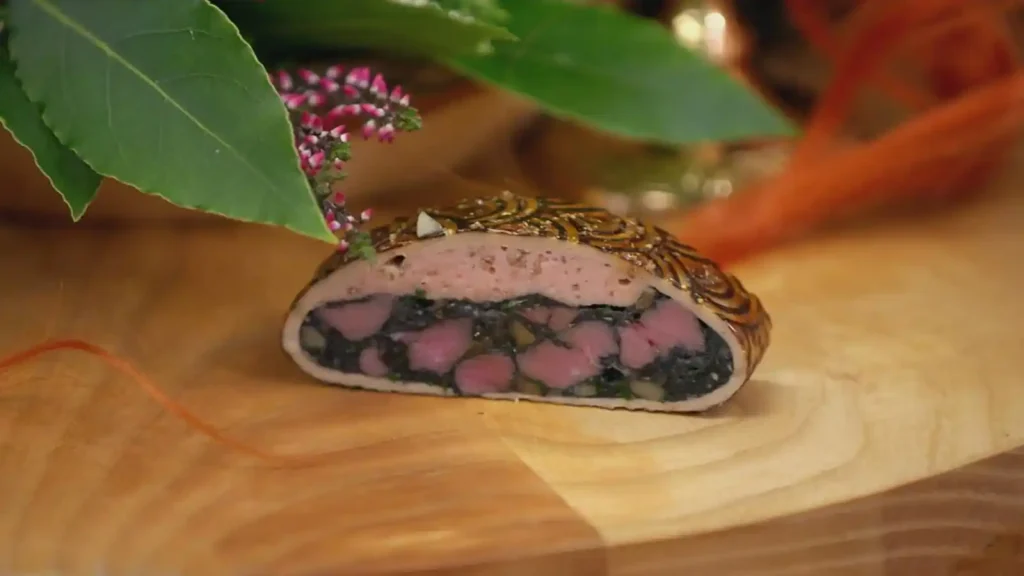
Orry’s main course, A Feast for Merida, inspired by Kelly Macdonald’s role as Princess Merida in the Pixar film Brave, receives a nine and stands in a different class entirely. The concept imagines the feast that the Scottish princess would enjoy: a short saddle of Scotch lamb barbecued on the bone, lamb ribs, a lamb and guinea fowl terrine with truffle mousse and a farce of spinach, shallots, mushrooms and truffle, a fried bun with sticky lamb mix, a lamb-fat rosti topped with crowdie cheese, a courgette puree with lemon verbena and basil, and a lamb-fat consomme served as a side drink.
Adam describes the presentation as dramatic and banquet worthy, praises the barbecue saddle’s great flavour, and calls the floral notes of the courgette puree magical, singling out the verbena as particularly impressive. His only significant criticism concerns the consomme drink, which he advises losing completely, describing it as not working in the slightest. The dish overall he calls a fantastic effort and a whisper away from perfection.
After the main course scores are applied, Orry extends his lead to 28 points. Jun moves to 22 and Hannah to 20. The gap between second and third is just two points. Adam tells the chefs plainly that the scoring will shape everything going into desserts, and he reminds them that Scotland has a proud history with this course, given that his own Champion of Champions win came in the dessert round. He expresses genuine hope that Scotland will send a dessert to the banquet.
Pre-Dessert Performances in Great British Menu 2026
The pre-dessert course is unscored but ranked, with those rankings used as a tiebreaker should the final scores demand it. Given the closeness of the competition, both Jun and Hannah understand the stakes are anything but ceremonial. Orry, already leading by a comfortable margin, treats the course as an opportunity to consolidate.
Jun’s pre-dessert draws inspiration from Sunshine on Leith, a musical film starring Peter Mullan about two soldiers returning from deployment who arrive home to a breakfast morning. Jun translates the homecoming scene into a lemon and sea buckthorn ice cream mochi designed to resemble a fried egg. It is a fusion concept that bridges his Scottish context with his Japanese culinary influence, using mochi’s glutinous rice wrapper to encase the ice cream. Crowdie cheese, the traditional Scottish soft cow’s milk cheese, flavours his ice cream, connecting the Japanese technique to Scottish terroir.
Hannah’s pre-dessert takes its brief from How to Train Your Dragon, a film set in Scotland with a partially Scottish cast. Her concept is a play on fire and ice: brambles and crowdie cheese mousse served over an oat crumble and bramble compote, topped with a bramble, lemon and thyme granita and presented under a smoking cloche. The fire of the dragon is evoked through the smoky presentation, the ice through the granita’s sharp cold. Adam finds it a little too much smoke and oak, placing it third in his pre-dessert rankings.
Orry’s pre-dessert interprets Skyfall as a dessert cocktail: a blood orange sorbet in a martini glass, topped with a sparkling wine and whisky espuma, olive oil for creaminess, and long pepper for warmth. It is described by tasters as refreshing, elegant, and technically precise. Adam ranks it first, calling it his favourite without hesitation, attributing all three dishes to their correct chefs with immediate confidence.
Dessert Drama Defines Great British Menu 2026’s Scottish Outcome
The dessert course is where the competition fractures decisively. Jun’s dessert, The Spell Cake, takes the Brave scene in which Princess Merida gives her mother a magical cake that transforms her into a bear. Jun constructs a frangipane tart with blackberry and blueberry jam, fennel pollen and blackberry ripple ice cream, and a compote of berries. The concept is charming, but the execution carries a fundamental flaw: Jun overfills the tart with jam and under-commits on the frangipane.
Adam, who had warned earlier that Jun needed to make the best frangipane tart he had ever tasted for the dish to score highly, finds the almond filling absent in effect. The entire thing falls flat, he says, because there is not enough frangipane and all he can taste is berry jam. A last-minute blueberry and ginger sauce, added at Adam’s earlier suggestion, is praised warmly for adding real warmth to the dish, but it cannot save the central failure. Jun scores a five from Adam, accompanied by the verdict that in its current form the dessert is simply not at the required level.
Orry’s dessert is called Happee Birthdae Harry, the intentional misspelling a deliberate tribute to the Harry Potter films and specifically to the birthday cake delivered by Robbie Coltrane’s Hagrid when he first encounters Harry. Orry designs the entire presentation around that cinematic moment, delivering his cake in a box with a blue ribbon, complete with the original spelling mistakes rendered in green icing on a pink fondant surface. Inside the theatrical exterior, the cooking is sophisticated: a chocolate mousse encasing a blackcurrant insert, a feuilletine base, a heather honey and brown butter sponge, shortbread ice cream, and a peat-smoked whisky caramel sauce.
The chocolate mousse receives particular praise from Adam, who calls it faultless, and the visual recreation of Hagrid’s cake is immediately recognisable. However, the sponge is criticised for being dry and the heather honey flavour does not come through with sufficient strength. The shortbread ice cream is also judged dull. Adam recommends either losing the ice cream entirely or rethinking it as a baked custard insert to add another textural layer to the cake. Orry scores an eight, with the assessment that detailed refinement could elevate the dish to match the standard of his other courses.
Hannah’s Harry Potter Dessert and the Timing Crisis in Great British Menu 2026
Hannah’s dessert represents the most technically audacious cooking of the entire week, and its execution produces the episode’s most dramatic sequence. Her dish, The Goblet’s Chosen, takes its inspiration from Harry Potter and the Goblet of Fire. The concept centres on a chocolate wand presented in a wand box, made from tempered chocolate with a cremeux filling built from a 64% Manjari chocolate anglaise, the higher percentage chosen deliberately for a dark, rich finish. The goblet itself contains a caramelised chocolate custard base with feuilletine, wild rice, buckwheat, genoise sponge, and a malt ice cream. A cocoa tuile completes the visual architecture.
The technical complexity is enormous. Hannah has anglaise, custard, ice cream, two tuiles, and a cremeux running simultaneously, along with the chocolate tempering required for the wands and the silicone mould handles she must release and attach under time pressure. Adam acknowledges that tempering chocolate in the Great British Menu kitchen presents considerable challenges.
He watches Hannah’s preparation with a combination of admiration and anxiety, noting she is coming all guns blazing with every technique she knows and speaking with real confidence about pastry. The problem is the wand handles. Brushing the inside of the moulds with metallic powder rather than straight chocolate creates a release problem, and the thick silicone makes the handles extremely difficult to extract under time pressure.
Hannah falls sixteen minutes over her allotted time at the pass, a penalty that Adam confirms he must deduct from her score. The kitchen watches her struggle with the moulds as the other chefs wait at the pass with their plates ready. Liquid nitrogen is brought in to help chill the handles and encourage release.
Orry helps loosen one from its mould. Hannah is composed throughout, acknowledging the lateness with quiet acceptance but refusing to rush the final assembly, accepting the judges’ advice that if she is going to be late it must be worth it. Eventually the wands are attached, the goblets assembled with puffed rice, buckwheat, malted ice cream, chocolate sponge, and cocoa tuile, the flowers placed precisely, and Hannah walks to the pass.
The presentation draws immediate admiration. Adam calls the wand elegant and grown-up. The chocolate tempering is noted as a little thick but competently achieved. The cremeux inside the wand carries a nice pinch of salt and is judged to have great mouthfeel. The dish hits the brief completely and is described as beautiful. Hannah scores herself a theoretical ten for the food, then reduces her own estimate to an eight in acknowledgement of the timing penalty. Adam scores her a seven, confirming he deducted two points for the sixteen minutes over time.
Final Scores and the Elimination Decision in Great British Menu 2026
The dessert scores produce a result that almost defies the competition’s structure. After Adam’s marks are applied, Orry stands on 36 points overall, comfortably advancing. However, Jun and Hannah are level on 27 points each, forcing the competition to its pre-dessert rankings as a tiebreaker. It is the second tie in the heat, the first having occurred earlier in the week when three chefs shared second place. Adam reveals that in third place in the pre-dessert ranking was Hannah. Jun’s mochi and Orry’s blood orange sorbet were ranked above her How to Train Your Dragon creation. As a consequence, despite Hannah’s technically superior and more ambitious dessert, Jun progresses alongside Orry to face the judges.
Hannah’s elimination is one of the episode’s most genuinely moving moments. She returns to Great British Menu 2026 having felt she did not represent herself well enough in a previous series, and this time she competes with clear-eyed determination and deep personal motivation. She credits her father as the inspiration for her love of food and cooking, describing him as literally her best friend.
Her roast potato technique comes directly from him, and she takes visible pride in executing them well under pressure. Her stated goal throughout the week is not merely to reach the banquet but to give one hundred percent to every dish, and she achieves exactly that standard across the dessert even at the cost of her position.
Her parting message carries weight beyond the competition itself. She speaks directly to any young women watching, encouraging them to enter. The room responds with genuine warmth, and even Adam, known for exacting standards and limited sentimentality, notes her perseverance as impressive and sincere.
Jun and Orry Advance in Great British Menu 2026
Jun moves forward carrying self-awareness about his own limitations. He describes himself as horrible with desserts and acknowledges that Hannah is a skilled chocolatier and patissier. His advancement comes not through dominance but through accumulated consistency, particularly the strong performances in the fish and meat courses and a pre-dessert judged more refreshing and refined than Hannah’s. His restaurant, Pomelo, which he opened after the pandemic using savings from his London years, reflects his philosophy of modern Asian cuisine reimagined through Scottish ingredients and culture. The macaroni kimchi pie he describes from his menu is a perfect illustration of the way he thinks: two distinct culinary traditions merged without apology, each made stronger by the other.
Orry’s path through the week is defined by a quality gap that becomes more pronounced with each course. His ten in the fish course, his nine in the main, and his eight in the dessert mark a chef of consistent high output rather than sporadic brilliance. The Feast for Merida concept demonstrates genuine understanding of what a banquet dish must achieve: visual drama, structural confidence, flavour depth, and conceptual clarity.
Adam’s advice about the lamb consomme drink is the only substantive note against a main course he regards as almost perfect. In the dessert, the dry sponge and underpowered heather honey present genuine technical issues, but the mousse faultlessness and the theatrical cake presentation confirm that Orry understands how to make food feel cinematic.
Adam’s closing remarks to the two advancing chefs are pointed and practical. He tells them to take his notes seriously because tomorrow they face tougher judges, and he wants Scotland to be represented at the banquet. His own Championship win came through a dessert, and he carries personal investment in the Scottish heat delivering food worthy of that occasion. The standard required by the banquet is not simply high quality but distinction, the quality of cooking that stays with guests long after the evening ends.
The Scottish Brief and Its Cinematic Legacy in Great British Menu 2026
The British film industry brief reveals itself across the episode as one of the most generative concepts the competition has set. It does not merely ask chefs to name a film and cook something Scottish. It asks them to locate the emotional and visual core of a specific cinematic moment and then translate that core into edible form. Jun’s gunpowder tea smoking is a genuine flavour decision that also serves as a concept anchor.
The word gunpowder connects Bond’s world to the kitchen without becoming a cheap gimmick. The spy suitcase presentation may have been judged confusing in its secret message delivery, but the ambition behind it, the desire to make the guest an active participant in the dish’s world, reflects exactly the kind of thinking a banquet brief rewards.
Hannah’s Mrs Brown reference is equally precise. The film centres on a Victorian widow finding unexpected friendship and solace in Scotland’s landscapes, and Hannah’s Sunday roast format captures that mood of comfort and tradition elevated to occasion. The haggis bonbons are Scotland in a mouthful, the whisky and amaretto sauce is Victorian indulgence, and the whole construction aims to feel both home-cooked and ceremonially grand. That it falls short in execution rather than concept is itself informative about the week’s central tension: in Great British Menu 2026, imagination alone is never sufficient. The food must deliver.
Orry’s Brave concept is the most seamlessly integrated of the three main course ideas. A feast for Princess Merida requires exactly what Orry produces: abundance, Scottish provenance, multiple animal preparations, and cooking that feels ancient and celebratory at once. Barbecuing the saddle on the bone in a competition kitchen environment earns specific praise for its impressiveness in that setting. The crowdie cheese rosti sits comfortably within both the film’s Highland world and Scotland’s actual culinary heritage. His Harry Potter dessert achieves something similar, bringing a specific cinematic object, the misspelled birthday cake, into the kitchen without losing either the reference or the flavour integrity.
The episode closes with a competition reshaped but far from resolved. Two talented chefs carry their accumulated scores and Adam’s detailed feedback into a final day of cooking before judges who will show no further mercy. Jun knows his dessert and starter disappointed and that only fighting as hard as he can will be enough. Orry knows that his lead is real but that a nine in the dessert and Adam’s notes about the dry sponge and dull ice cream mean the dish is not yet complete. The food has been extraordinary in places, honest about its own limitations in others, and throughout the episode, consistently worthy of the cinematic brief that inspired it.
FAQ Great British Menu 2026 episode 5
Q: What is the central theme of Great British Menu 2026 episode 5?
A: Great British Menu 2026 episode 5 focuses on the Scottish heat, where three talented chefs cook dishes inspired by the British film industry. Each dish must honour a specific film connected to Scotland. The chefs cover the main course, pre-dessert, and dessert courses. Frontrunner Orry leads the competition, while Hannah and Jun battle to secure the second qualifying spot.
Q: Which chefs compete in Great British Menu 2026 episode 5?
A: Three chefs compete in episode 5: Orry, Hannah, and Jun. Orry enters the episode as the clear frontrunner on 19 points. Hannah and Jun are tied on 14 points each, making their rivalry particularly intense. All three chefs have strong culinary backgrounds, and each brings a distinct cooking philosophy to the Scottish heat.
Q: Who judges the cooking in Great British Menu 2026 episode 5?
A: Michelin-starred chef Adam Handling judges the episode. He is also the 2023 Champion of Champions dessert winner, which gives the dessert course additional personal significance for him. Furthermore, Adam is known for demanding nothing less than perfection. He expresses a strong desire to award tens and urges all three chefs to push their cooking to banquet standard.
Q: What film inspires Orry’s main course in Great British Menu 2026 episode 5?
A: Orry’s main course, titled A Feast for Merida, draws inspiration from the Pixar film Brave. Kelly Macdonald voices Princess Merida in the film, which is set in the Scottish Highlands. Orry creates an elaborate feast of Scotch lamb, including a barbecued saddle on the bone, lamb ribs, a terrine, a lamb-fat rosti topped with crowdie cheese, and a lamb consomme drink. Adam calls the presentation dramatic and banquet worthy.
Q: How does Jun incorporate the James Bond film Skyfall into his cooking?
A: Jun’s main course is titled Skyfall Lodge: 007 Hours and directly references Bond’s ancestral Scottish home shown in the film. He smokes venison loin in gunpowder tea, creating a flavour connection to Bond’s world. Additionally, Jun includes a beremeal brose cake made from an ancient Orcadian grain, confit pink fir potatoes, autumn chanterelles, and a black bean sauce. He also serves a dirty olive martini as a side flourish.
Q: What main course does Hannah cook and which film inspires it?
A: Hannah’s main course is titled The Queen, the Stag and the Hillman, inspired by the film Mrs Brown starring Judi Dench. The dish is structured as an elevated Sunday roast featuring venison loin with a chestnut and walnut crumb, haggis bonbons, roast potatoes, and glazed parsnip. Her cafe au lait sauce combines beef gravy, amaretto, whisky, peppercorns, and cream. However, Adam scores Hannah a six, noting technical errors including an incorrect sear on the venison.
Q: What are the main course scores awarded in Great British Menu 2026 episode 5?
A: Adam awards Orry a nine for his Brave-inspired lamb feast, praising its dramatic presentation and exceptional flavour. Jun receives an eight for his Skyfall venison dish, which Adam enjoys but considers more suited to a restaurant than a banquet. Hannah receives a six, the lowest score of the course. Consequently, after the main course, Orry leads on 28 points, Jun sits on 22, and Hannah holds 20.
Q: How does the pre-dessert course affect the outcome in Great British Menu 2026 episode 5?
A: The pre-dessert is unscored but ranked, and those rankings serve as the official tiebreaker if final scores are level. Orry presents a Skyfall-inspired blood orange sorbet with sparkling wine and whisky foam. Jun creates a lemon and sea buckthorn ice cream mochi resembling a fried egg, inspired by Sunshine on Leith. Hannah presents a How to Train Your Dragon bramble and crowdie cheese creation under a smoking cloche. Adam ranks Orry first, Jun second, and Hannah third, a ranking that ultimately decides the competition.
Q: What desserts do the chefs cook in Great British Menu 2026 episode 5?
A: Each chef draws on a different film for their dessert. Jun presents The Spell Cake, a frangipane tart inspired by Brave, with fennel pollen and blackberry ice cream. Orry creates Happee Birthdae Harry, a chocolate mousse cake modelled on Hagrid’s gift to Harry Potter, complete with deliberate spelling mistakes. Hannah crafts The Goblet’s Chosen, inspired by Harry Potter and the Goblet of Fire, featuring a tempered chocolate wand, cremeux filling, malt ice cream, and a caramelised chocolate custard goblet. Adam scores Orry an eight, Hannah a seven, and Jun a five.
Q: Who advances and who is eliminated at the end of Great British Menu 2026 episode 5?
A: Orry and Jun advance to cook for the judges, while Hannah is eliminated. After the dessert scores, Orry leads on 36 points overall. Hannah and Jun are tied on 27 points, forcing the competition back to the pre-dessert rankings. Because Adam ranked Hannah third in the pre-dessert, Jun progresses on the tiebreaker. Hannah exits with dignity, encouraging other women to enter Great British Menu. Adam urges Orry and Jun to take his feedback seriously before facing the tougher judging panel the following day.