MasterChef UK 2026 Episode 16: Eight Semi-Finalists, One Historic Venue, and a Brutal Invention Test Decide the Race
MasterChef UK 2026 episode 16 drops eight amateur cooks into one of the most demanding challenges in the competition’s history, pairing the grandeur of the National Railway Museum in York with the uncompromising standards of chef Anna Haugh — and makes clear that, at the semi-final stage, good simply isn’t good enough anymore. After five gruelling weeks, the field has narrowed to Jhane, Tony, Sabina, Kristen, Daniel, Antos, Matt and Frankie — eight individuals who have each proved their culinary worth under pressure.
Now they face a challenge on a scale none has encountered before: a fine dining banquet for 100 railway staff, volunteers and enthusiasts, built around a menu designed and overseen by Anna herself. One cook will go home before the episode ends. Six words from Anna early in the day set the tone for everything that follows: “This is one service that must run on time.”
The stakes extend well beyond the individual. Whichever team performs best during the banquet earns an automatic pass into the next round. The remaining two teams return to MasterChef HQ to face an Invention Test — cook one dish using a banquet ingredient they didn’t handle during service, with just 90 minutes to deliver something truly exceptional. The combination of these two challenges is specifically designed to expose whoever can’t hold their nerve when it counts.
The location itself adds weight. The National Railway Museum holds the largest railway collection in the world, and the occasion marks not one but two milestones: 200 years of the modern British railway and the museum’s own 50th birthday. This is a cooking competition, but the history pressing in from every direction makes excellence feel non-negotiable.
MasterChef UK 2026 episode 16
MasterChef UK 2026 Episode 16 Opens with Anna Haugh’s Banquet Brief at the National Railway Museum
Anna divides the eight contestants into three teams. Jhane, Tony and Sabina take on the starter. Kristen, Daniel and Antos handle the main course. Matt and Frankie own the dessert. Each team faces a very different set of technical demands, but the unifying instruction is absolute: polished, perfect, beautiful — and on time.
The starter is Anna’s elevated take on fish and chips. Crispy cod fillets wrapped in kataifi — a finely shredded pastry with a texture Tony describes as “almost like hair” — served alongside pea velouté, tartar sauce and lemon pearls. Anna strips back any room for error early. “There is a simplicity to this dish,” she says, “which means there is no room for error.”
Tony’s first task is to fillet and portion four whole cod, larger fish than he has worked with before. Jhane simultaneously tackles three kilos of pea velouté, determined to get that “vibrant, bright green” Anna demands. Sabina faces two litres of tartar sauce, a recipe requiring a mayonnaise base thickened with cooked egg, mixed with capers and gherkins.
The lemon pearls are among the most technically specific elements of the day. Jhane must work quickly to create a lemon gel, then drop it into freezing cold oil to form individual spheres. She nearly skips the freezer step entirely, needing Anna’s intervention before the process can begin properly. Meanwhile, all three members of the starter team stop to hand-wrap 100 individual cod portions in kataifi — a task that must be completed within 15 minutes or the pastry will dry out and lose the pliability essential to its crispy finish.
The Main Course Team Struggles with Six Demanding Elements and a Clock That Doesn’t Wait
The main course represents the single most technically complex challenge of the day. Six elements must be prepared and plated for 100 guests: roasted saddle of venison rolled in pine crumb, a complex potato terrine cooked in clarified butter over roughly ninety minutes, a cauliflower purée, port gravy, a venison sauce, and additional garnishes. Daniel butchers 12 whole venison loins. He describes it as “a voyage of discovery,” trying to understand how each piece of meat reveals itself under the knife. Anna is more precise: “This is a beautiful animal and it must be respected.”
From the outset, the main course team runs behind. The potato terrines — which need to be layered perfectly, rested in clarified butter, and cooked for over an hour before they can be portioned and caramelised in a frying pan during service — go in late. Daniel also applies too much heat to the venison sauce during an early reduction stage, drawing a sharp warning from Anna who tells him that if the sauce finishes tasting burnt, “you’ll know all about it.” The cauliflower purée presents its own problem: Antos produces something closer to a velouté than a purée, far too thin for plating. He attempts to salvage it by straining out the excess liquid under pressure.
Ultimately, the main course team gets everything to the table, but not without significant stress on both sides of the pass. The venison goes out rarer than intended. There are no complaints from the guests — the flavour holds — but Grace is honest about the narrowness of the margin. “It’s beyond doubt that time got the better of them,” she says, “but wasn’t it amazing to see them pull it back?”
Matt and Frankie’s Rhubarb Custard Tart Becomes the Standout Dish of the Banquet
While the starter and main teams navigate repeated crises, Matt and Frankie work in a different register entirely. By the time service looms, they have blind-baked enough pastry for all 100 portions of their custard tart — a feat that requires precise timing just to get right. The custard must have the texture of crème brûlée: set but yielding, with a flavour that is rich without tipping into cloying sweetness.
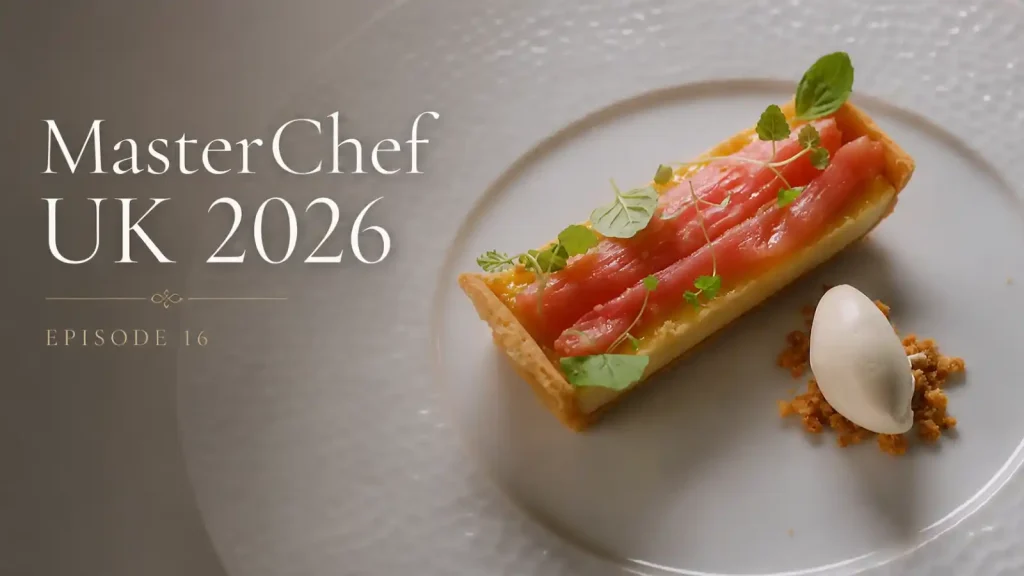
Their rhubarb is cut to exactly ten centimetres per baton and poached at a controlled low temperature with orange, where the risk of overcooking is real and permanent. “When rhubarb is overcooked,” Anna reminds Grace, “it just goes to mush.” The tarts go out with a rocher of orange syllabub alongside — Anna demonstrates the technique just before service kicks off, and Frankie then joins in the rochering. The plates, Anna tells them, look “stunning.” She adds: “Technically, it was a very difficult thing to do.”
The guests confirm it. The pastry is described as flaky, crispy and cooked to perfection. The custard carries a lovely note of vanilla. The rhubarb is tangy, zingy and well-calibrated against the sweetness beneath it. The orange syllabub ties the plate together. Grace calls it her favourite course of the evening. Anna agrees that the contestants should feel proud of what they delivered. The Blue team has executed under pressure, communicated throughout, and plated 100 identical portions without losing composure.
The Winning Team Decision and What it Means for the Competition
Back at the pass after service, Anna and Grace make their call. The winning team is Matt and Frankie. Their approach was praised specifically for two qualities beyond the food itself: flawless communication and consistent composure under extreme conditions. The dessert team is immediately through to the next round.
The six remaining cooks return to MasterChef HQ. The dynamic shifts sharply. During the banquet, they worked as units with shared outcomes. Now, each contestant stands alone.
For many of them, the prospect of the Invention Test is more frightening than the banquet. Grace puts it plainly. “It’s about thinking on your feet. It’s about running with whatever we throw at you.” The rules are designed to prevent any contestant from leaning on familiar ground. Whatever ingredient they cooked with during the banquet cannot be used again.
Tony worked with cod at the starter; he must now leave it alone. Kristen and Antos handled venison and potato terrine on the main course; venison is off-limits to both. Daniel’s involvement with the main course sauce and butchering means he pivots entirely to rhubarb. Jhane and Sabina worked the starter alongside Tony, so both are free to choose venison.
Ninety minutes. One dish. Everything on the line.
Six Cooks Turn Three Ingredients into Wildly Different Culinary Arguments
What follows reveals each contestant’s culinary identity under the purest possible test. There is no menu to hide behind, no team to share the pressure with, and no brief beyond the single ingredient restriction.
Kristen reaches across culinary traditions. Having spent the banquet working on a venison main, she now takes cod in a Japanese direction: grilled cod with Jerusalem artichoke crisps seasoned with seaweed salt, pickled grapes, and a sake butter sauce. She acknowledges to Anna that she has never combined these elements before. Anna’s response is frank: “That’s quite a big gamble at this stage of the competition.” Kristen meets it squarely. “But I think that’s what we’re here for, right?” The logic holds. Sake naturally lacks acidity, and Kristen builds the pickled grapes specifically to compensate — an intelligent structural decision that Anna validates before the dish is even plated.
Tony chooses venison and builds a composed plate that is ambitious in scope: venison loin roasted in a Szechuan crust with potato fondant, sriracha carrots, celeriac crisps, miso cauliflower purée and a rhubarb and chicken sauce. It is a dish with real visual impact and clear ambition. Consequently, the criticism cuts deeper. Anna and Grace both find the promised heat absent: the sriracha barely registers on the carrots, the Szechuan pepper on the venison is almost imperceptible, and nearly every element needs more salt. The rhubarb and chicken sauce, meanwhile, earns genuine praise for its balance of acidity and meatiness — a bright spot that partially redeems an underseasoned plate.
Daniel turns to rhubarb and decides to build a dessert: a rhubarb and vanilla panna cotta topped with rhubarb caramel, served with compressed rhubarb in ginger syrup with tarragon, and a tarragon and ginger shortbread crumb finished with spun sugar. The concept shows genuine bravery. The execution runs into problems. The rhubarb caramel sets far too hard to eat, and the compressed rhubarb — despite holding its colour beautifully — is also hard rather than yielding. The shortbread crumb is overcooked. Anna commends the ambition. But she cannot taste rhubarb in the panna cotta itself, and the crumb lets the plate down in texture and colour. Daniel calls it “one experiment too far” in his own quiet assessment.
Sabina makes the biryani her children have been asking for all series. It is a personal decision as much as a strategic one. She cooks the venison separately from the rice to avoid overcooking it — a sensible adjustment to a classically slow dish. The rice comes out fragrant and feathery. The ginger, garlic and chilli chicken sauce is described by Anna as “very beautiful.”
The stewed-down potatoes are rich and decadent. The problem, once again, is the venison itself: both judges judge it undercooked. Grace remains impressed by the volume of garam masala packed onto the loin. Anna concedes it is edible. It is a good effort on a dish with real ambition, but the meat undoes some of what the supporting elements built.
Antos plays to his identity. This is, as Anna puts it, “a classic Antos dish” — taking something relatable and turning it on its head. His concept is an Indian-spiced fish and chips: tandoori-marinated cod roasted in the oven, presented on a spiced hash brown loaded with garlic, coriander and turmeric, with green bean pakoras and a tartar sauce-inspired yoghurt raita alongside.
The hash brown earns genuine praise — the right balance of crunch outside and softness within. The cod is beautifully cooked: shiny, juicy, consistent. But the tandoori marinade hasn’t penetrated the fish, and the green bean pakoras disappoint Grace, their filling gone soft inside. The raita packs a real punch and demonstrates the palate behind the dish. Overall, it’s a mixed but largely creditable result.
Jhane’s Hickory-Smoked Venison Stops the Room
The standout moment of the entire Invention Test belongs to Jhane. She picks venison — an ingredient she hasn’t worked with during the banquet — and builds a dish that is authentically, unapologetically herself. Hickory-smoked venison, dressed with herbs, served with a rhubarb chutney and roti flatbread, finished with a Scotch bonnet jerk sauce. She has never used a smoker before. She is using one now, under competition conditions, with 90 minutes on the clock. The Scotch bonnet goes in whole and unrestrained.
Anna’s response when she tastes the jerk sauce is immediate. “Holy Mary, mother of God, Jhane, this is incredible!” The smokiness has penetrated the venison completely — the meat arrives moist, succulent and deeply flavoured. The jerk sauce carries Scotch bonnet heat that makes Grace’s nose run mid-sentence.
The rhubarb chutney is sweet and acidic in exactly the right measure, complementing rather than competing with the fire of the sauce. The roti flatbread, Anna tells her, is “perfect for mopping up this beautiful sauce.” For Anna, the dish has “the heartbeat of the Caribbean.” For Jhane, who describes the cook as “a real representation of me, of my heritage, of my background,” it is the most personal plate she has put up in the competition.
MasterChef UK 2026 Episode 16 Sends Daniel Home After a Tough Final Deliberation
The judging after the Invention Test produces two quick decisions and one that requires real deliberation. Jhane goes straight through: her dish bowled Anna over with flavour and technique in combination, and her bravery in attempting new skills at this stage of the competition sets her apart. Kristen also advances without hesitation — her flavour combinations landed precisely as intended, and Anna’s description of the plate as “a flavour bomb” leaves nothing open to debate.
That leaves Tony, Antos, Daniel and Sabina fighting for three places. The deliberation is genuinely difficult. Tony had beautiful cookery on his venison but failed to deliver on the bold spicing he promised. Antos produced a cleverly conceived plate with a well-cooked piece of fish but didn’t fully achieve the tandoori impact the dish required. Sabina’s biryani was ambitious, fragrant and largely successful, but the undercooked venison represented a significant execution failure in an ingredient-forward dish. Daniel’s rhubarb panna cotta showed real courage but arrived with too many technical errors to overlook: the caramel was inedible, the crumble was burnt, and the central flavour of the featured ingredient wasn’t present in the lead component.
It is Daniel who leaves. His departure is gracious — a goodbye in English and Welsh, warmth for everyone in the room, and a kind of pride that has nothing to do with the result. “I’m so proud,” he says, walking out. “This is my chance to live, to do something that on my deathbed I’ll be really proud of.” He hasn’t held back. That, in itself, is something.
Seven remain. The semi-finals are not finished with them yet. As one of the surviving contestants puts it, already looking toward whatever comes next: “I can only imagine what’s in store.” In MasterChef UK 2026 at this level, that’s the point.
FAQ MasterChef UK 2026 episode 16
Q: What happened in MasterChef UK 2026 episode 16?
A: Eight semi-finalists cooked a fine dining banquet for 100 guests at the National Railway Museum in York, celebrating 200 years of the modern railway and the museum’s 50th birthday. The contestants worked in teams across three courses designed by Anna Haugh. Matt and Frankie won the banquet challenge and progressed automatically, while the remaining six faced an Invention Test. Daniel was eliminated at the end of the episode, leaving seven cooks in the race.
Q: Why was the National Railway Museum chosen for MasterChef UK 2026?
A: The venue hosted a celebratory banquet marking two significant milestones simultaneously: the 200th anniversary of the birth of the modern railway and the National Railway Museum’s own 50th birthday. Home to the largest railway collection in the world, it provided a prestigious and historically meaningful setting for the semi-finals challenge, with 100 railway staff, volunteers and enthusiasts in attendance as guests.
A: Anna designed a three-course fine dining menu built around premium ingredients. The starter was crispy cod wrapped in kataifi pastry with pea velouté, tartar sauce and lemon pearls — her elevated take on fish and chips. The main was roasted saddle of venison rolled in pine crumb, served with potato terrine, cauliflower purée and port gravy. Dessert was a custard tart topped with poached rhubarb and an orange syllabub rocher.
Q: Why did Matt and Frankie win the banquet challenge in MasterChef UK 2026 episode 16?
A: Their custard tart with poached rhubarb and orange syllabub delivered technically accomplished results that impressed both judges and guests. The pastry was flaky, crispy and perfectly cooked. The vanilla custard balanced richness without excessive sweetness, and the rhubarb provided sharp contrast. Anna and Grace also praised the pair’s communication and composure throughout service — qualities that set them apart from the other two teams.
Q: What is kataifi pastry and why was it used in the MasterChef banquet starter?
A: Kataifi is a finely shredded pastry with a texture resembling thin hair-like strands. Anna used it to wrap individual cod portions, providing a distinctive crispy exterior when fried. The technical challenge was significant at banquet scale — all 100 portions needed to be wrapped quickly, because the longer the pastry sat before cooking, the drier it became, compromising the crispiness essential to the dish.
Q: What went wrong for the main course team during the MasterChef banquet service?
A: The Red team fell behind on multiple fronts. The potato terrines — which required over 90 minutes of cooking — went into the oven too late. Daniel took too long to butcher and portion the venison loins, and applied excessive heat during sauce-making, risking a burnt reduction. Antos’s cauliflower purée came out too thin for plating. The team ultimately served all 100 guests, but the venison went out rarer than intended and several elements arrived under pressure.
Q: How does the MasterChef Invention Test work in the semi-finals?
A: In episode 16, the six cooks who didn’t win the banquet challenge returned to MasterChef HQ to cook individually. Anna and Grace provided three ingredients from the banquet — cod, venison and rhubarb — with one restriction: each contestant could not cook with the ingredient they had handled during service. They had 90 minutes to produce a single dish demonstrating creativity, technical skill and strong flavour. One cook would be eliminated based on the result.
Q: What did Jhane cook in the MasterChef UK 2026 Invention Test and why did it impress the judges?
A: Jhane produced hickory-smoked venison with a Scotch bonnet jerk sauce, rhubarb chutney and roti flatbread — a dish she described as a direct reflection of her heritage and background. She had never used a smoker before. The venison arrived moist and deeply flavoured. The jerk sauce carried intense Scotch bonnet heat, the rhubarb chutney provided sweet acidity, and the flatbread completed the plate. Anna called it incredible and said the dish had “the heartbeat of the Caribbean.”
Q: Why was Daniel eliminated from MasterChef UK 2026 in episode 16?
A: Daniel’s Invention Test dish — a rhubarb and vanilla panna cotta with rhubarb caramel, compressed rhubarb and shortbread crumb — had too many technical failures to overcome. The rhubarb caramel set so hard it was impossible to eat. The compressed rhubarb also lacked the required softness. The shortbread crumb was overcooked. Critically, neither judge could taste rhubarb in the panna cotta itself. Despite praise for the dish’s ambition, the execution errors were too significant at semi-final level.
Q: What are lemon pearls and how are they made in professional cooking?
A: Lemon pearls are small spheres of concentrated lemon gel used as a garnish in fine dining. To make them, a lemon gel is prepared and then dropped in small quantities into freezing cold oil, which causes the droplets to set instantly into firm, glossy spheres on contact. The oil must be at a very low temperature — ideally chilled in a freezer beforehand — or the gel will not hold its shape. In episode 16, Jhane produced them for 100 portions of the banquet starter.


