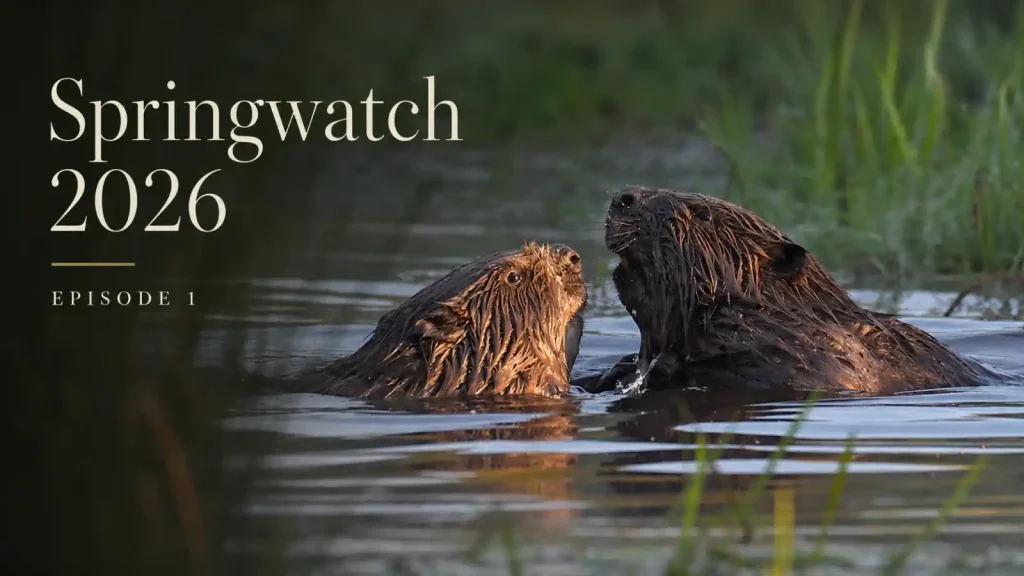
Springwatch 2026 episode 1 arrives with more wildlife drama, more scientific revelation, and a brand new location than any season opener in recent memory. Broadcasting live from the National Trust’s Crom Estate in County Fermanagh, Northern Ireland — the first time the show has ever based its main camp there — Chris Packham and Michaela Strachan kick off three weeks of live British wildlife coverage against a backdrop of eutrophic lakes, ancient woodland, flower-rich meadows, and an unseasonably scorching May.
Meanwhile, Iolo Williams heads to the Knepp Estate in West Sussex, a 3,500-acre rewilding paradise squeezed between the M23 and Brighton, where white storks nest, nightingales sing, and turtle doves call — simultaneously and in the same airspace, something Williams declares he has never witnessed anywhere else in the UK.
From frogspawn dissected at the microscopic level to the biomechanics of a drumming woodpecker, from jackdaw chick communication to a Belfast man who discovered peregrine falcons in his native hills and built a conservation career from scratch, this first episode sets a remarkably ambitious scientific and human-interest agenda.
The weather deserves mention early, because it shapes almost everything on screen. Kew Gardens recorded 34.8°C — the hottest May temperature ever logged — on the day of broadcast. At Crom, Chris describes it as a perfect spring day, warm enough to present the show in a T-shirt for what he claims is the first time in his Springwatch career. Michaela performs a celebratory dance. But behind the high spirits, a serious monitoring task begins immediately: the team commits to tracking how exceptional heat affects nesting success across every camera they have live on the estate. Some chicks are already struggling.
Springwatch 2026 episode 1
Springwatch 2026 Episode 1 Establishes Crom Estate as a Wildlife Powerhouse
The Crom Estate in the upper reaches of Lough Erne dominates the map with waterways. A mosaic of islands, inlets, and peninsulas threads across the landscape, and those lakes — naturally eutrophic, meaning genuinely rich in plant life and nutrients — support a food chain that starts with invertebrates, rises through fish, and culminates in apex predators. Damselflies and dragonflies patrol the water surface. Common terns pluck fish from below. A buzzard nest is already identified and camera-rigged within hours of the crew arriving. And the team announces it will be watching for white-tailed eagles, successfully reintroduced into this part of Northern Ireland, that have been sighted in the area.
Beyond the water, the estate surprises at every turn. Flower-rich meadows speckle with colour and buzz with insect life. Irish hares graze. Deer move through the tree margins. Spotted flycatchers are possible in the woods. Red squirrels are confirmed present. Most tantalisingly of all, Chris reveals that pine martens are almost certainly active on the site — he found droppings earlier in the day. The show’s camera setup reflects the ambition: nine cameras active before the first episode even goes to air, and more being rigged throughout.
The courtyard at the heart of the production site turns out to be an extraordinary arena in its own right. Between 10 and 15 pairs of swallows — the most ever accommodated on Springwatch — nest in the barns there. Around 20 house martin nests cling to the eaves. A starling has squeezed her clutch of five pale-blue eggs into a gap between two bricks. Sixty to seventy birds are present at any one time, which Chris notes immediately makes the courtyard a predator magnet. Sure enough, a sparrowhawk has already been spotted on the roof in the evenings, watching the swallows and martins below.
The Swallow Nests at Crom Reveal How Brutal the Heat Has Become for Nesting Birds
The swallow footage is among the most striking of the episode. Six chicks in one nest, a week old, were filmed the previous afternoon with some of their eyes still closed. By the evening of the broadcast, all six had their eyes open and their heads lifting higher to beg. Growth at that speed is remarkable, but the heat complicates everything. Earlier in the day, the chicks were hanging over the rim of their mud-cup nest with mouths open, attempting to shed body heat through gaping — a last resort for a nestling that cannot yet regulate its own temperature effectively.
The parent birds are working at the absolute limit of what the conditions allow. On one footage sequence, an adult returns with a beak crammed with insects, can barely distinguish which chick to target in the heat-addled scramble, and ultimately stuffs the entire delivery into the strongest chick at the back. That single moment captures the brutal arithmetic of spring — food flows toward the most vigorous, and the margin between survival and failure for the weakest is extremely thin.
House martin behaviour adds another dimension. Chris explains that older birds return first to last year’s nests, attempting to reclaim structures where mud fabric has survived the winter. But this brings its own complications: mites and parasites that overwintered in the cup may already be waiting. The competition for nest sites is fierce and physical. Springwatch cameras catch one bird attempting to dislodge another mid-flight — clinging to its rival’s wing in what Chris dryly calls “argy-bargy” before eventually being evicted.
Knepp Estate Rewilding Gives Iolo Williams His Most Remarkable British Wildlife Experience
Iolo Williams arrives at the Knepp Estate having always wanted to visit and immediately describes it as everything he hoped. Three and a half thousand acres of West Sussex have been handed back to nature by owners Sir Charles Burrell and Isabella Tree. The estate was inherited by Sir Charles from his grandfather; the land’s heavy clay soil proved poorly suited to modern intensive agriculture.
Rather than continue losing money trying to force it to perform, the family made the radical decision to rewild it. They introduced longhorn cattle to graze as aurochs once did, and Tamworth pigs to root the soil as wild boar once would have. The result, over years, has been a cascade of habitat diversity — scrub, woodland, hedgerow, meadow, and wetland — that has drawn in hundreds, possibly thousands, of species.
Beavers are now established at Knepp. Their engineering work has created wetlands that fill rapidly with invertebrate life. The rare purple emperor butterfly does well here. Nightingales, cuckoos, and turtle doves all breed. Williams stands in a field and hears all three calling at the same moment. He pauses, visibly moved. He says he has never experienced that combination anywhere else in Britain. It is a statement worth dwelling on from a broadcaster who has spent decades in the field across the length of the UK.
The standout species, however, is the white stork. Williams describes it simply: he never expected to see white storks breeding in the wild in Britain. They were extinct as UK nesters for centuries, although records show a pair used Edinburgh Cathedral as a nest platform in 1416. The conservation programme at Knepp uses rehabilitated birds sourced from Poland to establish a breeding population.
The results have been extraordinary. Twenty nests are now active on the estate. One pair Williams watches live on camera has raised four eggs, hatched all four chicks, and although two did not survive early infancy, the remaining two chicks are doing well. In the evening heat, both adults have been bringing water to the nest to cool it — behaviour captured on Knepp’s own camera.
Williams notes that in the stork world, bill length directly correlates with clattering efficiency: longer bills produce louder, more resonant clapping sounds, which the birds use instead of a voice to communicate. The German medieval name for white storks was “clappenstork.” It stuck.
Springwatch 2026 Episode 1 Goes Deep into the Science of Frogspawn
The frogspawn sequence is the most extended piece of pure science in the episode, and one of the most visually compelling the programme has produced. Chris frames it personally: he describes watching frogspawn develop in a classroom aquarium as a child as one of the formative pleasures of his early life. What the programme now offers is not the classroom view, but a microscopic descent into the biology of development, narrated frame by frame.
It begins with amplexus — the mating embrace in which a male frog, chosen by the female after competition from multiple males, holds her for days to position himself to fertilise her eggs the moment she releases them. A single female can produce around 3,000 eggs. Once released into water, each egg swells to approximately one centimetre in diameter, and the eggs clump into the familiar gelatinous rafts visible in garden ponds every spring. The protective jelly is the key to what follows.
Within hours of fertilisation, cell division begins — a process called cleavage — and the single fertilised cell rapidly multiplies into thousands. A hollow sphere of cells called a blastula forms. Spring sunshine warming the water triggers the next stage: the cells rearrange into three distinct layers, and part of the outermost layer folds inward to form the neural tube. That tube becomes the brain and the spinal cord. Days later, the embryo elongates, the head begins to form, and muscles link up with the developing nervous system, producing the first twitching movements. Within a week, an embryonic tadpole exists inside the egg — but with its mouth and nostrils sealed and no lungs yet formed, it breathes entirely through its skin.
Gills bud from the back of the head, branching into tree-like structures that extract oxygen from the surrounding water. At three weeks, the tadpole hatches — pushing its head against the jelly wall and thrashing furiously until it punches through. It sinks to the bottom of the pond for rest, then begins feeding on vegetation. Legs will follow. However, the arithmetic of this survival story is sobering: from 3,000 eggs, only four or five individuals from a single clutch will reach adulthood. The ones that do will return to the exact pond where they were conceived.
The Great Spotted Woodpecker’s Return to Ireland Rewrites a Conservation Story
The great spotted woodpecker carries enormous ecological significance at Crom, and Chris uses its appearance to tell one of the most striking conservation stories of the episode. For viewers in England, Scotland, and Wales, the bird is entirely familiar — its population has increased by 378% since the late 1960s. But great spotted woodpeckers did not nest in Ireland until 2006, when a pair bred in Northern Ireland; the first southern Irish nest followed in 2009. Their absence from Ireland for so long has a straightforward and devastating explanation.
Ten thousand years ago, Ireland was approximately 80% forested. By 1925, that figure had collapsed to just 1%. The woodpeckers — which depend entirely on mature woodland — disappeared with the trees. Bronze Age cave remains do contain great spotted woodpecker bones, confirming the species was once native. Forest cover in Ireland has since recovered to around 11.6%, and with it the woodpeckers have returned. Crom may now hold as many as 100 pairs, though no formal count has yet been conducted. Chris calls this astonishing, and it is.
Springwatch 2026 Episode 1 Unpacks the Biomechanics of Woodpecker Drumming
The woodpecker science goes further than the conservation story. Chris and Michaela examine new research from Brown University in the United States, where scientists attached muscle sensors to downy woodpeckers and filmed them with high-speed photography to understand precisely how a bird weighing just 80 grams strikes with a force of nearly two kilograms — hitting up to 25 times per second.
The answer involves the whole body working in a coordinated sequence. First, the chest muscles pull the head back. Then — and this is the new finding — the hips push the body away from the tree, priming the strike. The tail, composed of unusually stiff feathers with rigid quills, presses against the bark to brace the bird throughout. Neck muscles further amplify the force at the moment of impact.
The bird can modulate the power of each strike through the hips, not through the neck. Most surprisingly, the research reveals the woodpecker’s breathing apparatus is also integrated into the process: as the beak withdraws, the bird draws a tiny breath into its body in a fraction of a millisecond; as the beak makes contact, it expels that air. Scientist Dr Nick Antonsen translated the pressure changes inside a drumming woodpecker’s body into audible sound. The resulting recording — played live on the show — gives a remarkable acoustic portrait of a body operating at the absolute limit of biological engineering.
Both males and females drum. They do so to claim territory and attract mates, and with particular intensity when excavating the nest cavities that define where they breed.
Jackdaw Chicks in the Crom Boathouse Show How Parent Recognition Develops
Tucked inside a picturesque Victorian boathouse on the Crom waterfront, a jackdaw pair has established what Chris describes as one of the finest nest sites he has ever encountered on the programme. Four chicks, two weeks old, fill the camera frame. Jackdaws have appeared in only around three previous Springwatch nests across the show’s entire run, making them relatively rare in the programme’s history.
As the smallest of the corvids, jackdaws possess a distinctively grey-capped head and a pale eye that Chris finds particularly striking. More scientifically interesting, though, is the communication system the family has developed. When an adult arrives at the nest, it makes a barking call — a prompt for the chicks to begin begging behaviour, maximising the efficiency of food transfer. Research shows that newly hatched jackdaw chicks respond to almost any sound. Over days and weeks, they narrow their response to the calls of any jackdaw. Eventually, they learn to recognise and respond specifically to their own parents’ individual calls. By the time they are fledged, they have learned to distinguish their own adults from every other bird.
Aron Kelly and the Belfast Hills Represent a New Kind of Nature Guardian
One of the most quietly affecting sequences of the episode follows Aron Kelly, a West Belfast man who grew up with the Black Mountain as his constant backdrop and who, through a combination of obsession, lockdown free time, and sheer stubbornness, became a self-taught naturalist and conservation worker in the hills above the city.
Kelly did not come to nature through academia or formal training. He grew up doing ordinary jobs, always drawn to wildlife but unsure how to make it a vocation. During the Covid lockdowns, he began spending serious time on the Belfast hills, and there he found something that most professional ecologists believed did not exist locally: peregrine falcons. He spotted droppings on a walking route. He eventually caught one on camera on Christmas Eve. He shouted into the empty hillside with joy. He was the first person to confirm peregrines on those specific hills.
The discovery gave him credibility and opened a door. He now works in conservation. But he speaks with directness about the barriers he faced: coming from working-class West Belfast, with a thick city accent, he felt that his sightings would not be believed. The nature world, he implies, did not immediately look like somewhere someone like him could belong. The discovery of the peregrines changed that. Chris responds by noting, without sentimentality but with clear conviction, that a degree is not required to love and protect wildlife. Passion is.
Kelly’s ongoing project on the Belfast hills includes dug ponds that have already attracted newts, dragonflies, damselflies, frogs, and bats. He describes water as life — add a water source, and the food chain follows immediately. He talks about a picture he carries in his head of what the mountain could be, insisting with absolute certainty that it will happen someday. He owes the mountain everything, he says. It quite literally held his hand.
Springwatch 2026 Episode 1 Closes with a Jackdaw Colony and an Eye on What Comes Next
The episode’s final wildlife reveal returns to Crom and the boathouse jackdaws, sitting in what Chris calls a smorgasbord of active nests — robins, swallows, jackdaws, all live on camera, all due to be followed through the coming three weeks. The swallows’ mud-cup nests, the house martins competing over eaves space, the starling buried between bricks with five blue eggs: all of them represent stories at their most fragile and consequential point.
The season is early, the heat is record-breaking, and the cameras are rolling across Northern Ireland and Sussex simultaneously. Episode two promises the hidden life of slow worms, a climate advocate who finds solace in nature for her mental health, and caterpillars explored under darkness. Live camera feeds on the iPlayer run from 10am to 10pm throughout. The jackdaws will be noisy. The sparrowhawk will be watching. Spring in 2026 has barely started.
FAQ Springwatch 2026 episode 1
Q: Where is Springwatch 2026 filmed this year?
A: Springwatch 2026 broadcasts live from the National Trust’s Crom Estate in County Fermanagh, Northern Ireland — the first time the show has based its main camp in Northern Ireland. The estate sits in the upper reaches of Lough Erne and features eutrophic lakes, ancient woodland, flower-rich meadows, and a mosaic of islands rich in wildlife.
Q: What makes the Knepp Estate special for British wildlife?
A: Knepp is 3,500 acres of rewilded West Sussex farmland where owners Sir Charles Burrell and Isabella Tree replaced intensive agriculture with grazing cattle, rooting pigs, and beavers. The result is a mosaic of scrub, woodland, and wetland supporting nightingales, turtle doves, cuckoos, purple emperor butterflies, and white storks — all thriving simultaneously in the same landscape.
Q: Are white storks really breeding in the UK?
A: Yes. A conservation project at the Knepp Estate uses rehabilitated birds from Poland to establish a UK breeding population. Twenty active nests are now on the estate. Historical records confirm white storks nested on Edinburgh Cathedral in 1416, suggesting they were once native before centuries of extinction. Two chicks from one Knepp nest are currently being monitored live on Springwatch cameras.
Q: How does frogspawn develop into a tadpole?
A: After a female frog releases up to 3,000 eggs into water, fertilised cells divide rapidly in a process called cleavage, forming a hollow ball of thousands of cells known as a blastula. The cells then rearrange into three layers, fold inward to create a neural tube — the future brain and spinal cord — and within a week an embryonic tadpole forms. At three weeks, it hatches by pushing through the protective jelly wall.
Q: How does a woodpecker peck so fast without injuring itself?
A: Research from Brown University found that the woodpecker’s entire body coordinates the strike. Chest muscles pull the head back, hips push the body away from the tree to prime force, and stiff tail feathers brace the bird against the bark. Crucially, the hips generate most of the striking power — not the neck. The bird also takes and expels tiny breaths in milliseconds with each impact, integrating its breathing apparatus into every strike.
Q: Why did great spotted woodpeckers disappear from Ireland?
A: Ireland was 80% forested 10,000 years ago. By 1925, only 1% of that forest remained, eliminating the woodland habitat woodpeckers depend on. Great spotted woodpeckers did not nest in Ireland again until 2006 in the north and 2009 in the south. Forest cover has since recovered to 11.6%, and Crom Estate alone may now hold as many as 100 breeding pairs.
Q: How do jackdaw chicks learn to recognise their parents’ calls?
A: Newly hatched jackdaw chicks respond to almost any sound. Over the first weeks of life they narrow their response to jackdaw calls generally, then gradually tune in specifically to the individual adults feeding them. By the time they are ready to fledge, chicks respond to their own parents’ calls and no others — a learned recognition that maximises the efficiency of food delivery at the nest.
Q: What is the survival rate of frogspawn from egg to adult frog?
A: The odds are extremely low. From a single clutch of around 3,000 eggs, only four or five individuals typically survive to adulthood. Predation, competition, disease, and environmental conditions eliminate the vast majority at every stage from egg to tadpole to froglet. The adults that do survive return to breed in the exact pond where they were originally conceived.
Q: Why is the Springwatch 2026 launch episode significant for Northern Ireland?
A: Springwatch has never previously based its main broadcast camp in Northern Ireland. Crom Estate offers a genuinely distinct habitat profile — naturally nutrient-rich lough waters, ancient woodland, raised bogs, and flower meadows — supporting species including red squirrels, pine martens, Irish hares, great crested grebes, and white-tailed eagles. The combination of waterway habitats and diverse woodland makes it one of the richest Springwatch locations in the show’s history.
Q: How did Aron Kelly become a conservation worker without a formal degree?
A: Aron Kelly grew up in West Belfast with the Black Mountain as a constant backdrop. During the Covid lockdowns he began spending serious time on the Belfast hills, teaching himself to identify wildlife. He became the first person to confirm peregrine falcons on those specific hills — a discovery that gave him credibility and opened the door to a professional conservation role. He has since created ponds that have attracted frogs, newts, dragonflies, damselflies, and bats to the area.