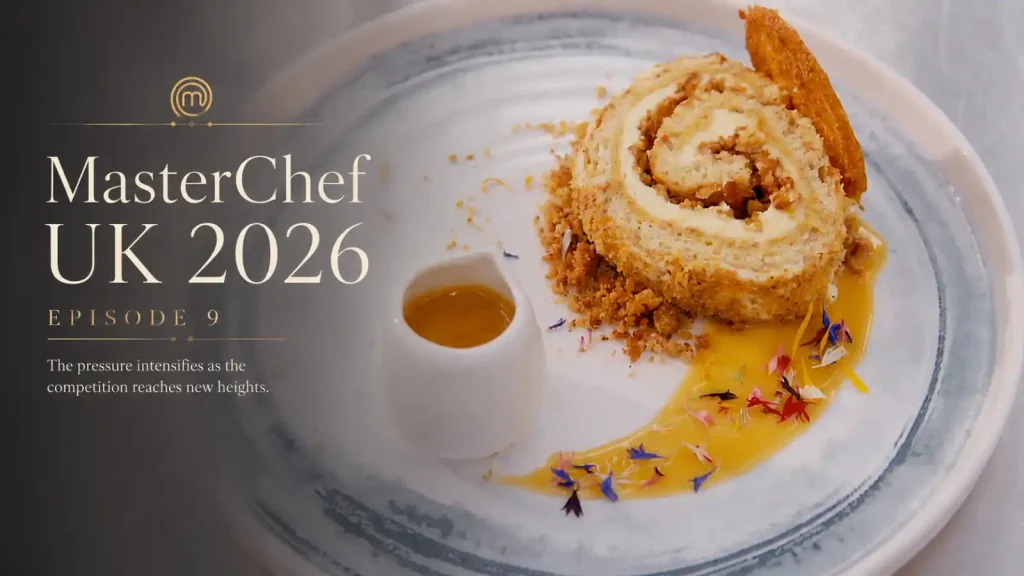
MasterChef UK 2026 episode 9 arrives at a pivotal crossroads in the competition, delivering the third quarter-final of the series and forcing six of the week’s strongest amateur cooks to prove, once again, that their skills are no fluke. The stakes have sharpened considerably by this stage. Getting this far already marks these six contestants as exceptional home cooks, but exceptional is no longer enough. To secure a place in knockout week, they must perform across two distinct and demanding challenges, satisfying judges Anna Haugh and Grace Dent with every plate they send to the pass.
The quarter-final structure in MasterChef UK 2026 is designed specifically to reveal character under pressure. A cook who excels in one challenge but stumbles in another faces elimination regardless of earlier brilliance. Anna and Grace are looking for consistency, imagination, and technical command — not flashes of inspiration followed by hesitation. Both judges have watched these six cooks across the week and know their strengths and vulnerabilities better than the contestants might realise.
What makes this particular episode so compelling within the broader cooking competition is the range of demands placed on the contestants in a single day. They open the proceedings with an invention test that rewards spontaneity and confident decision-making. They close with a brief set by a respected external voice who carries his own cultural framework into the judging room. Between those two poles, six very different cooks attempt to define themselves as something more than promising amateurs.
The MasterChef UK 2026 format at the quarter-final stage strips away the safety nets that earlier rounds sometimes provide. There is no team challenge to hide within, no technical recipe to follow, no established dish to replicate. Every choice belongs entirely to the cook making it, and every failure is entirely their own. That exposure is precisely what makes this stage of the cooking competition so revealing and so watchable.
Anna Haugh, the Irish chef with a background rooted in classical French technique and Irish produce, and Grace Dent, one of Britain’s most widely read and respected food critics, form a judging partnership that balances culinary precision with cultural literacy. Anna evaluates execution. Grace evaluates impact. Together they push these amateur cooks toward a standard that goes beyond home cooking and edges toward something approaching professional quality.
The six cooks entering the MasterChef kitchen today do so knowing that only the strongest will advance. The competition has already claimed talented individuals in the weeks prior. Those who remain have survived because they possess something — a palate, a technique, an instinct — that has kept them ahead. Today will test whether that something is sustainable or whether it only surfaces under certain conditions.
Throughout the day, the atmosphere inside the MasterChef kitchen carries a tension that is entirely proportionate to what is at stake. Knockout week awaits those who succeed. Elimination waits for those who do not. In a cooking challenge of this nature, there is no middle ground and no consolation for the runner-up. The six cooks are competing not just against each other but against the very best version of what they are capable of producing.
This episode of MasterChef UK 2026 demonstrates, across its two challenges, how the competition consistently demands more than technical proficiency. Culture, instinct, creativity, and nerve all factor into what Anna and Grace are looking for. The cooks who advance into knockout week will be those who manage to deliver all four within a single, pressurised day.
MasterChef UK 2026 episode 9 review
MasterChef UK 2026: The Invention Test Opens the Quarter-Final
The first challenge of the day is the invention test, and it opens with a clear declaration from the judges: this is not a time for timid cooking. Anna and Grace are specific about what they do not want. A limp sausage bap, as the brief pointedly puts it, is the antithesis of what this moment demands. The invention test requires the cooks to produce their best brunch dish using only their imagination, their instincts, and whatever they can source from the MasterChef Market.
The MasterChef Market is fully stocked for this challenge. Every type of meat, fish, vegetable, fruit, and spice is available. The abundance is deliberate. When a cook has access to everything, their choices become entirely revealing. There is no excuse rooted in limited ingredients. Whatever ends up on the plate reflects a genuine decision, made under pressure and on the clock.
Brunch as a category is deceptively broad. It accommodates the sweet and the savoury, the light and the substantial, the classical and the inventive. However, that breadth also creates a trap. A cook who cannot narrow the field quickly and commit to a clear vision will waste precious minutes in indecision. The invention test rewards those who think fast, plan efficiently, and cook with conviction from the very first moment.
Across the six cooks, several distinct approaches emerge. Some move toward the hearty and protein-forward, building dishes around eggs, cured meats, or smoked fish. Others choose lighter, produce-led plates that lean into the sweeter register brunch occasionally permits. The diversity of interpretation is itself one of the pleasures of watching this cooking challenge unfold.
Dish by Dish: The Brunch Plates That Define the Morning
Sagar opens the judging with a dish that centres on black pudding and egg. He constructs the plate carefully, bringing a considered approach to both seasoning and presentation. Anna notes the quality of his technique, and Grace responds positively to the boldness of the pairing. It is a strong start, grounded and executed with care.
Roisin prepares a brunch plate that features potato rosti and smoked salmon. The combination is familiar territory for brunch cooking, but the execution determines everything at this level. Her rosti is crisp and well-seasoned, and the salmon is handled with a lightness that prevents the dish from feeling heavy. Both judges acknowledge the skill involved, though the question of whether the concept pushes far enough into invention territory lingers.
Meanwhile, Daniel takes a more ambitious route. He constructs a dish that incorporates flavours from his own culinary background, bringing a personal dimension to the invention test that catches Anna and Grace’s attention. The specificity of his choices — the spicing, the structural logic of the plate — suggests a cook who draws from a genuine well of reference rather than assembling familiar components for the sake of safety.
Abby’s brunch dish travels in a different direction entirely. She works with sweet elements alongside savoury, attempting a balance that requires real precision to carry off successfully. The risk is considerable. A brunch dish that leans sweet can easily tip into dessert territory or lose the savoury anchoring that keeps it within the meal’s register. Her execution, however, demonstrates an understanding of that balance. The judges respond with interest, recognising the ambition behind the choice.
Mo prepares a dish that draws on his cultural background, incorporating spicing and ingredients that are not commonly seen in brunch contexts. The invention test is designed for exactly this kind of thinking. Rather than defaulting to convention, Mo uses the open brief to express something distinctive, and the resulting plate carries a coherence that reflects genuine culinary identity.
Laila rounds out the brunch session with a dish that prioritises texture and layering. Her plate demonstrates an understanding of how contrasting elements — crisp against soft, sharp against rich — can lift a dish from competent to compelling. Grace in particular responds to the intelligence of the construction.
The MasterChef Market and the Logic of Ingredient Selection
The MasterChef Market’s role in this cooking competition extends beyond simple provision. Its presence represents a philosophical commitment to the invention test format: the belief that a fully stocked larder, rather than simplifying the challenge, actually intensifies it. When every option is available, a cook’s choices become a direct expression of their culinary thinking.
The cooks who use the market most effectively in this episode are those who arrive at it with a clear mental image of the finished dish. They move through the stalls with purpose, selecting specific cuts, varieties, and accompaniments that serve a pre-formed concept. The cooks who struggle are those who browse without direction, accumulating ingredients that do not yet form a coherent whole.
In this sense, the market functions almost as a psychological test that runs parallel to the cooking challenge itself. The speed and confidence of a cook’s decisions at the market frequently predicts the quality of the dish that subsequently emerges. Hesitation at the stall often manifests as hesitation at the hob, and the judges — who are watching everything — take note of both.
Jimi Famurewa Brings the Second Challenge to MasterChef UK 2026
After the brunch plates have been assessed and the feedback delivered, the competition pivots toward its second and decisive challenge of the day. Anna and Grace have invited restaurant critic Jimi Famurewa into the MasterChef kitchen, and he arrives with a brief that is both personal and culturally specific.
Jimi Famurewa is one of the most prominent food critics working in Britain today. His writing combines sharp culinary analysis with a broad cultural sensibility, and he brings both qualities into the room with him. The brief he sets for the six cooks is rooted in his Nigerian heritage and the ingredients that defined his experience of food growing up.
Nuts hold a central place in Nigerian culinary culture, and Jimi’s brief reflects that centrality. He asks each of the six cooks to prepare a dish that showcases a nut or nuts of their choice. The parameters beyond that single requirement are deliberately generous. A cook can roast nuts and work them into a brittle, pound them into flour, use them as a foundational sauce base, or explore any other application that highlights the distinctive flavour and texture that nuts provide.
The versatility of the brief is, simultaneously, its challenge. Nuts appear in almost every global culinary tradition in some form. Peanuts, hazelnuts, walnuts, almonds, pistachios, cashews, pine nuts, and macadamias all carry different flavour profiles and respond differently to heat, acid, and fat. The cook who succeeds in this challenge must understand not just which nut to select, but how to construct a dish around it that makes the nut’s character impossible to ignore.
Nuts as a Culinary Focal Point: What Jimi Famurewa’s Brief Demands
The framing of Jimi’s brief is worth examining carefully, because it reveals something important about what this cooking challenge is genuinely testing. He is not asking the cooks to simply include a nut in a dish. He is asking them to build a dish in which the nut performs a starring role — where it provides flavour, texture, and structural logic, rather than garnish or decoration.
This distinction is significant. A walnut pressed into a salad and a walnut ground into a sauce and reduced with aromatics are categorically different acts of cooking. The former treats the ingredient as an afterthought. The latter demonstrates an understanding of what the ingredient can become when treated as a primary element. Jimi’s feedback to the cooks makes clear that he is looking for the latter.
The brief also carries a cultural dimension that the cooks must navigate thoughtfully. Jimi has explicitly grounded his request in Nigerian food culture and his personal relationship with nuts as an ingredient. A cook who engages with that context — even if their dish does not draw from Nigerian culinary traditions — demonstrates a kind of respect for the brief that a cook who ignores it entirely does not. However, the cooks are not expected to cook Nigerian food. They are expected to find their own relationship with the ingredient and present it convincingly.
The Nut Dishes: Ambition, Technique, and Cultural Dialogue
The six cooks approach Jimi’s brief with markedly different strategies. Sagar, whose earlier brunch dish had demonstrated disciplined technique, continues in a similarly grounded register. His nut dish shows a clear understanding of how to use the ingredient as a flavour base, building depth without allowing the dish to become monotonous.
Daniel, who had impressed during the invention test with his personal culinary references, leans further into his heritage for the nut challenge. His dish positions the nut as a structural element of the plate, not an accent, and the decision pays off in a result that carries both cultural conviction and technical precision.
Roisin’s approach brings a different kind of ambition. She works with the textural properties of her chosen nut, using preparation techniques that transform its appearance and character on the plate. The result is a dish that demonstrates creative thinking about ingredient transformation, and Jimi responds positively to the ambition behind the method, even as he evaluates the execution critically.
Abby, who had taken risks during the brunch challenge with her sweet-savoury balance, applies a similar boldness to the nut dish. She selects a combination that requires careful handling at every stage of the cooking process. The dish she presents to Jimi is layered and considered, and while it does not entirely resolve every tension it sets up, it convinces both Jimi and the judges that she is a cook with a genuine and distinctive point of view.
Mo’s nut dish, like his brunch, draws explicitly from his cultural background. He uses the nut as a sauce base, working it through a process that extracts flavour and creates a richness that becomes the foundation of the plate. The dish resonates with Jimi, who recognises in it both culinary skill and cultural fluency.
Laila’s approach is perhaps the most technically precise of the six. She selects a nut that does not typically occupy centre stage in restaurant cooking, and constructs a dish around it that makes a convincing argument for its versatility. Her understanding of balance — demonstrated throughout the brunch challenge — reasserts itself here in a plate that is coherent, carefully executed, and genuinely surprising.
Anna and Grace Deliver Their Verdict on MasterChef UK 2026’s Quarter-Finalists
Following Jimi’s feedback, Anna and Grace retire to consider the performances of all six cooks across both challenges. The deliberation at this stage is never straightforward. A cook who excelled in the brunch round but faltered in the nut challenge presents a different evaluative problem from a cook who underperformed early but delivered a remarkable final plate.
The judges’ approach to this decision reflects the broader values of MasterChef UK 2026 as a cooking competition. They are not simply tallying strong performances against weak ones. They are asking which cooks demonstrated a consistent quality of thinking across the entire day, and which cooks showed the kind of growth, composure, and ambition that knockout week will demand.
Jimi’s assessment of the nut dishes weighs significantly in the final decision. As an external voice with a specific cultural and critical framework, his feedback carries the authority of someone who has spent years examining food at the highest levels. His observations about which dishes genuinely showcased the nut and which merely included it provide Anna and Grace with a sharp analytical lens through which to view the afternoon’s performances.
The cooks who progress from this episode do so having satisfied both challenges and both judging voices. Their places in knockout week are not gifts. They are earned through the quality of their cooking, the intelligence of their decisions, and their ability to perform under conditions that are designed specifically to make performing difficult.
Knockout Week and What MasterChef UK 2026 Demands Next
For those who advance from the third quarter-final, knockout week represents a significant escalation in pressure. The name itself communicates the format’s ruthlessness: each challenge eliminates directly, without the partial safety nets that earlier rounds sometimes provide. The cooks who survive this episode of MasterChef UK 2026 will face an environment in which every performance must be their best.
The amateur cooks who have reached this point in the competition have already demonstrated that they belong at this level. However, belonging and thriving are different conditions. Knockout week will test not just culinary skill but psychological endurance. The ability to cook at a high level once, twice, or three times across a week is not the same as the ability to sustain that level when elimination is the direct consequence of a single poor performance.
Anna and Grace, throughout this series of MasterChef UK 2026, have consistently sought cooks who combine technical skill with creative confidence. The quarter-final format, with its dual challenges and its external judging voice, is constructed to identify precisely that combination. The cooks who have impressed across both the invention test and Jimi’s nut brief have shown that they possess both qualities in sufficient measure to continue.
The cooking competition at this stage is no longer about potential. It is about delivery. The cooks who advance carry with them the expectation that they will deliver again, under conditions that are harder than anything they have yet faced. The MasterChef trophy, still weeks away, is simultaneously closer than it has ever been and more demanding than it has ever seemed.
The Cultural Dimension of MasterChef UK 2026 Episode 9
One of the most significant aspects of this episode is the way it positions cultural identity as a legitimate and valued dimension of competitive cooking. Jimi Famurewa’s brief does not simply introduce nuts as an ingredient challenge. It introduces the idea that food is always embedded in culture, and that a cook who understands this embeddedness produces dishes with a depth that purely technical cooking cannot match.
Several of the amateur cooks in this episode draw explicitly from their own cultural backgrounds in both challenges. The brunch dishes that reference heritage ingredients or spicing traditions, and the nut dishes that engage with culinary methods rooted in specific cultural contexts, consistently produce some of the most memorable plates of the day. This is not coincidental. When a cook cooks from a place of genuine personal reference, the resulting dish carries a conviction that is immediately legible to experienced judges.
Anna Haugh’s own culinary identity is deeply bound to Irish produce and classical French technique. Grace Dent’s critical sensibility has always been alert to the cultural layers within food. Their receptiveness to culturally inflected cooking in this episode reflects a consistent value the culinary competition has championed across its 2026 series: that the best cooking is personal, specific, and impossible to fully separate from the life and background of the cook who produces it.
Reflecting on the Third Quarter-Final of MasterChef UK 2026
The third quarter-final delivers everything the format promises and then some. Across two very different cooking challenges, six talented amateur cooks compete for a limited number of places in a round that will demand even more of them than this one has. The invention test reveals how quickly and confidently each cook can make decisions under an open brief. Jimi’s nut challenge reveals whether those same cooks can translate a specific, culturally grounded brief into a dish that is both technically accomplished and genuinely expressive.
The performances across the day are uneven in the way that high-level competition always produces unevenness. Some cooks peak in the morning and struggle in the afternoon. Others build momentum as the day progresses and deliver their finest cooking in the final hour. The judges account for this variability in their deliberations, but they are ultimately looking for cooks who demonstrate a consistent standard rather than isolated moments of brilliance.
MasterChef UK 2026 continues to operate at a level that justifies its reputation as one of British television’s most rigorous and compelling cooking competitions. The quarter-final format, the quality of the guest judges, and the calibre of the remaining amateur cooks all contribute to an episode that functions both as a genuine test of culinary ability and as a portrait of what it means to cook from a place of real ambition. Those who advance deserve their place in knockout week. Those who do not leave having shown what they are capable of producing. In a competition of this standard, that is never nothing.
FAQ MasterChef UK 2026 episode 9
Q: What is MasterChef UK 2026 Episode 9 and why does it matter in the competition?
A: MasterChef UK 2026 Episode 9 is the third quarter-final of Series 22. Six of the week’s strongest amateur cooks return to compete across two demanding challenges. Only the best performers earn a place in knockout week, making this one of the most decisive episodes of the entire series.
Q: Who are the judges in MasterChef UK 2026 Episode 9 and what do they look for?
A: Anna Haugh and Grace Dent judge the episode. Anna evaluates culinary technique and precise execution, while Grace assesses overall impact and cultural intelligence. Together they seek cooks who demonstrate consistent quality, creative confidence, and genuine personal conviction in every dish they produce throughout the day.
Q: What is the invention test in the MasterChef UK 2026 quarter-final?
A: The invention test challenges cooks to create their best brunch dish using only their imagination and the fully stocked MasterChef Market. No recipe is provided. Cooks must think quickly, make decisive ingredient choices, and deliver a skilful, imaginative plate that genuinely impresses the judges. Timid or unadventurous cooking is firmly discouraged.
Q: What does the MasterChef Market provide during the brunch cooking challenge?
A: The MasterChef Market offers every type of meat, fish, vegetable, fruit, and spice the cooks could need. Its abundance is deliberate. When every ingredient is available, a cook’s selections become entirely revealing. Cooks who arrive with a clear dish in mind move efficiently; those without direction often struggle to produce a coherent plate.
Q: Who is Jimi Famurewa and what brief does he set for the cooks?
A: Jimi Famurewa is one of Britain’s most respected restaurant critics, known for combining sharp culinary analysis with broad cultural awareness. He sets a brief rooted in his Nigerian heritage, asking each cook to prepare a dish that showcases a nut or nuts of their choice as the primary, starring ingredient rather than a garnish.
Q: Why are nuts the focus of the second challenge in MasterChef UK 2026 Episode 9?
A: Nuts hold a central place in Nigerian culinary culture, which is personal to Jimi Famurewa. He wants cooks to treat nuts as a primary element rather than decoration. Cooks can roast them into brittles, pound them into flour, or build them into a sauce base. The key requirement is that the nut’s distinct flavour must define the finished dish.
Q: How do the amateur cooks approach the nut-based cooking challenge differently?
A: Each cook takes a distinctive approach. Some use nuts as a sauce foundation, extracting deep flavour through grinding and reduction. Others focus on textural transformation through roasting or brittling. Several draw from their own cultural backgrounds, producing dishes with personal conviction. Jimi and the judges consistently respond most positively to plates where the nut genuinely leads the dish.
Q: How do Anna and Grace decide which cooks progress from MasterChef UK 2026 Episode 9?
A: Anna and Grace evaluate performance across both challenges rather than focusing solely on one outstanding moment. They consider consistency, ambition, technical precision, and creative thinking throughout the entire day. Jimi’s critical feedback on the nut dishes also informs their deliberations. Cooks who demonstrate sustained quality across both rounds earn their place in knockout week.
Q: What role does cultural identity play in the cooking competition at this stage?
A: Cultural identity plays a significant role throughout MasterChef UK 2026 Episode 9. Cooks who draw from their personal heritage produce dishes with a depth and conviction that purely technical cooking rarely matches. Jimi’s brief explicitly acknowledges this by grounding the challenge in Nigerian food culture, signalling that the best cooking is always personal and specific.
Q: What awaits the cooks who advance from MasterChef UK 2026 Episode 9 into knockout week?
A: Knockout week is significantly more demanding than the quarter-final stage. Each challenge eliminates directly, with no partial safety nets. The amateur cooks who progress must sustain their highest performance level across every round. Furthermore, the MasterChef trophy remains the ultimate prize, and only cooks who consistently deliver under intense pressure will remain in contention to become MasterChef Champion 2026.


