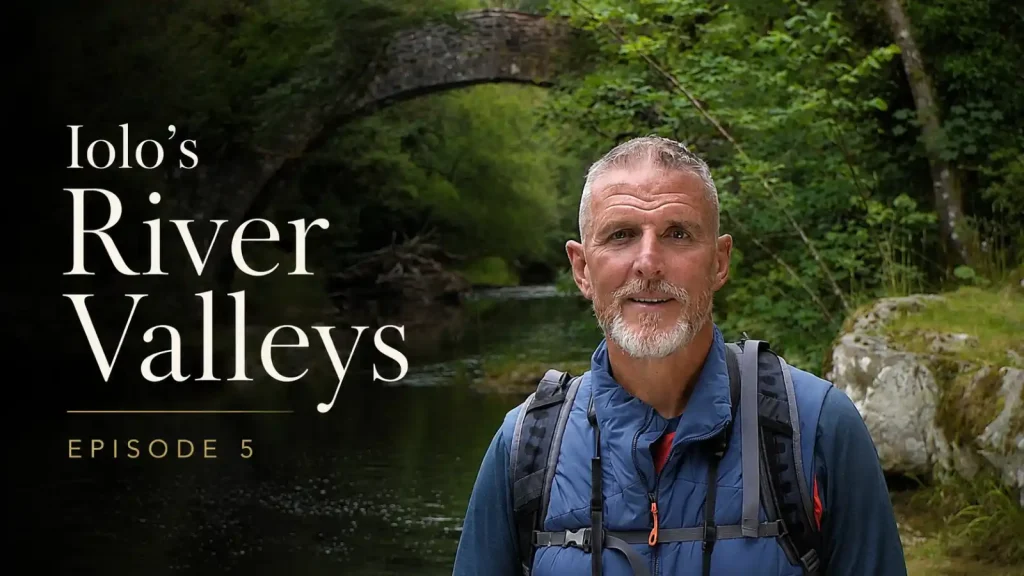
Wales has a way of hiding its greatest treasures in plain sight. In Iolo’s River Valleys episode 5, naturalist Iolo Williams proves exactly that. He traces the River Usk from its industrial mouth all the way to its quiet mountain source, uncovering a world that most people never slow down enough to see. This is South Wales nature at its most vivid and surprising — a 77-mile journey that feels less like a documentary and more like a love letter to a living landscape.
The adventure begins near Newport’s industrial docklands, where the iconic transporter bridge towers over the Usk estuary. At first glance, the surrounding wasteland seems like the last place you’d go looking for wildlife. In reality, it’s the opposite. Iolo discovers a genuine pollinator’s paradise here, buzzing with flowering plants and alive with red admiral and speckled wood butterflies. Perhaps most remarkably, he encounters the javelin wasp — a parasite so extraordinarily equipped that its long ovipositor looks precisely like a sting. Urban nature, it turns out, punches well above its weight.
Moving upstream, the character of the river shifts entirely. Near Usk town, the gravelly shallows become a vital spawning ground for the rare shad — a sea fish that makes an extraordinary journey into freshwater just to lay its eggs. Meanwhile, on the quiet shingle banks nearby, Iolo deploys his specialist licence to monitor the nests of little ringed plovers. These birds are masters of disguise. Their eggs blend so perfectly into the stones that finding them feels like solving a puzzle nature itself set.
The river’s health tells its own story through its insect life. Iolo finds several species of mayflies along the Usk, including the medium olive and the large brook dun. These delicate creatures are more than beautiful — they are essentially a buffet for the local brown trout population. Consequently, where mayflies thrive, the whole ecosystem tends to follow. In other words, the Usk isn’t just a pretty river. It’s a finely balanced machine, humming with interdependence.
The journey then takes a wonderfully atmospheric turn at Llanfoist. Specifically, Iolo ventures deep into a dark, dripping tunnel beneath the Monmouthshire and Brecon Canal, searching for the European cave spider. These light-shunning arachnids lead lives that feel almost mythological. Their egg sacs resemble tiny bundles of cotton wool, and when the spiderlings finally emerge, they launch themselves into the air on silk parachutes, drifting toward new homes. It’s the kind of detail that makes you realise nature has already invented everything we think we’ve imagined.
Above the valley floor, the landscape opens up dramatically at Craig y Ciliau — an old quarry that reinvented itself as a national nature reserve. Among rare Arctic-alpine plants like mossy saxifrage, the cliffs feel ancient and unhurried. Iolo observes a wheatear nesting in the scree, which is expected enough. But then comes the genuine surprise: redstarts, typically birds of woodland glades, raising their young in holes in the ground. Nature, as always, refuses to follow the rulebook.
As evening settles over the Brecon Beacons, Iolo joins the Vincent Wildlife Trust for one of the most remarkable moments in this Welsh nature documentary. Together, they wait for the emergence of the lesser horseshoe bat — one of Britain’s rarest mammals and a genuine conservation success story. Using thermal and infrared technology, Iolo gets an extraordinary window into a maternity roost of 500 adults. The bats perform what researchers call light sampling behaviour, briefly hovering at the roost entrance to test the conditions before committing to the hunt. It’s precise, instinctive, and quietly breathtaking to watch.
Iolo’s River Valleys episode 5
The lesser horseshoe bat is a species that nearly slipped away from Wales altogether. Consequently, witnessing a roost of this size feels genuinely significant. These animals depend on undisturbed roost sites, clean waterways, and insect-rich hunting grounds — all of which the Usk valley, thankfully, still provides. In this sense, the bat roost functions as a kind of report card for the whole river system. Specifically, it tells us the landscape is still doing something right.
The final stretch of Iolo Williams’ journey leads into the coniferous woodlands above Sennybridge, where the river valley feels remote and self-contained. Here, Iolo strikes gold. Two tiny firecrests engage in a territorial dispute, their brilliant orange crests flaring like lit matches in the green gloom. Firecrests are among Britain’s smallest birds, and consequently, finding them at all requires patience and sharp eyes. Watching two of them face off is the kind of moment that rewards every hour spent quietly waiting in the woods.
The journey concludes at the Usk reservoir, nestled beneath the brooding Black Mountain peaks. It’s a fittingly dramatic setting for the end of such an epic exploration of Welsh river valleys. On the slopes nearby, six-spot burnet moths go about the serious business of mating, their vivid crimson markings providing one last burst of colour against the moorland grasses. Specifically, it’s a scene that captures everything this episode does so well — the ordinary made extraordinary, the overlooked made luminous.
Iolo’s River Valleys episode 5 is, at its heart, a celebration of Wales wildlife in all its layered complexity. From a wasp with a javelin to bats with infrared-worthy flight patterns, the River Usk rewards curiosity at every turn. This is Welsh nature documentary filmmaking that respects both its subject and its audience — unhurried, deeply knowledgeable, and genuinely moved by what it finds.
Iolo’s River Valleys episode 5 opens at the southern edge of Wales, where the River Usk completes its 77-mile journey from mountain source to tidal estuary, and where Iolo Williams begins one of the most revealing wildlife journeys in recent Welsh nature documentary television. The Usk is not merely a river. It is a living corridor, threading through industrial margins, ancient limestone cliffs, working farmland, and remote upland forest, connecting habitats that at first glance seem to have nothing in common. What unites them is the river itself — and the extraordinary cast of species that depends on it.
South Wales nature carries a reputation shaped largely by its industrial past, but the Usk tells a different story. From Newport’s docklands to the Black Mountains above Sennybridge, the river sustains a diversity of life that would surprise anyone who equates Wales’s southern valleys with coal dust and concrete. The programme makes this point immediately and continues making it with mounting conviction across every kilometre of its journey upstream.
Welsh river valleys have long attracted naturalists and walkers, but the Usk in particular rewards those willing to look carefully. Its gravel banks shelter nesting waders. Its insect-rich margins feed trout. Its limestone crags harbour Arctic plants that have clung to the cliffs since the last ice age. Its canals conceal secretive spiders. And its mature trees above Brecon provide roost sites for one of Britain’s rarest mammals. No single stretch of the river is merely transitional — every section holds something specific and significant.
Iolo Williams is the ideal guide for such a journey. A lifelong naturalist and broadcaster with deep roots in Welsh wildlife, he approaches each location not with detached curiosity but with evident personal investment. He knows what a rare species looks like from a distance, he understands how to move quietly enough to watch undisturbed behaviour, and he brings to the screen a quality that distinguishes the best wildlife presenting: genuine excitement tempered by hard-won knowledge. That combination makes Iolo’s River Valleys episode 5 more than a travelogue.
The journey’s opening section, in the industrial fringe of Newport, immediately establishes the tone. This is not pristine wilderness. The transporter bridge — an enormous Victorian structure spanning the Usk estuary — serves as the episode’s gateway symbol. It is extraordinary in its own right, one of only a handful of such bridges surviving anywhere in the world. But Iolo uses it to frame a broader point: the landscape around it, which most people would dismiss as wasteland, turns out to be remarkably alive.
The gravelled and scrubby margins of the Newport docklands support a rich pollinator community. Flowering plants colonise disturbed ground with characteristic speed, and where flowers establish, insects follow. Iolo identifies red admiral and speckled wood butterflies feeding among the vegetation, both species recognisable to most observers. Less recognisable, and considerably more surprising, is the javelin wasp — a parasitoid insect equipped with an elongated ovipositor that mimics the appearance of a sting. The wasp uses this structure to insert its eggs directly into the larvae of other insects, a reproductive strategy as precise as it is alarming.
This urban opening serves a deliberate purpose. By demonstrating that abandoned industrial ground can function as a pollinator’s paradise, the episode challenges the assumption that conservation value and human activity are mutually exclusive. The Usk does not begin in pristine upland meadows. It ends, at its tidal mouth, in one of South Wales nature’s most overlooked wildlife habitats — and the species found there are no less remarkable for their unglamorous surroundings.
Moving upstream from Newport, the character of the River Usk changes substantially. The tidal influence retreats, the banks firm up, and the river takes on the gravelly, well-oxygenated character that defines its middle reaches. Here, Iolo turns his attention to species that are nationally scarce, behaviourally fascinating, and easy to miss if you do not know what to look for. The transition from city fringe to open floodplain happens gradually, but the shift in wildlife is pronounced and instructive.
Rare Shad and the River Usk as a Spawning Corridor
Near the town of Usk, the river’s gravel beds become critical habitat for one of Britain’s most overlooked migratory fish: the shad. Both the allis shad and the twaite shad are sea fish that travel into freshwater specifically to spawn, selecting clean, well-oxygenated rivers with appropriate substrate. The Usk is one of a small number of rivers in Wales and England where shad populations still exist in meaningful numbers, and the gravelly stretches near Usk town provide ideal spawning conditions.
Shad are ancient fish with a biology shaped by migration. They spend the majority of their lives at sea, feeding and growing, before returning to the rivers where they were born to reproduce. The Usk’s consistent water quality and accessible gravel make it hospitable in ways that many other Welsh river valleys are not. Pollution, abstraction, and physical barriers have eliminated shad from rivers where they were once common, making each surviving population the more ecologically precious.
Iolo’s encounter with shad on the Usk is brief but pointed. The fish are visible in the shallows, their presence itself a marker of river health. Unlike salmon — a species familiar enough to appear in television documentaries routinely — shad remain genuinely obscure, their conservation status rarely discussed and their ecological role even less understood by the general public. The episode’s focus on them reflects a broader commitment, evident throughout Iolo’s River Valleys episode 5, to foreground species that are important but underrepresented in mainstream wildlife media.
Little Ringed Plovers and the Iolo’s River Valleys Episode 5 Approach to Nesting Waders
On the quiet shingle banks of the middle Usk, Iolo turns his attention to a bird whose camouflage is so effective that its nest can be virtually invisible from a metre away. The little ringed plover is a small wader that nests directly on bare gravel, laying eggs that are indistinguishable from the surrounding stones at a casual glance. Its colonisation of gravel pits and river banks in Britain is a relatively recent conservation success story, but its nests remain extremely vulnerable to disturbance.
Iolo carries a specialist licence that permits him to approach nesting little ringed plovers for monitoring purposes. The scene on the Usk’s shingle bank is handled with exceptional care. The bird, returning to its clutch, picks its way deliberately through the stones, pausing frequently to check for danger. The eggs, when finally located, demonstrate precisely why this species’ nesting strategy works: against a background of variegated grey and brown pebbles, the clutch is almost impossible to see. The plover’s behaviour and the nest’s concealment together represent an evolutionary solution so elegant it appears almost intentional.
The little ringed plover section does more than showcase a single attractive species. It illustrates the Usk’s function as a habitat provider for ground-nesting birds, a guild that is under increasing pressure across Britain as gravel extraction, flooding, and recreational disturbance reduce available nesting space. The river’s natural shingle bars, maintained by the Usk’s own flood dynamics, provide what man-made gravel pits only partially replicate. Protecting the physical character of the River Usk therefore means, in direct and measurable terms, protecting the little ringed plover.
Mayflies, Brown Trout, and the Insect Life of the River Usk
The Usk holds a distinguished reputation among fly fishers, and the episode makes clear why that reputation is deserved. The river’s insect fauna — and specifically its mayfly populations — represents a biological richness that supports not only the trout for which the Usk is famous but the entire food web that the river sustains. Iolo examines several mayfly species in close detail, identifying the medium olive and the large brook dun as among the most significant for both ecological function and angling practice.
Mayflies are exquisitely sensitive to water quality. Their larvae, which live in the river substrate for months or years before emerging as winged adults, require clean, well-oxygenated water to complete their development. A river with abundant and diverse mayfly populations is, by any ecological measure, a healthy river. The Usk’s mayfly assemblage is therefore not simply a feeding opportunity for brown trout — it is a living indicator of the river’s condition, a biological gauge more reliable in many ways than any chemical test.
The brown trout themselves complete this ecological loop in the most visible way. Feeding in the surface film as mayfly duns emerge and spinner falls settle on the water, the trout are simultaneously the river’s most iconic inhabitants and the most obvious beneficiaries of its insect wealth. Iolo frames the relationship between mayfly and trout with appropriate precision: without the insects, there are no rising fish; without the clean gravel and cool water that the insects require, there are no insects. The Usk’s health is systemic, and every species Iolo encounters along its banks is connected to every other through exactly this kind of dependency.
The Monmouthshire and Brecon Canal and the European Cave Spider
At Llanfoist, the Usk’s valley floor carries one of Wales’s most distinctive heritage features: the Monmouthshire and Brecon Canal, a navigable waterway that once served the iron and coal industries of the southern valleys and now functions as a leisure corridor and wildlife habitat. The canal runs along the valley side at a level above the river, carried in places by embankments and through tunnels cut into the hillside. One of these tunnels is the focus of one of the episode’s most memorable sequences.
Deep within a long, dark, and perpetually damp canal tunnel, Iolo searches for the European cave spider. This large, reclusive arachnid requires conditions of near-total darkness and high humidity to thrive, making canal tunnels and cave systems its preferred habitat in Britain. The spider itself is an impressive animal — considerably larger than most British species and equipped with a biology adapted in detail to lightless environments. Iolo locates specimens on the tunnel walls and ceiling, where they rest in characteristic postures between hunting forays.
The European cave spider’s reproductive behaviour is particularly striking. Females produce egg sacs that Iolo describes as resembling balls of cotton wool — large, pale, and carefully suspended from the tunnel wall. When the eggs hatch, the spiderlings disperse using silk threads as parachutes, ballooning out of the tunnel on air currents to colonise new locations. This combination of maternal investment and airborne dispersal gives the species both local persistence and long-range colonisation ability, a life history strategy as sophisticated as anything found in the more celebrated mammals and birds that share the Usk valley.
The Monmouthshire and Brecon Canal itself deserves recognition beyond its role as a spider habitat. The canal’s towpath, water surface, and marginal vegetation support a wide range of invertebrates, birds, and aquatic plants. Its historical function has been entirely superseded, but its ecological function continues to grow. The Llanfoist tunnel, in particular, demonstrates how human infrastructure, once repurposed and left undisturbed, can acquire genuine conservation value over time.
Craig y Ciliau: Limestone Cliffs and the Iolo’s River Valleys Episode 5 Ascent to the Uplands
Above the Usk valley floor, the landscape rises steeply to limestone escarpments and cliff systems that contain some of the rarest plant communities in Wales. Craig y Ciliau is a national nature reserve occupying the face of a former limestone quarry, and it represents a dramatic shift in ecological character from the river corridor below. Where the Usk’s banks are defined by moisture and movement, Craig y Ciliau is a world of exposure, thin soils, and specialised vegetation adapted to survive conditions that would defeat most plants.
The limestone cliffs at Craig y Ciliau support Arctic-alpine plant communities — species whose distribution in Britain is restricted to upland and northern locations where competition from more vigorous lowland plants is reduced. Iolo identifies mossy saxifrage as one of the key species at the site, a compact and tenacious plant that clings to rock faces and scree slopes with apparent indifference to the harsh conditions around it. These plants are relicts of the post-glacial period, populations that have persisted on suitable limestone outcrops for thousands of years while the lowlands around them were colonised by woodland and improved grassland.
Among the scree and cliff ledges at Craig y Ciliau, Iolo finds nesting wheatears — a species typically associated with open, stony upland terrain and one whose presence here is ecologically appropriate. More unusual is the discovery of redstarts nesting in holes in the ground. Redstarts are conventionally described as woodland glade nesters, selecting cavities in mature trees for their breeding attempts. Their use of ground-level holes in the scree at Craig y Ciliau represents an interesting behavioural flexibility. The site provides what these birds evidently require — shelter, concealment, and proximity to good foraging — regardless of the substrate in which they find it.
Craig y Ciliau is presented in Iolo’s River Valleys episode 5 as a place where the expected rules of habitat and species distribution require revision. The reserve’s combination of limestone geology, old quarry topography, and altitude creates conditions that support an assemblage of species not found together anywhere else along the Usk. The journey from Newport’s urban margins to this exposed upland reserve captures the full ecological breadth of the Welsh river valleys that the series sets out to explore.
Lesser Horseshoe Bats and the Vincent Wildlife Trust Roost Near Brecon
As evening approaches near Brecon, the episode transitions from diurnal wildlife to the nocturnal world, and in doing so arrives at one of the most spectacular sequences in the programme. Iolo joins members of the Vincent Wildlife Trust to observe the emergence of a lesser horseshoe bat maternity roost — a colony of approximately 500 adult females gathered in a single building to give birth and raise their young.
The lesser horseshoe bat is among Britain’s rarest mammals, its distribution concentrated in Wales and the southwest of England. Unlike the more familiar pipistrelle, which has adapted with some success to modern suburban environments, the lesser horseshoe bat is highly sensitive to habitat change. It requires traditional farm buildings or old country houses for its roost sites, a network of linear landscape features for commuting, and insect-rich pastures for foraging. Its continued presence in the Usk valley reflects both the quality of the local landscape and the effectiveness of targeted conservation work over recent decades.
The technology deployed at the roost site reveals behaviour that would otherwise be entirely invisible. Thermal and infrared cameras show individual bats manoeuvring at the roost entrance, a behaviour Iolo describes as light sampling — the bats pausing at the threshold to assess the ambient light level before committing to emergence. This apparently cautious behaviour reflects a genuine predation risk: bats caught in full daylight are vulnerable to aerial predators, and the delay at the roost entrance is a risk-management response rather than simple hesitation.
The scale of the maternity roost — 500 lesser horseshoe bats in a single building — is remarkable from a conservation perspective. Maternity colonies of this size are uncommon for any British bat species, and for a species as restricted as the lesser horseshoe bat they represent a genuinely significant population node. The work of the Vincent Wildlife Trust in monitoring, protecting, and researching such roosts is presented as a model of the kind of targeted, species-specific conservation effort that can make measurable differences to rare mammal populations. South Wales nature, at this point in the episode, feels like a place where conservation is working.
Firecrests and Six-Spot Burnet Moths on the Iolo’s River Valleys Episode 5 Journey to the Source
The final section of the episode carries Iolo into coniferous woodland above the valley floor near Sennybridge, and then to the remote upland reservoir that marks the Usk’s source. These closing habitats bring encounters with two species that serve as fitting conclusions to a journey defined throughout by the unexpected.
In the coniferous woodland, Iolo witnesses a territorial confrontation between two firecrests. Britain’s second-smallest bird, the firecrest is a species of the southern counties in England but has been colonising Welsh conifer plantations with increasing regularity. The males’ territorial displays involve the raising of their orange and gold crests — structures that blaze with colour against the dark green of the trees. Two males displaying against each other is a spectacle disproportionate to the birds’ size: the intensity of the interaction, the brilliance of the crests, and the speed of the movements combine to make it genuinely arresting. Iolo’s visible delight at the encounter reflects both its rarity and its visual impact.
At the Usk reservoir, the journey reaches its conclusion in a landscape shaped by altitude and exposure. The reservoir lies in the shadow of the Black Mountain peaks, a remote and quiet location whose character stands in complete contrast to the Newport docklands where the episode began. Here, six-spot burnet moths — small, day-flying moths with deep red spots on metallic green-black forewings — are mating on vegetation around the reservoir margins. The six-spot burnet is a species of flower-rich grassland and unimproved ground, and its presence at the Usk’s headwaters reflects the quality of the upland habitat that surrounds the reservoir.
The moths’ mating behaviour is direct and unambiguous: pairs couple on flower stems and grass blades, the female’s weight pulling the male into postures that make their activity unmistakable. Iolo responds to the scene with characteristic warmth, noting that the moths provide a final splash of intense colour at the end of a journey that has been, from its industrial beginnings to its upland conclusion, consistently surprising. The six-spot burnet’s vivid patterning serves as a warning to predators — the moths are toxic, their colouration advertising their unpalatability to any bird that might consider eating them. Even here, at the very end of the journey, appearance deceives.
The River Usk as a Living System in Iolo’s River Valleys Episode 5
What Iolo’s River Valleys episode 5 ultimately demonstrates is that the River Usk is not a series of disconnected habitats but a single, integrated living system. The water quality that supports mayflies near Usk town is the same quality that allows shad to spawn successfully in the gravel downstream. The floodplain dynamics that create shingle banks for little ringed plovers also maintain the open structure that hunting lesser horseshoe bats require. The limestone geology at Craig y Ciliau is part of the same geological formation that underlies the canal tunnel where the European cave spider thrives.
Each species Iolo encounters along the Usk is a thread in a fabric whose integrity depends on all the other threads remaining intact. Remove the clean water and the mayflies go, and then the trout. Alter the flood regime and the shingle bars stabilise, and then the plovers lose their nesting sites. Drain and improve the flower-rich pastures around Brecon and the lesser horseshoe bats lose their foraging habitat, however well-protected their roost buildings may be. This systemic interdependency is the episode’s deepest and most important message, delivered not through commentary but through accumulated observation.
Welsh nature documentary television has, over recent years, developed a strong tradition of place-based natural history that combines personal presentation with genuine ecological depth. Iolo’s River Valleys episode 5 sits comfortably within that tradition while extending it in important ways. The decision to follow a single river from sea to source — to treat the Usk as a unified subject rather than a backdrop for a series of unrelated species encounters — gives the episode a structural coherence that rewards sustained attention.
The River Usk, by the time the episode ends at the reservoir, feels fully known: not exhaustively catalogued, but understood in its essential character. That understanding, transmitted through careful observation and precise communication, is the most any wildlife programme can offer.
FAQ Iolo’s River Valleys episode 5
Q: What is Iolo’s River Valleys episode 5 about?
A: Iolo’s River Valleys episode 5 follows wildlife presenter Iolo Williams on a 77-mile journey along the River Usk in South Wales. Starting near Newport’s industrial docklands, he travels upstream through farmland, limestone cliffs, canal tunnels, and coniferous woodland to the remote Usk reservoir. Along the way, he encounters rare and remarkable wildlife at every stage of the river.
Q: Where does Iolo Williams begin his River Usk journey?
A: Iolo begins near Newport’s industrial docklands, close to the iconic Victorian transporter bridge. Despite the urban setting, the scrubby marginal land here supports a surprisingly rich pollinator community. Red admiral and speckled wood butterflies feed among colonising plants, and the remarkable javelin wasp — a parasitoid insect that inserts its eggs into other insects’ larvae using a long ovipositor — is also present.
Q: What are shad, and why are they significant on the River Usk?
A: Shad are migratory sea fish that travel into freshwater rivers to spawn. The River Usk is one of a small number of Welsh rivers where shad populations survive in meaningful numbers. Near Usk town, the river’s clean, gravelly stretches provide ideal spawning conditions. Additionally, their presence serves as a direct indicator of the river’s water quality and ecological health.
Q: How does Iolo Williams monitor little ringed plovers on the River Usk?
A: Iolo carries a specialist licence that permits him to approach little ringed plover nests for monitoring purposes. The birds nest directly on bare shingle banks, laying eggs camouflaged to blend perfectly with the surrounding stones. He watches carefully as the plover navigates back to its clutch, demonstrating the remarkable concealment strategy these waders use to protect their young on the Usk’s natural gravel bars.
Q: What role do mayflies play in the River Usk ecosystem?
A: Mayflies are central to the Usk’s food web and serve as biological indicators of water quality. Species including the medium olive and the large brook dun require clean, well-oxygenated water to complete their larval development. Furthermore, their emergence as winged adults provides a critical food source for the river’s celebrated brown trout population. A thriving mayfly community confirms the Usk’s exceptional ecological condition.
Q: What does Iolo find inside the Monmouthshire and Brecon Canal tunnel at Llanfoist?
A: Inside a long, dark, and perpetually damp tunnel beneath the Monmouthshire and Brecon Canal, Iolo searches for the European cave spider. This large, light-shunning arachnid thrives in conditions of near-total darkness and high humidity. Females produce distinctive cotton-wool egg sacs suspended from the tunnel walls. When the eggs hatch, spiderlings disperse by ballooning on silk threads, allowing them to colonise new locations beyond the tunnel.
Q: What makes Craig y Ciliau a nationally significant nature reserve?
A: Craig y Ciliau is a national nature reserve occupying a former limestone quarry above the Usk valley. Its exposed cliff faces and scree support rare Arctic-alpine plants, including mossy saxifrage, which have persisted on the limestone since the post-glacial period. Additionally, the reserve hosts wheatears nesting in the scree and, unusually, redstarts raising young in ground-level holes — a significant departure from their typical woodland tree-cavity nesting behaviour.
Q: Why are lesser horseshoe bats so rare, and what does the Usk valley roost reveal?
A: The lesser horseshoe bat is one of Britain’s rarest mammals, requiring traditional buildings for roosting, insect-rich pastures for foraging, and connected hedgerow networks for commuting. Near Brecon, Iolo joins the Vincent Wildlife Trust to observe a maternity roost of approximately 500 adults. Thermal and infrared cameras reveal ‘light sampling’ behaviour, where bats pause at the roost entrance to assess ambient light before emerging, minimising their exposure to aerial predators.
Q: What wildlife does Iolo encounter in the coniferous woodland near Sennybridge?
A: In coniferous woodland above the valley floor near Sennybridge, Iolo witnesses a territorial dispute between two male firecrests — Britain’s second-smallest bird. The males raise their vivid orange and gold crests during the confrontation, producing a display of intense colour against the dark woodland. Firecrests have been colonising Welsh conifer plantations with increasing regularity, and a close encounter between two displaying males is a genuinely rare and spectacular event.
Q: How does Iolo’s River Valleys episode 5 conclude at the Usk reservoir?
A: The journey ends at the remote Usk reservoir, set beneath the Black Mountain peaks near Sennybridge. Here, six-spot burnet moths — day-flying insects with vivid red spots on metallic dark forewings — are mating on vegetation around the reservoir margins. Their striking colouration advertises their toxicity to predators. However, it also provides a visually arresting conclusion to a journey that has moved, in 77 miles, from Newport’s industrial waterfront to one of Wales’s most remote upland landscapes.