The story of Once Upon a Time in Space episode 2 begins at a pivotal moment in history, as the Soviet Union collapsed and the Cold War thawed. While communism fell across Eastern Europe, a crown jewel of the fallen empire remained: the Soviet space station Mir. This orbiting outpost, a final remnant of a superpower, soon became the center of an unprecedented new partnership. This program was born from geopolitical fear as much as from scientific curiosity. It would test the limits of technology and human endurance. Moreover, it would force two former enemies to navigate a perilous new era of cooperation.
After the Soviet collapse, the United States government grew deeply concerned. The fallen Soviet empire space legacy included thousands of highly trained rocket scientists. These individuals suddenly found themselves unpaid and with uncertain futures. A significant fear was the potential for Russian rocket scientists recruitment by other nations. These scientists possessed valuable knowledge not just of spaceflight. Critically, their expertise extended to nuclear weapons technology and ballistic missiles.
This specific threat was identified as nuclear expertise and rogue states. The US government worried that scientists might take their weapons knowledge to countries like Libya, Iran, or Iraq. The post-Soviet Russian space agency was struggling to survive. It had no money to pay its people. This situation created an urgent need for a solution. This potential for Russian rocket scientists recruitment prompted an unlikely and creative diplomatic maneuver.
The solution was the Shuttle-Mir Programme. This joint venture was designed to achieve two primary goals. First, it would funnel vital American funds to the post-Soviet Russian space agency survival. This money would keep the Russian space program active and its scientists employed. Second, it marked a definitive end to the Cold War space rivalry. It replaced decades of competition with a new, fragile collaboration. This, in turn, would help prevent the spread of dangerous nuclear expertise and rogue states.
In return for this financial and political support, NASA gained something it desperately needed. While America had the Space Shuttle, the Russians were masters of long-duration spaceflight experience. They routinely kept cosmonauts alive in space for six months or more. This new US-Russia space cooperation would serve as an international astronaut exchange programme. It would provide NASA with the critical human and operational data needed to build a future international space station.
For the American astronauts, this new directive was a shock. Many were old Cold War warriors, trained to view Russia as the foe. NASA astronaut Jerry Linenger recalled the skepticism. In the astronaut corps, the new venture was dismissively called “the Russian thing.” This feeling mixed suspicion with the undeniable pull of a flight assignment. This transition forms the basis of a real-life aerospace Cold War documentary, capturing a unique moment of change.
Once Upon a Time in Space episode 2
A New Era: From Waving at Mir to Training in Star City
The first steps of the Shuttle-Mir Programme were tentative. An early shuttle mission, with Russian cosmonaut Vladimir Titov aboard, was tasked with a simple fly-by. They would not dock. They would just “fly up to it and wave.” During this ten-minute encounter, the crew saw cosmonaut Valeri Polyakov, who held the record for the longest single spaceflight. This brief, distant greeting was the symbolic start of a new chapter in Mir space station history.
Soon, however, this distance vanished. The new international astronaut exchange programme required NASA training in Russia. American astronauts were sent to live and work in Star City. This top-secret facility near Moscow was a legendary part of the Soviet space program. Linenger described it as a former “KGB place,” complete with gates and armed guards. This glimpse, resembling Star City Russia archive footage, revealed a world few Westerners had ever seen.
The astronauts harbored deep reservations. Moscow in 1995 was depicted as chaotic. Astronaut Michael Foale recalled stories of criminal gangs and open theft. His first drive into the city seemed to confirm these fears. The streets looked rough. Yet, in the midst of this, the driver turned on music: Depeche Mode. This small moment of shared culture hinted that things were more complex than they seemed.
Foale’s initial visit was as a tourist. He was shocked to be greeted by a secretary who said, “Isn’t it just wonderful that you and your family are going to be living here in six weeks’ time?” He had not even agreed yet. The decision had been made for him. He would be moving his family to Russia for a year and a half.
For his wife, Rhonda Foale, the experience was magical. She described their time in the snowy forest as a “fairyland.” She learned to cross-country ski. This archive footage Star City cosmonaut training experience was one of sharp contrasts. The Americans were housed in new cottages, dubbed the “Big Yellow House,” built to American standards. This gesture, however, created an unintentional culture clash. Foale was distressed to learn the houses were built on a “beautiful park where all the children would play.” He was told, “Then they cut it all down for the Americans.”
The training itself was a lesson in differing philosophies. The Space Shuttle had over 2,000 switches. The Soyuz capsule was simpler, more analogue. The American astronauts, many of them naval officers, also had to navigate the attitudes of the trainers. Some older Russian trainers were wary. They questioned why a US military officer was suddenly sitting in front of them in the heart of Star City.
Life in “Grandma’s Basement”: The Reality of the Soviet Space Station Mir
Jerry Linenger was one of the first Americans to undertake a long-duration mission. When he arrived, he found the Soviet space station Mir was not the pristine laboratory many imagined. He famously described the aging station as “grandma’s basement.” It was musty, mouldy, and overwhelmingly cluttered with the legacy of a decade in orbit.
Bags, broken equipment, and leftover gear were velcroed or bungeed to every surface. Linenger said moving through the modules was “like scuba diving in kelp beds.” You had to constantly push a tangle of cables and bags out of the way just to get through. He explored the station, concluding that “there is nothing in here that works any longer.” This was the stark reality of his long-duration spaceflight experience.
This difficult physical environment was compounded by profound isolation. On the shuttle, astronauts enjoyed relatively clear satellite communication with Earth. On Mir, the system was antiquated. The crew would get, at best, a few minutes of contact every 90-minute orbit. Often, it was just a minute and a half of “garbled communication.” During these brief windows, ground controllers would bark orders for critical computer inputs.
The psychological toll of this isolation was immense. Linenger was in space while his young son, John, was back on Earth. He began writing letters to his son every night. He knew he might not return. He lamented that his son, when seeing a picture of him, would point and say, “Mommy.” His son had not yet learned the word “daddy.” As Linenger wrote, “That is my fault.” These were the difficult long-term human space mission lessons being learned in real time.
Crisis Point: The 1997 Space Station Fire Emergency
The station’s aging systems were a constant problem. The main oxygen generation system was breaking down “pretty much once a week.” This forced the crew to rely on backup systems. These included chemical oxygen canisters, often called “candles,” which generated oxygen through a chemical reaction. One day, cosmonaut Sasha Lazutkin went to activate one of these canisters in a different module.
Shortly after, a master alarm sounded. This was not initially a cause for panic. Linenger noted that the alarm went off “two or three a day” on the failing station. He casually finished the data entry he was working on. When he pushed off to float back to the main module, he turned the corner and saw the fire.
It was not a small flame. Linenger described it as a “blowtorch.” The flame was “two or three foot in length,” with sparks flying off the end. Smoke spread with shocking speed. “Within the first 30 seconds or so,” Linenger recalled, “I can’t see the five fingers in front of my face.” It was a full-blown space station fire emergency.
He felt his way along the wall, fumbling for a respirator. He began to feel tunnel vision from the lack of oxygen. He located a mask and flicked the lever to activate it. The mask just “collapses around my face.” It was not working. “I’m in big trouble,” he thought, “if I can’t get this thing working.”
The crew, working together in the smoke-filled blackness, eventually managed to extinguish the blaze. The official story, however, was quickly managed on the ground. The crew all agreed the fire lasted 14 minutes. But official Russian and NASA reports soon claimed it was only 90 seconds, “like a cigarette burning.” Linenger was adamant. “It was not 90 seconds,” he stated. “It was life and death.” After this space station accident Mir, he sent a serious report to NASA advising, “I don’t think we should continue” the program.
Once Upon a Time in Space Episode 2: The Handover
Despite Linenger’s dire warning, the Shuttle-Mir Programme continued. The political stakes were too high. NASA was already planning the future International Space Station, and Russia was a critical partner. Michael Foale was next in line. His reasoning for going, even after the fire, was pragmatic. “If the danger has already happened,” he reasoned, “it’s not going to happen again.”
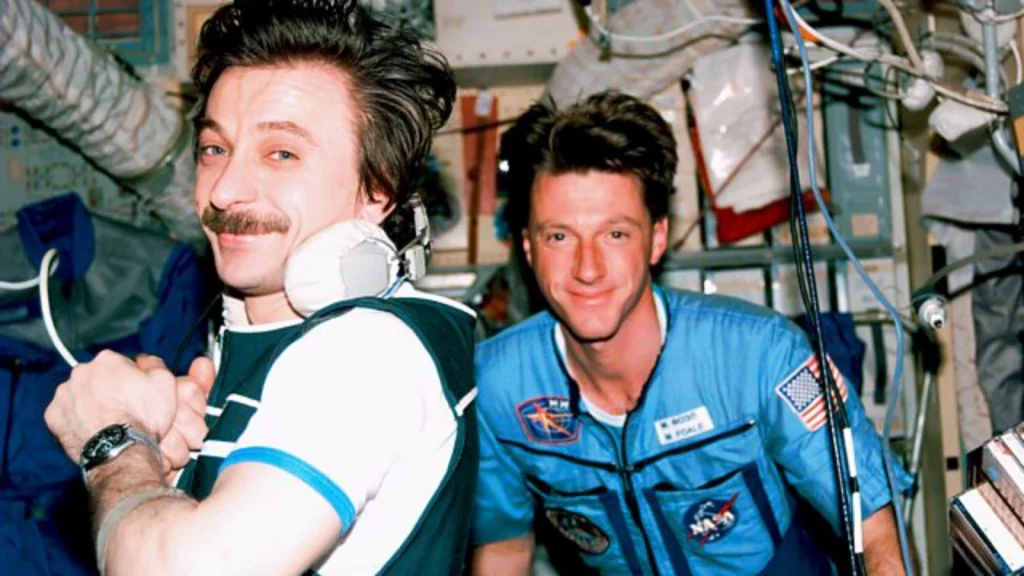
Foale launched on the Space Shuttle Atlantis. When the shuttle docked, the international astronaut exchange programme handover began. The cosmonauts, Sasha Lazutkin and Vasily Tsibliev, had prepared for their American guests. Foale arrived to the smell of “meat and potatoes” and the sound of “loud Russian disco music.”
Linenger, however, gave him a stark warning. As they prepared to part, Linenger told Foale, “Don’t believe what you see.” He explained that the good food and clear communications were temporary. “You’re not going to get that when we close this hatch,” he said. “You’re going to have to make that space station work for you.” Linenger was overjoyed to be going home. He looked forward to eating “shrimp cocktail” instead of “borscht.”
Foale, however, took a different approach to his mission. He spoke Russian and made an effort to integrate. Where Linenger had often worked and eaten separately, Foale made a conscious change. Soon after the shuttle left, Sasha floated into his module and said, “Michael, how are you doing? Come and have some tea.” Foale realized Jerry had never done that. “So I floated after him,” Foale said, “and we just chilled.”
This simple act of camaraderie built a crucial new bond between the crew members. Foale even held movie nights on his laptop. He showed his Russian crewmates films like 2001: A Space Odyssey and The Right Stuff. He also showed the sci-fi action film Total Recall. Sasha later told him he had a premonition of disaster while watching a scene where the Mars dome depressurizes. This dark foreshadowing would soon become a terrifying reality.
The Cargo Ship Collision Mir and the Fight for Survival
The crew was tasked with a new manual docking test. An unmanned Progress cargo ship was approaching the station. This test was intended to save money. Commander Vasily Tsibliev was at the controls, manually flying the large ship using a console. Michael Foale watched from a window, looking at the television monitor that showed the incoming craft.
Foale, a physicist, immediately noticed something was wrong. The station was in a “weird orientation” for the docking. Then he looked at the TV screen. The Progress cargo ship looked “pretty big,” and it was “getting bigger.” He could see it was coming in too fast.
Suddenly, the entire 100-ton station shuddered violently. A moment later, the depressurization alarm blared. “Baah, baah, baah!” Foale’s ears started to pop. “Oh, OK, I get what’s going on,” he thought. “We are leaking. The air is moving out of the station.” The cargo ship collision Mir had breached the hull.
The crew was now in a race for their lives. They had to find which module was hit and seal it off before the entire station lost its air. They quickly identified the leak in the Spektr module. Working together, they managed to close the hatch, sealing off the damaged section. The immediate depressurization emergency was over. But this space station accident Mir had triggered a second, more insidious crisis.
Saving Mir: The Dead Station and the Thumb-to-the-Stars Solution
The crew had only a moment of relief before another alarm sounded. As Mir drifted into the Earth’s shadow, the station died. The collision had damaged the solar panels on the Spektr module. The fans stopped. The lights went out. The station’s batteries were draining fast. Mir was now powerless, silent, and “dead and tumbling.”
Foale knew they had to act. He proposed a desperate, high-risk idea. They could use the thrusters on their Soyuz “lifeboat” capsule. By firing them at the right moments, they could stop the tumble. This would point the station’s remaining solar panels back at the sun to recharge.
The risk was astronomical. The Soyuz was their only way home. Firing its thrusters for approximately ten minutes would use up all the fuel. As Foale noted, “Then you can’t come home.” They had one chance to get it right.
To save the station, they first had to understand the problem. How fast were they tumbling? Foale used a classic, low-tech navigation trick. He floated to a window, shut one eye, and put his thumb up against a star. He timed how long it took for the star to move past his thumb. This told him they were rotating at about half a degree per second.
Now they had to translate that information into action. Vasily was in the Soyuz, connected through a long tunnel. They were “completely confused” as to which way he should fire the thruster to get the effect Foale wanted. They had to use trial and error. Their first attempt fired the thrusters the wrong way. They made the tumble worse before they finally got it worked out. After a grueling ordeal, they stopped the spin and saved the station. These were invaluable long-term human space mission lessons.
“We as a crew saved Space Station Mir that day,” Foale stated. He knew the management on the ground might blame the crew for the accident. But he disputed that view. “We saved it.”
Once Upon a Time in Space Episode 2: A Legacy of Cooperation
This series of events, detailed in Once Upon a Time in Space episode 2, forged an unbreakable bond between the crew. After the press reported the drama, the crew was finally able to have a video conference with their families. It was a moment of profound relief. Eventually, Foale had the sad task of saying goodbye to his crewmates, Vasily and Sasha, who were returning to Earth.
The two cosmonauts returned not as heroes, but to “a nation of sceptics and critics.” The Russian space agency, under pressure, was looking for someone to blame. Foale, who remained on Mir, knew their actions had been “heroic.”
He later learned something profound. Sasha Lazutkin, the quiet military engineer, had finally “spoke truth to power.” During the intense government debriefs, it was Sasha who spoke up. He fearlessly told the Russian management, “No, it was your mistake.”
The Shuttle-Mir Programme was perilous. It was a clash of cultures, technologies, and personalities, all unfolding in the most dangerous environment imaginable. Yet, this US-Russia space cooperation ultimately succeeded. It transformed the fallen Soviet empire space legacy from a threat into a partnership. This successful, if terrifying, US-Russia space cooperation was the first, crucial step toward the International Space Station. The hard-won lessons from the aerospace Cold War documentary that was Mir’s reality were invaluable. This chapter of Mir space station history, born from the post-Soviet Russian space agency survival, became the bedrock for modern human collaboration in space.
From Cold War Rivals to Cosmic Partners: The Enduring Spirit of Mir
The Shuttle-Mir Programme stands as one of history’s most audacious experiments in turning adversaries into allies. What began as a geopolitical chess move—keeping Russian rocket scientists employed and away from rogue states—evolved into something far more profound: a crucible that forged genuine human connection in the harshest environment imaginable.
Think about the sheer improbability of it all. Just years after the Berlin Wall fell, American astronauts who’d spent careers viewing Russia as “the enemy” were moving their families to Star City, learning to navigate not just Soyuz capsules but borscht, Russian disco, and the complexities of post-Soviet life. They were training in facilities that had been the beating heart of Cold War competition, now repurposed as workshops for cooperation. The symbolism alone could give you whiplash.
But Mir taught lessons that went far beyond symbolism. When Jerry Linenger warned “don’t believe what you see,” he wasn’t just talking about temporary shuttle comforts—he was revealing a deeper truth about long-duration spaceflight that NASA desperately needed to understand. You can’t just engineer your way out of every problem in space. Sometimes survival depends on relationships, on trust, on the kind of bond that forms when Michael Foale accepts Sasha’s invitation for tea instead of working in isolation.
The fire and collision weren’t just dramatic setbacks—they were brutal stress tests of this new partnership. When Foale used his thumb against the stars to save a tumbling station, when Sasha Lazutkin spoke truth to power during the debriefings, they were demonstrating something essential: that international cooperation in space isn’t about perfect systems or flawless execution. It’s about imperfect humans from different worlds choosing to trust each other when everything goes wrong.
This matters now more than ever. The International Space Station—Mir’s direct descendant—has become the longest continuous example of peaceful international collaboration in human history. As we push toward the Moon and Mars, as commercial space ventures multiply, as new space powers emerge, the lessons from that “dead and tumbling” station remain vital. Complex missions require more than just shared technology; they demand the kind of deep cultural understanding and interpersonal trust that only forms through shared hardship.
The Shuttle-Mir Programme was messy, dangerous, and at times seemingly doomed. It was also exactly what both nations needed. It transformed thousands of rocket scientists from potential proliferation risks into partners in humanity’s greatest adventure. It gave NASA the long-duration spaceflight expertise that American astronauts simply didn’t have. Most importantly, it proved that even the deepest divides can be bridged when people choose cooperation over conflict.
The next time you look up at the ISS passing overhead, remember: that orbital outpost exists because a small group of astronauts and cosmonauts once chose to float over for tea, to share Depeche Mode and Total Recall, to save each other’s lives in the darkness. They showed us that the future of human spaceflight isn’t written in the stars—it’s written in our willingness to reach across borders, cultures, and old enmities to explore them together.
FAQ Once Upon a Time in Space episode 2
Q: What was the Shuttle-Mir Programme and why was it created?
A: The Shuttle-Mir Programme was a groundbreaking joint venture between the United States and Russia that ran during the 1990s. Following the Soviet Union’s collapse, thousands of highly trained Russian rocket scientists faced unemployment, raising fears they might sell nuclear weapons expertise to rogue states like Libya, Iran, or Iraq. Consequently, NASA partnered with the post-Soviet Russian space agency, funneling American funds to keep scientists employed while gaining invaluable long-duration spaceflight experience. This arrangement transformed Cold War rivals into partners, ultimately laying the groundwork for the International Space Station.
Q: Why did American astronauts initially resist the Shuttle-Mir Programme?
A: Many NASA astronauts were Cold War veterans who had spent their entire careers viewing Russia as the enemy. They dismissively nicknamed the initiative “the Russian thing,” mixing deep-rooted suspicion with pragmatic desire for flight assignments. Furthermore, moving families to Star City—a former KGB facility with armed guards—felt like entering hostile territory. Moscow in 1995 appeared chaotic and dangerous, with stories of criminal gangs circulating among concerned astronauts. Nevertheless, the allure of spaceflight and professional duty eventually overcame these reservations, though cultural barriers persisted throughout the program.
Q: What was life actually like aboard the Mir space station?
A: Jerry Linenger famously described Mir as “grandma’s basement”—musty, moldy, and cluttered with a decade’s worth of broken equipment, cables, and bags velcroed to every surface. Moving through modules felt like “scuba diving in kelp beds,” requiring constant navigation through tangled obstacles. Additionally, communication was severely limited, with crews receiving only 90 seconds of garbled contact each orbit compared to the Space Shuttle’s clear satellite links. The aging station’s oxygen generation system failed weekly, alarms sounded multiple times daily, and the psychological isolation proved immense for astronauts separated from their families.
Q: How serious was the 1997 fire emergency on Mir?
A: The fire was catastrophic, not the minor incident official reports suggested. When a chemical oxygen canister malfunctioned, it created a blowtorch-like flame two to three feet long, shooting sparks while thick smoke filled the station within 30 seconds. Linenger couldn’t see his hand in front of his face and experienced tunnel vision from oxygen deprivation when his first respirator failed. Although official NASA and Russian reports claimed the fire lasted only 90 seconds, Linenger adamantly insisted it burned for 14 minutes—a truly life-threatening emergency. Subsequently, he recommended discontinuing the program entirely, though political considerations ensured it continued.
Q: What caused the Progress cargo ship collision with Mir?
A: The collision resulted from a cost-saving manual docking test that went disastrously wrong. Commander Vasily Tsibliev was manually piloting an unmanned Progress cargo ship toward Mir using a console, while Michael Foale monitored from a window. Foale immediately noticed the station’s orientation seemed incorrect, then watched the approaching ship grow alarmingly large on the television screen. The 100-ton station suddenly shuddered violently as the Progress breached the hull, triggering depressurization alarms. The crew raced to identify and seal the damaged Spektr module before losing all their air, narrowly averting complete disaster.
Q: How did Michael Foale save Mir after the collision?
A: After the collision damaged solar panels, Mir became powerless and began tumbling through space, draining its batteries rapidly. Foale proposed using their Soyuz escape capsule’s thrusters to stop the rotation, despite the enormous risk—firing thrusters for ten minutes would consume all fuel, potentially stranding them without a way home. First, he calculated their rotation speed using an ingenious low-tech method: holding his thumb against a star and timing its movement across his field of vision. Through trial and error communication with Vasily, they eventually oriented the thrusters correctly and successfully stabilized the station, pointing solar panels sunward to recharge.
Q: How did Michael Foale’s approach differ from Jerry Linenger’s?
A: While Linenger often worked and ate separately from his Russian crewmates, maintaining professional distance, Foale deliberately chose integration and camaraderie. He spoke Russian fluently and accepted Sasha’s invitation for tea—something Linenger had never done. Moreover, Foale organized movie nights on his laptop, screening films like 2001: A Space Odyssey, The Right Stuff, and Total Recall for his cosmonaut colleagues. This cultural bridge-building created crucial trust that proved invaluable during subsequent emergencies. Essentially, Foale understood that surviving Mir required more than technical competence—it demanded genuine human connection across cultural divides.
Q: What happened to cosmonauts Vasily Tsibliev and Sasha Lazutkin after returning to Earth?
A: Despite their heroic actions saving Mir, the cosmonauts returned to “a nation of skeptics and critics” rather than receiving heroes’ welcomes. The struggling Russian space agency, facing intense pressure and scrutiny, sought scapegoats for the accidents. However, Sasha Lazutkin—the quiet military engineer—courageously “spoke truth to power” during government debriefings. He fearlessly confronted Russian management, declaring “No, it was your mistake,” defending the crew’s actions and rejecting unfair blame. This moment exemplified the personal courage and integrity forged through the Shuttle-Mir Programme’s intense challenges.
Q: What were the most important lessons learned from the Shuttle-Mir Programme?
A: Beyond technical long-duration spaceflight data, Mir taught that international cooperation requires deep cultural understanding and interpersonal trust built through shared hardship. NASA learned that perfect engineering cannot replace human relationships when systems fail catastrophically. The program demonstrated that former enemies could collaborate effectively under extreme pressure, transforming geopolitical threats into productive partnerships. Furthermore, these hard-won lessons became the bedrock for the International Space Station, proving that peaceful international collaboration in space was not only possible but essential for humanity’s future beyond Earth.
Q: Why does the Shuttle-Mir Programme remain relevant today?
A: The Shuttle-Mir Programme’s legacy extends far beyond its 1990s timeframe, as it established the longest continuous example of peaceful international collaboration in human history through the ISS. As humanity pushes toward lunar bases, Mars missions, and commercial space ventures, these lessons about cross-cultural cooperation under extreme conditions remain vital. The program proved that complex space missions demand more than shared technology—they require the kind of profound trust that forms only when diverse teams choose mutual support over national pride. Ultimately, Mir showed that our future in space depends on our willingness to bridge borders and old enmities.