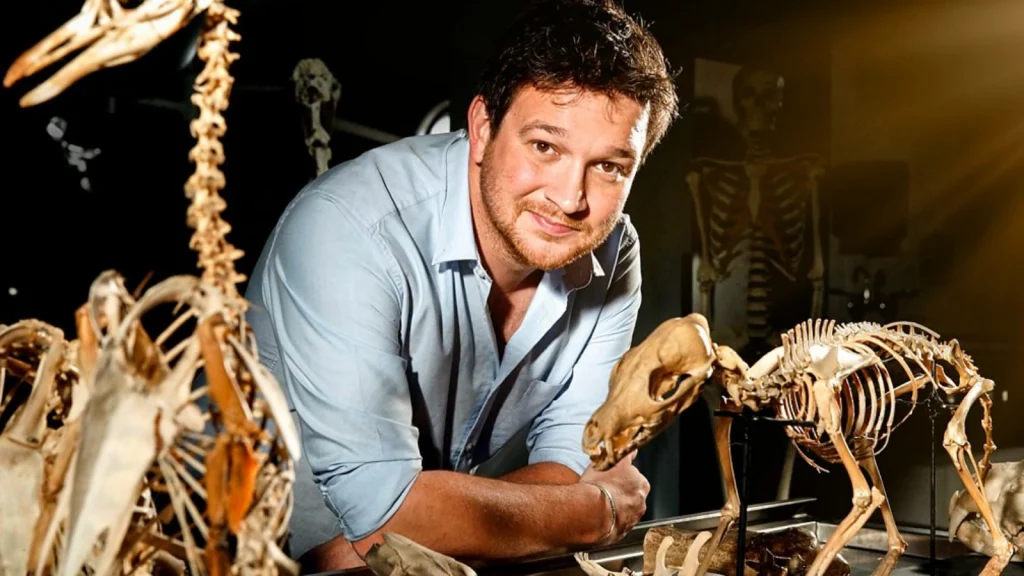
In the documentary Secrets of Bones episode 2, evolutionary biologist Ben Garrod reveals how the skeletal system provides the blueprint for all movement on land. Bones offer the essential structure, support, and strength for vertebrates. However, their story goes much deeper, telling a tale of adaptation and survival across millions of years. The skeleton has enabled animals to hunt, move, and even sense their surroundings in incredibly diverse ways.
Though vertebrates appear vastly different on the outside, a unifying skeleton connects them all. This single bony framework is the secret behind the massive diversity seen across the animal kingdom. It has allowed life to dominate the planet. The Secrets of Bones series explores this very concept, examining the world from the inside out. It shows how this internal architecture dictates how an animal lives and thrives in its environment.
The scope of Secrets of Bones episode 2 focuses specifically on terrestrial locomotion. It uncovers how skeletal adaptations allow animals to perform remarkable feats. Creatures can swing through high trees or slide across the forest floor. They can dig through subterranean worlds or run at incredible speeds across open savannahs. Each adaptation is a chapter in the story of survival, written in bone.
To truly understand movement, one must begin with the spine. The spine, or spinal column, is shared by every vertebrate on earth. It serves as the body’s central support. This crucial structure provides rigidity, flexibility, and anchor points for powerful muscles. Furthermore, it protects the mass of nerves running the length of the body. This exploration of skeletons, a core theme in Secrets of Bones, starts by assembling the vertebrae that form this foundational column.
The flexibility of the spine comes from the way its individual bones work together. Each vertebra possesses an incredible structure that allows it to interlock perfectly with the ones before and after it. This design gives the spinal column its remarkable flexibility and range of movement. While the spine is a constant feature in all vertebrates, its structure varies significantly between species. Ultimately, it is these structural changes that have had a dramatic effect on how different animals are able to move.
Bone itself is far from a static, unchanging material. Instead, it is a living, flexing, and ever-changing framework. This dynamic nature is precisely what makes every single species what it is. The adaptations for movement on land are a powerful testament to bone’s ability to be molded by evolutionary pressures.
Secrets of Bones episode 2
The Spine: A Blueprint for Speed and Flexibility
The spine’s adaptability is perhaps most dramatically illustrated in the fastest animal on land, the cheetah. Capable of reaching nearly 70 miles per hour in short bursts, the secret to its speed lies directly in its spine. When observing a cheetah hunting swift and agile Thomson’s gazelles, the difference in their spinal structure becomes clear. The gazelle runs with an incredibly flat, straight, and relatively inflexible back. In stark contrast, the cheetah’s back forms a beautiful, deep curve.
This curvature is not just for show; it is a functional marvel. The spine flexes and extends so much that the cheetah’s back legs and front legs overlap as it runs. This motion creates a powerful spring-like effect, giving the cheetah a massive seven-meter stride. The anatomical reason for this extreme flexibility is found in the vertebral joints, which are simple and open, allowing for a much wider range of movement. This flexible spine not only generates phenomenal speed—0 to 60 mph in just three seconds—but also allows the cheetah to change direction suddenly, making it one of the big cats’ most successful hunters.
In other animals, the spine has adapted to an even greater extreme, becoming practically the only structure left to generate movement. Snakes, which lost their limbs over 100 million years ago, are essentially one long, highly flexible spine with ribs. Their beautiful S-curve movement, known as undulatory locomotion, is a product of unique vertebral evolution. According to Professor Susan Evans from University College London, snake vertebrae form a ball and socket joint, similar to a human hip or shoulder.
However, if a snake simply rotated these joints, it would damage its spinal cord. To prevent this, the vertebrae evolved a double set of joints that permit side-to-side (lateral) movement while completely stopping any twisting. Interestingly, the snake’s famous flexibility comes less from the movement between individual joints and more from the sheer quantity of them. With up to 500 vertebrae in some species, the small amount of movement between each one multiplies along the body’s length to create its fluid motion. This adaptation likely arose to help snakes burrow or move in confined spaces, allowing them to escape predators and exploit new food sources underground.
The Pentadactyl Limb: A Versatile Tool for Locomotion in Secrets of Bones episode 2
While snakes showcase an extreme of limbless specialization, most terrestrial vertebrates rely on arms and legs to navigate their world. Remarkably, all vertebrate limbs are based on the same ancestral blueprint: the pentadactyl limb. This structure, as seen in a gorilla’s arm, consists of one large upper bone (the humerus), followed by two smaller bones in the forearm (the radius and ulna). Next is a group of small bones in the wrist (the carpals), leading to five distinct digits. This same five-digit pattern is mirrored in the hind limbs and is identical in human limbs. As animals evolved, this basic plan has been modified and specialized to master every environment on earth.
High in the forest canopy, the gibbon displays a limb that sets it apart. These acrobats of the primate world are perfectly adapted to life in the trees. Their hands and feet have elongated fingers and toes, effectively turning them into long, grasping hooks ideal for swinging. They also possess incredibly long arms, 1.5 times the length of their legs. What truly makes them unique is their method of movement, called brachiation, where they use only their arms to swing through the canopy at speeds up to 35 miles per hour.
The key to this ability is a specialized wrist. Unlike humans, who cannot rotate their hands at the wrist, a gibbon has a ball-and-socket-like joint that allows for 80 degrees of rotation. This adaptation allows the gibbon to turn its body as it swings, building momentum to propel itself through the trees without ever losing its grip. This highly efficient movement saves energy and makes the gibbon almost limitlessly agile, a great advantage for an animal whose food is dispersed over a wide area.
Perhaps the most extreme modification of the pentadactyl limb belongs to the horse. Many people misidentify a horse’s anatomy, assuming the joint halfway down its leg is a knee. In reality, that is the horse’s wrist; everything from that point down is equivalent to the hand and a single digit. The horse’s limb has evolved through two primary processes: lengthening and lightening.
Bones have been dramatically reduced in number to lighten the limb. For example, the ulna is now just a small projection fused to the much larger radius. In what would be the hand, the central bone (metacarpal number three), known as the cannon bone, is huge. Meanwhile, the metacarpals that would form the index and ring fingers are reduced to tiny splints, and those for the thumb and pinky finger are gone completely.
Effectively, the horse walks on the single, massive middle finger of each limb. This radical reduction in bone number makes the limb incredibly lightweight. Professor John Hutchinson of the Royal Veterinary College explains that an animal’s speed is a product of its stride length and stride rate. The horse’s long limbs give it a massive stride length, while the lightweight design allows it to swing its legs very quickly for a high stride rate. This combination allows the horse to increase both factors simultaneously, resulting in speeds over 40 miles per hour. To cope with the immense forces—around 600kg on a single digit when galloping—the small bones within the hoof flex and move, providing crucial shock absorption.
Convergent Evolution and the Oddities of Bones in Secrets of Bones episode 2
The shape, size, and weight of every single bone can tell us about an animal’s locomotion. A comparison of the humerus—the largest bone in the upper limb—from three different animals makes this clear. A cow’s humerus is large, robust, and stocky, built to support an animal weighing up to 500 kilograms. A human humerus is long and slender, as we do not bear weight on our forelimbs.
The mole’s humerus, however, is so bizarre it hardly looks like a bone at all. A scaled-up 3D print reveals a squat, flat, paddle-shaped bone with incredible projections and grooves all over its surface. This large surface area allows for much stronger muscle attachments, a perfect adaptation for a creature that spends its life tunnelling underground.
The mole’s adaptations for digging go even further, leading to a bone that has puzzled scientists for years. A mole’s hand appears to have an extra digit, which is strange because no known living species normally has more than the five digits of the pentadactyl limb. X-rays clarify what is happening: alongside the five true digits, there is a solid, sickle-shaped bone that looks like an impostor. Scientists recently discovered this “impostor” is not a true digit but an enlarged sesamoid bone.
Sesamoid bones are typically found where a tendon passes over a joint, like the human kneecap. They protect the joint and increase tension in the tendon, making movement more effective. In the mole, this wrist sesamoid has evolved to massively increase the surface area of its hand, making it a much more effective shovel. This is not a unique evolutionary trick; the elephant also co-opted a sesamoid bone to act as an extra toe for additional support as it grew larger and more land-based.
These skeletal oddities can also reveal surprising stories about evolutionary history, as a comparison between the common European mole and the golden mole from South Africa shows. At first glance, the two animals and their skeletons seem very similar. Dr. Nick Crumpton, a mammal expert from Cambridge University, points out that both have small, tubular bodies and much larger forelimbs than hindlimbs—all clear adaptations for a life underground. However, a closer look reveals they evolved very differently.
The European mole uses its famously strange, paddle-like humerus. The golden mole, conversely, has a less peculiar humerus. Instead, its key adaptation is an ulna with a very long olecranon process—the bone that forms the point of the elbow. This long lever allows a muscle to whip the arm down with incredible speed and power, a completely different digging mechanism than the European mole’s.
These variations hinted at an astonishing fact confirmed by genetic techniques in the 1990s: the two moles are not closely related at all. European moles are related to shrews and hedgehogs. Incredibly, the golden mole is more closely related to elephants and manatees than it is to any other mole. This is a fantastic example of convergent evolution. The two animals are remarkably unrelated, but because they faced the same environmental challenge of digging, natural selection favored similar anatomical shapes. They look so alike because that body plan is simply a very good design for burrowing. This shows how the challenge of moving on land can drive completely different skeletons to adapt in very similar ways.
The Living Architecture That Conquered Land
Standing before a museum’s dinosaur skeleton or watching a cheetah blur across the savanna, we’re witnessing the same fundamental miracle: a framework of bone that has been writing the story of life on land for hundreds of millions of years. The skeletal revelations explored in Secrets of Bones episode 2 illuminate a profound truth—that beneath every leap, sprint, and swing lies an ancient blueprint, endlessly reimagined by the relentless creativity of evolution.
The spine’s journey from a simple support column to the cheetah’s spring-loaded powerhouse or the snake’s sinuous highway reveals bone’s most remarkable quality: its ability to be simultaneously constant and infinitely variable. While every vertebrate shares that fundamental spinal architecture, each species has molded it into something uniquely theirs. The cheetah’s flexible vertebrae create a seven-meter stride that defies physics, while the snake’s 500-joint masterpiece turns limitation into liberation, proving that losing limbs doesn’t mean losing mobility—it means finding new ways to flow through the world.
Perhaps most striking is how the pentadactyl limb—that five-fingered foundation we share with gibbons and horses—has become evolution’s ultimate Swiss Army knife. The gibbon’s ball-and-socket wrist joint transforms swinging into an art form, while the horse’s radical digit reduction creates a single-toe speed machine that can outrun predators across open plains. These aren’t random modifications but precise engineering solutions, each bone telling us exactly how that animal makes its living.
The tale of the two moles offers perhaps the most profound lesson of all. Here, completely unrelated creatures—one closer to hedgehogs, the other to elephants—arrived at nearly identical solutions for underground living. This convergent evolution reveals that skeletal adaptations aren’t just random experiments but responses to universal physical laws. When faced with similar challenges, life discovers similar answers, written in the language of bone and joint, muscle and tendon.
What emerges from this exploration is a new way of seeing the natural world. Every skeleton becomes a biography, every bone a chapter in an epic of adaptation. The robust cow humerus speaks of weight-bearing stability, while the mole’s bizarre paddle-shaped version tells of a life spent carving through earth. These aren’t just anatomical curiosities—they’re testimonies to life’s extraordinary ability to find solutions, to take a basic toolkit and craft instruments for any conceivable lifestyle.
As we face our own challenges in an ever-changing world, there’s something deeply inspiring about bone’s message of adaptation and resilience. These skeletons remind us that survival isn’t about being the strongest or fastest—it’s about being perfectly suited to your particular corner of existence. Whether you’re built for speed like a cheetah, agility like a gibbon, or persistence like a burrowing mole, success comes from making the most of your unique architecture.
The next time you move through the world—walking, running, or simply reaching for something—remember that you’re participating in an ancient tradition of skeletal storytelling, one that connects you to every vertebrate that has ever navigated life on land. Your bones, like theirs, are living proof that evolution’s greatest masterpiece isn’t any single creature, but the endless capacity for reinvention itself.
FAQ Secrets of Bones episode 2
Q: What is the main focus of Secrets of Bones episode 2?
A: Secrets of Bones episode 2 explores how skeletal systems provide the blueprint for all terrestrial movement. Evolutionary biologist Ben Garrod reveals how bones offer essential structure, support, and strength for vertebrates. Additionally, the episode demonstrates how skeletal adaptations enable animals to perform remarkable feats, from swinging through trees to running at incredible speeds across savannas.
Q: How does the spine enable movement in land animals?
A: The spine serves as the body’s central support system, providing rigidity, flexibility, and anchor points for powerful muscles. Furthermore, it protects the nervous system running along the body’s length. Each vertebra interlocks perfectly with adjacent ones, creating remarkable flexibility and range of movement that varies significantly between species, ultimately determining how different animals move.
Q: What makes the cheetah so fast compared to other animals?
A: The cheetah’s speed comes from its incredibly flexible spine, which forms a deep curve unlike the flat, inflexible back of gazelles. This spinal flexibility allows the cheetah’s legs to overlap during running, creating a spring-like effect that generates a massive seven-meter stride. Consequently, this adaptation enables acceleration from 0 to 60 mph in just three seconds.
Q: How do snakes move without limbs?
A: Snakes are essentially one long, highly flexible spine with ribs, having lost their limbs over 100 million years ago. Their vertebrae form ball-and-socket joints with double joint sets that permit side-to-side movement while preventing dangerous twisting. Moreover, with up to 500 vertebrae, the small movement between each joint multiplies to create fluid undulatory locomotion.
Q: What is the pentadactyl limb?
A: The pentadactyl limb is the ancestral blueprint underlying all vertebrate limbs, consisting of one upper bone, two forearm bones, small wrist bones, and five digits. This same five-digit pattern appears in human hands, gorilla arms, and horse legs. Remarkably, this basic plan has been modified and specialized to master every terrestrial environment on Earth.
Q: How are gibbon arms adapted for swinging through trees?
A: Gibbons possess elongated fingers and toes that function as grasping hooks, plus arms 1.5 times longer than their legs. Most importantly, they have specialized ball-and-socket wrist joints allowing 80 degrees of rotation. This adaptation enables them to turn their bodies while swinging, building momentum to propel through trees at speeds up to 35 mph without losing grip.
Q: Why do horses run on their middle fingers?
A: Horses have evolved through lengthening and lightening their limbs for speed. The horse’s leg bones have been dramatically reduced in number, with the massive middle finger bone (cannon bone) supporting the entire weight. Additionally, other finger bones either disappeared completely or became tiny splints. This radical reduction creates an incredibly lightweight limb that swings quickly for high stride rates.
Q: What can bone shape tell us about an animal’s lifestyle?
A: Bone shape directly reflects how animals move and live. For instance, a cow’s humerus is robust and stocky for supporting 500 kilograms, while a human’s is long and slender since we don’t bear weight on forelimbs. Conversely, a mole’s humerus is paddle-shaped with grooves for powerful muscle attachments, perfectly adapted for underground tunneling.
Q: What is convergent evolution in skeletal adaptations?
A: Convergent evolution occurs when unrelated species develop similar skeletal features to solve identical environmental challenges. European moles and South African golden moles exemplify this perfectly—they appear remarkably similar but are completely unrelated. However, both evolved similar body plans because that design is simply optimal for burrowing underground, demonstrating how similar challenges produce similar skeletal solutions.
Q: How do moles’ bones help them dig underground?
A: Moles have evolved bizarre skeletal adaptations for digging efficiency. Their paddle-shaped humerus provides extensive surface area for muscle attachments, while an enlarged sesamoid bone acts as an extra digit, effectively increasing their hand’s digging surface. These modifications transform their forelimbs into powerful shovels perfectly suited for their subterranean lifestyle, demonstrating evolution’s remarkable problem-solving capabilities.