Springwatch 2026 episode 9 opens the final week of the series with a sweeping swing between two contrasting British landscapes: the still, reed-fringed waterways of the National Trust’s Crom Estate in Northern Ireland, and the towering chalk seabird cliffs of Bempton on the Yorkshire coast. Chris Packham and Michaela Strachan anchor the live nest cameras at Crom, where pine martens patrol a bridge, badgers and foxes share a single mammal highway, and a brood of little grebe chicks fledges in cold, driving rain. Meanwhile, Iolo Williams has migrated north to Bempton Cliffs for a seabird extravaganza built around gannets, puffins, kittiwakes and guillemots.
The episode is shaped by weather, predation and survival in equal measure. A weekend of cold, wet conditions tests every nest at Crom, while a pine marten quietly removes an entire family of sedge warblers from the equation. Yet the same predator pressure underlines a healthy, balanced ecosystem, one rich enough to support high-density nesting and the predators that depend on it. Against that backdrop, Springwatch 2026 weaves in conservation success on a remote island, a deep-dive into why swallows line their nests with white feathers, and a Kenyan ornithologist’s first sighting of nesting barn swallows.
That blend of intimate nest drama and large-scale spectacle defines this instalment. Crom delivers serenity and small-scale tension; Bempton delivers half a million seabirds, a gannet feeding frenzy and bottlenose dolphins riding the bow wave of a boat. Together they capture British wildlife at its most varied, from a great crested grebe hauling a javelin-sized stick to a colony of mining bees living unnoticed beneath a city street.
The White Bridge at Crom connects the main estate to a heavily wooded island, and it has become the unexpected star of the live cameras. Camera teams first captured a pine marten crossing it, so the production rigged live cameras directly onto the structure to see what else might appear. The gamble paid off immediately. Pine martens, normally nocturnal, were filmed crossing in broad daylight, not once but three times.
The animal proved hard to pin down. Pine martens carry distinctive markings on their white bibs, and the team confirmed at least one clear individual, a male, while suspecting there could be two or possibly three using the route. The same bridge then delivered a fox, filmed sniffing at the pine marten’s scent, followed by a badger ambling across. One narrow crossing was serving an entire community of mammals.
The significance runs deeper than charming footage. These animals are all capable swimmers, and badgers have even been seen crossing rough rivers. Bridges, however, open up new habitat far more efficiently. The point was made plainly: until the Skye Bridge was built, no pine martens lived on the Isle of Skye, but once the crossing existed they colonised the island. At Crom, the bridge functions the same way, giving mammals reliable access to the wooded island and the resources it holds.
Springwatch 2026 episode 9
Little Grebe Chicks Fledge as Their Floating Nest Finally Sinks
The little grebes have been the emotional heart of Springwatch 2026, and this episode delivered their bittersweet finale. The chicks, hatched on a nest of floating vegetation, had stayed put far longer than usual. Grebes typically leave the nest once the final egg hatches, but these three lingered, using the slowly sinking platform like a life raft and giving viewers extended, intimate views.
Cold, wet weather changed their behaviour. The chicks were filmed snuggling down into their parents’ feathers for warmth, piling together against the chill. Feeding, however, never let up. The cameras caught one chick wrestling with a small pike, an ambitious mouthful it could not manage, before another pike arrived and was swallowed whole in a single impressive gulp. These were exceptionally well-fed birds, growing steadily, the size difference between the first-hatched and youngest chick clearly visible.
Then came the inevitable. The chicks fledged, and the waterlogged nest finally drowned beneath them. The presenters framed it as a natural and successful end rather than a loss, the young birds heading off to live independently. The drowned nest also doubled as a wry comment on the conditions, with the presenting team taking their own drenching live on air as the rain swept across Crom.
A Pine Marten Predation and a Strange Tan-Coloured Badger Reveal Crom’s Wild Balance
Not every nest survived the weekend. The sedge warblers, one of the standout nests of the series, had been doing well with four healthy chicks tucked low by the lochside. The low position rang quiet alarm bells, and on Friday morning those fears were realised. The pine marten returned and predated the nest. The chicks were gone, and the team chose not to dwell on the grisly detail.
The response was measured rather than mournful. Pine martens have young of their own to feed, and demonising them misses the point. Yes, predation had been heavy across the series, but fledglings were appearing everywhere too. A landscape able to sustain high-density nesting and the predators that exploit it is, by definition, a healthy one. Everything at Crom appeared to be in balance, exactly as a functioning ecosystem should be.
The trail cameras added their own oddity. Set out to monitor a remote fox family living among log piles, with up to three animals seen at once, the cameras instead captured something stranger: an unusually coloured badger. Its body looked shaved and tanned, an unfamiliar shade quite unlike the blonde or white variants the team had seen before. The animal looked healthy and was accompanied by two cubs, suggesting a genetic aberration rather than illness, a reminder of how much individual variation hides within familiar species.
Curlew Conservation on Lough Erne Shows How Island Sanctuaries Save Rare Waders
One of the episode’s most powerful segments left Crom behind for Lower Lough Erne, where the RSPB is running conservation action for one of the country’s rarest waders. The destination was Trasna, an island within a network managed as a sanctuary for breeding curlew, lapwing and oystercatcher. Even before the boat set off, two curlews were calling overhead, and chicks were visible on a nearby hill, hard evidence the project was working.
The island had a difficult history. Back in the 1920s it was a hotspot for wading birds, but over the decades it scrubbed over and grew trees, losing its value. Restoration meant reversing that, with scrub removal and grazing returning the land to open grassland. The reward was the first successful breeding curlew on the island, with one chick raised. The mission on the day was simple but telling: locate the hatched nest and inspect the empty shells.
Reading those shells is a skill in itself. A shell with its top neatly removed indicates a successful hatch, while one bashed in at the side points to predation. The nest had held four eggs, the typical clutch, and the evidence pointed to a clean, successful outcome. For a bird as endangered and as deserving of every advantage as the curlew, returning to a nest with a confirmed positive result was described as genuinely special, an insight into one of the most successful conservation efforts in the landscape.
Why the Curlew Has Vanished From Northern Ireland’s Farmed Landscape
The Lough Erne success comes with a sobering context that Springwatch 2026 refused to soften. The curlew has declined catastrophically in Northern Ireland, falling by 82% and leaving only a handful of pairs. That is a colossal loss, and understanding it means looking hard at how the land is managed.
Northern Ireland is overwhelmingly farmland, around 76% of it, and much of that has been converted to improved pasture. Roughly 60% of the farmland is grass, 70% of that intensively managed, and livestock farming has risen by 20%. The pressure on natural and semi-natural habitats is immense. Spring grass cutting is especially damaging, slicing through fields at the precise moment curlew, redshank and lapwing are nesting, with devastating effects on their numbers.
That fragmentation forces emergency measures. When nests are found, the RSPB moves in fast, encircling them with electric fences to keep out generalist ground predators such as foxes and badgers. The approach genuinely improves hatching and fledging rates, but it was honestly described as a sticking plaster. Protecting individual nests helps the birds within reach, yet the real solution lies in managing the wider landscape to be more resilient, more harmonious and more sustainable for all wildlife.
A Kenyan Birder Sees His First Nesting Barn Swallows in Dartmoor
A standout human-interest thread followed Kenyan ornithologist Benji Owuor, who knew barn swallows only as wintering visitors. Each year the birds arrive in Kenya between September and October, coinciding with the start of the short rains, and their appearance is almost a celebration, a sign that relief and water are coming. They stay through the dry months into March, gathering on the plains in huge numbers, which had always made them feel like African birds to him.
That, he realised, was only half the story. The swallows migrate to Europe to breed, and seeing them court and raise young had become a lifelong dream. A visit to friends in the UK gave him the chance, and he travelled to a farm in Dartmoor National Park known for its swallows. The moment was layered with surprise. He heard his first-ever cuckoo, a bird he knew from Kenya but had never heard call, before the swallows themselves came sweeping all around him.
The nests delivered the real revelation. Barn swallow pairs work together, gathering hundreds of mouthfuls of mud to plaster onto barn walls, returning to the same structures year after year. Seeing five or six nests clustered in the corner of a building made the name barn swallow suddenly obvious to him. The thought that hatchlings raised here would, within months, fly thousands of miles back to Kenya captured the wonder cleanly. These are not African birds or European birds, but shared birds that span borders and cultures and belong to everyone along their route.
The Hidden Science of White Feathers in Swallow and House Martin Nests
One of the episode’s most surprising stories explained a detail hiding in plain sight across multiple nests. Swallows, starlings and house martins were all seen lining their nests with white feathers, and the question was whether this was chance or choice. The answer, drawn from research, is choice, and the reason is microscopic.
A study in Denmark offered swallows a choice between coloured and white feathers, and the birds overwhelmingly preferred white, taking 73% of them. Nests with more white feathers showed higher hatching success, and feather numbers correlated with faster chick growth. The mechanism comes down to bacteria. One type of bacteria lives on feathers and feeds on keratin, the protein that makes up 90% of a feather and also forms human hair and fingernails. As it degrades the feather, it produces a compound with antimicrobial properties, which spreads through the nest and reduces the harmful bacteria that otherwise lower hatching and growth rates.
White feathers work better than dark ones because of pigment. Dark feathers get their colour from melanin, a tough, complex pigment that is far harder to break down. White feathers, low in melanin, degrade more efficiently, releasing more of the beneficial compound. The conclusion is neatly counterintuitive: less melanin means better bacteria, which means higher hatching and faster growth. The presenters confirmed the birds make an active selection rather than grabbing whatever floats past, and shared a personal tip too, freezing collected feathers for a week to kill the surface organisms that would otherwise destroy them.
Bempton Cliffs Delivers a Gannet Feeding Frenzy and a Seabird Spectacle
Iolo Williams’ move to Bempton Cliffs provided the episode’s big-scale drama. The RSPB reserve mixes clifftop meadows, scrub and hedgerows, but the focus is the towering chalk cliffs, the tallest over four hundred feet, packed at peak with around half a million seabirds. The sound was likened to a choir, every bird adding its voice, while the smell of guano from so many birds was, in Iolo’s view, a pungent but oddly likeable signature of the place.
The cast of birds was introduced with real affection. Kittiwakes, with their short yellow bills and clean white plumage, were constantly adding to nests, most already on eggs. The razorbill earned praise as underrated, its stout bill recalling an old cut-throat razor, while the guillemot, chocolate brown and white with a narrow bill, nests on the ledges in its thousands. A rare bridled guillemot also appeared, a genetic variation marked by a thin white eye-ring, becoming more common the further north you travel, with only six or seven spotted across three days.
The gannet stole the show. With a wingspan close to two metres, long, thin wings adapted for the open ocean, these birds were filmed in a full feeding frenzy. Gannets dive from great height, hitting the water at high speed, protected by a suite of adaptations: forward-facing binocular vision angled down to spot fish, wings folded back like a dart, an extra cartilaginous bone at the bill base acting as a buffer, and air sacs under the skin of the face, neck and chest working like an airbag.
Underwater, opaque third eyelids act as goggles and sealable internal nostrils protect the lungs as they pursue mackerel, garfish and sprats. Iolo offered his own collective noun for the scene: a blizzard of gannets.
Mining Bees, Bottlenose Dolphins and the Wildlife Drama Still to Come
Springwatch 2026 episode 9 also looked beyond its two main bases to the wildlife thriving in unexpected places. Wildlife filmmaker Thomas Cassar, who moved from Malta to Bristol, revealed a colony of thousands of ashy mining bees living beneath a patch of grass on a busy city thoroughfare. After almost a year underground as larvae, the bees emerge en masse, and the short adult life that follows, just a few weeks, becomes a frantic race for males to find a mate before rivals do.
The colony is shadowed by freeloaders. The nomad bee sneaks into unattended burrows to lay its own egg, leaving its larva to feed on pollen and nectar gathered by another. The bee-fly takes an even stranger approach, flicking its eggs into open nest entrances mid-flight, never landing, like a bomber dropping cargo. Despite the skulduggery, these parasites barely dent the colony, and within six weeks the females complete their work and die, leaving the underground full of growing larvae ready to emerge the following year. As a reminder of how much complex behaviour unfolds unnoticed beneath our feet, it was hard to beat.
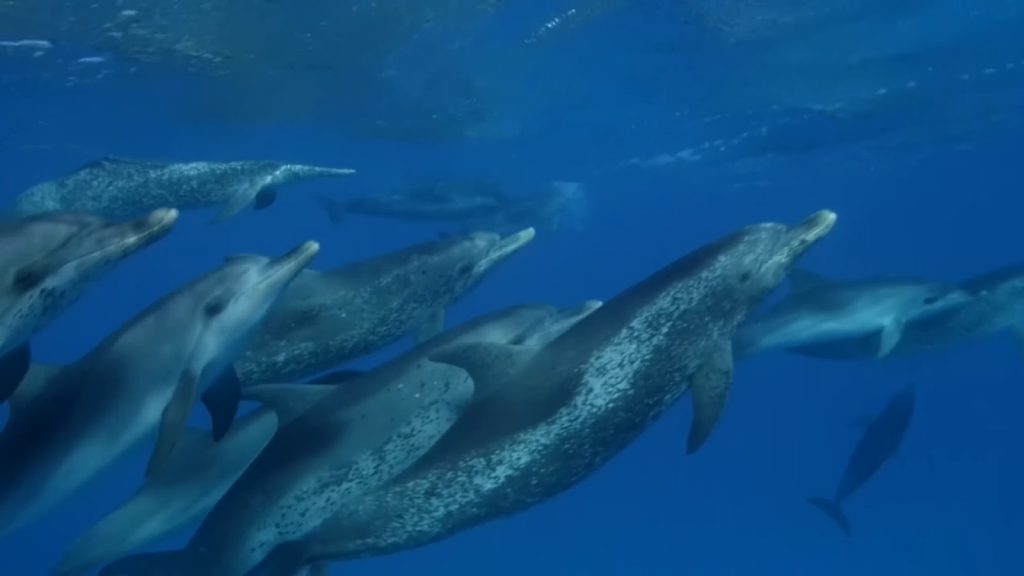
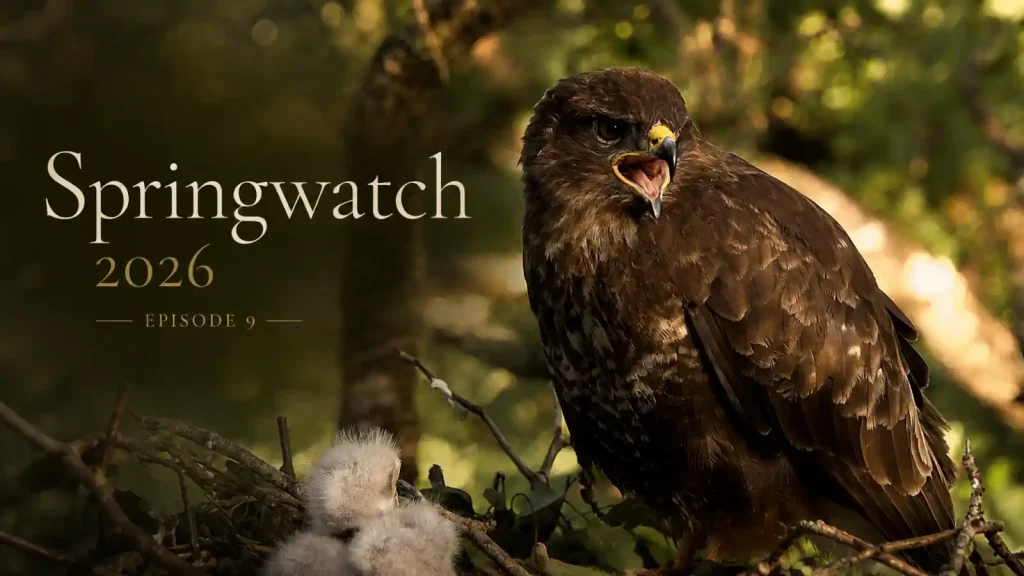
The episode kept its sense of spectacle and humour throughout. Iolo’s journey to Bempton began with bottlenose dolphins riding a boat’s wave for around fifteen minutes, a moment the Crom presenters playfully countered with their live fish camera. House martins delivered a first-ever internal nest view, four eggs hatching into tiny pink chicks behind a privacy screen of white feathers, while the buzzard chicks continued growing well under their attentive mother.
With promises of red squirrels, the Great Northern Diver, honey buzzards, puffins and a beetle that lives on the surface of ponds still to come, Springwatch 2026 closed its first instalment of the final week poised between intimate nest stories and the raw, large-scale drama of British wildlife at its richest.
FAQ Springwatch 2026 episode 9
Q: Where was Springwatch 2026 episode 9 filmed?
A: The episode split between two locations. Chris Packham and Michaela Strachan presented the live nest cameras from the National Trust’s Crom Estate in Northern Ireland, while Iolo Williams reported from Bempton Cliffs on the Yorkshire coast. Crom delivered intimate nest drama; Bempton brought half a million seabirds and a large-scale spectacle.
Q: Why were pine martens crossing the Crom bridge in daylight?
A: Pine martens are mainly nocturnal, so daytime footage was unusual and valuable. After camera teams filmed one crossing the White Bridge, the production rigged live cameras directly onto it. The structure links the estate to a wooded island, giving the martens reliable access to habitat and food, which made repeated crossings worthwhile.
Q: What animals used the White Bridge at Crom?
A: The bridge became a genuine mammal highway. Cameras captured a male pine marten crossing several times, a fox sniffing its scent trail, and a badger ambling across. Although all three swim well, bridges open new habitat far more efficiently. The Skye Bridge famously allowed pine martens to colonise the Isle of Skye for the first time.
Q: What happened to the little grebe chicks on Springwatch?
A: The three chicks fledged successfully, then their floating nest finally drowned beneath them. They had stayed far longer than usual, using the sinking platform like a life raft. Cold, wet weather pushed them to snuggle into their parents’ feathers, yet they remained extremely well fed, with one swallowing a small pike whole.
Q: Why did a pine marten predating a nest matter for Crom’s ecosystem?
A: The pine marten took the sedge warbler nest of four chicks, but the loss reflected a healthy balance rather than a crisis. The marten has its own young to feed, and the landscape supported heavy nesting alongside plenty of surviving fledglings. An ecosystem able to sustain both dense nesting and predators is functioning exactly as it should.
Q: Why has the curlew declined so badly in Northern Ireland?
A: The curlew has fallen by 82%, leaving only a handful of pairs. Northern Ireland is roughly 76% farmland, much of it converted to intensively managed grass, with livestock up 20%. Spring grass cutting is especially damaging, slicing through fields exactly when curlew, redshank and lapwing are nesting, devastating their numbers.
Q: How does the RSPB protect breeding curlew on Lough Erne?
A: The RSPB restored Trasna island through scrub removal and grazing, returning it to open grassland for waders. The island raised its first successful curlew chick. When nests are found, teams rapidly ring them with electric fences to block foxes and badgers. The method works, though it remains a temporary fix rather than a landscape-wide solution.
Q: Why do swallows line their nests with white feathers?
A: Swallows actively choose white feathers because they boost hatching success and chick growth. A Danish study found birds took 73% of offered white feathers. Bacteria feeding on feather keratin produce an antimicrobial compound that kills harmful bacteria in the nest. White feathers, low in melanin, degrade faster than dark ones, releasing more of that protective compound.
Q: What adaptations let gannets dive safely at high speed?
A: Gannets plunge from great height with several built-in protections. Forward-facing binocular vision angled downward locks onto fish, while wings fold back like a dart. An extra cartilaginous bone at the bill base acts as a buffer, and air sacs under the skin cushion impact. Opaque third eyelids work as goggles and sealable nostrils protect the lungs underwater.
Q: What threats do ashy mining bees face from other insects?
A: Two freeloaders shadow the colony living beneath a Bristol street. The nomad bee sneaks into unattended burrows and lays its egg, leaving its larva to eat another bee’s pollen stores. The bee-fly flicks eggs into open nests mid-flight, never landing. Despite the trickery, these parasites barely dent the colony before the females finish their work.