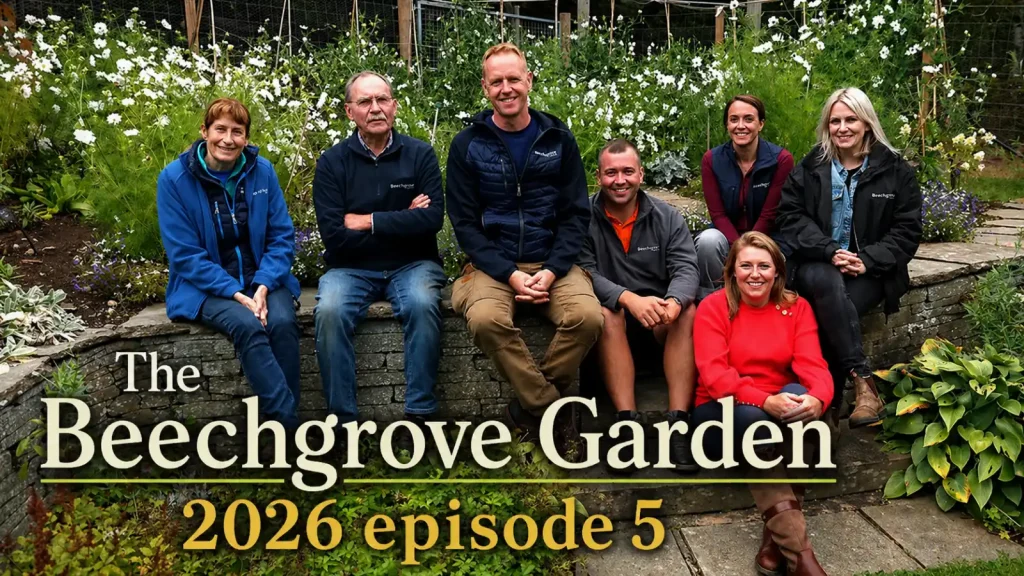
The Beechgrove Garden 2026 episode 5 arrives at a moment of genuine seasonal momentum, when the ambitions of early spring begin to take tangible, edible form. At Beechgrove, that momentum is particularly charged this year, because the garden’s presenters are not simply growing for pleasure or demonstration — they are competing. Each has been assigned a sensory theme to guide the design and planting of their own competition border, and in this episode, the first of those borders begins to take shape in earnest. The result is an episode dense with practical instruction, horticultural ambition, and the kind of considered decision-making that separates productive gardening from hopeful guesswork.
Scotland’s growing conditions demand a particular kind of gardener: adaptable, patient, and realistic about what the climate will and will not allow. The Beechgrove Garden has always reflected that reality, and its value as a gardening resource lies precisely in its refusal to romanticise the process. The plants chosen here are chosen because they work, because they taste extraordinary, or because they represent a carefully managed experiment worth documenting. That combination of practicality and curiosity runs through every segment of this episode, making it one of the more instructive of the 2026 series.
Kirsty Wilson takes centre stage for much of the episode, launching work on her competition plot with a planting list built around the sense of taste. Her selections span a remarkable range — from familiar brassicas and alliums to more unusual crops — and she introduces something entirely new to Beechgrove: hops. That single addition speaks to the spirit animating this series. The garden is not content to repeat itself. It tests, adapts, and occasionally surprises, and the hop trial represents exactly the kind of structured experiment that viewers can follow and, where conditions allow, replicate at home.
Brian Cunningham, meanwhile, provides the continuity that grounds the more experimental elements. His update on vegetables sown at the start of the series offers a genuine progress report — honest about setbacks, clear about what has thrived — and his work in the rain garden addresses one of the defining challenges of Scottish horticulture: persistent, heavy rainfall and the waterlogged conditions it creates. His segment is a reminder that sustainable gardening is not simply about choosing the right plants, but about designing the right systems. A well-functioning ecogarden does not fight the weather; it works with it.
The episode also travels beyond the Beechgrove site itself, visiting Calum Clunie’s allotment in Leven. That visit expands the scope of the episode considerably, demonstrating that the principles practised at Beechgrove translate directly to the kind of community growing spaces that many viewers actually use. Allotment gardening has its own rhythms and constraints, and Calum’s plot provides a grounded, real-world counterpoint to the more controlled environment of the main garden.
Running beneath all of these strands is a consistent emphasis on growing for the plate. This is not ornamental gardening, though beauty and structure are not ignored. The priority here is yield, flavour, and the satisfaction of producing food in conditions that demand genuine skill. Every plant chosen, every technique demonstrated, carries that functional intention. The green garden at Beechgrove is, in this episode, a kitchen garden in the fullest and most serious sense.
The episode’s handy hints add a further layer of practical value, addressing the small but often consequential decisions that determine whether a season succeeds or falters. Taken together, these elements form a coherent and unusually rich hour of horticultural television. The Beechgrove Garden 2026 has, from its opening episodes, set itself an ambitious agenda, and episode five delivers on that agenda with confidence and detail.
What follows is a thorough examination of every major gardening topic covered in this episode: the competition border, the edible planting choices, the hop trial, Brian’s vegetable update, the rain garden assessment, and the allotment visit. Each subject rewards close attention, and together they make a compelling case for the kind of thoughtful, climate-aware growing that defines the best of Scottish horticulture.
Kirsty Wilson’s Competition Border and the Sense of Taste
The competition at the heart of this series of The Beechgrove Garden 2026 is a genuinely interesting structural device. Each presenter has been given a sense to incorporate into their border design, and Kirsty’s assigned sense is taste. That constraint might initially seem limiting, but in practice it functions as a creative catalyst, pushing her toward planting choices that are simultaneously productive, flavourful, and visually considered.
Kirsty is the first of the Beechgrove team to begin active work on her plot, and she approaches the task with clear intention. Her goal is not simply to fill space with edible plants, but to create a border that will produce crops of exceptional flavour while also functioning as a coherent garden space. That dual ambition — aesthetic and edible — shapes every decision she makes, from plant selection to spacing and support.
The plants she introduces to the border represent a wide spectrum of edible gardening. She works across multiple crop families, choosing varieties with specific flavour qualities rather than simply planting for yield. This episode of The Beechgrove Garden 2026 makes clear that growing for taste is a distinct discipline, requiring variety-level research and a willingness to prioritise quality over convenience. Kirsty’s approach models that discipline clearly.
Hops at Beechgrove: A New Trial for The Beechgrove Garden 2026
The introduction of hops to Beechgrove is the episode’s most striking horticultural development. Hops — Humulus lupulus — have never been grown at the garden before, and Kirsty’s decision to include them in her competition border represents a genuine experiment. She is clear that this is new territory for Beechgrove, and that transparency is part of what makes the trial valuable. Viewers are not watching a demonstration of a proven method; they are watching an experiment unfold in real time.
Hops are vigorous climbing plants, capable of extraordinary seasonal growth. In a single season, a well-established hop bine can climb six metres or more, making it one of the fastest-growing perennial climbers available to British gardeners. That vigour makes them attractive as a screening plant and as a structural element in a border design, but it also demands careful management. Without adequate support and space, hops quickly become unruly.
Kirsty’s choice of hops for a taste-themed border is not arbitrary. Young hop shoots — known as hop tips — are edible and have been eaten as a vegetable since Roman times. They taste something like asparagus and can be prepared in similar ways: blanched, steamed, or briefly sautéed. Using hops as both a flavour crop and a structural climber is therefore entirely consistent with the border’s theme. The plant earns its place on multiple levels.
The practical requirements of establishing hops are also addressed. The plants need strong, tall support structures, as the bines climb by twining rather than by tendrils or adhesive pads, meaning they require vertical strings or wires to grip. Soil preparation matters too: hops prefer a well-drained but moisture-retentive growing medium with good fertility. The Beechgrove team’s willingness to attempt a crop with specific and demanding requirements reflects the garden’s broader commitment to honest, experimental horticulture.
The Full Edible Planting Spectrum in The Beechgrove Garden 2026
Beyond hops, Kirsty’s planting list for the competition border encompasses a broad range of edible crops. The episode gives a clear sense of the diversity involved, with plants drawn from multiple families and representing different parts of the culinary repertoire. That diversity is itself instructive: a productive edible border should not rely on a single crop type, but should layer annuals, perennials, and biennials to spread the harvest across the season.
Among the crops introduced, brassicas feature prominently. This plant family — which includes kale, cabbage, and various Asian greens — is particularly well suited to Scottish conditions, tolerating cool temperatures and even light frosts with relative ease. Brassicas sown or planted in spring will provide harvests that extend into autumn and winter, making them an efficient use of border space. Their strong flavours also make them natural candidates for a taste-themed planting scheme.
Alliums — the family that includes onions, garlic, leeks, and chives — are also part of the scheme. These are among the most flavourful of all edible plants, and their culinary versatility makes them indispensable in any serious kitchen garden. Several allium varieties are also ornamentally attractive, producing globe-shaped flowerheads in shades of purple and white that work well aesthetically within a designed border. In a taste border where appearance cannot be entirely neglected, alliums offer a genuine dual function.
The broader planting list reflects a sophisticated understanding of edible gardening — one that recognises the relationship between growing conditions, variety selection, and final flavour. A plant grown in the right conditions, at the right time of year, and harvested at the right moment will always taste superior to one grown under stress or picked past its prime. Kirsty’s approach throughout this segment of The Beechgrove Garden 2026 is built on that understanding.
Brian Cunningham’s Vegetable Update: Progress and Honest Assessment
Brian Cunningham’s contribution to this episode centres on a structured update of the vegetable sowings he made at the series’ start. This kind of progress report is one of the most useful things a long-running gardening programme can offer: it provides viewers with a realistic picture of what grows, what struggles, and what factors determine the difference. Brian’s segment is characterised by honesty and precision.
The vegetables sown at the beginning of the series have had several weeks to establish, and the results are varied. Some crops have performed strongly, germinating well and developing into healthy seedlings ready for the next stage of their growing journey. Others have been slower, affected by the kind of temperature fluctuations and inconsistent light levels that characterise a Scottish spring. Brian’s assessment does not gloss over these variations; instead, it uses them as teaching moments.
Germination rates, seedling health, and the timing of potting on or transplanting outdoors are all addressed. These are the practical concerns that occupy any vegetable grower in spring, and Brian handles them with the matter-of-fact expertise of someone who has navigated many growing seasons. He explains not just what has happened, but why — connecting outcomes to the specific conditions that produced them. That explanatory approach is one of The Beechgrove Garden 2026’s consistent strengths.
The update also touches on the decisions that lie ahead: when to move seedlings outside, whether to harden off gradually or use a cold frame, and how to manage the gap between indoor sowing and outdoor planting. These transitions are often where beginning growers lose confidence, and Brian’s clear guidance provides a reliable framework for navigating them.
The Rain Garden: Designing for Scottish Weather
Brian’s work in the rain garden is one of the most practically significant elements of this episode. The rain garden — a planted depression or basin designed to capture and slowly absorb surface water runoff — represents a thoughtful response to one of Scotland’s most persistent horticultural challenges. Heavy rainfall, waterlogged soil, and poor drainage are realities that Scottish gardeners must address, and the rain garden does so through design rather than intervention.
The principle behind a rain garden is straightforward: instead of fighting water or trying to drain it away quickly, you create a managed space that collects it, holds it temporarily, and releases it slowly into the surrounding soil. Plants selected for a rain garden must tolerate periodic inundation followed by drier conditions — a demanding combination that limits the available palette but by no means restricts it. Several ornamental and structural plants thrive in exactly these conditions.
Brian’s check on what survived the wet weather this year provides valuable real-world data. A rain garden designed and planted in previous seasons is now being tested by actual conditions, and the results reveal which plants genuinely perform as expected and which struggle despite being recommended for such environments. This kind of empirical feedback is enormously useful for gardeners considering similar installations. The ecogarden approach prioritises learning from observation, not just from theory.
The rain garden also connects to broader themes of sustainable gardening practice. Managing water on site — capturing it, slowing it, and using it — reduces demand on drainage systems and helps support soil life and plant health during drier periods. A well-established rain garden functions as a small-scale hydrological system, moderating the garden’s response to both rainfall and drought. In the context of increasingly unpredictable British weather, that function is growing in importance for every home garden.
Calum Clunie’s Allotment in Leven: Community Growing in The Beechgrove Garden 2026
The visit to Calum Clunie’s allotment in Leven introduces a different scale and context to the episode. An allotment operates under different constraints to a purpose-built demonstration garden: space is finite, resources are personal rather than institutional, and the growing must fit around work, family, and the practical realities of shared site management. Calum’s plot demonstrates how serious and productive allotment gardening can be when approached with skill and intention.
Leven, on the east coast of Fife, has a climate not dramatically different from Aberdeen’s, but there are local variations in exposure and soil type that affect what grows well. The visit to Calum’s allotment situates the episode’s horticultural content in a specific place and community, reminding viewers that gardening is always local. The general principles demonstrated at Beechgrove apply, but their application must always be adjusted for specific site conditions.
Calum’s plot shows the kind of productive intensity that characterises the best allotment gardening. Space is used efficiently, with crops at various stages of development occupying every available area. The visit in The Beechgrove Garden 2026 also demonstrates the importance of planning and succession — the disciplined scheduling of sowings and plantings that ensures a continuous supply of produce rather than a single glut followed by bare ground.
The allotment visit also touches on the social dimension of community growing. Allotments are shared spaces with their own cultures, traditions, and sometimes fierce debates about best practice. Calum’s engagement with his plot reflects a depth of knowledge and commitment that speaks well of the allotment community more broadly. His experience reinforces one of the episode’s central themes: that growing food well requires sustained attention, accumulated knowledge, and genuine care.
Handy Hints and Practical Guidance in The Beechgrove Garden 2026
The handy hints section of this episode, as in previous weeks, provides a range of concise, actionable advice covering common gardening situations. These hints are not filler; they address specific, timely questions that arise for gardeners working through the spring season. The Beechgrove Garden 2026 uses this section to address the practical margins of the growing calendar — the small decisions that collectively determine how well a garden performs.
Among the topics addressed are questions relating to plant protection and pest management. Spring is the season when slugs, aphids, and other pest populations begin to build, and early intervention is significantly more effective than reactive treatment later in the season. The hints provide clear guidance on monitoring, thresholds, and appropriate responses, reflecting the programme’s commitment to sustainable, considered pest management rather than reflexive chemical use.
Seasonal timing receives attention too. Knowing when to sow, when to transplant, and when to wait is one of the most difficult and consequential skills in gardening, particularly in Scotland where the window for reliable warmth is shorter than in southern parts of Britain. The hints draw on decades of Beechgrove experience to offer guidance that is calibrated to Scottish conditions, making them particularly valuable for the programme’s core audience.
Soil management, watering practice, and the use of compost and organic matter also feature. These foundational topics repay regular attention because they underpin everything else in the garden. A well-structured, biologically active soil makes every other gardening task easier and more successful. The hints reinforce that principle without oversimplifying the underlying complexity.
Growing for Flavour: The Philosophy Behind The Beechgrove Garden 2026 Episode Five
The coherence of this episode rests on a shared commitment to growing for the plate — a philosophy that connects Kirsty’s competition border, Brian’s vegetable update, and the allotment visit. Growing for flavour is not the same as growing for yield, and the distinction matters. Maximum yield often comes at the expense of taste: varieties bred for uniformity and shelf life frequently sacrifice the complex, intense flavours found in older or more specialised cultivars.
The Beechgrove Garden 2026 consistently champions the alternative: choosing varieties for taste, harvesting at the right moment, and understanding that flavour is partly a product of growing conditions. A tomato grown in poor light and overwatered will not taste like one grown in generous sun with restrained irrigation. A kale harvested after the first frosts of autumn will taste sweeter than one picked in September. These relationships between cultivation practice and final flavour are woven through the episode’s content.
That philosophy also has an ecological dimension. Growing a diverse range of food crops, using organic amendments, managing water thoughtfully, and supporting soil biology are all practices that improve both flavour and environmental sustainability. The edible garden and the ecogarden are not competing concepts; they reinforce each other. At its best, a kitchen garden is also a model of ecological balance, supporting insects, birds, and soil life while producing extraordinary food.
The hop trial captures this dual ambition particularly well. Hops are an unusual choice, but they are a choice made on culinary, structural, and experimental grounds simultaneously. They will feed, they will screen, and they will test the limits of what Beechgrove can grow. That combination of functions is, in miniature, what the whole episode achieves: it feeds the viewer’s knowledge, it structures their understanding, and it pushes at the edges of what Scottish gardening can accomplish.
Sustainability, Water, and Ecological Gardening at Beechgrove
Sustainability is not an abstract commitment at Beechgrove — it is demonstrated through specific choices and systems. The rain garden is the clearest expression of that in this episode, but the ecological approach runs through the whole programme. Water management, soil health, reduced reliance on synthetic inputs, and the prioritisation of plants that support biodiversity are all present as practical values rather than theoretical positions.
Brian’s rain garden assessment is particularly telling in this respect. A rain garden is only as good as the plants that inhabit it, and those plants must genuinely perform in alternately wet and dry conditions. Some of the species planted in previous seasons have proved resilient; others have not. That honest reckoning with what works is characteristic of good ecological gardening, which requires observation and adjustment rather than adherence to a fixed prescription.
The broader lesson is that sustainable gardening is iterative. You design a system, plant it, observe it, and modify it based on what you learn. The rain garden at Beechgrove is a living experiment in that iterative process, and Brian’s willingness to report its results — including the failures — makes it valuable to viewers far beyond the immediate context of the Beechgrove site. Every gardener working in a wet climate can learn from what survives a hard season in that planted basin.
Growing edible produce sustainably adds another layer of complexity. Vegetables and herbs are hungry, thirsty plants, and feeding and watering them without ecological cost requires careful attention to soil building, composting, and the use of collected rainwater. The episode touches on all of these practices, presenting them not as burdensome obligations but as sensible, integrated parts of a productive growing system. The green garden at its most functional is also, necessarily, its most sustainable.
Structure, Support, and Long-Term Planning in The Beechgrove Garden 2026
One of the quieter but important themes running through this episode is the relationship between structure and long-term planning. Kirsty’s competition border requires support structures for the hops, a considered layout that allows access and air circulation, and a planting scheme calibrated to develop and improve over multiple seasons. Brian’s vegetable growing requires a schedule that works backward from harvest dates to sowing dates. Calum’s allotment requires a seasonal plan that uses every square metre productively. All of these are exercises in thinking ahead.
Experienced gardeners understand instinctively that the best gardens are planned in reverse: you decide what you want to harvest and eat, then work back through the growing calendar to determine when things must be planted, when they must be sown, and what the soil needs to be ready for them. That reverse engineering of the growing season is one of the most sophisticated and rewarding aspects of serious vegetable gardening.
The Beechgrove Garden 2026 models this kind of structured thinking clearly and accessibly. It does not assume that viewers have extensive experience, but it does assume that they are serious about gardening well. The result is a programme that raises expectations rather than simply confirming existing habits. Episode five, in particular, challenges its audience to think more carefully about variety selection, seasonal timing, and the relationship between growing conditions and the food they ultimately produce.
Taken as a whole, this episode of The Beechgrove Garden 2026 is a masterclass in purposeful, climate-aware, flavour-focused horticulture. It combines competition, experiment, practical instruction, and community context into a coherent and richly informative programme. Viewers who follow its guidance — whether they garden on a Scottish allotment, a suburban plot, or a small urban space — will find in it a set of ideas and techniques that are both immediately applicable and genuinely inspiring.
FAQ The Beechgrove Garden 2026 episode 5
Q: What is the main gardening theme explored in The Beechgrove Garden 2026 Episode 5?
A: Episode 5 focuses on growing food for the plate. Kirsty Wilson begins planting her taste-themed competition border, while Brian Cunningham updates viewers on his vegetable sowings. Additionally, the episode visits Calum Clunie’s allotment in Leven and examines Brian’s rain garden after a challenging wet season.
Q: What is the competition element featured in The Beechgrove Garden 2026 this series?
A: Each Beechgrove presenter has been assigned a human sense to inspire their individual competition border. Kirsty Wilson draws the sense of taste, which shapes every planting decision she makes. Her border must produce crops of exceptional flavour while also functioning as a coherent, well-structured garden space throughout the season.
Q: Why is Kirsty Wilson growing hops at Beechgrove, and what makes this significant?
A: Hops are entirely new to Beechgrove, making their introduction a genuine first for the garden. Kirsty chose them because young hop shoots, called hop tips, are edible and taste similar to asparagus. Furthermore, hops serve as vigorous structural climbers, earning their place in a taste-themed border on both culinary and design grounds simultaneously.
Q: How should gardeners support hops, and what growing conditions do they require?
A: Hops climb by twining rather than using tendrils, so they need tall vertical strings or wires for support. A single bine can reach six metres in one season. They prefer well-drained but moisture-retentive, fertile soil. Providing strong, adequate structures before planting is essential, as established hops grow with remarkable speed during the warmer months.
Q: What vegetables did Brian Cunningham sow at the start of The Beechgrove Garden 2026, and how have they performed?
A: Brian sowed a range of vegetables at the series’ beginning and provides an honest progress update in Episode 5. Some crops germinated strongly and are developing well. Others were slower, affected by spring temperature fluctuations typical of the Scottish climate. Brian explains the reasons behind each outcome, connecting growing conditions directly to seedling performance.
Q: What is a rain garden, and why does Brian Cunningham feature one at Beechgrove?
A: A rain garden is a planted depression designed to capture surface water runoff and release it slowly into the surrounding soil. Rather than fighting heavy rainfall, it manages water sustainably on site. Brian checks which plants survived this year’s wet conditions, providing genuine empirical data for gardeners considering similar water-management installations in their own plots.
Q: Which plant families does Kirsty include in her edible competition border, and why were they chosen?
A: Kirsty plants brassicas, alliums, and several other edible crops chosen specifically for outstanding flavour. Brassicas tolerate Scotland’s cool temperatures and extend harvests into winter. Alliums such as onions, garlic, leeks, and chives deliver intense culinary flavour and many also produce ornamental flowerheads. Together, these families provide seasonal range, taste complexity, and structural variety across the border.
Q: What does Calum Clunie’s allotment visit in Leven add to The Beechgrove Garden 2026 Episode 5?
A: The Leven allotment visit demonstrates that Beechgrove’s principles translate directly to real community growing spaces. Calum’s plot showcases productive intensity, careful succession planting, and disciplined seasonal planning. Additionally, the visit highlights that gardening is always local — general techniques must be adjusted for each site’s specific soil, exposure, and microclimate conditions.
Q: How does growing for flavour differ from simply growing for maximum yield?
A: Growing for flavour requires choosing varieties bred for taste rather than uniformity or shelf life. Harvest timing matters enormously — kale picked after the first autumn frosts tastes noticeably sweeter than summer-harvested leaves. Furthermore, growing conditions directly influence final flavour. Restrained watering, healthy soil, and adequate light all contribute to producing crops of genuinely superior quality.
Q: What practical advice do the handy hints in The Beechgrove Garden 2026 Episode 5 cover?
A: The hints address timely spring gardening decisions, including pest monitoring, sowing schedules, and transplanting timing. Early intervention against slugs and aphids proves far more effective than reacting later in the season. Soil management, composting, and careful watering also feature. Calibrated specifically to Scottish growing conditions, these tips help gardeners make confident, well-informed decisions throughout the spring season.