The Secret Genius of Modern Life episode 15 – Rollercoaster: Have you ever felt that glorious, terrifying mix of excitement and dread? You know the feeling. It happens right as you crest the hill of a giant rollercoaster. Your heart pounds like a drum against your ribs. Your stomach seems to vanish entirely. Then, suddenly, you plunge downwards, screaming with pure, unadulterated joy. For well over a century, these incredible machines have offered us this unique blend of fear and fun. Today, millions flock to amusement parks worldwide. They eagerly seek the topsy-turvy thrills of these daredevil joyrides. It’s a primal urge, a desire to safely touch the edge of danger.
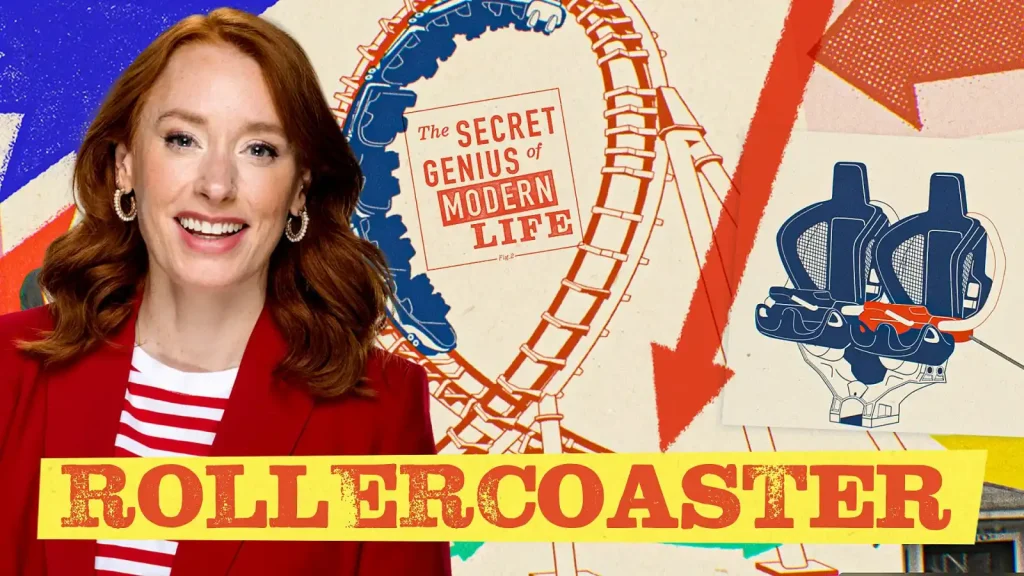
In a fascinating journey, Hannah Fry delves into this world. She explores the secrets behind these beloved thrill machines. Specifically, she focuses on the UK’s newest, tallest, and fastest example. Meet Hyperia, the gleaming giant at Thorpe Park. This ride represents the very pinnacle of modern rollercoaster design. But how did we get here? How did simple slides evolve into complex steel beasts like Hyperia? Hannah uncovers the captivating story in episode 15 of “The Secret Genius of Modern Life.” Prepare to learn about the rollercoaster’s wild origins. You’ll also discover the unexpected twists in its development.
The story begins long before Thorpe Park existed. Surprisingly, its roots lie not in sunny California, but in icy Russia. Imagine 17th-century St. Petersburg during winter. People constructed enormous wooden slides, covering them with thick ice. Brave souls would then climb aboard simple sleds. Afterwards, they’d hurtle down these frozen ramps at exhilarating speeds. These were the “Russian Mountains,” the earliest ancestors of our modern coasters. They offered a simple, gravity-powered thrill. Indeed, it was a basic concept, yet utterly captivating for its time. This fundamental idea of using gravity for amusement laid the groundwork.
Eventually, the concept migrated westward, landing in France. French entrepreneurs saw potential in these Russian amusements. However, they needed a way to replicate the experience without the Russian winter. Consequently, they adapted the idea, creating wheeled carts on tracks. These early versions, known as “Les Montagnes Russes à Belleville” (The Russian Mountains of Belleville), appeared around 1812. Another variation, the “Promenades Aériennes” (Aerial Walks), debuted shortly after. These rides were groundbreaking for their era. Still, they relied on some rather questionable physics, according to Hannah’s findings. Early designs weren’t always perfectly calculated. Therefore, accidents sometimes happened, reminding everyone of the inherent risks.
The real leap forward occurred across the Atlantic, in the United States. An inventor named LaMarcus Adna Thompson became fascinated by these early rides. He saw potential for something grander, safer, and more controlled. In 1884, he opened his “Switchback Railway” at Coney Island, New York. This ride was a sensation. Crucially, it used rollers under the track and side-friction wheels. This design provided more stability than its French predecessors. Thompson is often called the “Father of the Gravity Ride.” His creation truly kickstarted the rollercoaster boom in America. People lined up, eager for this novel form of entertainment. It felt safer, yet still delivered a satisfying thrill.
However, coaster technology was still in its infancy. Rides were improving, but safety remained a significant concern. Another key innovator emerged: John A. Miller. Miller was a prolific inventor with numerous patents related to rollercoasters. Perhaps his most crucial invention was the underfriction wheel, also known as the up-stop wheel. This wheel ran underneath the track. As a result, it locked the coaster train securely onto the rails. This prevented cars from flying off the track during sharp turns or hills.
Before this, coaster designs relied solely on gravity and side-friction wheels. Miller’s invention, therefore, was revolutionary. It allowed for much more daring designs. Engineers could now create steeper drops, sharper curves, and faster speeds with greater confidence. Additionally, Miller helped develop safety chain dogs. These click-clacking mechanisms prevent trains from rolling backward down the lift hill. Both inventions remain fundamental to rollercoaster safety today.
As designs became bolder, the physics became even more important. Engineers had to master concepts like potential and kinetic energy. Think about the slow climb up the lift hill. Here, the train gains potential energy, storing the power for the ride ahead. Then, as it crests the hill and begins its descent, potential energy converts rapidly into kinetic energy – the energy of motion. This conversion is what creates the incredible speed. Furthermore, designers carefully calculate G-forces.
These forces press you into your seat or lift you out of it (creating that “airtime” feeling). Positive Gs push you down, while negative Gs create weightlessness. Lateral Gs push you side-to-side in turns. Managing these forces is crucial. It ensures the ride is thrilling but remains safe for passengers. It’s a delicate balancing act between excitement and physical limits.
Surprisingly, the quest for better rollercoasters received help from an unexpected source: NASA. Yes, the space agency! As engineers pushed for faster, taller, and more complex rides, they needed advanced materials and techniques. NASA’s research into aerodynamics, stress analysis, and strong, lightweight materials proved invaluable. Techniques used to test rockets and spacecraft components found applications in coaster design. Understanding how structures behave under extreme forces was critical for both rockets and rollercoasters. This cross-pollination of ideas helped accelerate coaster innovation. It allowed for smoother rides, more intricate track layouts, and enhanced safety features. The connection might seem unlikely, yet space-age science played a part in perfecting the thrill machine.
Another major influence arrived in the form of an ambitious cartoonist: Walt Disney. Walt wasn’t just interested in cartoons; he dreamed of immersive theme parks. His vision for Disneyland required attractions far beyond simple carousels. He wanted rides that told stories, transported guests to other worlds. This ambition fueled significant advancements in ride technology through his Imagineering department. The Matterhorn Bobsleds, opened in 1959, marked a turning point. It was the first tubular steel track rollercoaster.
The Secret Genius of Modern Life episode 15 – Rollercoaster
This innovation allowed for much smoother transitions and more complex track shapes compared to traditional wooden coasters. Disney’s focus on thematic integration and storytelling pushed ride engineers to think differently. They needed to blend thrills seamlessly with narrative and environment. Consequently, his parks became showcases for cutting-edge ride systems.
From wooden classics to tubular steel giants, the evolution continued relentlessly. Wooden coasters offer a distinct, rattling thrill, a sense of raw power. Steel coasters, on the other hand, enabled inversions – loops, corkscrews, zero-G rolls. These elements turned riders upside down, adding a whole new dimension of excitement. Then came the era of hypercoasters, generally defined as coasters exceeding 200 feet in height. These focused on speed, airtime hills, and towering drops rather than inversions.
Following them were giga coasters, breaking the 300-foot barrier. And eventually, strata coasters emerged, soaring past an incredible 400 feet. Each new category represented a push beyond previous limits. Engineers constantly sought new ways to maximize speed, height, and G-forces, delivering ever more intense experiences.
This brings us back to Hyperia at Thorpe Park. As the UK’s tallest and fastest coaster, it stands on the shoulders of all this history. Its towering lift hill gathers immense potential energy. Its steep drops unleash incredible kinetic energy and speed. The smooth steel track allows for complex maneuvers and carefully controlled G-forces. Hyperia embodies the culmination of over a century of innovation. It incorporates lessons learned from Russian ice slides, French experiments, American ingenuity, NASA science, and Disney’s imagination. It is a testament to human engineering and our enduring fascination with controlled fear. Riding it connects you directly to that long lineage of thrill-seekers.
But why do we crave this? Why subject ourselves to stomach-lurching drops and high speeds? Psychologists suggest it taps into our primal fight-or-flight response, but in a safe environment. We experience the adrenaline rush, the feeling of danger, without actual risk. It’s a cathartic release. Moreover, riding a rollercoaster is often a shared experience. We scream together, laugh together, and conquer our fears together. There’s a sense of accomplishment afterwards. You faced the giant, and you survived, emerging exhilarated on the other side. It’s a powerful reminder that sometimes, facing fear head-on can be incredibly fun.
Hannah Fry expertly unravels this entire fascinating narrative. She connects the dots between dodgy 19th-century physics and sophisticated modern engineering. She reveals how rocket scientists and visionary entertainers unknowingly collaborated across time. They all contributed to perfecting the ultimate thrill machine. The journey from simple ice slides to the towering Hyperia is truly remarkable.
It’s a story of physics, engineering, ambition, and our innate desire for excitement. Listening to the podcast episode provides the full, mind-blowing story. It uncovers the secret genius behind the technologies we often take for granted, especially those designed purely for our delight. So next time you strap into a rollercoaster, remember the incredible history beneath your feet. You are partaking in a tradition over a century in the making.
FAQ The Secret Genius of Modern Life episode 15 – Rollercoaster
Q: What are the origins of modern rollercoasters?
A: Modern rollercoasters trace their roots back to 17th-century Russia, where enormous wooden slides covered with ice served as winter attractions in St. Petersburg. Brave thrill-seekers would climb aboard simple sleds and hurtle down these frozen ramps at exhilarating speeds. These “Russian Mountains” offered a basic yet captivating gravity-powered experience that laid the groundwork for future developments. The concept later spread to France around 1812, where entrepreneurs created wheeled carts on tracks to replicate the thrill without requiring winter conditions.
Q: Who is considered the father of modern rollercoasters?
A: LaMarcus Adna Thompson is widely recognized as the “Father of the Gravity Ride” after opening his groundbreaking “Switchback Railway” at Coney Island, New York in 1884. His innovative design utilized rollers under the track and side-friction wheels, providing significantly more stability than earlier European versions. Thompson’s creation sparked the rollercoaster boom in America, drawing crowds eager to experience this novel form of entertainment that balanced thrills with improved safety standards. His vision transformed simple gravity rides into commercial attractions that would evolve into the complex coasters we enjoy today.
Q: What was John A. Miller’s crucial contribution to rollercoaster safety?
A: John A. Miller revolutionized rollercoaster safety with his invention of the underfriction wheel, also known as the up-stop wheel. This ingenious component runs underneath the track and locks the coaster train securely onto the rails, preventing cars from flying off during sharp turns or hills. Before this breakthrough, designs relied solely on gravity and side-friction wheels, which limited their potential for thrilling elements. Additionally, Miller developed safety chain dogs, those click-clacking mechanisms that prevent trains from rolling backward down lift hills. Both innovations remain fundamental to rollercoaster safety today, enabling the creation of increasingly daring designs.
Q: How do physics principles apply to rollercoaster design?
A: Physics forms the backbone of every thrilling rollercoaster experience through careful manipulation of energy transformations and forces. During the slow climb up the lift hill, trains accumulate potential energy, which rapidly converts to kinetic energy during descent, creating breathtaking speed. Engineers meticulously calculate G-forces throughout the ride – positive Gs push riders into their seats, negative Gs create weightlessness (that coveted “airtime”), while lateral Gs provide side-to-side pressure in turns. This delicate balancing act between excitement and physical limitations ensures rides remain thrilling yet safe for passengers of various builds and health conditions.
Q: How did NASA contribute to rollercoaster development?
A: Surprisingly, NASA played a significant role in advancing rollercoaster technology through their research into aerodynamics, stress analysis, and lightweight materials. As engineers pushed for faster, taller, and more complex rides, they adopted techniques originally developed for testing rockets and spacecraft components. Understanding how structures behave under extreme forces proved crucial for both space exploration and thrill ride design. This unexpected cross-pollination of aerospace technology accelerated coaster innovation, enabling smoother rides, more intricate track layouts, and enhanced safety features. Consequently, modern thrill-seekers benefit from space-age science every time they board a high-tech coaster.
Q: What was Walt Disney’s impact on rollercoaster evolution?
A: Walt Disney transformed rollercoaster design through his vision of immersive storytelling in theme parks. His Matterhorn Bobsleds, opened in 1959, marked a pivotal moment as the first tubular steel track rollercoaster. This innovation enabled smoother transitions and more complex track shapes compared to traditional wooden designs. Disney’s Imagineering department pushed ride engineers to blend thrills seamlessly with narrative and environment, rather than focusing solely on physical sensations. As a result, his parks became showcases for cutting-edge ride systems where the physical experience served a larger storytelling purpose, forever changing how designers approach thrill ride creation.
Q: How have rollercoasters evolved in terms of height and speed categories?
A: Rollercoasters have undergone remarkable evolution in height and speed classifications over decades. The industry progressed from wooden classics to tubular steel giants that enabled inversions like loops and corkscrews. Later came hypercoasters, exceeding 200 feet and focusing on speed and airtime rather than inversions. Engineers then created giga coasters, breaking the 300-foot barrier, followed by strata coasters soaring beyond 400 feet. Each category represents a push beyond previous limitations, with designers constantly seeking new ways to maximize thrills through increased height, speed, and carefully controlled G-forces while maintaining strict safety standards.
Q: What makes Hyperia at Thorpe Park significant in rollercoaster history?
A: Hyperia stands as the UK’s tallest and fastest rollercoaster, embodying over a century of innovation in thrill ride design. Its towering lift hill harnesses immense potential energy, while steep drops unleash incredible kinetic energy and speed. The smooth steel track enables complex maneuvers with precisely controlled G-forces for maximum excitement within safety parameters. Remarkably, Hyperia incorporates lessons from the entire history of coaster development – from Russian ice slides to French experiments, American ingenuity, NASA science, and Disney’s storytelling approach. This impressive attraction represents the culmination of engineering advances and humanity’s enduring fascination with controlled fear.
Q: Why are humans psychologically drawn to rollercoaster experiences?
A: Our attraction to rollercoasters stems from their unique ability to trigger our primal fight-or-flight response within a controlled environment. Riders experience an adrenaline rush and the feeling of danger without actual risk, creating a cathartic release of tension. Furthermore, coaster rides typically serve as shared experiences where people scream, laugh, and conquer fears together, fostering social bonds through collective excitement. Many riders feel a sense of accomplishment afterward – they faced the imposing machine and emerged exhilarated on the other side. This powerful reminder that confronting fear can lead to joy keeps thrill-seekers returning for more heart-pounding adventures.
Q: What can viewers expect from Hannah Fry’s episode on rollercoasters?
A: In episode 15 of “The Secret Genius of Modern Life,” Hannah Fry masterfully unravels the fascinating narrative behind rollercoaster development. Viewers will discover how she connects seemingly unrelated historical dots between early physics misconceptions and sophisticated modern engineering principles. The show reveals how rocket scientists and visionary entertainers unknowingly collaborated across time to perfect these ultimate thrill machines. Furthermore, Fry explores the remarkable journey from simple Russian ice slides to the towering Hyperia at Thorpe Park. This captivating story encompasses physics, engineering innovation, human ambition, and our innate desire for controlled excitement, making for a truly mind-expanding viewing experience.