The Secret Life of the Sun: We think we know the sun. It is the warm, reliable heart of our day. It is a painter of sunrises and sunsets. It is the constant friend that rises every morning. But this familiar, glowing face hides a complex and fiery personality. Our star, in fact, has a volatile and dramatic private life. This is The Secret Life of the Sun. It is a story of incredible power, rhythmic cycles, and sudden violence. This story affects every single one of us, every single day. We are only just beginning to truly understand its secrets.
Our sun is not a static ball of fire; it “breathes.” It follows a grand rhythm known as the solar cycle. This predictable pattern lasts about eleven years. During this time, the sun moves from a quiet, calm state to a stormy, active peak. Then, it slowly settles down again. This entire cycle is driven by its powerful magnetic fields. They twist, tangle, and then eventually “flip” the sun’s poles. We are currently in solar cycle 25. This means sun activity is increasing dramatically.
When you hear solar cycle 25 explained, it means we are ramping up. We are climbing toward the “solar maximum.” This is the peak of the cycle’s activity. Consequently, scientists are predicting more excitement and more solar storms in the coming years. This is not just an academic curiosity. This rising activity has direct impacts on our life here on Earth. The sun is, in essence, waking up and becoming more energetic.
So, what happens when the sun “wakes up”? It throws massive, energetic tantrums. These are powerful solar eruptions. Imagine a spot on the sun, a tangle of magnetic fields. This spot, thousands of times bigger than Earth, suddenly snaps. It explodes in a blinding, ferocious flash. This is a solar flare. These flares unleash a flood of solar radiation at the speed of light. This radiation can reach Earth in just over eight minutes.
Sometimes, the sun does something even more spectacular. Along with a flare, it hurls a massive blob of its own atmosphere into space. This is a coronal mass ejection, or CME. It is like a plasma cannonball weighing billions of tons. This cloud of superheated gas travels fast, but not at light speed. It can take one to three days to cross the 93 million miles to Earth. This gives us a crucial, short window to prepare.
This blast of plasma and radiation travels through the solar system. As a result, it creates a phenomenon called space weather. Space weather is not like the weather in our atmosphere. Instead, it is a dangerous storm of high-energy particles. It is also a shockwave of intense magnetic fields. This solar radiation is extremely hazardous to unprotected astronauts. However, it also poses a growing threat to our modern technology. This invisible “weather” is what solar science and heliophysics try to predict.
Thankfully, Earth is not defenseless. Our planet has a natural shield called the magnetosphere. This magnetic field, generated by our planet’s core, deflects most of the storm. But when a powerful coronal mass ejection hits, our shield buckles and strains. This violent collision triggers massive electrical events in our upper atmosphere. These are known as geomagnetic storms. They are, in effect, global electrical disruptions. The consequences can be surprisingly severe and widespread.
What happens on the ground during geomagnetic storms? The biggest risk is power grid disruption. The storm can create massive, uncontrolled currents in long power lines. This can fry building-sized transformers. This could cause blackouts lasting weeks or even months. Furthermore, GPS disruption becomes a major problem. The satellite signals we rely on for navigation, banking, and farming get scrambled. This leads to the critical question: how solar storms affect satellites.
Our crucial weather monitoring satellites are incredibly vulnerable. In fact, all satellite monitoring systems are at risk. The high-energy particles can damage their solar panels. They can also fry their delicate electronics. This, in turn, can leave us “blind,” unable to forecast weather or communicate. However, there is a beautiful silver lining. The storm’s energy excites gas in our atmosphere. This creates the breathtaking aurora activity. We see this as the shimmering northern and southern lights. Therefore, a strong northern lights forecast often follows a major solar flare.
People often ask about the long-term climate effects of the sun. Is there a solar flare climate connection? This is a complex and vital area of space research. The sun’s 11-year cycle does change its total energy output. However, the field of astrophysics shows this change is very, very small. Most scientists agree it is not the main driver of modern, rapid climate change. Yet, understanding these long-term solar eruptions is vital. It helps refine our climate models and separate natural cycles from human-caused effects.
The Secret Life of the Sun
So, who watches this dynamic, secret life? Dedicated solar observatory teams work around the clock. They use massive ground-based telescopes. They also rely on a fleet of advanced spacecraft. These satellites stare at the sun 24/7. The entire field of heliophysics is dedicated to this. It is the specific space research of our very own star. We are living in a golden age of solar science. We have never had a clearer, more detailed view of the sun’s complex behavior.
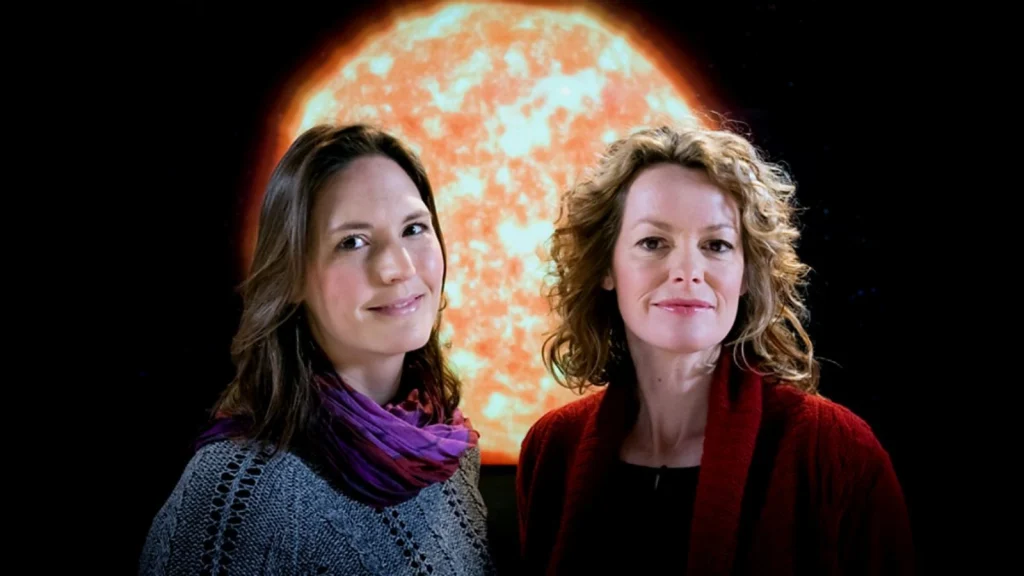
Making sense of this astrophysics is crucial for everyone. Public figures help bridge the gap between complex science and our daily lives. Scientists and presenters like Dr. Helen Czerski are vital. She has a gift for explaining the physics of our world. Similarly, presenters like Kate Humble bring these remote observatories into our homes. She connects us to the passionate solar observatory teams on the front lines. They help us all appreciate the sun’s awesome and terrifying power.
The Secret Life of the Sun is fascinating, beautiful, and a little bit frightening. It is a story of beauty and potential chaos. Our star is not just a quiet neighbor; it is a dynamic, living part of our solar system. Understanding its solar cycle and its solar storms is not just academic. It is essential for protecting our modern, technological civilization. The sun gives us life, warmth, and light. But we must also understand and respect its hidden, fiery power.
The Secret Life of the Sun review
The Secret Life of the Sun is a story of dual personalities. We see our star as a familiar, reliable source of warmth and light. It is the constant friend that rises every morning. This glowing face, however, hides a complex and fiery personality. Our star has a volatile and dramatic private life. This story involves incredible power, rhythmic cycles, and sudden violence. It affects every single one of us, every single day.
The sun is currently going into overdrive. Our star is more active now than it has been for a decade. This increasing sun activity presents a unique opportunity for study. It also presents potential risks to our modern way of life. Scientists are therefore studying the sun with renewed urgency. We are only just beginning to truly understand its secrets.
This heightened activity means the sun is sending powerful solar eruptions toward our planet. These events include eruptions of superheated plasma. They also involve vast waves of radiation. These phenomena have the potential to disrupt our lives in completely unexpected ways. This entire field of study is known as space weather.
A new generation of advanced satellite monitoring is showing us the sun in more detail than ever before. This technology allows us to see beyond our limited, visible-light view. This space research is vital for understanding our star. This new era of solar science is revealing a complex and dynamic object.
Presenters Kate Humble and Helen Czerski guide this exploration of our star. They are based at the Rutherford Appleton Laboratory (RAL) in Oxfordshire. This facility is Britain’s leading centre for solar research. It is one of the most important centres for solar science in the world.
The teams at RAL are part of a global network of solar observatory teams. They use the latest satellite images to decode the sun’s inner workings. They help us understand the forces that drive our star. We will explore the sun’s most spectacular displays. We will also investigate its mysterious cycles. This is The Secret Life of the Sun.
Observing Our Star with New Eyes
We cannot look directly at the sun without damaging our eyesight. However, a new fleet of satellites allows scientists at RAL to get a unique picture. In 2006, NASA launched the twin STEREO spacecraft. These observe the sun from two sides simultaneously.
The Solar Dynamics Observatory (SDO) followed four years later. It is able to visualize the sun in high resolution for the first time. This heliophysics mission reveals far more than the simple burning disc we see. These weather monitoring satellites space weather missions are revolutionary.
Richard Harrison is the head of space science at RAL. He and his team are responsible for analysing those images. Harrison notes that we have now built an international fleet of spacecraft. These satellite monitoring missions are studying the sun in phenomenal detail. For the first time, we can see a complete star.
These satellites can also detect types of light from the sun that are invisible to the naked eye. Harrison identifies the brighter areas as “active regions.” He compares these regions to volcanoes and earthquakes on Earth. They are places where the sun is active and interesting things are happening.
The images show a truly complex atmosphere. Harrison describes it as a “plate of writhing spaghetti.” It is moving all the time. This illustrates how fantastic it is to be studying the sun. This advanced heliophysics reveals the sun’s true, complex nature.
The Sun’s 11-Year Pulse: The Solar Cycle
This peak in activity is known as a solar maximum. It is the high point in a solar cycle that the sun goes through. This cycle repeats on average every 11 years.
The sun moves from relative calm, known as solar minimum, to intense activity and back again. This solar cycle is fundamental to how the sun works. Understanding it will help us discover The Secret Life of the Sun.
To begin to understand this cycle, Kate Humble traveled to Cairns, Australia, in November 2012. She was there to witness one of the most dramatic events in the astronomical calendar. She went to observe a total solar eclipse.
This event provides a unique view of the sun. Earth is the only planet in the solar system from which you can witness a total eclipse. This is thanks to an astonishing coincidence.
The moon is 400 times smaller than the sun. However, it is also 400 times closer to the Earth. It therefore appears to be exactly the same size in the sky. This allows it to block the sun’s entire surface from our view.
Decoding the Corona and the Solar Cycle
When the moon completely covers the sun, the moment is called totality. This moment reveals something normally hidden by the sun’s glare. We can see the sun’s faint atmosphere, the corona. The corona is key to what this eclipse could tell scientists.
This particular eclipse was special. It occurred during the period predicted to be solar maximum. Scientists needed to confirm if the sun had reached its peak of activity. One way to do that is to study the sun’s corona during totality.
Astronomer Francisco Diego has seen 17 total eclipses. He was in Cairns to photograph the corona. He explains that the shape of the corona is an indication of solar activity. The shape of the corona changes all the time.
Diego’s photographs provided a clear answer. He compared the 2012 image to one from a solar minimum in 1994. At solar minimum, the 1994 corona was very orderly, steady, and quiet. It had a very clear axis.
By contrast, the 2012 corona was completely different. It was “all over the place.” The solar activity had blown the corona in all directions. This confirmed the sun was extremely dynamic. It was indeed at or near its solar maximum, an exciting time for the solar cycle.
The Engine of the Sun: Nuclear Fusion
What causes these solar cycles? To understand, we must first look deep inside the sun. Presenter Helen Czerski explains that the sun’s journey begins deep within our star.
The sun’s mass is enormous. It makes up 99.85 percent of the entire mass of the solar system. The solar system is basically just the sun, with a few fragments circling it. This enormous mass creates the conditions to produce sunlight.
Its intense gravity forces the sun into layers. Deepest is the core, a 16-million-degree furnace. Around 550,000 kilometers down, the entire mass of the sun pushes inwards. This exerts vast pressure. This is where sunlight is born.
Helen Czerski explains this process is called fusion. The pressures and temperatures in the middle of the sun are so enormous that hydrogen atoms can fuse together.
When this happens, a tiny, tiny bit of mass is converted into a huge amount of energy. This little process is the key to a star like our sun. This is a core concept in Astrophysics. The solar radiation from this process is the start of sunlight.
Scientists at the National Ignition Facility (NIF) in California are trying to recreate this. They are trying to make a “tiny sun.” Beth Dzenitis, who works at NIF, creates tiny hydrogen fuel capsules.
These capsules are smaller than a grain of rice. 192 powerful laser beams then converge on the capsule. This causes the fuel to be compressed so that the hydrogen atoms fuse.
The NIF team routinely achieves short-lived fusion. However, their goal is to create a self-sustaining reaction, known as ignition. It is this elusive trick of generating endless energy that makes our sun so miraculous. This branch of Astrophysics is key to energy research.
The Photon’s Epic Journey
This fusion process creates the birth of sunlight in the sun’s core. It is born in particles of light energy known as photons. Their journey, however, is far from over. They must now reach the sun’s surface.
This is a really complex and difficult journey. In between the core and the surface is a seething mass of stuff that we call plasma.
Helen Czerski uses a pinball analogy to explain this. The newly created photon is the pinball. It must now navigate through the plasma, which acts like the flippers and bumpers.
The photon cannot take a direct route out. It is forever colliding with particles of plasma. These particles are moving at thousands of miles per hour. This solar radiation takes a very long time to escape.
The photon has hundreds of thousands of miles of plasma to cross. A journey that should take two and a half seconds at the speed of light takes much, much longer.
Even though it travels at the speed of light, it is estimated to take 10,000 to a million years. This is just the time to get from the core of the sun to its surface.
Only then does the photon gain its freedom. What we think of as sunlight’s journey, the 90 million miles to Earth, is only the last eight minutes. It is the final leg of an odyssey that could have taken thousands of years. This ancient solar radiation finally reaches us.
The Magnetic Driver of Solar Cycle 25 Explained
Fusion in the core never stops. So why does the sun’s sun activity go up and down with the 11-year solar cycle? The answer, as Lucie Green explains, lies in the plasma.
Lucie Green is a solar physicist. She explains that the heat from fusion superheats the gas. The gas particles are torn apart to form a plasma. This plasma moves.
Just as hot air in a room rises, the gases in the outer layers of the sun do the same. This is called convection. Gases get heated from below and rise to the surface.
Because this plasma is so hot, it is also electrically charged. As it moves up and down with convection currents, it creates powerful magnetic fields. This solar radiation and plasma movement is key.
The sun, like the Earth, also spins on its axis. This means the plasma also flows sideways. This has a dramatic effect on those magnetic fields. This is a key principle of heliophysics.
Lucie Green notes that you start to see the magnetic field lines being wound up. Eventually, they become so strong that the magnetic fields rise up. They penetrate the surface of the sun. This is when we have the build-up to solar maximum.
At times of solar maximum, these magnetic loops break out from the surface. This one loop is many times bigger than the Earth. The study of solar cycle 25 explained this way shows a complex engine.
Eventually, the magnetic fields disperse. They rearrange themselves, and we go back to solar minimum. This whole cycle repeats every 11 years. The understanding of solar cycle 25 explained as our current example is vital.
Earth’s Defense Against Space Weather
The sun’s outer atmosphere is constantly expanding out into space. This is what we call the solar wind. At times of solar minimum, the wind is fairly ungainly.
At solar maximum, the magnetic fields become more complex. This leads to vast streams of solar wind coming our way. This space weather constantly bombards the Earth.
Most of it is deflected by our planet’s own magnetic field. However, a small amount of its energy does get through. This can have extraordinary effects.
Kate Humble traveled to Lapland in Arctic Sweden to see these effects for herself. She was hoping to witness the aurora borealis, also known as the northern lights. A good northern lights forecast is essential for this.
The aurora is the solar wind made visible on Earth. As the wind encounters our planet’s magnetic field, it sends energy down the magnetic field lines toward the poles. This causes our atmosphere to luminesce in ghostly colours.
Solar maximum is the best time to see aurora activity. However, Kate Humble still needed a cloud-free, moonless night. Her northern lights forecast was initially blocked by clouds.
On her final night, the sky was clear. She witnessed the stunning display, a giant green rainbow spanning the eastern sky. This aurora activity is mesmerizing.
Scientist Gabriela Sternberg studies this interaction in Sweden. She explains the solar wind moves at speeds of 400 kilometers per second. A gigantic shock wave forms where the solar wind slows down.
This boundary separating our space from the solar wind is very thin. She describes it as a “thin, transparent veil.” The aurora is but a faint trace of the solar wind’s true strength. It is a reminder of the protection we get from Earth’s magnetic shield.
The Threat of Violent Solar Eruptions
What would happen if we were exposed to the full force of the sun? The solar wind is a mere hint of the sun’s power. The most violent form of solar eruptions are known as solar storms.
Richard Harrison explains how these form. The magnetic loops in the sun’s atmosphere, like elastic bands, can snap. This event is called a coronal mass ejection.
A billion tonnes of mass from the sun is ejected into space. This coronal mass ejection can hurl clouds of plasma towards us at alarming speeds.
They can cover the 90 million miles from the sun to the Earth in less than a day. These solar storms have the power to overwhelm the Earth’s defenses.
The impacts on our modern, technological lives are serious. Geomagnetic storms can destroy satellites. This is how solar storms affect satellites. They can also silence communications, ground aircraft, and cause GPS disruption.
The biggest threat, however, is to our power grid. This is a major risk of power grid disruption. A report published by Lloyd’s of London, written with RAL, highlights this vulnerability.
Geomagnetic storms can induce powerful electrical currents on the Earth’s surface. These currents can overload circuits and melt transformers.
Our world is highly interconnected. A power grid disruption would not only mean losing lights and heating. We would also lose fuel, because pumping stations rely on electricity. Sanitation and water supplies would also fail. This is a serious threat from how solar storms affect satellites and ground systems.
We know we are vulnerable because we have been hit in the past. In Quebec, in 1989, the entire power grid went down after a solar storm. This plunged millions of people into freezing darkness.
Forecasting Solar Flares and Storms
We are not helpless. There are precautions we can take against the effects of solar storms. We can build resilient systems. It would be even better, however, if we could prepare for specific storms.
For that, we need an early warning system. The Space Weather Prediction Center in Colorado provides this service. It is one of the world’s key solar observatory teams.
They are dedicated to watching for solar storms. They alert governments, power companies, and the aviation industry. Even a few hours’ warning can help them prepare for GPS disruption. Their weather monitoring satellites space weather data is critical.
Chief forecaster Bob Rutledge explains how to predict solar storms. He states that space weather really starts with sunspots. The complexity of the magnetic fields in sunspots is the first clue.
When an event begins, we see a solar flare. This is the giant explosion. We see it as a brightening in X-rays. This solar flare is the first clue. Solar flares are a key indicator.
The team must then determine if a coronal mass ejection also occurred. They watch other images of the sun, using weather monitoring satellites space weather missions that block out the sun’s disc.
They look for the faint halo of plasma being blown into space. The ones that go off to the side do not matter to Earth. They must see if it is coming our way, how fast it is, and when it will get here.
Bob Rutledge shows an event from late October 2003. It was a massive “halo” cloud. It was a level-five storm, as big as it gets. It made it to Earth in under a day.
That solar storm took out the power grid in the Swedish city of Malmo. Tens of thousands were left without electricity. On that occasion, the Earth was only struck a glancing blow. We cannot be sure we will be so lucky next time.
Uncovering Deeper Cycles in The Secret Life of the Sun
We are only just beginning to understand the sun. The 11-year solar cycle is not the full story. New research suggests the cycles themselves could be changing. We may be living through bigger shifts. The current solar cycle 25 explained by scientists is just one part of a larger pattern.
The clue comes from a phenomenon astronomers have observed for centuries: sunspots. They were known long before satellites or even telescopes.
Early astronomers, like Galileo, mapped these dark spots. It became apparent they were part of the surface of the sun. This space research was foundational.
Sunspots are one of the few bits of evidence we have about the sun’s long-term behaviour. We know that the more active the sun is, the more sunspots there are.
They are caused by the magnetic fields deep inside the sun. As the fields get tangled, they disrupt the flow of hot plasma to the surface. This creates zones of cooler plasma, which appear as dark sunspots.
Sunspots are like windows into the sun’s interior. A study at the McMath solar telescope in Arizona began 17 years ago. This space research yielded surprising results.
A group of astronomers, including Matt Penn, began to look at the strength of the magnetic fields in sunspots. They wondered if it was increasing with the number of sunspots.
The data showed something completely different. The magnetic field strength of sunspots was not cycling. Instead, it has been steadily decreasing, year by year.
Matt Penn notes this is a consistent trend. This decreasing trend means that in the future, we may not have any sunspots at all. This suggests we may be heading for an extended quiet period, what scientists call a “grand minimum.”
The Solar Flare Climate Connection and The Secret Life of the Sun
This is an extraordinary result. Intriguingly, we have been here before. Thanks to historical records, we know that sunspots almost vanished around 350 years ago. This grand minimum lasted for 70 years.
Matt Penn notes there are possible climate effects of the sun linked to this. Records suggest the temperature in Europe, for instance, decreased during the last grand minimum.
This period coincided with a time of brutally harsh winters. It was known as the “Little Ice Age.” The River Thames in London famously froze solid.
This suggests a solar flare climate connection, or more accurately, a solar activity connection. A grand minimum would be a double-edged sword. It might mean fewer solar storms.
However, it could also mean a dramatic change in our weather. These climate effects of the sun could be profound. The data suggests the sun is going through a “global change.” This Astrophysics puzzle is fascinating.
We are just seeing this tiny, tiny sliver of the lifetime of the sun. It is hard to imagine this enormous timescale. The familiar 11-year cycle is not the full story.
What’s emerging is that there are bigger, longer-term patterns in the life of our sun. These patterns could have profound influences on our planet. This is the big challenge that lies ahead for solar scientists.
FAQ The Secret Life of the Sun
Q: What is The Secret Life of the Sun about?
A: The Secret Life of the Sun explores the complex, dynamic nature of our star beyond its familiar appearance. It reveals how the sun follows an 11-year solar cycle, moving from calm periods to intense activity peaks with powerful eruptions. The documentary examines solar storms, space weather, and their effects on Earth’s technology and climate. Presenters Kate Humble and Helen Czerski guide viewers through cutting-edge research from Britain’s Rutherford Appleton Laboratory and global solar observatories. Additionally, it investigates how advanced satellites now allow scientists to study the sun in unprecedented detail, uncovering mysteries that affect our daily lives.
Q: What is solar cycle 25 and why does it matter?
A: Solar cycle 25 represents the current 11-year period of solar activity, during which the sun transitions from quiet to stormy conditions and back again. We are currently climbing toward solar maximum, the peak of heightened activity. This matters because increased solar activity produces more solar flares and coronal mass ejections that can disrupt satellites, GPS systems, and power grids. Furthermore, understanding this cycle helps scientists predict space weather events and protect critical infrastructure. The cycle is driven by the sun’s magnetic fields, which twist and eventually flip the star’s magnetic poles before resetting.
Q: How do solar flares and coronal mass ejections differ?
A: Solar flares are explosive bursts of radiation that travel at light speed, reaching Earth in just over eight minutes. They appear as brilliant, ferocious flashes when tangled magnetic fields suddenly snap and release energy. In contrast, coronal mass ejections (CMEs) are massive blobs of the sun’s atmosphere hurled into space, weighing billions of tons. These plasma cannonballs travel slower than flares, taking one to three days to reach Earth. Consequently, CMEs provide a crucial warning window for preparation. Both phenomena can occur simultaneously, with CMEs often accompanying powerful flares during periods of intense solar activity.
Q: What is space weather and how does it affect us?
A: Space weather refers to dangerous storms of high-energy particles and intense magnetic field shockwaves traveling through the solar system. Unlike atmospheric weather, it poses serious threats to modern technology and unprotected astronauts. When space weather reaches Earth, it can damage satellites, disrupt GPS navigation systems, and interfere with communications and aviation. The most severe consequence is power grid disruption, where geomagnetic storms induce massive electrical currents in power lines. These currents can destroy building-sized transformers, potentially causing blackouts lasting weeks or months. However, space weather also creates the beautiful aurora borealis and aurora australis at Earth’s poles.
Q: How does Earth’s magnetosphere protect us from solar storms?
A: Earth’s magnetosphere acts as a natural shield generated by our planet’s core, deflecting most dangerous solar radiation and plasma. This magnetic field forms a protective bubble around Earth, preventing the full force of the solar wind from reaching the surface. Nevertheless, when powerful coronal mass ejections strike, the magnetosphere buckles and strains under the assault. During these collisions, small amounts of energy penetrate through magnetic field lines toward the poles, triggering geomagnetic storms. Scientists describe this boundary as a “thin, transparent veil” separating Earth’s safe space from the hostile solar environment. Without this defense, life as we know it would be impossible.
Q: What causes the sun’s 11-year cycle?
A: The 11-year solar cycle is driven by the sun’s powerful magnetic fields interacting with its plasma. Nuclear fusion in the core never stops, but the sun’s outer layers consist of electrically charged plasma that moves through convection currents. As hot plasma rises and cooler plasma sinks, it creates magnetic fields that become increasingly tangled. Moreover, the sun’s rotation causes these fields to wind up like twisted elastic bands until they become strong enough to break through the surface. At solar maximum, massive magnetic loops erupt, creating sunspots and solar storms. Eventually, these fields disperse and rearrange, returning the sun to solar minimum before the cycle repeats.
Q: How long does sunlight actually take to reach Earth?
A: While we often hear that sunlight takes eight minutes to reach Earth, this is only the final leg of an extraordinary journey. Photons are created through nuclear fusion in the sun’s core, where hydrogen atoms fuse at 16 million degrees. However, these light particles must navigate through hundreds of thousands of miles of dense plasma, constantly colliding with particles moving at thousands of miles per hour. Scientists estimate this journey from core to surface takes anywhere from 10,000 to one million years. Only then do photons gain freedom to travel the 93 million miles to Earth in those final eight minutes. Therefore, the sunlight warming us today began its odyssey millennia ago.
Q: Can scientists predict when solar storms will hit Earth?
A: Yes, organizations like the Space Weather Prediction Center in Colorado monitor the sun continuously to forecast solar storms. Scientists first watch for complex sunspot formations, which indicate where magnetic fields might snap. When a solar flare erupts, satellites detect the X-ray brightening immediately. Forecasters then determine whether a coronal mass ejection accompanied the flare by looking for plasma halos blown into space. If the CME is Earth-directed, they calculate its speed and arrival time, typically providing several hours to a few days of warning. This advance notice allows power companies, airlines, and governments to take protective measures. Nevertheless, forecasting remains challenging due to the sun’s unpredictable nature.
Q: Is there a connection between solar activity and climate change?
A: The relationship between solar activity and climate is complex and frequently misunderstood. The sun’s 11-year cycle does cause small variations in total energy output, but astrophysics research shows these changes are minimal. Most scientists agree solar variations are not the primary driver of modern, rapid climate change. However, longer-term patterns exist beyond the 11-year cycle. Historical records indicate that during the “Little Ice Age” 350 years ago, sunspots nearly vanished for 70 years, coinciding with brutally harsh European winters. Current research suggests sunspot magnetic field strength is steadily decreasing, potentially indicating another “grand minimum” ahead. Understanding these long-term solar cycles helps scientists separate natural variations from human-caused climate effects.
Q: What happens during a total solar eclipse and what can scientists learn?
A: During a total solar eclipse, the moon completely blocks the sun’s bright surface, revealing its faint outer atmosphere called the corona. This rare opportunity occurs because of an astonishing cosmic coincidence: the moon is 400 times smaller than the sun but also 400 times closer to Earth, making them appear identical in size. Scientists photograph the corona’s shape during totality to determine the sun’s activity level. At solar minimum, the corona appears orderly and steady with a clear axis. Conversely, at solar maximum, the corona extends chaotically in all directions, blown outward by intense magnetic activity. Earth is the only planet where total solar eclipses occur, making these events invaluable for solar research and understanding our star’s cycles.