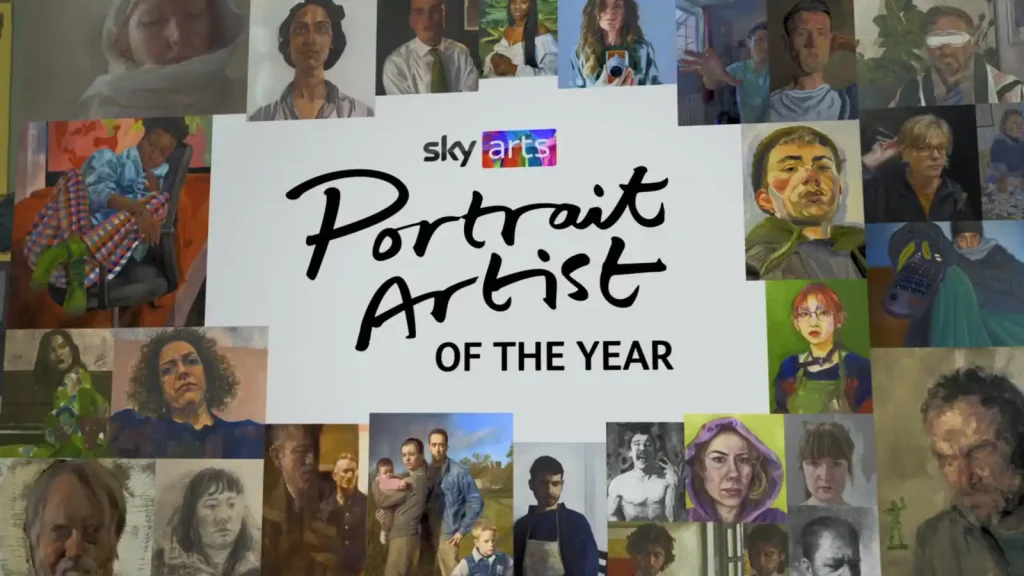
The pursuit of a place in the semi-final of Portrait Artist of the Year 2025 episode 7 created an atmosphere of intense focus. This event, a premier art competition, challenges artists to capture a likeness under extreme time pressure. The self-portraits of the day’s contenders had previously revealed their relaxed sides, showing moments of bingeing television or snoozing. However, the studio environment demanded the opposite, pitting their creative instincts against a ticking clock. The day’s work would ultimately be judged, with one artist moving closer to a prestigious commission for the Royal Society and the creation of future Celebrity Portraits.
This particular heat followed a compelling previous round. In that contest, Uthman Wahab’s instinctive approach secured his victory. His insightful portrait of journalist Beth Rigby impressed the judges. Therefore, the nine new artists felt the pressure to perform. Each hoped to be the next to earn a coveted place in the semi-final. The painting challenge was not just a test of technical skill. It was also a test of composure and artistic decision-making.
This article will explore the specific events of the Portrait Artist of the Year 2025 episode 7 heat. It will detail the diverse group of artists who competed. Furthermore, it will introduce the notable celebrity sitters they were tasked with painting. We will also examine the unique artistic strategies employed during the timed challenge. Finally, the article will cover the meticulous judging process and the ultimate selection of the heat’s winner. This portrait artist faced a significant creative hurdle.
The grand prize for the competition winner is substantial. It consists of a £10,000 commission to create a portrait for the Royal Society. The subject of this future portrait painting will be the award-winning mathematician and broadcaster, Professor Hannah Fry. This commission is especially significant. It serves to celebrate a major milestone.
Specifically, the commission marks the 80th anniversary of the first women elected to the Royal Society fellowship. These two pioneering women were Professor Kathleen Lonsdale and Professor Marjorie Stevenson. Consequently, the prize connects the contemporary art competition to a rich historical legacy. The winning artist’s work will join this important cultural institution.
Guiding the competition are three expert judges. They are the art historian Kate Bryan, the curator Kathleen Soriano, and the award-winning artist Ty Shan Sheeranberg. This panel holds the responsibility of evaluating each portrait painting. Their expertise is crucial in determining which artist’s work best satisfies the rigorous demands of the painting challenge. They would soon evaluate nine new contenders: Hannah Broadhead, Nazarene Nazir, Bernie Lumacko, Joe Capps, Sarah Lee Bailey, Milly Wilkins, Vincent Stokes, Hamley Jenkins, and James Isaacs.
Portrait Artist of the Year 2025 episode 7
The Sitters: A Study in Celebrity Portraits
The nine artists were split into groups of three. Each group had the task of painting one of three distinguished sitters. These Celebrity Portraits presented unique opportunities and challenges. The sitters included the comedy legend Jack Dee. Joining him was the rising-star comedian Fatiha Elgore. The third sitter was the multi-talented musician Jacob Collier. Each brought a distinct energy to the studio.
Jack Dee, one of Britain’s best-loved comedians, brought a personal object with him. He chose to bring a radio. He explained that he has always loved listening to the radio, even as a child. Moreover, he finds the rhythms of conversation important. This sense of cadence and rhythm, he noted, is also terribly important in stand-up comedy. His thoughtful, and at times pensive, pose offered a distinct challenge.
Comedian Fatiha Elgore, known for her television appearances, also brought a meaningful item. She presented a traditional Moroccan family plate. She explained its significance, noting it is a gift given when one leaves the family home. Therefore, the plate reminds her of family, tradition, coming together, and sharing. Fatiha also proved to be an exceptionally disciplined and still sitter, which her artists appreciated. Her request for her Celebrity Portraits was simple: “paint me how they see me.”
The third sitter, Jacob Collier, brought a completely different energy. The seven-time Grammy-winning musician was described as “fizzing with energy.” He humorously broke the rule of bringing one object by bringing three. His instruments each represented a different area of his musical love. He brought an uddu drum, a five-string guitar, and a melodica. The primary challenge for his artists was capturing his vibrant, kinetic personality in a static portrait painting.
The Four-Hour Challenge: Diverse Artistic Strategies
As the four-hour painting challenge commenced, the nine artists immediately adopted diverse strategies. Hamley Jenkins, a live sketch artist, embraced a significant risk. She opted for a very large canvas to paint Jacob Collier. Her plan was to focus intently on his face, hair, and colourful clothing. She intended to leave large portions of the canvas empty, using the negative space as a compositional element.
Also painting Jacob Collier, Joe Capps began with a different philosophy. His self-portrait was heavily impastoed. However, for this challenge, he chose to “create some chaos” early. He used bold, gestural strokes to capture the musician’s energy. He consciously decided against building up thick texture, fearing it would cost him the likeness. He sought to find the form “through the storm” of his energetic marks.
Meanwhile, the artists painting Fatiha Elgore also varied in their approaches. Vincent Stokes, a librarian, opted for a “zoomed out” composition. He focused on her head and torso to fully include the drape of her hijab. His process was meticulous, resembling a collage. He drew each aspect—the face, the hands, the plate—in relation to itself, trusting his imagination to fill the gaps.
Milly Wilkins, an illustrator, was also captivated by Fatiha. She was drawn to the “shapes of everything working together.” Her focus was on the interplay of light and shadow on the fabric of Fatiha’s hijab and robe. Hannah Broadhead, another artist painting Fatiha, was struck by her “proper powerful face.” She saw a “queen sort of look” and aimed to capture that regal attitude.
For the artists painting Jack Dee, his distinct persona was the focus. Bernie Lumacko, inspired by old masters, sought to capture a “deepness” in the comedian. He aimed to make Jack look “pondering,” perhaps as if listening to the radio he brought. Conversely, Sarah Lee Bailey found herself drawn to his relaxed, slumped posture. She joked that she felt she was “repainting my submission,” which had also featured a figure slumped in an armchair.
James Isaacs, an art director, composed his portrait of Jack Dee with a “landscape feel.” He placed the comedian off to one side. This was intended to create a sense of space for his thoughts, as if he were “drifting off into the distance.” Nazarene Nazir, working with pro markers, focused on Jacob Collier’s dynamic pose. She purposefully placed him “sitting forward” to use his body language, a technique she had explored in her self-portrait.
Judging the Heats of Portrait Artist of the Year 2025 episode 7
The judges—Kate Bryan, Kathleen Soriano, and Ty Shan Sheeranberg—closely observed the artists’ progress. They offered insights throughout the four-hour art competition. They admired the “courageous” large size of Hamley Jenkins’s canvas. However, they cautioned that she had many decisions to make about the blank space. They also noted that Joe Capps, who had started at the “speed of light,” was now in a stage of “restraint” and “damage limitation.”
Regarding the portraits of Fatiha Elgore, the judges were intrigued. They found Milly Wilkins’s work to be “very painterly” and “seduced” by it, though they also described it as “sombre.” They found Hannah Broadhead’s portrait to be “powerful,” but “not pretty.” Vincent Stokes’s work drew praise, with Kate Bryan calling his drawing “exquisite.” Still, the judges worried that the delicate line work might lack “presence” from a distance.
The judges also assessed the portraits of Jack Dee. They felt Bernie Lumacko had “caught something really subtle” in the comedian’s pose, making the portrait more interesting. They praised Sarah Lee’s piece, noting the “whole portrait is in the shoulders.” She successfully captured Jack’s “comic slump” purely through his body language. James Isaacs’s work drew mixed comments. His “initial drawing… was exquisite,” but as he added paint, they felt he lost the specific likeness, which devolved into an “everyman.” These observations would be critical for the final judging of the Portrait Artist of the Year 2025 episode 7 heat.
The Verdict: Sitter Selections and the Shortlist
Before the judges rendered their final verdict, the sitters had their own chance to select a favorite. After reviewing their respective portraits, each celebrity chose one to take home. Jack Dee chose the painting by James Isaacs. Fatiha Elgore selected the delicate drawing by Vincent Stokes. Finally, Jacob Collier picked the large-scale, expressive work by Hamley Jenkins.
Following the sitters’ choices, the judges announced their official shortlist. The three artists selected to move on to the final deliberation for this heat were Milly Wilkins, Bernie Lumacko, and Vincent Stokes. This decision narrowed the field from nine talented contenders down to three. The judges then reviewed the day’s work alongside the artists’ original submission portraits.
The panel’s discussion highlighted the strengths of each. They praised Bernie Lumacko’s “old masterly feel with a modern twist.” They noted the “beautiful passages” of shadow, but also felt there was “something slightly agitated” about the final piece. Regarding Milly Wilkins, they felt she “understands figures in space” and made “excellent decisions” to manage the time. However, they wished she had paid more attention to capturing a precise likeness of Fatiha.
The judges’ most complex discussion centered on Vincent Stokes. They grappled with the nature of his work. They debated if his highly-skilled, linear drawing was “illustration” or if it qualified as “fine art.” This discussion touched on the art world’s traditional hierarchies. Ultimately, the judges concluded that his submission portrait, a complex family scene, “does sit much more in the fine art tradition,” and his work for the day was a valid extension of that practice. This art competition tested every portrait artist.
A Winner for Portrait Artist of the Year 2025 episode 7
After their deliberation, the judges returned to announce their decision. They named Vincent Stokes as the winner of the heat. This victory secured his place in the semi-final of the Portrait Artist of the Year 2025 art competition. The announcement visibly shocked Vincent, who said he felt “absolutely fantastic” and “very relieved.”
The judges elaborated on their choice. Kate Bryan called his work “one of the most exquisite drawings I’ve seen in a long time.” She praised his extraordinary ability “to be able to give us a believable body, a believable likeness with the really important elements… with this tiny, thin hair-width line.” She concluded, “It is magical.”
Vincent Stokes, a librarian who creates narrative-rich figurative pieces in his spare time, had successfully translated his complex studio practice into a high-pressure, timed environment. His unique approach, which some had questioned as illustration, was ultimately celebrated by the judges as a masterful and magical display of draftsmanship. His journey in the competition continues, bringing him one step closer to the prestigious commission from the Royal Society.
The Delicate Line Between Victory and Vision
Vincent Stokes’s triumph in Portrait Artist of the Year 2025 episode 7 offers a masterclass in the power of conviction. In an art world often obsessed with bold, gestural marks and thick impasto, his victory through “tiny, thin hair-width lines” challenges conventional wisdom about what makes a portrait compelling. His win wasn’t just about technical skill—it was a validation that precision, patience, and narrative depth can hold their own against more immediately dramatic approaches.
What makes this heat particularly fascinating is the spectrum of artistic philosophies on display. Hamley Jenkins gambled on negative space and monumental scale. Joe Capps sought to harness chaos and energy. Meanwhile, Vincent meticulously constructed his portrait like a literary passage, each line carrying meaning. The judges’ initial hesitation about whether his work constituted “fine art” or “illustration” speaks to deeper questions the competition continues to explore: What defines a successful portrait in contemporary practice? Can delicacy command the same presence as boldness?
The answer, as Vincent demonstrated, lies in absolute commitment to one’s vision. His approach—drawing each element in relation to itself and trusting his imagination to unify the whole—reveals a sophisticated understanding of composition that transcends medium debates. When Kate Bryan called his work “magical,” she wasn’t just praising technical prowess. She was recognizing an artist who maintained his integrity under pressure, refusing to compromise his distinctive voice for perceived competition demands.
For aspiring portrait artists watching this heat, the lesson extends beyond drawing technique. Vincent’s success as a librarian who creates art “in his spare time” dismantles the myth that serious artistic achievement requires full-time dedication or formal validation. His journey suggests that consistent practice, clear artistic intent, and unwavering belief in one’s methodology matter more than credentials or conventional career paths.
The diverse approaches of all nine artists also illuminate something crucial about portrait painting: there’s no single formula for capturing human presence. Fatiha Elgore’s powerful stillness inspired vastly different interpretations, from Milly Wilkins’s painterly exploration of light to Hannah Broadhead’s regal attitude. Jack Dee’s contemplative demeanor prompted Bernie Lumacko to channel old masters while Sarah Lee Bailey found poetry in comic slump. These variations aren’t failures of consensus—they’re evidence of portraiture’s inexhaustible possibilities.
As Vincent moves forward to the semi-finals, he carries not just his own ambitions but a broader vindication for artists working outside mainstream expectations. His path toward the £10,000 Royal Society commission—celebrating the pioneering women scientists Kathleen Lonsdale and Marjorie Stevenson—adds historical weight to contemporary artistic debate. The judges’ ultimate embrace of his “illustration” as fine art suggests the competition continues evolving, expanding its definition of what constitutes outstanding portraiture.
For viewers and artists alike, this heat reinforces a fundamental truth: in portrait painting, authenticity trumps conformity. Whether you wield broad brushes or fine pens, whether you work in studios or between library shifts, your unique perspective has value. Vincent Stokes proved that success doesn’t require abandoning your artistic identity—it requires refining it until it becomes undeniable.
FAQ Portrait Artist of the Year 2025 episode 7
Q: What is Portrait Artist of the Year 2025 episode 7 about?
A: Episode 7 featured nine talented artists competing in a high-pressure heat to secure a coveted semi-final place. The competition challenged participants to create celebrity portraits within a strict four-hour timeframe, testing both technical skill and composure. Vincent Stokes, a librarian who creates art in his spare time, ultimately won the heat with his exquisite linear drawing of comedian Fatiha Elgore. His victory advanced him closer to the £10,000 Royal Society commission, which celebrates the 80th anniversary of the first women elected to its fellowship.
Q: Who were the celebrity sitters in this episode?
A: Three distinguished personalities sat for portraits during this heat. Comedy legend Jack Dee brought a radio, explaining how rhythms and cadence inform his stand-up work. Rising comedian Fatiha Elgore presented a traditional Moroccan family plate symbolizing home and togetherness. Additionally, seven-time Grammy winner Jacob Collier arrived fizzing with energy, humorously breaking rules by bringing three instruments: an uddu drum, five-string guitar, and melodica. Each sitter presented unique challenges, from Jack’s contemplative demeanor to Jacob’s kinetic personality.
Q: What artistic approaches did the competitors use?
A: The nine artists demonstrated remarkably diverse strategies during the painting challenge. Hamley Jenkins embraced risk with a monumental canvas emphasizing negative space, while Joe Capps created controlled chaos through bold gestural strokes. Vincent Stokes employed a meticulous collage-like process, drawing each element in relation to itself. Meanwhile, Bernie Lumacko channeled old masters to capture philosophical depth, and Sarah Lee Bailey found poetry in body language. These varied methodologies highlighted how portraiture accommodates multiple valid approaches, from delicate line work to thick impasto.
Q: Why did Vincent Stokes win the heat?
A: Vincent’s victory stemmed from his extraordinary draftsmanship and unwavering commitment to his distinctive artistic voice. Kate Bryan praised his work as “one of the most exquisite drawings” she’d seen, describing his ability to create believable forms with “tiny, thin hair-width lines” as magical. Furthermore, the judges appreciated how he successfully translated his complex studio practice into a high-pressure environment. His win challenged conventional assumptions about portraiture, proving that precision and delicacy can command presence equal to bolder, more gestural approaches in contemporary art competitions.
Q: What prize awaits the overall competition winner?
A: The ultimate winner receives a £10,000 commission to create a portrait for the prestigious Royal Society. Significantly, the subject will be award-winning mathematician and broadcaster Professor Hannah Fry. This commission carries special historical weight, as it commemorates the 80th anniversary of the first women elected to Royal Society fellowship: Professor Kathleen Lonsdale and Professor Marjorie Stevenson. Consequently, the winning artist’s work will join an important cultural institution, connecting contemporary portraiture to groundbreaking scientific achievement and gender equality milestones.
Q: How did the judges evaluate the artwork?
A: Judges Kate Bryan, Kathleen Soriano, and Ty Shan Sheeranberg assessed portraits throughout the four-hour challenge, offering real-time insights. They evaluated technical execution, compositional decisions, and likeness accuracy while considering each artist’s unique vision. Notably, they engaged in nuanced discussions about artistic hierarchies, particularly debating whether Vincent’s linear work constituted illustration or fine art. Their deliberations balanced immediate visual impact against subtle psychological depth, ultimately recognizing that successful portraiture transcends medium and style preferences to capture authentic human presence.
Q: Which portraits did the celebrity sitters choose?
A: Before the judges’ final verdict, each sitter selected a favorite portrait to take home. Jack Dee chose James Isaacs’s composition, which featured a landscape feel with thoughtful spatial arrangements. Fatiha Elgore selected Vincent Stokes’s delicate drawing, appreciating its exquisite craftsmanship. Jacob Collier picked Hamley Jenkins’s large-scale expressive work, which captured his vibrant energy through bold use of negative space. Interestingly, these choices didn’t necessarily align with the judges’ ultimate shortlist, demonstrating how subjective responses to portraiture can vary between subjects and art experts.
Q: What lessons can aspiring artists learn from this episode?
A: This heat reinforces that authenticity trumps conformity in artistic practice. Vincent Stokes’s success as a part-time artist dismantles myths about requiring full-time dedication or formal credentials for achievement. Moreover, the diverse approaches demonstrated that no single formula exists for capturing human presence successfully. Artists should develop their unique vision through consistent practice and unwavering commitment to their methodology. The episode proves that whether working with broad brushes or fine pens, maintaining artistic integrity under pressure matters more than adapting to perceived competition expectations or industry trends.
Q: What controversy arose during the judging process?
A: The judges engaged in substantive debate about whether Vincent Stokes’s highly skilled linear drawing qualified as fine art or illustration. This discussion touched upon traditional art world hierarchies and classification systems. Ultimately, they concluded that his submission portrait—a complex family scene—firmly sits within fine art tradition, making his competition work a valid extension of that practice. The debate highlighted evolving definitions of contemporary portraiture and challenged outdated distinctions between artistic categories. Kate Bryan’s declaration that his work was “magical” signaled the panel’s embrace of technical excellence regardless of stylistic labels.
Q: Who were the other shortlisted artists besides Vincent Stokes?
A: Milly Wilkins and Bernie Lumacko joined Vincent in the final shortlist of three artists. The judges praised Milly’s painterly approach and her excellent time-management decisions, though they wished for stronger likeness accuracy. Bernie impressed with his old masterly feel combined with modern sensibility, creating beautiful shadow passages. However, judges detected something slightly agitated in his final execution. All three finalists demonstrated exceptional skill, making the deliberation challenging. Their diverse strengths—Milly’s spatial understanding, Bernie’s classical influence, Vincent’s linear precision—represented different paths to portraiture excellence within contemporary art competition contexts.