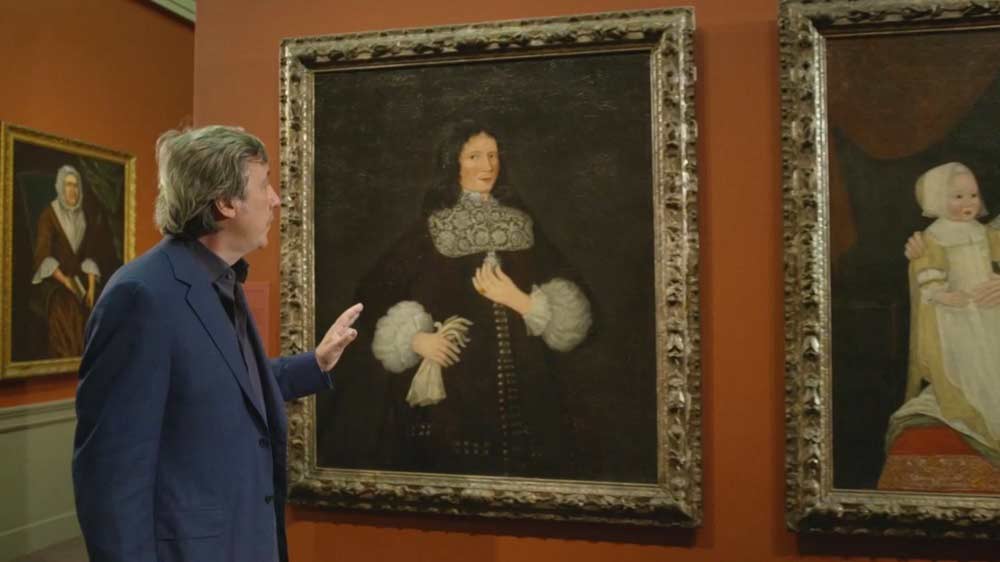
In Art of America episode 1 of a series exploring the history of American art, Andrew Graham-Dixon embarks on an epic journey from east to west, following in the footsteps of the pioneers who built the foundations of modern America.
He also uncovers the paradox at the heart of America: that progress and innovation have come at a tragic price, the destruction of the unique cultural heritage of Native Americans by European settlers. Andrew Graham-Dixon’s journey takes us to the end of the 19th century and the announcement that the era of westward expansion was officially over.
The documentary Art of America episode 1 explores how the story of America is intrinsically linked to the art it has produced. America has always existed as a powerful idea in the human imagination. It was envisioned as a land of new beginnings and endless opportunity. This perception of a vast frontier, waiting to be discovered and settled, was captured and shaped by artists from the very beginning. Every step of the nation’s epic journey, from the clash between humanity and nature to the conflicts between cultures, was documented through art. These images helped forge the American dream, yet they also reflected the more complex truths that lay just beneath the surface.
This journey through art reveals the many ways the modern world took shape in America. It is a story about the nation’s prolonged struggle to define its own identity and find its direction. From the first encounters between Europeans and Native Americans to the closing of the frontier, art served as both a mirror and a tool. It was used to reproduce and sell an idea of America to the world. Consequently, understanding this art provides deep insight into the nation’s foundational myths and the often-unsettling realities of its creation. The art became a battleground of ideas, telling a story of a search for paradise and the profound costs of that pursuit.
The chronicle presented in Art of America episode 1 begins with the earliest European explorers. While people had lived in America for millennia, 16th-century Europeans saw it as a virgin territory. They viewed the land as a barely-occupied wilderness that promised a better life. The first Englishmen to arrive were explicitly looking for a new Eden. To promote this idyllic vision and recruit settlers, they harnessed the persuasive power of art, creating images that would entice others to make the perilous journey across the Atlantic.
This artistic endeavor began in earnest in the summer of 1585. Sir Walter Raleigh sponsored an expedition to Chesapeake Bay, bringing along an official artist named John White. His mission was to document the landscape, its resources, and its people. White produced a series of breathtakingly vivid watercolors of the Algonquian people. He captured their compelling exoticism with a wide-eyed sense of wonder, depicting them as noble inhabitants of a paradise on Earth. These beautiful images were effectively advertisements, successfully recruiting over 100 English settlers, including his own family, to establish a new colony.
However, the dream portrayed in White’s art quickly soured. The reality of colonial life was far from idyllic. The ill-prepared settlers suffered failed harvests, dwindling supplies, and violent skirmishes with the local tribes they had displaced. The colony vanished without a trace, a stark testament to the gap between the artistic promise and the brutal challenges of the New World. Despite this failure, the prospect of a new continent with virgin land remained irresistible. A ferocious scramble for territory ensued, with English, French, Spanish, and Dutch colonists claiming vast territories and pushing the frontier ever westward.
Art of America episode 1
The Art of Colonization and Commerce
America in the 17th century was both a land of opportunity and a place of refuge. Breakaway religious groups, such as the Pilgrims and the Puritan settlers, sought to build their own “New Jerusalem.” The art from this period offers a direct glimpse into the values of these early colonists. Portraits of John and Elizabeth Freake, among the first paintings of settlers, reveal the DNA of both American civilization and its art. John Freake, a Puritan merchant who settled in Boston, is depicted not as a joyless ascetic, but as a man proud of his success. His elaborate lace collar and flourished jewel serve as symbols of his prosperity, puncturing the common stereotype of the austere Puritan.
For these Puritan settlers, material success was not a source of shame. Instead, they viewed it as a tangible mark of God’s providence and favor. This pleasure in worldly success is a cultural trait that has persisted in America. Mrs. Freake’s portrait communicates a similar pride, not only in her jewels and fine clothing but most importantly in her child. An X-ray of the painting reveals that the child was a later addition, painted over a book she originally held. This small figure represents the future, a powerful statement that these settlers and their descendants were here to stay, putting down permanent roots in this new land.
During the first centuries of colonization, American art remained largely provincial. It consisted mainly of portraits that emulated the grand styles of European masters but often fell short. Nonetheless, these paintings are poignant records of the sitters’ status and ambitions. They depict the people who brought their dreams of a spiritual utopia to a new continent. Tragically, they also unwittingly brought deadly European diseases like smallpox and measles. These illnesses decimated the local Indian population, leading to an unintentional genocide through germs that soon became a deliberate colonial practice through the power of the gun.
Sanitizing History in the Art of America
One of the crucial functions of art in colonial America was to act as a cover-up. It helped to construct an official history that glorified the building of new cities while conveniently ignoring the grim reality of how that expansion was achieved. The chief artist of this historical revisionism was Benjamin West. Born in Pennsylvania, West became America’s first internationally famous artist. A brilliant salesman of his own reputation, he invented a new kind of storytelling art that proved profoundly useful to the nation’s founders. His work offered a sanitized version of American history, one that smoothed over the violent and troubling aspects of colonization.
West’s celebrated painting, Penn’s Treaty With The Indians, was created quite literally to frame history. The work depicts the founding of Pennsylvania as a dignified, just, and tolerant affair. On one side stands William Penn, presenting a treaty, while on the other, Native Americans are depicted as a receptive group. West himself said the painting’s subject was the civilization of the savage. He cleverly relegates the actual treaty to the shadows, instead casting a bolt of white cloth, held by a trader, into the light. The composition strongly recalls religious paintings of the adoration of the shepherds at the birth of Christ.
This powerful image became the classic depiction of a bloodless colonization, suggesting that the god of free trade effortlessly transformed “noble savages” into civilized men. However, the painting is a blatant lie. While William Penn may have had peaceful intentions, by the time Benjamin West created the work, colonists and Native Americans were locked in a bitter and brutal war. In one infamous incident, a British representative knowingly handed blankets from a smallpox hospital to Indian leaders during peace negotiations. This early act of germ warfare gives a horribly ironic twist to the bolt of white cloth at the center of West’s painting. Art was used to craft a beautiful lie that masked a violent truth.
Dissenting Voices and the Vanishing Wilderness
As the nation expanded, some artists began to question the official narrative of progress. They lamented the destruction of nature and native cultures that accompanied the relentless push west. The most significant of these dissenting voices was the pioneering artist and naturalist John James Audubon. His great work, The Birds of America, begun in 1827, stands as one of the masterpieces of world art. It was an ambitious attempt to document every bird in America, a project that made him a frontiersman and adventurer in his own right.
Audubon’s genius was his ability to portray birds not as static scientific specimens, but as vivacious, living creatures in their natural habitats. His wild turkey, the first plate in the book, strides with attitude, a character full of life. His birds seem ready to fly right off the page, captured with the immediacy of a wildlife filmmaker. Yet, a deep sense of loss pervades Audubon’s project. He was acutely aware that the westward expansion he witnessed was a destructive force. He spoke of the “murderous white man” and understood that nature itself was being fought into submission. His work is both a celebration of America’s natural paradise and a memorial for a world that was rapidly disappearing.
Another artist who grappled with the cost of progress was the landscape painter Thomas Cole. Born in industrial northern England, Cole emigrated to America and fell in love with the epic wilderness he found in the Catskill Mountains. He saw the untamed American landscape as a manifestation of the sublime, a place to connect with God.
The waterfall became a key symbol in his work, representing the purity of nature in contrast to the polluted rivers of America’s growing cities. Yet his paintings are also full of disquiet. Dark skies, blasted trees, and the lone figure of an Indian—the “last of the Mohicans”—all signal his awareness that this sublime beauty was under threat from what he called the “iron tramp of progress.”
Cole’s fears culminated in his epic five-painting series, The Course of Empire. While ostensibly charting the rise and fall of a classical civilization, the series is a thinly veiled allegory for the destiny of America. It moves from a primitive world of hunter-gatherers, visually linked to Native American life, to a decadent, corrupt, and overcrowded imperial city that parodies the America of his day. His vision of destruction is not just a warning but a fantasy of the land being swept clean, of nature reclaiming its dominion from man. For Thomas Cole, this was the true climax—a world returned to a state of desolate, natural purity.
A Nation Forged and Fractured in Art
The divisions that John James Audubon and Thomas Cole feared ultimately tore the nation apart, though not in the way they imagined. The long-festering wound of slavery in the South led to the American Civil War in 1861. This conflict, which claimed over 600,000 American lives, was documented with brutal clarity by the new medium of photography. But the lingering bitterness of the war also found expression in a more intimate and revealing art form: the American flag. As a collector and expert explains, early flags were a form of individualistic expression, with makers arranging the stars in any “new constellation” they chose.
This folk art provides a unique window into the nation’s psyche during its most trying period. Abraham Lincoln had specifically instructed Northerners not to remove the stars representing the seceded Southern states from the flag, as a symbol that the union was perpetual. However, some flag-makers defied this. So-called “Southern-exclusionary” flags, with only 20 stars instead of 34, became powerful expressions of outrage and loss.
They are tangible records of a patriot, perhaps a mother who had lost a son, declaring that the Southern states were out of the union for good. Conversely, other flags from the post-war period subtly hide the “Southern Cross” of the Confederate battle flag within the official Stars and Stripes, a defiant, coded message of enduring Southern identity. These flags embody the violence of the conflict, acting as a rebel yell in textile form.
The Canvas of Truth: What American Art Reveals About Our National Soul
The journey through America’s artistic evolution in this first episode reveals a profound and unsettling truth: from the very beginning, American art has served as both mirror and mask, simultaneously revealing and concealing the nation’s deepest contradictions. John White’s enchanting watercolors promised paradise while colonists starved; Benjamin West’s dignified treaty scenes masked genocide; Thomas Cole’s sublime landscapes mourned a wilderness already under assault. This isn’t just art history—it’s the story of how America learned to live with its own mythology.
What emerges most powerfully is art’s role as America’s great reconciler of irreconcilable truths. How do you celebrate progress while acknowledging its victims? How do you build a national identity on both opportunity and tragedy? The answer, as these artists discovered, lies in the extraordinary power of images to hold multiple realities simultaneously. Audubon could capture both the magnificence of American wildlife and his heartbreak at its destruction. Civil War-era flag makers could embed both union and rebellion in the same stars and stripes.
This artistic legacy speaks directly to our contemporary moment, when America continues grappling with the gap between its highest ideals and its historical actions. The sanitized narratives that Benjamin West pioneered—where complex, often brutal realities get smoothed into digestible national stories—remain a powerful force in how we understand everything from Thanksgiving to westward expansion. Yet the dissenting voices of artists like Cole and Audubon remind us that there have always been those willing to document uncomfortable truths alongside celebrated myths.
Perhaps most remarkably, these early American artists anticipated our modern understanding that all representation is political. They knew they weren’t just painting birds or landscapes or historical scenes—they were painting America itself into existence. Every brushstroke was a vote for what the nation should remember, celebrate, or forget.
As we navigate our own era of contested narratives and competing visions of American identity, the artists in this episode offer both warning and wisdom. They show us how seductive it can be to let beautiful lies obscure difficult truths, but they also demonstrate art’s unique power to preserve what might otherwise be lost to progress or propaganda. Their legacy suggests that the most honest American art has always done both: celebrated the dream while mourning the cost.
The next time you encounter an image of America—whether in a museum, a textbook, or on social media—ask yourself what John White or Benjamin West or Thomas Cole might have asked: What story is this telling? What story is it hiding? And perhaps most importantly: What responsibility do we have to see both?
FAQ Art of America episode 1
Q: What is Art of America episode 1 about?
A: Art of America episode 1 explores how American art documented the nation’s westward expansion from the 16th century through the Civil War. Additionally, it reveals the paradox that progress came at the tragic cost of Native American cultural destruction. The episode examines how artists shaped America’s self-image while both celebrating and mourning the consequences of colonization.
Q: Who was John White and why was he significant to early American colonial art?
A: John White was the official artist on Sir Walter Raleigh’s 1585 expedition to Chesapeake Bay. Furthermore, his breathtaking watercolors of Algonquian people served as effective advertisements for colonization, successfully recruiting over 100 English settlers. However, his idyllic depictions contrasted sharply with the harsh realities that ultimately led to the colony’s mysterious disappearance.
Q: How did art function as propaganda during American colonization?
A: Colonial art primarily promoted America as a paradise to entice European settlement. Moreover, artists like John White created compelling images that portrayed Native Americans as noble inhabitants of Eden. Subsequently, these artistic representations became powerful recruitment tools, though they often masked the brutal realities of colonial life and the devastating impact on indigenous populations.
Q: What do Puritan portraits reveal about early American values?
A: Puritan portraits, particularly those of John and Elizabeth Freake, demonstrate that material success was viewed as God’s favor rather than vanity. Notably, John Freake’s elaborate lace collar and jewels symbolized prosperity, contradicting stereotypes of austere Puritans. Elizabeth’s portrait originally featured a book, later painted over with a child, emphasizing the settlers’ commitment to permanent American roots.
Q: Why is Benjamin West considered America’s first internationally famous artist?
A: Benjamin West, born in Pennsylvania, gained international recognition by inventing a new storytelling art style that served national interests. Specifically, his sanitized historical paintings like Penn’s Treaty with the Indians provided digestible narratives for America’s founders. Consequently, West’s work successfully framed American history while conveniently obscuring violent colonization realities through beautiful artistic lies.
Q: What makes Penn’s Treaty with the Indians historically problematic?
A: West’s painting depicts Pennsylvania’s founding as peaceful and dignified, yet it’s fundamentally dishonest. Indeed, by the time West created this work, colonists and Native Americans were engaged in brutal warfare. Furthermore, the prominent white cloth in the painting gains horrific irony considering British representatives knowingly distributed smallpox-infected blankets to Indian leaders during supposed peace negotiations.
Q: What distinguished John James Audubon’s approach to wildlife art?
A: Audubon revolutionized wildlife art by portraying birds as vivacious, living creatures rather than static scientific specimens. Additionally, his Birds of America captured subjects with the immediacy of wildlife filmmaking, making them appear ready to fly off the page. Nevertheless, his work carries profound melancholy, as Audubon understood that westward expansion was destroying the natural paradise he documented.
Q: What was the message behind Thomas Cole’s Course of Empire series?
A: Cole’s five-painting series serves as a thinly veiled allegory for America’s potential destiny, moving from primitive hunter-gatherer societies to decadent imperial corruption. Moreover, the series culminates in destruction and nature’s reclamation of civilization. Essentially, Cole viewed this apocalyptic cleansing as the true climax—a fantasy of the land returning to desolate, natural purity away from human progress.
Q: How did Civil War-era flag art reflect national divisions?
A: Civil War flags became powerful expressions of individual patriotic sentiment and regional identity. Specifically, Southern-exclusionary flags with only 20 stars instead of 34 expressed outrage over secession, possibly made by mothers who lost sons. Conversely, post-war flags cleverly hid Confederate symbols within official Stars and Stripes, creating coded messages of enduring Southern identity and defiance.
Q: What does early American art teach us about national mythology?
A: Early American art demonstrates how nations construct identities through simultaneous revelation and concealment of truth. Furthermore, artists like West created beautiful lies that masked violence, while others like Audubon and Cole documented uncomfortable realities alongside celebrated myths. Ultimately, this artistic legacy reveals that the most honest American art has always celebrated dreams while mourning their costs, showing art’s political power in shaping collective memory.