The documentary Secrets of Bones episode 4 reveals that the skeleton does far more than provide structure; it is a masterclass in evolutionary engineering that allows animals to perceive their environment. While bones offer fundamental support and strength, their deeper story is one of sensory adaptation. The skull, in particular, has evolved from a simple protective case for the brain into a sophisticated sensory hub. It houses the complex organs of sight, hearing, and smell, with the very shape and structure of its bones dictating how an animal experiences the world around it. This process of adaptation is a critical theme in understanding the diversity of life.
The skull’s role as a sensory center is one of the most compelling narratives in the study of vertebrates. The placement, size, and even the internal structure of cranial bones can reveal an animal’s lifestyle, from its hunting strategy to its methods of avoiding predation. These bony adaptations are so distinct that an expert can deduce an animal’s primary senses and survival tactics just by examining its skull. The journey into the Secrets of Bones shows how this single bony blueprint has been modified over millennia to produce an incredible array of sensory abilities across the animal kingdom.
This exploration delves into the remarkable ways different animals have evolved to see, hear, and smell. We will investigate how specific modifications to the skeleton have resulted in extraordinary sensory capabilities. For instance, the position of eye sockets distinguishes predator from prey, while the internal architecture of the nose can grant a sense of smell powerful enough to detect prey from kilometres away. Moreover, some animals have developed senses that seem almost supernatural, all thanks to unique features within their bones.
The fundamental framework for these abilities is the skeleton, a unifying feature among all vertebrates, from fish to mammals. This internal scaffold is the platform upon which evolution has built countless solutions for survival. The intricate relationship between an animal’s bones and its ability to interact with the environment is a cornerstone of evolutionary biology. Understanding this connection provides profound insights into the pressures that have shaped life on Earth. Consequently, every curve, opening, and process on a bone tells a part of this grand story of survival and evolution.
The transition from a simple protective structure to a complex sensory apparatus is a testament to the power of natural selection. The challenges of finding food, avoiding enemies, and navigating complex habitats have driven the development of specialized sensory systems. As we will see, these systems are not merely soft tissue phenomena; they are intrinsically linked to the underlying bony framework. The ways in which the skeleton facilitates sight, hearing, and smell offer clear examples of this deep integration. The movement and function of these animals are directly tied to these sensory enhancements.
The sense of sight, for many animals, is paramount, and this importance is etched into their skulls. The orbits, or eye sockets, do more than just house and protect the delicate eyes. Their placement on the skull is a critical adaptation that reflects an animal’s position in the food chain. This distinction creates an evolutionary trade-off, where each side strives to out-compete the other for survival. The ongoing development of these features highlights a key aspect of natural evolution.
Secrets of Bones episode 4
The Architecture of Vision
The placement of eye sockets offers immediate clues about an animal’s life. In prey animals, such as the sheep, the eye sockets are situated on the sides of the head. This arrangement provides an expansive field of view, granting them nearly 360-degree peripheral vision. Such a wide vantage point is essential for an animal that spends much of its time with its head down grazing, as it allows for the early detection of predators approaching from almost any direction. This adaptation is a direct response to the constant threat of being hunted.
Conversely, predators like the wolf possess forward-facing eyes. This configuration creates a significant overlap in the fields of vision of each eye, resulting in superior stereoscopic vision. This binocular vision provides excellent depth perception, which is crucial for accurately judging the distance to prey during a hunt. A wolf does not need to see what is sneaking up behind it; its survival depends on its ability to precisely locate and pursue what is in front of it. This clear division in visual strategy is a recurring pattern throughout the animal kingdom.
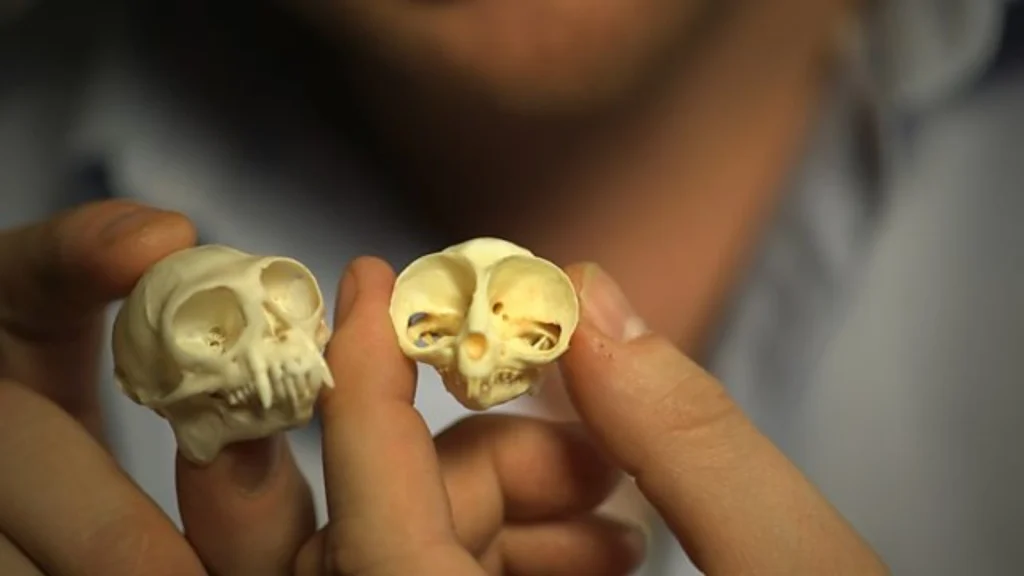
The size of the eye sockets also reveals vital information, particularly about when and where an animal is active. The tarsier, a small nocturnal primate, possesses enormous orbits relative to its body size. These huge sockets house massive eyes that can gather the maximum amount of light, enabling the tarsier to hunt effectively in the dark. In fact, each of a tarsier’s eyes is larger than its brain. However, these colossal eyes are so large they cannot move within their sockets. To compensate, the tarsier has a remarkable adaptation in its spine, with specialized neck vertebrae that allow it to rotate its head almost 180 degrees in either direction, much like an owl.
Secrets of Bones episode 4: The Symphony of Sound
Hearing is another sense intricately shaped by the skeleton. The great grey owl, for instance, has hearing so precise it can detect a mouse moving under half a metre of snow from over ten metres away. This incredible ability is partly due to its wide, circular facial disc, which acts like a satellite dish to funnel sound towards its ear openings. However, the true secret to its auditory prowess lies in the asymmetry of its skull. One ear opening is positioned slightly higher than the other, an adaptation that allows the owl to pinpoint not only the direction but also the height of a sound with astonishing accuracy.
Within the inner ear, the role of bones becomes even more fundamental. Most vertebrates would hear very little without the help of tiny ear bones called ossicles. As sound waves enter the ear, most of their energy would be reflected away if not for these structures. Mammals possess three ossicles: the malleus, incus, and stapes. These are the smallest bones in the human body. They form a vibrating chain that transmits and amplifies sound waves, converting a small force at the eardrum into a larger force in the inner ear.
The composition of these bones is also unique. They are extremely rich in minerals, making them very hard and dense. This rigidity allows them to conduct sound perfectly, a property that would be disastrous in a weight-bearing bone like the femur, which requires more flexibility. This specialized composition, combined with the lever system of the three ossicles, creates an exceptionally efficient hearing system. This is a key example of how the evolution of bones has enhanced the senses of many animals.
The Intricate World of Scent and the Secrets of Bones episode 4
The sense of smell is also profoundly connected to the bony structures within the skull. The positioning of nostrils offers clues, as seen in the kiwi, the only bird with nostrils at the very tip of its long beak. Being nocturnal and virtually blind, the kiwi relies on smell to find food. It taps the ground with its beak, sniffing for earthworms and insects hidden up to 15cm deep in the soil. This unique adaptation allows it to “see” its world through scent.
In other animals, the internal structure of the nasal cavity reveals an even more sophisticated system. The polar bear, for example, has a sense of smell estimated to be 100 times greater than a human’s. This is due to a delicate, honeycomb-like bony structure inside its long muzzle called turbinates. These bones create a massive surface area covered in sensory cells. The intricate system of turbinates warms the frigid arctic air while channelling it over these cells, allowing the polar bear to detect a seal from over a kilometre away.
Perhaps the most bizarre adaptation for smell belongs to the Hispaniolan solenodon, a rare mammal that diverged from other mammals during the age of the dinosaurs. X-rays reveal a unique feature in its elongated snout: an extra bone called an os proboscis, or nose bone. This bone forms a ball-and-socket joint at the tip of the snout, providing both support and incredible flexibility. This allows the solenodon to use its nose for complex movement, constantly twitching and probing crevices for insects, a perfect example of how the skeleton can evolve in unique ways.
Beyond the Five Senses: Echolocation
Some animals use their skeleton to harness senses that go beyond the traditional five. The sperm whale, the largest of the toothed whales and the deepest diving mammal, navigates and hunts in the pitch-black depths using echolocation. Its massive head contains a specialized oil called spermaceti. The whale produces a series of powerful clicks at the front of its head, which are then focused by a concave, dish-like part of its skull. These clicks, the loudest sounds produced by any animal, travel for kilometres.
When the sound waves bounce off an object, the echoes return not to the whale’s forehead, but to its lower jaw. The jawbone of these vertebrates has evolved to have a long, grooved channel filled with a fatty, jelly-like substance. This channel picks up the returning echoes and transmits them through the jaw to the inner ear, allowing the brain to build a three-dimensional “sound picture” of the environment.
This system is made even more effective by another skeletal adaptation in the whale’s spine. Like most mammals, sperm whales have seven neck vertebrae. However, most of these are fused into a single, large bone. This fusion holds the massive head completely rigid, ensuring the sensitive echolocation system remains stable. This prevents any wobbly movement from interfering with the precise reception of echoes. In effect, the sperm whale’s skeleton turns it into a 40-tonne, swimming radar gun, showcasing a masterful combination of adaptations.
Nature’s Masterpiece: Where Engineering Meets Evolution
Standing before the intricate architecture of animal skeletons, we witness evolution’s most elegant engineering solutions—blueprints refined over millions of years to solve the fundamental challenge of survival. The story revealed in “Secrets of Bones” isn’t just about how animals see, hear, and smell; it’s about how life itself has transformed constraints into advantages, turning the simple framework of bone into sophisticated sensory machinery that would make our most advanced technologies seem primitive by comparison.
Consider the remarkable efficiency at work here: a polar bear’s turbinates create a surface area so vast it can detect prey from over a kilometer away, while occupying mere centimeters within the skull. The sperm whale’s jaw has become a living acoustic antenna, transforming the ocean’s darkness into a detailed three-dimensional map. These aren’t accidents—they’re masterclasses in optimization, where every curve, every hollow, every joint serves multiple purposes with breathtaking precision.
What emerges from this exploration is a profound realization about the nature of evolutionary adaptation. The traditional boundaries between structure and function dissolve when we see how a tarsier’s inability to move its enormous eyes led to extraordinary neck flexibility, or how an owl’s asymmetrical skull creates pinpoint acoustic accuracy. Evolution doesn’t just solve problems—it finds elegant solutions that often accomplish multiple goals simultaneously, turning apparent limitations into distinctive advantages.
These natural innovations offer more than scientific fascination; they provide a roadmap for human ingenuity. As we face our own challenges in robotics, architecture, and sensory technology, the animal kingdom presents time-tested solutions that have withstood millions of years of real-world testing. The whale’s echolocation system could revolutionize underwater navigation, while the structural principles behind a bird’s lightweight yet strong skull might transform aerospace design.
Perhaps most remarkably, these adaptations remind us that specialization comes with trade-offs that reveal deeper truths about survival and success. Predators sacrifice peripheral vision for depth perception, nocturnal hunters develop oversized sensory organs at the expense of mobility, and deep-sea mammals fuse their spines to maintain acoustic precision. Each choice represents an evolutionary bet, a commitment to a particular way of engaging with the world.
The skeleton, far from being just the body’s scaffolding, emerges as evolution’s most versatile platform—a foundation upon which countless sensory solutions have been built. Every skull tells a story of environmental pressures, survival strategies, and the relentless drive of natural selection to find better ways of perceiving and interacting with the world.
As we continue to unravel these biological mysteries, we’re not just learning about animals—we’re discovering principles that could reshape how we approach our own technological and design challenges. The next time you encounter an animal, remember that its skeleton isn’t just supporting its body; it’s housing millions of years of evolutionary innovation, waiting to inspire the next breakthrough in human understanding and capability.
FAQ Secrets of Bones episode 4
Q: What role do bones play in animal senses beyond just structure?
A: Animal skeletons function as sophisticated sensory platforms that go far beyond simple structural support. Evolution has transformed bones into complex sensory machinery, with skull modifications dictating how animals see, hear, and smell. Furthermore, specific bone shapes and positions reveal an animal’s lifestyle, hunting strategies, and survival tactics, making the skeleton a masterclass in evolutionary engineering.
Q: How do eye socket positions reveal whether an animal is a predator or prey?
A: Eye socket placement immediately indicates an animal’s ecological role. Prey animals like sheep have side-positioned eye sockets, providing nearly 360-degree peripheral vision for detecting approaching predators. Conversely, predators such as wolves possess forward-facing eyes that create overlapping fields of vision, resulting in superior depth perception crucial for accurately judging distances during hunts.
Q: Why do some nocturnal animals have such large eyes?
A: Nocturnal animals develop oversized eyes to maximize light-gathering capabilities in dark environments. The tarsier exemplifies this adaptation, with each eye larger than its brain, housed in enormous orbital sockets. However, these massive eyes cannot move within their sockets, requiring specialized neck vertebrae that allow 180-degree head rotation to compensate for this limitation.
Q: How do owls achieve such precise hearing abilities?
A: Great grey owls demonstrate extraordinary auditory precision through skeletal adaptations, detecting mice under half a meter of snow from over ten meters away. Their circular facial disc funnels sound like a satellite dish, while asymmetrical skull construction positions one ear opening higher than the other, enabling pinpoint accuracy in determining both direction and height of sounds.
Q: What are ossicles and why are they important for hearing?
A: Ossicles are three tiny ear bones—the malleus, incus, and stapes—that form a vibrating chain transmitting sound waves. These mineral-rich structures convert small eardrum forces into larger inner ear forces, amplifying sound effectively. Additionally, their specialized rigid composition allows perfect sound conduction, contrasting with flexible weight-bearing bones that require different mechanical properties.
Q: How do polar bears use their skull structure for superior smell?
A: Polar bears possess honeycomb-like bony structures called turbinates within their elongated muzzles, creating massive surface areas covered in sensory cells. These intricate bone formations warm frigid Arctic air while channeling it over smell receptors, enabling polar bears to detect seals from over a kilometer away with smell capabilities 100 times greater than humans.
Q: What makes the kiwi bird’s sense of smell unique among birds?
A: The kiwi represents the only bird species with nostrils positioned at the very tip of its long beak, reflecting its unique ecological niche. Being nocturnal and virtually blind, kiwis rely entirely on smell to locate food, tapping the ground and sniffing for earthworms and insects buried up to 15 centimeters deep in soil.
Q: How do sperm whales use echolocation through their skeleton?
A: Sperm whales transform their skeleton into a 40-tonne swimming radar system through remarkable adaptations. Their concave skull focuses powerful clicks, while their jawbone contains grooved channels filled with fatty substances that pick up returning echoes. Furthermore, fused neck vertebrae hold the massive head rigid, preventing movement from interfering with precise echo reception.
Q: What evolutionary trade-offs do animals make for specialized senses?
A: Evolutionary specialization requires significant compromises that reveal survival priorities. Predators sacrifice peripheral vision for enhanced depth perception, nocturnal hunters develop oversized sensory organs at mobility’s expense, and deep-sea mammals fuse spinal structures to maintain acoustic precision. Each adaptation represents an evolutionary commitment to specific environmental engagement strategies.
Q: How can understanding animal skeletal adaptations inspire human technology?
A: Animal skeletal innovations provide time-tested solutions for modern technological challenges, having withstood millions of years of real-world testing. Whale echolocation systems could revolutionize underwater navigation, while bird skull structural principles might transform aerospace design. These biological blueprints offer optimization strategies that make current human technologies seem primitive by comparison.