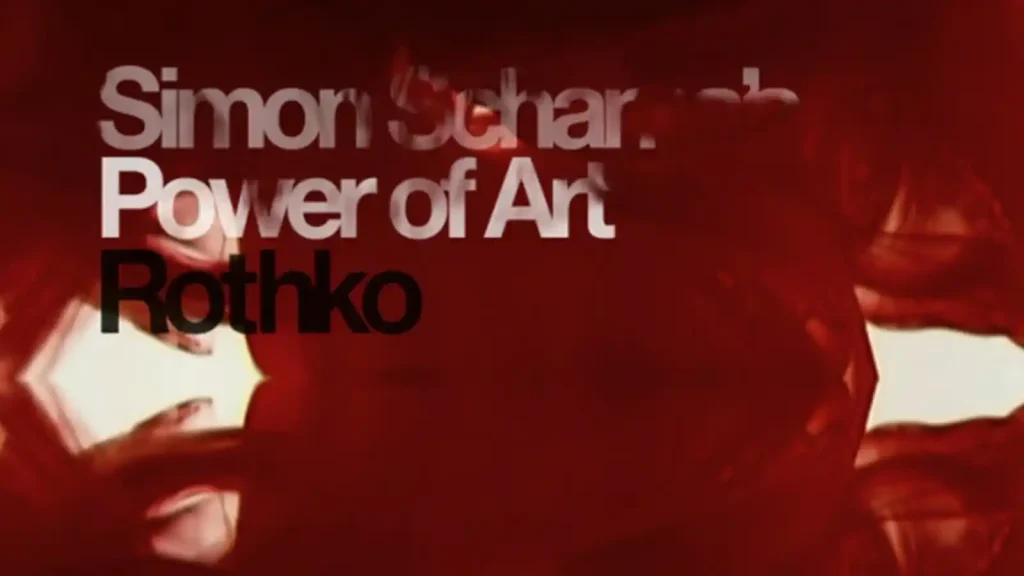
In Power of Art episode 8 –, Simon Schama delivers a profound meditation on the life and work of Mark Rothko, an artist whose mission was not simply to paint, but to wrestle with the meaning of existence through color, scale, and silence. Rothko did not believe in decoration or passive beauty. Instead, he believed painting should be a tragic performance, capable of stirring the deepest human emotions—tragedy, ecstasy, and despair. This episode guides viewers through Rothko’s lifelong pursuit of a new visual language, one that could cut through the noise of modern life and reach the human soul.
In today’s world, saturated with spectacle and surface, Rothko’s ideas remain urgently relevant. His rejection of figurative art was not an act of rebellion but a necessity. As Simon Schama explains, Rothko believed that traditional forms could no longer express the horrors and hopes of the 20th century. After Auschwitz and Hiroshima, after decades of alienation and violence, only abstraction could do justice to the enormity of human tragedy. His paintings invite us not to observe, but to feel—to be immersed in silence, solitude, and mystery. That’s why Rothko’s art is not just history; it’s a mirror held up to our own time.
This article explores the central themes in Power of Art episode 8 –: Rothko’s biography, his philosophical convictions, his struggle with artistic identity, and the monumental commission that led to one of the greatest confrontations between art and capitalism in the 20th century. From his early years as an immigrant in New York to his tragic death, Rothko’s life was a slow-burning conflict between the purity of vision and the seductions of success.
Rothko was born Markus Rothkowitz in Dvinsk, Russia, in 1903. His Jewish family immigrated to the United States to escape persecution, carrying with them not wealth, but culture. Rothko grew up poor in Portland, Oregon, reading voraciously, attending Hebrew school, and absorbing the Russian literary canon. He eventually won a scholarship to Yale, but dropped out, disillusioned by the university’s antisemitic climate. This early encounter with exclusion and identity shaped Rothko’s sense of mission—he would not be content to imitate old masters, but instead sought to create a new form that could speak across time, class, and culture.
After moving to New York in the 1920s, Rothko explored figurative art, drawing inspiration from urban life, subway commuters, and biblical mythology. His early works, full of dark tones and thick lines, reflected alienation and despair. But even in these formative pieces, color already began to act as a protagonist—alive, emotive, and symbolic. Over decades, Rothko refined his visual vocabulary, evolving from surrealism to color fields, and finally into the vast, glowing canvases that became his signature.
Power of Art episode 8 – Rothko
Rothko’s Artistic Philosophy and Emotional Language
Rothko did not paint pictures; he painted experiences. He once said, “I’m interested only in expressing basic human emotions—tragedy, ecstasy, doom.” For Rothko, the canvas was not a window but a threshold—an entrance into an “unknown adventure into an unknown space.” He likened the viewer’s relationship with his work to spiritual encounter: intimate, unsettling, and overwhelming.
His paintings are deceptively simple—large vertical canvases of stacked colors—but their power lies in their effect. When placed in dim lighting and hung low on gallery walls, the works seem to pulse, breathe, and shimmer. They draw the viewer inward, creating an experience that is less visual and more visceral. This immersive quality is where Rothko departs from many contemporaries. While Pop Art celebrated irony and consumerism, Rothko demanded sincerity, solemnity, and soul.
Simon Schama emphasizes that Rothko never saw his art as psychological or mystical. Instead, he saw it as profoundly worldly. His work wrestled with human suffering, cultural collapse, and the quest for meaning. He wanted art to be a moral force, not an ornament.
The Seagram Murals and Rothko’s Ultimate Rejection
In 1958, Rothko was commissioned to create a series of paintings for the Four Seasons restaurant in Manhattan’s Seagram Building—a monument to modernist architecture and corporate power. The commission was lucrative, offering him $35,000 (equivalent to $2.5 million today), and it was the largest project he had ever undertaken.
Initially, Rothko saw this as an opportunity not to conform, but to challenge. He envisioned the restaurant as a temple of wealth and excess—and planned to subvert it from within. His goal was to create a space so emotionally heavy, so spiritually oppressive, that diners would lose their appetites. Inspired by Michelangelo’s Medici Library in Florence, he sought to produce the same claustrophobic effect: viewers would feel trapped, entombed, and forced into confrontation with themselves.
The resulting Seagram Murals are among Rothko’s most powerful works. With blood reds, deep maroons, and pulsing blacks, the paintings feel like rituals—simultaneously inviting and forbidding. They suggest walls, veils, and tombs. Rothko wanted them to evoke what he called “tragic grandeur,” a sublime weight that could only be felt in the body.
But after visiting the Four Seasons himself, surrounded by wealthy patrons feasting on lobster thermidor and truffled sole, Rothko withdrew. He refused to let the paintings hang in a place so antithetical to his values. He returned the money and reclaimed the artworks. This act of defiance wasn’t just principled—it was existential. In that moment, Rothko made it clear: his art was not for the marketplace. It was for humanity.
The Final Years and the Search for a Sacred Space
After walking away from the Seagram commission, Rothko spent the rest of his life trying to find a setting worthy of his vision. He desired a place of quiet contemplation, a “chapel of expiation” where his paintings could become a spiritual environment. That vision was finally realized in Houston, Texas, when the de Menil family commissioned him to create murals for a non-denominational chapel.
The Rothko Chapel is both culmination and epitaph. Composed of fourteen monumental black-hued paintings, it abandons the glowing colors of his earlier work for an oppressive, inky void. It’s a place of stillness, not celebration—a tomb, not a gallery. The light is dim, the atmosphere solemn. Rothko had painted to the edge of darkness, to see how deep he could go without extinguishing the flame altogether.
In the Rothko Chapel, the viewer becomes a participant in mourning, reflection, and transcendence. There is no pulpit, no altar—only the paintings. They do not depict; they envelop. And it was here, more than anywhere else, that Rothko found the space he had dreamed of: his space.
Rothko’s Legacy in Modern Art and Human Feeling
What Rothko achieved in his later years was a visual language capable of articulating the unspeakable. His colors became performers, his canvases, stages for human emotion. Critics compared his work to that of Rembrandt and Turner—not in form, but in impact. Rothko’s paintings emanate presence. They linger in the mind, echo in memory, and haunt the viewer like a song without words.
In Power of Art episode 8 –, Simon Schama reminds us that Rothko painted not for connoisseurs or curators, but for people. He wanted his work to be felt, not analyzed. In an age increasingly defined by distraction and disposability, Rothko’s insistence on depth, silence, and sorrow feels radical once again. His art was not meant to soothe, but to awaken.
By refusing to compromise with fashion or finance, Rothko preserved the integrity of his vision. He left behind not just paintings, but portals—gateways to the eternal questions: Who are we? Why do we suffer? Can we be redeemed?
Rothko’s final paintings, with their darkened hues and luminous edges, seem to divide light from shadow as if reenacting the act of creation itself.
The Search for a New Language: From Alienation to Abstraction
A breakthrough came in the late 1930s with his Subway Series. These paintings captured the “bleak alienation” of modern urban life, creating a “clammy sensation of doom” that resonated with the existential dread of T.S. Eliot’s The Waste Land. The attenuated, faceless figures are less important than the architectural space they inhabit. The mournful rows of columns and receding tracks create a visual grammar of confinement and anonymity, a kind of purgatory on the uptown D train.
It was here that Rothko made a pivotal discovery: the “real action,” he realized, was happening with the colors themselves. A brilliant crimson smear on a platform edge was not just a detail; it was a “performer,” an active agent of emotion. This was the conceptual seed of his mature work—the idea that architecture and color could convey feeling more powerfully than any figure.
However, to fully realize this vision, Rothko had to demolish the old language of art completely. After World War II, a cataclysm that he believed rendered figurative painting morally untenable, he and his contemporaries felt it was impossible to continue painting reclining nudes and flowers in a “world in shambles”. Inspired by the example of European surrealists and the work of Henri Matisse, whose
Red Studio he saw in 1949, Rothko began to liberate color from objects entirely. Around 1947, he abandoned all mythic and surrealist imagery, entering a transitional phase that critics later dubbed his “multiforms”. These canvases feature hazy, dissolving patches of color that “swell and seep,” like layers of colored cloud. This was a necessary act of deconstruction. He was pulverizing the familiar to “destroy the finite associations,” breaking down the conventions of Western painting to their elemental components of color and feeling.
The Philosophy of Feeling: Tragedy, Music, and the Sublime
From the primordial chaos of the multiforms, a new and highly disciplined language emerged by 1949. This was Rothko’s classic format: large vertical canvases dominated by stacked, rectangular forms of luminous color. These were not simple compositions. They were the result of a sophisticated technique involving complex, self-mixed binders like rabbit-skin glue and egg, with pigments thinned and applied in dozens of translucent layers to achieve a unique, inner glow. The soft, feathered edges of these rectangles were essential, making the forms appear to breathe and rendering the entire surface porous, as if it were a veil between worlds.
This new language was in service of a profound philosophical goal. Rothko was a voracious reader, deeply influenced by Friedrich Nietzsche’s The Birth of Tragedy. He saw his work as a stage for the conflict between the Apollonian—the principle of order, reason, and form—and the Dionysian—the principle of chaos, intoxication, and tragedy.
The serene, rectangular structure of his paintings provided the Apollonian container for the violent, ecstatic, and tragic Dionysian emotions he sought to unleash in the viewer. He declared his aim was to express “basic human emotions—tragedy, ecstasy, doom,” and was furious when his work was dismissed as merely decorative. To call his paintings “beautiful” was to see only the container and miss the tempest sealed within.
Music, especially that of Mozart, provided another crucial model. Rothko, who often worked while listening to Mozart, saw a parallel between the composer’s ability to convey deep tragedy through the purest, most transparent forms and his own artistic aims. Music offered a blueprint for direct emotional communication, unburdened by literal representation. His layered glazes of color function like musical harmony and resonance, creating a visual experience that, like music, aims to bypass the intellect and speak directly to the soul.
The ultimate goal of this meticulously engineered art was to provoke an experience of the sublime—a feeling of awe, grandeur, and even terror that overwhelms the viewer. This was not the Romantic sublime of vast, external landscapes, but an internal one: a confrontation with the awesome and terrifying depths of human consciousness. Rothko controlled every aspect of the encounter to achieve this. He insisted on low lighting and an intimate viewing distance of just 18 inches, wanting his large canvases to engulf the viewer’s field of vision and create a state of total immersion. His paintings were machines for producing a cathartic, quasi-religious experience, modern icons for a secular age.
A Battle for the Soul of Art: The Power of Art episode 8 and the Seagram Murals
In 1958, Rothko’s principles faced their greatest test. He accepted a commission for $35,000—a fortune at the time—to create a series of murals for the Four Seasons restaurant, located in the newly completed Seagram Building on Park Avenue. The context was the apex of corporate modernism. The building, designed by Ludwig Mies van der Rohe, was a celebrated bronze-and-glass tower, and the restaurant, designed by Philip Johnson, was an opulent showcase of modernist luxury. This set the stage for an ideological clash. Rothko, the anti-capitalist outsider, was being invited into the inner sanctum of the establishment he had long mistrusted.
He approached the project not as a decorator, but as a warrior. He described the commission as a “gladiatorial contest—Mark versus Manhattan” and confessed to having “strictly malicious intentions”. He hoped his paintings would “ruin the appetite of every son of a bitch who ever eats in that room”. Taking inspiration from Michelangelo’s oppressive Laurentian Library in Florence, he aimed to make the diners feel “trapped in a room where all the doors and windows are bricked up”. He switched his compositions to a horizontal format, creating dark, heavy, column-like forms in a palette of deep maroons and reds, designed to loom over the diners and “swallow the swallowers”.
After months of intense work, Rothko and his wife went to dine at the Four Seasons. He was utterly repulsed by the ostentatious wealth and what he perceived as the shallow vanity of the clientele. His heart sank. He concluded, “Anybody who will eat that kind of food for that kind of money will never look at a painting of mine”. The next morning, he cancelled the contract, returned the entire fee, and withdrew his paintings.
This act was one of the most significant statements on artistic integrity in the 20th century. It was a costly, public refusal to allow his art to become, as he feared, mere “interior decoration for the rich”. He had shrewdly included a clause in his contract allowing him to retain the
paintings if the project went sour, suggesting he anticipated this moral showdown from the beginning. The murals he had created to be instruments of discomfort would not hang in a temple of commerce. A group of them would eventually find their home in London’s Tate Gallery, fulfilling his desire for them to exist in a contemplative, public space.
The Final Act: The Houston Chapel and the Power of Art episode 8’s Legacy
The final decade of Rothko’s life was a descent. He struggled profoundly with depression and alcoholism, his health deteriorated, and his marriage collapsed. His work mirrored this inner turmoil, the palette shifting from vibrant hues to somber, intense blacks, browns, and grays. He felt increasingly isolated as the art world turned toward Pop Art, a movement he saw as a frivolous accomplice to the consumer culture he despised. His dark paintings were not just a stylistic choice; they were direct, unflinching expressions of his psychological state.
In 1965, he was given one last chance to realize his grand ambition of creating a total environment. Patrons John and Dominique de Menil commissioned him to create a series of murals for a non-denominational chapel in Houston. Rothko had significant control over the architecture, insisting on an octagonal shape to fully immerse the viewer in his vision. The fourteen resulting paintings are overwhelmingly dark, enveloping the visitor in a space that has been described as both a “tomb” and a sanctuary of profound peace.
The Rothko Chapel is the artist’s ultimate, ambiguous statement. It embodies his core belief that the path to the sublime leads directly through tragedy and darkness. It is not a comforting space but a demanding one, forcing a confrontation with silence and the self. It is the culmination of a life spent in pursuit of an art that could hold the full, terrible, and ecstatic weight of the human condition.
The Courage to Choose Depth in a Surface World
Rothko’s story reads like a parable for our times—a cautionary tale about what we risk losing when we mistake visibility for value, when we confuse the marketplace with meaning. In our current era of algorithmic feeds and instant gratification, his radical commitment to slowness, silence, and spiritual weight feels almost subversive. Here was an artist who walked away from millions rather than let his life’s work become expensive wallpaper for the wealthy, who understood that true power lies not in reaching everyone, but in reaching someone deeply.
The Seagram commission rejection stands as one of art history’s most profound acts of integrity. It wasn’t just about money—it was about purpose. Rothko recognized that context is content, that a painting’s environment shapes its soul. His murals weren’t meant to accompany conversations about stock portfolios over champagne; they were designed to stop conversation altogether, to create the kind of hushed reverence we reserve for sacred spaces. In refusing to let his work serve as sophisticated decoration, Rothko preserved something increasingly rare: art that demands we pause, breathe, and confront ourselves.
This confrontation with the self is perhaps what makes Rothko’s legacy so enduring and necessary. In a world drowning in content, his paintings offer something different—not information, but transformation. They don’t explain; they experience. They don’t argue; they envelop. Standing before a genuine Rothko, you understand why he insisted on specific lighting, precise hanging heights, and intimate viewing distances. These weren’t artistic pretensions but spiritual technologies, carefully calibrated to bypass our defenses and speak directly to what he called “basic human emotions.”
The Rothko Chapel represents the full realization of this vision—a space where art transcends its traditional boundaries to become environment, meditation, and mirror. In those fourteen dark canvases, we see the culmination of a life spent refusing compromise. They offer us what our hyperconnected age desperately needs: permission to sit with difficulty, to embrace the profound over the merely pleasant, to choose depth over distraction.
For contemporary creators, entrepreneurs, and anyone navigating the tension between authentic expression and market demands, Rothko’s example poses uncomfortable questions: What are you willing to sacrifice for success? How do you measure value—in dollars or in depth? Can you create something so true to your vision that it changes not just what people see, but how they feel?
Perhaps most importantly, Rothko reminds us that the antidote to our age of surface spectacle isn’t found in louder voices or brighter screens, but in the courage to go deeper. His paintings whisper when the world shouts, and somehow, in that whisper, we hear truth. They suggest that the most radical act in our noisy, hurried world might be the simplest: creating spaces—physical, emotional, spiritual—where genuine encounter becomes possible.
In the end, Rothko didn’t just paint pictures. He painted possibilities—for connection, for contemplation, for the kind of authentic human experience that no algorithm can replicate. That possibility remains, waiting in galleries and chapels, in the spaces between heartbeats, in the courage to choose meaning over money, depth over surface, soul over spectacle.
FAQ Power of Art episode 8 – Rothko
Q: Who was Mark Rothko and what made him famous?
A: Mark Rothko was a Russian-born American abstract expressionist painter who became famous for his large-scale color field paintings. Born Markus Rothkowitz in 1903, he immigrated to America as a child. Furthermore, Rothko revolutionized modern art by creating emotionally powerful canvases featuring stacked rectangular forms in luminous colors. Additionally, his work focused on expressing basic human emotions like tragedy, ecstasy, and despair through pure color and scale.
Q: What is Rothko’s artistic philosophy about human emotions?
A: Rothko believed painting should function as a tragic performance capable of stirring profound human emotions. Moreover, he stated he was “interested only in expressing basic human emotions—tragedy, ecstasy, doom.” His canvas served as a threshold into unknown spiritual territory rather than merely a decorative surface. Consequently, Rothko wanted viewers to experience visceral emotional encounters that bypassed intellectual analysis and spoke directly to the soul through color and atmosphere.
Q: Why did Rothko reject the Seagram Building commission?
A: In 1958, Rothko accepted a $35,000 commission for the Four Seasons restaurant but ultimately withdrew after visiting the space. However, he realized his spiritually oppressive murals would serve merely as expensive decoration for wealthy diners. Therefore, Rothko returned the money and reclaimed his paintings, declaring his art was for humanity, not the marketplace. This rejection represented one of art history’s most profound acts of integrity over commercial success.
Q: What are Rothko’s color field paintings and how do they work?
A: Rothko’s color field paintings feature large vertical canvases with stacked rectangular forms in luminous colors. These deceptively simple works create immersive experiences through careful lighting and precise hanging heights. Additionally, the paintings appear to pulse, breathe, and shimmer when properly displayed. Subsequently, viewers experience visceral rather than visual encounters as the colors seem to envelop them, creating intimate spiritual confrontations that transcend traditional aesthetic appreciation.
Q: Where is the Rothko Chapel and what makes it special?
A: The Rothko Chapel sits in Houston, Texas, featuring fourteen monumental black-hued paintings commissioned by the de Menil family. Furthermore, this non-denominational space represents Rothko’s vision of a sacred environment for contemplation. Unlike traditional galleries, the chapel creates an atmosphere of solemn reflection through dim lighting and oppressive, inky voids. Consequently, visitors become participants in mourning, reflection, and transcendence within this spiritual sanctuary devoted entirely to Rothko’s final artistic vision.
Q: How did Rothko’s background influence his art?
A: Rothko’s Jewish immigrant background profoundly shaped his artistic mission and emotional depth. Growing up poor in Portland, Oregon, he experienced antisemitism at Yale University, which reinforced his sense of exclusion and identity. Moreover, his family carried culture rather than wealth from Russia, instilling deep literary and philosophical values. Therefore, these early encounters with persecution and displacement motivated Rothko to create universal visual language that could speak across time, class, and culture.
Q: What did Simon Schama say about Rothko in Power of Art?
A: In Power of Art episode 8, Simon Schama presented Rothko as an artist wrestling with existence through color, scale, and silence. Additionally, Schama emphasized that Rothko painted for people rather than connoisseurs, wanting his work to be felt rather than analyzed. Furthermore, the documentary explored how Rothko’s rejection of traditional forms became necessary after tragedies like Auschwitz and Hiroshima. Consequently, Schama positioned Rothko’s abstract expressionism as urgently relevant to contemporary audiences seeking authentic depth.
Q: Why did Rothko move from figurative to abstract art?
A: Rothko evolved from figurative art because traditional forms could no longer express 20th-century horrors and hopes. After witnessing events like Auschwitz and Hiroshima, he believed only abstraction could adequately address the enormity of human tragedy. Moreover, his early figurative works already featured color as an emotional protagonist rather than descriptive element. Therefore, Rothko’s transition to pure color fields represented artistic necessity rather than rebellious experimentation, allowing him to create universal emotional language.
Q: How should Rothko’s paintings be displayed and viewed?
A: Rothko insisted on specific lighting conditions, precise hanging heights, and intimate viewing distances for optimal impact. Furthermore, his paintings require dim lighting and low placement on gallery walls to create their signature pulsing, breathing effect. Additionally, viewers should approach these works seeking spiritual encounter rather than aesthetic appreciation. Consequently, proper presentation transforms Rothko’s canvases into thresholds for emotional and spiritual experiences that bypass intellectual defenses and speak directly to fundamental human emotions.
Q: What is Rothko’s legacy in contemporary art?
A: Rothko’s legacy centers on proving art’s capacity for authentic spiritual experience in an increasingly superficial world. Moreover, his commitment to integrity over commercial success provides a powerful model for contemporary creators facing market pressures. Additionally, his color field innovations influenced generations of abstract artists while his philosophical approach elevated painting’s emotional and spiritual potential. Therefore, Rothko’s work remains urgently relevant as society seeks depth, contemplation, and genuine human connection amid digital distractions and surface spectacle.