Art of America Episode 2: Andrew Graham-Dixon Uncovers the Modern Dreams Behind the American Metropolis
Art of America episode 2 follows Andrew Graham-Dixon from the foot of the Statue of Liberty to the silent triptychs of the Rothko Chapel in Houston, tracing how artists and architects pulled the United States out of Europe’s shadow. Subtitled Modern Dreams, this instalment confronts the modern American city in all its contradictions. Gleaming skyscrapers rise above miles of slums. Corporate fortunes tower over desperate poverty. And a remarkable cast of painters, from John Sloan and George Bellows to Edward Hopper, Jackson Pollock and Mark Rothko, must decide how to respond.
The journey moves through New York, Chicago, Detroit, Stockbridge, Long Island and Texas. Along the way, Graham-Dixon dismantles comfortable myths. Norman Rockwell’s small-town idyll turns out to be less sentimental than it appears. Louis Sullivan’s skyscraper manifesto still governs the skylines of the world 120 years on. The Great Depression drives Grant Wood towards nostalgia and pushes Arshile Gorky towards a revolution that becomes Abstract Expressionism, America’s first internationally acclaimed art movement.
What emerges is a portrait of a nation arguing with itself through paint, steel and copper. Should artists idealise the new urban reality or strip it bare? That question, posed in the first decades of the twentieth century, drives every encounter in the film. It remains unresolved at the end, and deliberately so.
Graham-Dixon opens at the most famous statue in the world. The Statue of Liberty embodies the old American dream of freedom and opportunity for all. Look beneath the surface, however, and she becomes a symbol of something else entirely: modern America’s economic and technological power.
Liberty is not quite what she seems. She stands as an American icon, yet the French gave her as a gift. She resembles a classical marble figure, yet no marble exists anywhere in her. Instead, a thin copper skin stretches across an intricate network of iron girders. That same cutting-edge construction technology would soon transform the skylines of America’s great modern cities. As Graham-Dixon puts it, she is herself a skyscraper.
From her installation in 1886, the statue beckoned immigrants in their millions. The numbers tell the story of a nation remade. At the beginning of the nineteenth century, fewer than four million people lived in the United States. By 1920, the population exceeded 100 million. That transformation redefined American identity and signalled the start of the modern age.
Art of America episode 2
John Sloan and George Bellows Painted Two Very Different New Yorks
Arriving in New York at the beginning of the twentieth century was a bewildering experience. The constant influx of immigrants created an extraordinary mix of nationalities and made it the most dynamic city in the most dynamic nation on earth. It was also a place of slums, gang wars, exploitation and disease.
To a small group of young painters, that contrast captured modern America perfectly. They abandoned Philadelphia for Manhattan, determined to make the city itself the subject of their art. They wanted the buzz and grit, the trashy sprawl of an overpopulated metropolis. They became known as the Ashcan School. Few of their favourite meeting places survive, but McSorley’s Old Ale House does, and John Sloan painted it many times. Ordinary life seemed to arrange itself into compositions before his eyes. He borrowed the swift, sketchy style of Manet and Degas and used it to capture American energy.
Sloan, however, tended towards sentimentality. He ignored the poverty and the ruthlessly competitive ethos of Manhattan, depicting the city as one vast extended family at a non-stop street party. His contemporary George Bellows took the opposite path. To Bellows, New York forced people to fight, literally, to survive. His painting Both Members Of This Club shows an illegal boxing match staged in a gentlemen’s club, where desperate men too poor for membership were briefly admitted so others could watch them bleed. One fighter’s screaming mouth resembles a raw wound. The crowd recalls Goya and anticipates Francis Bacon’s vision of man as meat. It is a brutal image of a brutalised society.
Louis Sullivan’s Chicago Manifesto Became the Blueprint for Every Skyscraper
The clash between Sloan’s softness and Bellows’ savagery anticipated the great dilemma facing American artists in the first half of the twentieth century. How do you respond to a world changing at breathtaking speed? Do you idealise it, or do you strip it bare? The answer would be shaped by an emblem that first appeared in Chicago.
A terrible fire in 1871 cleared the way for architects to experiment with new construction methods that allowed buildings to climb taller than ever before. The chief conceiver of the skyscraper, Louis Sullivan, lived and worked in Chicago, where his Auditorium Building was completed in 1889. Sullivan coined the phrase “form follows function”, arguing that America’s new social and economic structures demanded a new architecture. His manifesto on tall buildings laid out the formula plainly: a basement for power and heating, a ground floor for stores and banks, an accessible second storey, then offices piled tier upon tier, crowned by an attic. That blueprint has guided almost every skyscraper built in the last 120 years.
Sullivan called the skyscraper the perfect emblem of the proud, upwardly aspiring spirit of American man. Graham-Dixon suggests he should have said businessman. By 1920, more than 300,000 corporations served 100 million consumers in a vast interconnected single market, the mightiest economy the world had ever seen.
Skylines became graphs, with the tallest towers marking the greatest concentrations of wealth. Yet travel away from the gleaming downtown and a completely different city appeared, lower in look and lower in spirit. Upton Sinclair described it in his 1906 novel The Jungle: 34 miles along one road south of Chicago and nothing but ugliness. The American landscape was simply big enough to swallow the sprawl. The contrast between rich and poor, beauty and ugliness, remains exactly the same today.
The 1913 Armory Show Backfired Spectacularly on Modern Art
By 1913, a headline event in New York offered American artists one possible answer to the new urban reality. On Lexington Avenue, between 25th and 26th Street, the Armory of the 69th Regiment of the US Army hosted the first international exhibition of modern art. Around 1,250 paintings and sculptures by roughly 300 American and European artists went on display. For the American public, it was the first chance to experience the revolutions that had swept European art, from Fauvism to Picasso and the Cubists.
The show exploded, but not as its organisers hoped. Around 300,000 people attended, and most came not to be enlightened but to gawp and mock. A painting like Robert Henri’s Nude In Motion passed as acceptable. Marcel Duchamp’s Nude Descending A Staircase, painted a year earlier, struck most Americans as incomprehensible and became the butt of endless jokes. Matisse and Picasso were pilloried too. As an introduction to European contemporary art, the exhibition was a disaster.
Why such hostility? Partly all-American patriotism: large swathes of the press and public resented the idea that new-fangled Europeans represented a cutting edge unfamiliar to them. But many American artists also struggled with the work. Even the most forward-looking remained wedded to representational painting. Joseph Stella, an Italian immigrant thrilled by the teeming metropolis, painted Voice Of The City Of New York Interpreted in the early 1920s with almost abstract passages conjuring the lights of Broadway. Yet he framed it all in sharp-lined figurative style, structured as a five-panelled altarpiece erected to the steel and glass gods of the city.
Charles Sheeler Found a Cold Cathedral Inside Ford’s River Rouge Plant
The painter and photographer Charles Sheeler shared Stella’s excitement but expressed it through machine-made images. In 1921 he made the film Manhatta with Paul Strand, a powerful evocation of America’s most dynamic city. Sheeler believed the buildings and machines created by big business and heavy industry were the most distinctive features of American life. His painting American Landscape, from 1930, shows a huge factory rendered in a hauntingly cold, clinical style, all impersonal geometry and unreal, unsullied surfaces.
That painting grew out of a turning point in his career. In 1927, Sheeler arrived at the Ford River Rouge plant in Detroit with a commission to produce a series of photographs. He called the subject matter incomparably the most thrilling he had worked with. The plant was then the largest, most technologically advanced industrial complex in the world. Raw materials like iron ore entered one enormous site and finished automobiles emerged, a continuous workflow known as vertical integration.
Sheeler photographed it all like a modern Gothic cathedral, towering structures reaching to the heavens. But he saw an unwelcoming cathedral, hard and unyielding. Tellingly, almost no trace of human presence appears in his River Rouge images. The vast edifice of big business rested on a calculatedly impersonal view of the individual worker. Henry Ford had personally pioneered the production line, turning human beings into biological machines endlessly repeating the same actions. Graham-Dixon sees in this the apotheosis of America’s old puritan work ethic, work purged of every last ounce of inefficiency. The attitude runs so deep that a waitress will still ask a diner mid-meal whether they are still working on that.
Norman Rockwell’s Small-Town Paradise Is Not as Sentimental as It Seems
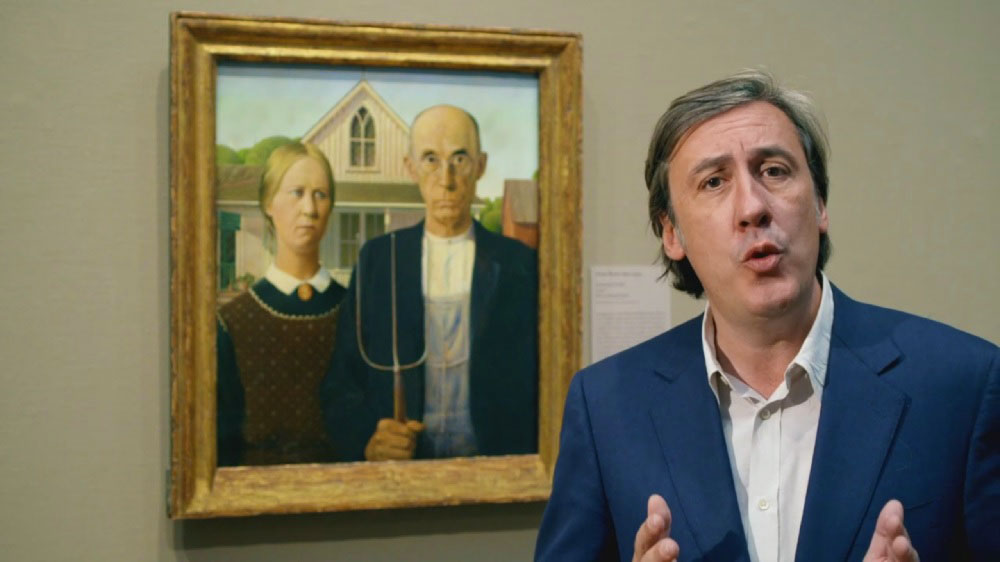
Then the engine broke. The stock market crash of 1929 sent the world economy into a downward spiral. Factories closed and unemployment soared. Against the backdrop of the Great Depression, Americans looked back to the familiar certainties of earlier times, and Grant Wood gave that longing its defining image. He submitted American Gothic to the Art Institute of Chicago’s juried annual exhibition in 1930, winning the Norman Wait Harris Bronze Medal and $300. The painting has since become one of the most famous images in American art history.
Wood painted it out of deep nostalgia for his Iowa childhood among frontiersmen and women. Not everyone approved. When a local newspaper captioned it Iowa Farmer And His Wife, a real farmer’s wife wrote in to complain that the woman’s face would positively sour milk. Graham-Dixon reads the couple differently: as specimens, the last representatives of old Victorian values, the homesteader equivalent of the last of the Mohicans. Urbanisation was depopulating the countryside while the Depression squeezed these people from the other side. The painting laments a passing nineteenth-century ideal of decent people in small communities.
That dream persisted most powerfully in Stockbridge, Massachusetts, the home of Norman Rockwell. For more than 40 years, Rockwell’s pictures arrived almost weekly on American doorsteps through magazines like the Saturday Evening Post. They offered a benevolent, comforting myth of a nation where people help each other, the sick are cared for, and a 20lb turkey always graces the Thanksgiving table.
Museum curator Stephanie Plunkett argues Rockwell saw the best in people, painting aspirational images of kindness, care and community. Yet Graham-Dixon presses on a troubling absence: would a black face ever appear at that endless Thanksgiving table? Plunkett’s answer is revealing. Rockwell cared deeply about human rights and equality, but the Post enforced an unwritten rule that people of colour could only appear in service positions. Look closely and the cracks in the American dream show through, even as Rockwell does his best to conceal them.
Edward Hopper’s Nighthawks Brings America’s Loneliness to the Surface
In the paintings of Rockwell’s contemporary Edward Hopper, those unsettling undercurrents rise fully into view. His art asked what was wrong with America. His scenes resemble voyeuristic glimpses of lonely individuals, the angst in the soul of the modern nation. Hopper’s world is neither dynamic nor dangerous. In its way, it is as soulless as a Sheeler factory, except this time we can see the people and believe we share their feelings.
Graham-Dixon meets photographer Philip-Lorca diCorcia, whose work carries the same ambiguity. DiCorcia values Hopper’s contradictions and the tension between what is there and what is not. He points to the usherette in the movie theatre, sealed in her own bubble where she and the audience cannot see each other. Hopper, he says, masters the elliptical narrative, where an element always goes missing and nothing ever concludes. DiCorcia’s own series Heads catches city dwellers in the same lonely isolation.
Hopper’s most cinematic painting, Nighthawks from 1942, presents four figures in a New York diner at night. The viewer is instantly gripped by what might be happening, and Hopper deliberately leaves the lives inscrutable. The diner glows like an aquarium, capturing what Graham-Dixon calls the oceanic emptiness of modern American existence: travelling salesmen, hookers, strangers from out of town briefly converging. Hopper claimed to be the great figurative artist holding modernism at bay. Yet the melted walls, the isolated stripe of window frame against yellow, the plays of light and shade, all suggest he stood closer to America’s first abstract painters than he admitted.
Arshile Gorky’s Forgotten Airport Murals Sparked an American Revolution
So who would finally defy America’s deep-seated preference for realism and put abstraction centre stage? The answer was Arshile Gorky, an Armenian immigrant with a passion for modern European art. Two of his most influential paintings now hang in the unlikely setting of the Newark Museum’s cafe, rediscovered only in the 1970s after spending more than 30 years buried under layers of whitewash.
Gorky painted them as murals for the Newark Airport authorities, almost singlehandedly trying to introduce everyday Americans to the language of the European avant-garde. One whirls together surrealism, Cubism’s flattened space and Fernand Léger’s machine-age aesthetic into a kaleidoscope built from aeronautical instruments. Hidden within those instruments lies the upside-down body of a female air traveller, complete with boater hat and high-heeled shoe. Ten grand murals originally existed; only two survive. The second shows America as a continent crisscrossed with flight paths, a place where you could literally take wing.
Gorky posed a piercing question to American artists. You live in a land of opportunity and technology, flying off into the future, so why does your art remain mired in the past? Why cling to Hopper and Rockwell when you could seize the language of Picasso and make it your own? He spent the rest of his career repeating that message until it got through. Perhaps not a genius himself, Gorky became the catalyst for a seismic shift, and his followers created one of the most exciting movements in all of twentieth-century painting.
Jackson Pollock’s Drip Technique Defines Art of America Episode 2’s Turning Point
The Abstract Expressionists answered Gorky’s challenge, with one crucial difference. Gorky loved modern America; they hated it. Barnett Newman, one of the movement’s high priests, saw his signature zip of paint as an assertion of human free will against the dead machine, proclaiming that proper understanding of his work would end state capitalism. Franz Kline painted not things but the feelings they aroused. Clyfford Still declared a limited mass of paint nobler than an acre of decorations in a rich man’s mansion. Their art said a resounding no to American materialism, consumerism and the obsession with money.
No one pulverised the world of appearances more thoroughly than Jackson Pollock, the first American abstract painter to achieve international fame. Hans Namuth filmed him making a drip painting in 1951 at the peak of his success, footage that fixed him in the public imagination as Jack The Dripper. Pollock insisted he controlled the flow of paint, that there was no accident, no beginning and no end, and that a painting had a life of its own which he tried to let live.
His perfectly preserved Long Island studio survives as a kind of shrine, complete with a reliquary case holding his pots and brushes. Pollock’s great innovation was painting on the floor, with an abandon no one had matched, on a scale he had never managed before. Spatters that missed his canvases still cover the boards. The critic Harold Rosenberg compared the action painter to a gladiator entering an arena, and this studio feels like one.
From those battles came monumental canvases like Autumn Rhythm, painted in 1950, the X-marks-the-spot moment when America appropriated the modern language of art. Yet Graham-Dixon finds something dark in it: man as an incoherent assembly of impulses, a universe with no logic and no meaning. Pollock himself harboured doubts, painting in his extreme drip style for only a few years. When Life magazine showcased his work alongside adverts for frozen dinners and Ford cars, he feared he had become a sell-out.
The Rothko Chapel Closes Art of America Episode 2 With Questions, Not Answers
The fear of selling out also haunted Pollock’s friend Mark Rothko. In 1958 he accepted a lucrative commission for the Four Seasons restaurant in Mies van der Rohe’s Seagram Building, Manhattan’s most talked-about new skyscraper. His excitement curdled into scepticism over the course of a year. The turning point reportedly came when he lunched there, looked around at a room full of bankers and businessmen, and asked himself whether he wanted his work to amuse people paying $50 a plate. He decided he did not. Rothko kept his art pure: translucent layers and fields of colour, oil paint with the shimmering qualities of watercolour, full of that old American love for the continent’s vast sublime nature.
His most ambitious work waits in Houston, Texas: an entire secular chapel, the culmination of his lifelong desire to exhibit his pictures in series under controlled light. The Rothko Chapel contains three triptychs, yet no principal point of orientation. Visitors find themselves in something like a hall of mirrors, unsure where to look for enlightenment. The paintings resist the gaze, coming back at the viewer with their materiality. Rothko reportedly hinted that anyone looking at these pictures was actually looking at themselves. Are they windows onto transcendence, or walls bearing down, symbols that this life is all there is? Rothko leaves it perfectly ambiguous. There are no answers in the chapel, only questions.
Graham-Dixon ends Art of America episode 2 with a final provocation. The Abstract Expressionists claimed to rise above the modern American city entirely, an almost priestly movement transcending daily banalities. He is not so sure. Kline’s girder-like shapes echo skyscrapers under construction. Rothko’s bruised walls of canvas recall the bruised walls of New York tenements. Still’s slabs of colour resemble slivers of sky glimpsed between towers. Even Pollock evokes not only nature but the spatter of oil on asphalt from a shattered sump. The movement wanted to rise above consumer culture, yet produced an art completely of the city. Idealism and materialism, inextricably intertwined. That, Graham-Dixon concludes, is America.
FAQ Art of America episode 2
Q: What does Andrew Graham-Dixon explore in Art of America episode 2?
A: He gets under the skin of the modern American metropolis, starting at the Statue of Liberty and ending at the Rothko Chapel in Houston. The journey covers the Ashcan School in New York, Louis Sullivan in Chicago, Charles Sheeler in Detroit, Norman Rockwell in Stockbridge, and the rise of Abstract Expressionism through Arshile Gorky, Jackson Pollock and Mark Rothko.
Q: Why is the Statue of Liberty described as an early skyscraper?
A: Despite resembling a classical marble statue, she is formed from a copper skin stretched across an intricate network of iron girders. That same cutting-edge construction technology soon transformed the skylines of America’s great modern cities. Installed in 1886 as a gift from the French, she also symbolises modern America’s economic and technological power.
Q: What was the Ashcan School and what did its painters depict?
A: The Ashcan School was a group of young artists who abandoned Philadelphia for New York to make the city the subject of their art. They painted the buzz and grit of Manhattan, its trashy sprawl and overpopulated streets. John Sloan captured ordinary life at places like McSorley’s Old Ale House, while George Bellows exposed the city’s brutality.
Q: How do John Sloan and George Bellows differ in their views of New York?
A: Sloan tended towards sentimentality, ignoring poverty and depicting New Yorkers as a vast extended family enjoying a non-stop street party. Bellows, by contrast, was savagely critical. His painting Both Members Of This Club shows desperate men fighting in illegal boxing matches for the entertainment of others, a brutal image of a brutalised, dog-eat-dog society.
Q: Why was the 1913 Armory Show considered a disaster?
A: Around 300,000 people saw the first international exhibition of modern art in New York, but most came to gawp and mock rather than be enlightened. Marcel Duchamp’s Nude Descending A Staircase became the butt of jokes, while Matisse and Picasso were pilloried. Patriotic resentment and America’s attachment to representational painting fuelled the hostile response.
Q: What did Louis Sullivan mean by form follows function?
A: Sullivan argued that America’s new social and economic structures required a new architecture. His manifesto laid out the skyscraper formula: a basement plant for power, a ground floor for stores and banks, offices piled tier upon tier, and an attic on top. That blueprint has guided almost every skyscraper built in the last 120 years.
Q: Is Norman Rockwell’s vision of America really sentimental?
A: Not entirely. His paintings show an idealised small-town America built on kindness, care and community, delivered weekly through the Saturday Evening Post for over 40 years. However, the Post enforced an unwritten rule that people of colour could only appear in service positions, forcing Rockwell’s own beliefs in equality and human dignity into a restrictive box.
Q: What makes Edward Hopper’s Nighthawks so powerful?
A: Painted in 1942, it shows four figures in a New York diner at night, rendered like an aquarium. Hopper deliberately leaves their lives inscrutable, evoking aftermaths or preludes rather than conclusions. The picture captures the oceanic emptiness of modern American existence, with touches of abstraction in its melted walls and isolated plays of light.
Q: How did Jackson Pollock create his famous drip paintings?
A: Pollock painted on the floor of his Long Island studio with unmatched abandon, working at a monumental scale. He insisted there was no accident, controlling the flow of paint while sabotaging anything resembling a recognisable image. His 1950 canvas Autumn Rhythm marks the moment America appropriated the modern language of art, earning him the nickname Jack The Dripper.
Q: Why did Mark Rothko abandon the Seagram Building commission?
A: Offered a lucrative commission for the Four Seasons restaurant in 1958, Rothko grew sceptical after lunching there and seeing a room full of bankers and businessmen. He asked whether he wanted his work to amuse people paying $50 a plate. Determined to keep his art pure, he later created the Rothko Chapel in Houston instead.