Art of America episode 3 takes Andrew Graham-Dixon from the neon blaze of Las Vegas to the wounded skyline of post-9/11 New York, asking one urgent question: what lies beneath the surface of the American Dream? The final part of his United States odyssey charges through six decades of contemporary American art, from Jasper Johns’s subversive White Flag and Andy Warhol’s soup cans to Jeff Koons’s studio and the burnt cityscapes of Matthew Day Jackson.
Graham-Dixon opens in Las Vegas, the world’s largest, brightest, brashest neon work of art and a perfect symbol of America’s can-do optimism, an Emerald City conjured out of desert. Yet he sharpens the stakes immediately. In the 21st century, America looks like a country in crisis, a nation that has lost its swagger and its certainty that life, liberty and the pursuit of happiness should anchor the civilised world.
His argument is bold and consistent: if you want to understand how America’s ways of seeing and thinking have transformed, the story of American art is the best map available. Along the way he interviews pop art legend James Rosenquist, Warhol’s former lover Billy Name, Philip Guston’s daughter Musa Mayer, and Jeff Koons himself. Each encounter peels back another layer of the national myth.
After World War II, suburban America became the battleground for the soul of the nation. An unprecedented economic boom put motorcars, fridges, freezers and television sets within reach of ordinary families. However, that comfort carried a shadow. The atom bomb had locked the USA and the Soviet Union into nuclear stalemate, each casting itself as the hero nation destined to vanquish the other.
Graham-Dixon visits Levittown in Long Island, New York, the first mass-produced suburb and the perfect emblem of this new order. Entrepreneur builder William J Levitt, encouraged by the US government in the late 1940s, constructed 17,500 houses in just four years, using cheap materials and a production-line process borrowed from Henry Ford. These simple, box-like structures housed a new American Dream, built on private home ownership and free enterprise as the answer to Soviet state control.
The dark side surfaces quickly. If Levittown’s cookie-cutter houses all looked the same, so did the faces. The rules explicitly barred residents who were not Caucasian; the dream was reserved for white Anglo-Saxon patriots, preferably male. Beneath that polished surface, America was teeming with desperate housewives, Black Americans, Hispanics and countless others whose frustrations stayed obscured. Artists would spend the next half-century dragging those hidden lives into view.
Art of America episode 3
Jasper Johns’s White Flag Hides Fury Beneath Layers of Wax
In 1954, Jasper Johns, a small-town Southern boy newly settled in New York City, began painting the ultimate symbol of American-ness: the Stars and Stripes. While most American artists produced intellectual abstractions, Johns fetishised one familiar image in subtle variations. His flags seemed refreshingly new and direct, but their meaning stayed slippery. Patriotic fervour, another kind of abstraction, or something else entirely?
At New York’s Metropolitan Museum, Graham-Dixon stands before his favourite, White Flag, painted on a vast scale in white rather than red, white and blue. Johns deflected questions, saying he simply painted things the mind already knows, as if the flag were a non-subject drained of meaning. Graham-Dixon dismisses that as nonsense. These are angry, passionate pictures.
His reading turns on the painting’s materials. White Flag is built from a collage of newsprint, a babble of muffled American voices smothered under thick encaustic beeswax oil paint. The picture becomes a metaphor for an America that promises freedom of speech and behaviour but delivers neither, a nation buried beneath the heavy snow of a cold, illiberal patriotic duty. Johns had personal reasons for anxiety. His homosexual relationship with artist Robert Rauschenberg was illegal and, in the McCarthyite era, could brand him a dangerous communist subversive.
James Rosenquist Reveals Why His Billboard Paintings Mean Nothing on Purpose
By the early 1960s, advertising had come of age. Ad men stopped lecturing and learned the dark arts of seduction, deploying hyperreal colours and graphic brand logos to repeat one mantra: you can never have too much. A new generation of artists confronted this strangeness and called themselves pop artists. Claes Oldenburg stitched supersize, floppily repulsive hamburgers from cloth, exposing the excesses of the fast food boom. Roy Lichtenstein borrowed the dot matrix language of comics, hinting that modern life was reducing human emotion to cartoon stereotypes.
James Rosenquist built vast collaged canvases that mimicked what Graham-Dixon calls the vomitous splurge of America’s yowling jungle of signs. Now 77 and still painting enormous pictures, including a recent work titled The Richest Person Looking At A Universe Through A Hubcap, Rosenquist is one of the last truly great surviving pop artists. He started out painting the billboards of Times Square, where movie stars’ heads were as wide as a room; he painted from hairline to eyelid before lunch and finished the lips the next morning.
When Graham-Dixon asks whether part of him loved that seductive imagery, Rosenquist’s answer is ferocious. No, he thought the billboards were terrible, eyesores. He had hated advertising all his life, yet there he was, painting gigantic advertisements above Times Square. So he set himself a radical experiment: assemble fragments of billboard imagery into a picture plane that meant nothing. His celebrated early works were anti-billboards, proof that enlarged commercial imagery is really empty. That emptiness was exactly what he wanted America to see.
Andy Warhol’s Soup Cans Turn Consumer Choice into a Prison
One pop artist appeared to embrace consumerism rather than parody it. Andy Warhol took America’s most familiar mass-produced objects and re-presented them as art, an art of numb repetition that mimicked the production line itself. Critics accused him of selling out and missed the starkness of the message. Graham-Dixon calls Warhol the single most significant American artist of the second half of the 20th century, a great philosopher who understood what made post-war American civilisation unlike anything before it.
The Campbell’s soup can paintings make the case. Tomato, vegetable, green pea, bean with bacon, cream of chicken, turkey noodle, minestrone, Cheddar cheese. You can have all this, Graham-Dixon observes, but so can everyone else. It is variety, but it is also a trap. The canvases line the gallery like the walls of a cell you can pace but never escape. This, he suggests, was Warhol’s verdict: this is your world, America, the prison you have made for yourself.
Warhol’s darkest register came in the Death and Disaster series, begun in 1962. Race riots, atomic bombs, electric chairs and car crashes, all made from actual press photographs. In America, even death was reproduced and homogenised. A gruesome image shocks you once, Warhol observed, but seen again and again it stops bothering you. The big media were desensitising Americans, and his bleakest line still stings: in the 1960s, Americans forgot what emotions were supposed to be, and never remembered.
To generate his mass-produced art, Warhol surrounded himself with free spirits at The Factory, his aptly named Manhattan studio, the hip hangout for bohemians, speed freaks and anyone chasing their 15 minutes of fame. One stalwart was photographer Billy Name, who began as Warhol’s lover and became the visual chronicler of the scene. Forty-five years on, Graham-Dixon finds him in Poughkeepsie, upstate New York, surrounded by silkscreen prints of his photographs. Name was the original fly on the wall, so ever-present that people stopped seeing him. He knew all the changes, all the Andys, from commercial artist to celebrated fine artist.
Asked to explain the remade Brillo and Del Monte boxes, Name’s answer is disarmingly direct: you live in art. Walk the supermarket aisles and the stacked cans become icons on shelves. Warhol was fascinated by the lucidity of repetition, the clarity of a space designed to make you see what is there. The older generation saw the artist as a hero who turned his back on cheap surface culture; Warhol arrived as the artist as a zero, facing consumer culture and taking it over. He treated celebrities exactly as America treated products, a single image screenprinted over and over like a stack of TV screens. Look, his art said, this is your world, mirrored back at you.
Art of America Episode 3 Hits the Open Road West to Los Angeles
Warhol saw the car as another of America’s morbid machines, mass-producing road deaths for tabloid readers. Others saw it more romantically, as the escape from suburbs and shopping malls. Jack Kerouac caught the mood: nothing behind me, everything ahead of me, as is ever so on the road. For generations of American photographers, the car became a mobile studio and darkroom, producing kaleidoscopically fractured images of the country seen from the two-lane blacktop. Their pictures proved that within Warhol’s society of identical churches, malls and gas stations, the individual still survived, travelling on in search of a better life.
Keep going west and you reach Los Angeles, in the 1960s one of America’s youngest, fastest-growing cities, home to Walt Disney’s first theme park and Hollywood. Graham-Dixon recalls renting a Buick on his first visit and driving for three days in search of a city centre that does not exist. He hated the sprawl at first. The painters of LA taught him to see it, and he now ranks the city among the most thrilling built environments ever created.
Those painters found freedom in a city unburdened by East Coast history. Richard Diebenkorn distilled LA’s bright planes of sky, sea and tarmac into romantic abstractions borrowing from cubism and expressionism. Wayne Thiebaud’s candy-coloured objects of desire captured the plastic brightness of its pop culture.
And Ed Ruscha, who left Oklahoma City for LA in 1956 along the same route as countless wannabe starlets, used advertising’s flat graphic shorthand to fix the city’s defining images. His painting of the Hollywood sign places it on the summit of a hill that does not exist; the sign actually sits on the slope. The joke is deliberate. As Ruscha put it, this is what Hollywood is, a piece of fakery held up on sticks.
Googie Architecture and the City Built to Make You Stop
Sixties LA adored artificiality, from unfeasibly tall imported palm trees to buildings shaped like nothing seen before. The city’s unique contribution to 20th century design became known as Googie architecture. Cheeky and referential, it evoked a stack of jukebox records or the speed fins of a Cadillac, borrowing the language of the car, the space rocket and the subatomic particle. This was modernism for the space age, born as President Kennedy promised the moon and families watched astronaut heroes from their living rooms.
Graham-Dixon insists the only way to grasp LA’s crazy beauty is to drive through it at night, when the whole place reveals itself as a vast collective work of art. Everyone here is always on the move, so the architecture and signage must shout to make you stop. Come and buy my liquor, come and get some gas. More than anywhere else on Earth, he declares, this is the city of the sign.
Not every artist celebrated the noise. A new wave, the minimalists, shared pop’s disdain for consumer society but loathed its embrace of gaudy packaging and the hard sell of buy two get one free. They too drew inspiration from the supermarket, but purged it of colour, image and detail while keeping its strategies of accumulation and stacking.
A gallery of their work resembles a supermarket where nothing can be consumed, only contemplated in blankness. Minimalism named what American life had become: objects without meaning, without hope of transcendence. Dan Flavin complicated that bleakness. From 1963 he sculpted with nothing but fluorescent tubes, installing them in a former Baptist church in Bridgehampton, Long Island, arranged like chapels. Flavin, who once studied for the priesthood, denied any spiritual intent. Is this a yearning for divine light, or proof that transcendence is just a neon sign to be switched on or off? You can read it either way.
Philip Guston’s Furious Late Paintings Tore Up the Rule Book
By the late 1960s, shocking clashes with authority were unravelling American society. Civil rights marchers were beaten by police; students protesting the Vietnam War were gunned down by the National Guard. The cool irony of pop and the chilly objectivity of minimalism no longer matched the atrocity of the times. Philip Guston, an abstract expressionist who had spent years on subtle, tasteful compositions, reached breaking point. What kind of man am I, he asked, reading magazines, going into a frustrated fury about everything, then going into my studio to adjust a red to a blue?
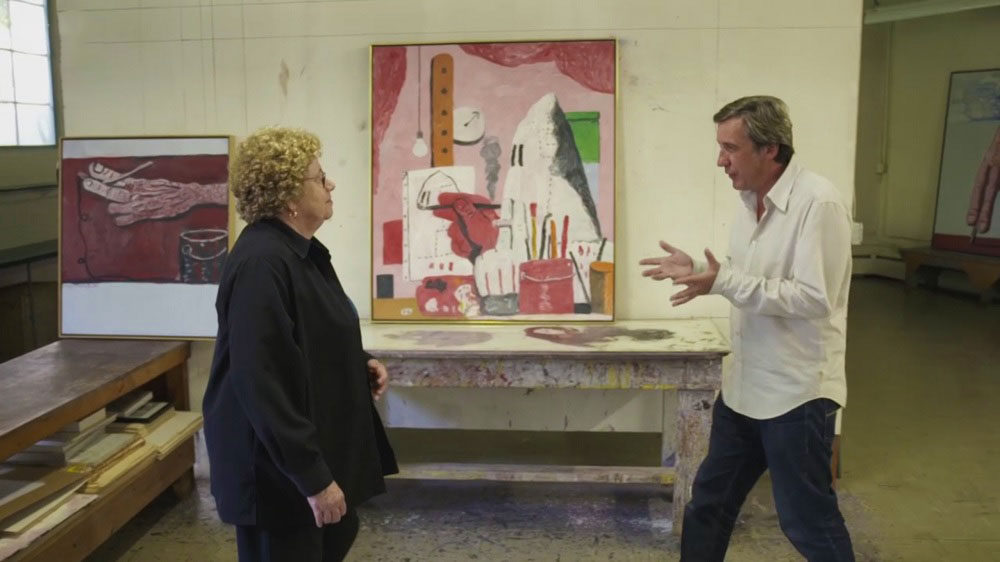
His answer was a seismic shift: angry, comic-book satires that changed the course of American art. Graham-Dixon visits Guston’s preserved studio with the artist’s daughter, Musa Mayer, the painter’s table still spattered with what she calls painter’s blood. She remembers the response to the first exhibition of the new work: the critics panned it almost universally.
The paintings themselves remain ferocious. Hooded figures resembling Klansmen, cigars smoking, blood on their hoods, populate canvases like Riding Around. Mayer reads them as meditations on concealment, on what Americans reveal and hide about themselves. Another picture shows Nixon at San Clemente, plagued by phlebitis, his swollen leg seeping pus and blood with state lines drawn through it, the body politic as a rotting map. Pride of place in the studio goes to a hooded self-portrait. Guston, Mayer says, painted the dark side of himself, a courage few artists of his time possessed. After Guston, anything was possible. Postmodernism was just the label critics stuck on the new freedom.
Nan Goldin Lifts the Flag to Reveal America’s Hidden Lives
The 1970s belonged to the individual. Black power, gay rights and women’s liberation brought marginalised voices into the open, and art became the means of exploring those new identities, from graffiti’s street language to the unflinching eye of the camera. In 1978, 25-year-old photographer Nan Goldin moved from Boston to Manhattan’s Lower East Side, then an extremely shabby district, drawn by its subculture of drag queens, heroin addicts and social outsiders.
Goldin photographed herself and the people she knew in tenement buildings, capturing intimate moments that were intentionally raw, unaltered and unstaged. Her friends lived much of their lives in secret, and she recorded it all. When some began to die of AIDS, she documented that too. These were never voyeuristic pictures; they were the chronicle of her own life. My camera has saved my life, she said; it made bearable things that feel unbearable.
Graham-Dixon draws one of the most striking connections in Art of America episode 3, reaching straight back to Jasper Johns. White Flag showed the Stars and Stripes as a quilt smothering America’s teeming multiplicity of voices and cultures. Goldin lifted a corner of that sheet to reveal the hidden, dark world beneath, and did so with affection and vibrancy rather than judgment.
Jeff Koons Defends Kitsch, Banishes Shame and Divides the Critics
When Ronald Reagan won the presidency in 1981, he repackaged the American Dream in an echo of 1950s Levittown, promising greatness through home ownership. If a B-list Hollywood actor could become President, anyone could make it, regardless of class, background or taste. The artist who captured that idea most perfectly was Jeff Koons, whose work transfigured the vulgar taste of the nouveau riche. Most critics were horrified; others saw a witty take on eclectic materialism. Graham-Dixon calls him Andy Warhol take two, a Warhol who wants Americans to wallow in their taste, however kitsch or obscene, though with an artist this deadpan, certainty is impossible.
Inside Koons’s studio, the artist shows works in progress from his Antiquity series, full of trademark motifs: the shiny inflatable, the sexy girl, a dolphin. He recalls his one-year-old daughter Scarlet pointing delightedly at a painting days earlier. At that age, he says, you are open to everything, the opposite of the reflex that sneers at kitsch. I don’t believe in kitsch, Koons declares. If lots of people like it, what is wrong with it? Art, for him, removes anxiety through acceptance, telling people to embrace their own cultural history, the ceramic knick-knacks, the commercial painting of a hut in a forest above the family fireplace.
Graham-Dixon presses him on the billboard-sized photographs of Koons making love to his then wife, La Cicciolina, images that felt weirdly pure, pornography somehow made innocent. Koons admits he still puzzles over them. The goal was work that removed guilt and shame, turning bodily insecurity into complete acceptance, the highest state art can reach. The art establishment judged him harshly, but wealthy bankers and social climbers disagreed. His work has since commanded some of the highest prices of any living artist.
How Art of America Episode 3 Confronts 9/11 and an Age of Anxiety
The 1990s brought sky-high confidence. The Soviet enemy had collapsed; the good guys had won, and America sank into a deep armchair of complacency. The era’s defining artwork appeared not on canvas but on millions of television screens. The Simpsons exuded corrosive cynicism about the old American Dream, summed up in Homer’s advice: you tried and you failed, the lesson is, never try. Yet the show, with guests ranging from Jon Bon Jovi to Jasper Johns himself, announced something seismic. Anything and everything, from Dunkin’ Donuts to the New York Philharmonic, could now count as American culture.
Then, on September 11th 2001, the world changed. The terrorist attacks were a murderous outrage planned with hatefully potent visual symbolism: American planes flown into American skyscrapers, the towering emblems of optimism and the free market. There was America before 9/11 and America after, Graham-Dixon says, and they are not the same place. Michael Arad’s 9/11 Memorial marks the towers’ exact footprints with two vast pits. It is solemn and heartfelt, yet also an unintentionally startling sign of lost confidence. There is no hope here, no old American spirit of overcoming, just a great wall of tears flowing endlessly into oblivion.
In a Brooklyn warehouse, sculptor Matthew Day Jackson makes art from that anxiety. His series August 6th 1945, named for the date of Hiroshima, presents aerial cityscapes that are then burnt uniformly, suggesting not a detonation but a continuing atmosphere of fire moving through streets and alleyways. The comfortable myth says the Cold War ended; Jackson insists it simply moved elsewhere, and we have forgotten. His rainbow spectrum of skeletons, spanning three million years of evolution and looping back again, imagines humanity’s large brain inventing the means to return itself to a pre-technological past. Graham-Dixon sees apocalypse here, but also exultation, laughter in the dark, or, as Jackson offers via Ronnie James Dio, a rainbow in the dark.
That uncertainty is where Art of America episode 3 leaves its audience. For centuries, American artists have shaped the nation’s sense of itself, giving visual form to its dreams, questioning its ideologies and defining what makes its civilisation unique. America was the home of the new, the place where the future was made. Now many Americans fear their destiny is being shaped elsewhere, and recent American art has become an art of questions rather than answers. At its centre sits the biggest question of all: what does the future hold?
FAQ Art of America episode 3
Q: What does Andrew Graham-Dixon explore in Art of America episode 3?
A: He examines what lies beneath the surface of the American Dream through contemporary art. Beginning in Levittown, the first mass-produced suburb, he traces post-war consumerism, pop art, minimalism and the anxiety of the post-9/11 era. The journey includes Jasper Johns, Andy Warhol, Ed Ruscha, Philip Guston, Jeff Koons and Matthew Day Jackson, ending with one question: what does the future hold?
Q: Why was Levittown so significant in post-war America?
A: Levittown in Long Island was the first mass-produced suburb, with 17,500 houses built in just four years using Henry Ford-style production-line methods. It embodied the new American Dream of private home ownership and free enterprise. However, its rules explicitly barred residents who were not Caucasian, exposing the exclusion hidden beneath the dream.
A: Graham-Dixon reads White Flag as an angry, passionate protest, not a neutral formal exercise. The painting buries a collage of newsprint, a babble of muffled American voices, under thick encaustic beeswax paint. It becomes a metaphor for an America that promises free speech but smothers it beneath a cold, illiberal idea of patriotic duty.
Q: Why did James Rosenquist call his paintings anti-billboards?
A: Rosenquist hated advertising all his life, yet earned a living painting gigantic billboards in Times Square. In response, he assembled fragments of billboard imagery into picture planes that deliberately meant nothing. His enlarged commercial imagery was intentionally empty, exposing the hollowness behind advertising’s seductive surfaces.
Q: What was Andy Warhol really saying with his Campbell’s soup can paintings?
A: The soup cans present consumer choice as a trap. Everyone can buy the same varieties, so abundance becomes uniformity. Graham-Dixon describes the paintings as lining a cell you can pace but never escape, Warhol’s way of telling America it had built a prison for itself out of its own consumer culture.
Q: How did Warhol’s Death and Disaster series criticise American media?
A: Begun in 1962, the series repeated press photographs of race riots, electric chairs, atomic bombs and car crashes. Warhol argued that a gruesome image shocks once, but repetition makes it stop bothering you. He believed television and newspapers were desensitising Americans, who, in his words, forgot what emotions were supposed to be.
Q: What is Googie architecture and why did it emerge in Los Angeles?
A: Googie was LA’s unique contribution to 20th century design, a cheeky space-age modernism evoking jukebox records and Cadillac speed fins. It borrowed from the car, the rocket and the subatomic particle. Because everyone in LA is always on the move, buildings and signage had to shout to make drivers stop.
Q: Why did Philip Guston’s late paintings shock the art world?
A: Guston abandoned refined abstract expressionism for angry, comic-book satires featuring hooded Klansmen-like figures and a grotesque Nixon. Critics panned the new work almost universally. His daughter Musa Mayer explains the hooded figures as meditations on concealment, including a self-portrait acknowledging the dark side of the artist himself.
Q: How does Jeff Koons defend his work against accusations of kitsch?
A: Koons rejects the concept entirely, saying he believes things are perfect as they are, and if many people like something, nothing is wrong with it. He sees art as generous, removing anxiety through acceptance and freeing people from guilt and shame about their own cultural history. His prices rank among the highest of any living artist.
Q: How did 9/11 change American art according to Art of America episode 3?
A: Graham-Dixon argues there was America before 9/11 and America after, and they are not the same place. Michael Arad’s memorial pits suggest lost confidence rather than hope, while artists like Matthew Day Jackson channel national anxiety, burning aerial cityscapes that recall Hiroshima. Recent American art has become an art of questions, not answers.