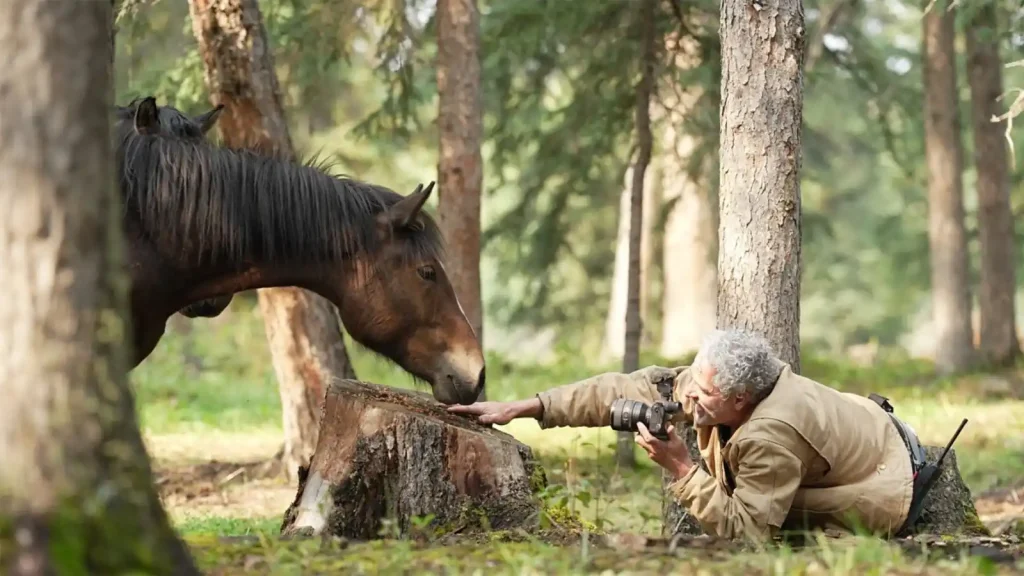
Wild Horses, the Rockies and Me: As the golden light of summer begins to fade, a sense of quiet anticipation settles over the Canadian wilderness. Wildlife filmmaker Gordon Buchanan stands on the edge of a vast, emerald frontier. He is venturing deep into the epic majesty of the Rocky Mountains. His mission is as ambitious as the landscape itself. He seeks one of nature’s most iconic and misunderstood creatures in the documentary Wild Horses the Rockies and Me.
Wild horses represent the very soul of the untamed West. They are powerful, dangerous, and incredibly elusive. They move like shadows across the rugged terrain. Despite their legendary status, these animals remain surprisingly overlooked by the scientific community. Their daily lives and social structures are largely undocumented. Gordon, who spent much of his youth in a saddle, feels a deep personal connection to these animals. He aims to pull back the curtain on their secret world.
The setting for this journey is nothing short of breathtaking. Stunning granite peaks pierce the clouds. Open grasslands roll like a velvet sea under the mountain breeze. Shadowy pine forests fringe the eastern slopes, offering a sanctuary for those who wish to remain hidden. Gordon knows that to find the horses, he must become part of their environment. Consequently, he chooses to ride out on his own steed. He hopes this will allow him to reach the remote corners where only a wild horse can thrive.
Every journey into the wild comes with its share of challenges. Gordon faces a series of frustrating setbacks as he navigates the dense timber and steep ridges. The horses do not want to be found. However, persistence eventually pays off. He stumbles upon a unique family of “wildies” tucked away in a hidden valley. This small band consists of two competing stallions, two protective mares, and two spirited young foals.
This discovery marks the beginning of an intense period of observation. Gordon starts bearing witness to complex behaviors that few humans have ever seen. A central drama quickly emerges within the group. Two stallions, named Red and Crusoe, live in a state of constant tension. Gordon watches closely to determine which male is the true father of the foals. He wonders who will ultimately earn the right to lead this small, fragile band.
The social dynamics of the herd are fascinating and puzzling. Red seems determined to keep his family separated from the massive “super-herd” that gathers nearby. This decision carries significant risks. In the wild, there is usually safety in numbers. Gordon questions the logic behind this isolation. Would it not be wiser to join the larger group? After all, the mountains are home to ravenous grizzly bears and wolves. These predators are currently looking to fatten up before the harsh winter arrives.
While the adults navigate power struggles, the youngsters live in a world of play. The two foals, Socks and Boots, embody pure innocence and boundless curiosity. They frolic through the high grass with clumsy grace. Yet, their playful nature often leads them toward danger. Gordon worries that their lack of fear might get them into trouble. He watches them with the protective eye of a guardian, hoping they stay close to the mares.
To truly understand these animals, Gordon decides to take a bold step. He immerses himself further into their world than most filmmakers would dare. He attempts to befriend the family and earn their hard-won trust. His goal is to experience their lives from within the heart of the herd. This is an intimate approach that has rarely been attempted before. It requires a level of patience that mirrors the slow changing of the seasons.
Living among wild horses requires a total shift in mindset. Gordon must move carefully and learn to think like a wild animal. He cannot afford to make a single mistake. This mission is certainly not without its physical dangers. A single, well-placed kick from a defensive stallion could prove fatal. Therefore, he must master a new form of communication. He learns to read the subtle language of the herd to stay safe.
Wild Horses, the Rockies and Me
Every movement in the herd carries a specific meaning. A flick of an ear or a sharp stamp of a hoof serves as a warning or a greeting. Even quiet, fleeting glances reveal what the horses are telling each other about their human visitor. As Gordon deciphers these signals, he uncovers a profound level of intelligence. He realizes that these animals possess complex emotions and incredibly close family bonds. They are far more than just “wild” beasts.
As he begins to gain acceptance, the atmosphere of the journey shifts. Gordon discovers that the horses face a danger far greater than any natural predator. They live under the constant threat of being culled by human hands. This realization hits him with the force of a mountain storm. He understands the devastating impact such an event would have on these tight-knit family groups. The loss would ripple through the entire community.
The threat of the cull also endangers the local environment. These horses help to shape the fragile ecosystems of the Rockies in vital ways. They are a living symbol of the untamed history of the West. Gordon finds himself becoming an advocate for their survival. He sees them not as a nuisance, but as an essential part of the landscape. His perspective on the species begins to transform.
Getting closer than expected to these creatures changes Gordon forever. He no longer sees them as mere subjects for a film. Instead, he views them as kindred spirits with a right to their ancestral lands. The bond he forms with Red, Crusoe, and the foals is deeply moving. It highlights the thin line between the human world and the wild. This experience proves that trust can exist even between the most different of beings.
As the expedition concludes, the lessons of the mountains remain. Wild Horses the Rockies and Me is more than just a nature documentary. It is a story of discovery, danger, and deep emotional resonance. Gordon leaves the eastern slopes with a renewed sense of wonder. He has witnessed the raw beauty of a family fighting to stay together against all odds. Their hoofprints may fade in the snow, but their story will now be told.
Wild Horses, the Rockies and Me
Wild Horses, the Rockies and Me captures a profound journey into the heart of the Canadian wilderness where wildlife filmmaker Gordon Buchanan seeks to understand an animal that has defined his life and the history of North America. Standing on the edge of the vast Rocky Mountains, Buchanan embarks on a three-week expedition to track and join a population of horses that lives entirely outside human control.
This nature documentary explores the intersection of raw power and delicate social bonds within a landscape that is wild beyond belief. The project serves as a deeply personal mission for Buchanan, who credits horses with providing him escape and confidence during a difficult childhood. By venturing into this remote territory, he aims to document the survival strategies of a species that is often misunderstood or overlooked by the broader scientific community.
The significance of this adventure travel lies in the scale of the environment and the sheer density of the animals inhabiting it. Spanning over 1,000 miles in length and 100 miles in width, the Canadian Rockies house one of the largest populations of wild horses in North America. Aerial surveys have identified nearly 1,500 individuals roaming this rugged terrain, yet they remain elusive, moving through dense timber and open meadows like shadows.
Buchanan’s approach to wildlife photography in this setting is unique; rather than filming from a distance with long lenses, he intends to walk among them and ultimately join a herd. This level of immersion requires a sophisticated understanding of animal behavior and a willingness to face the inherent dangers of a land populated by apex predators.
The scope of this narrative in Wild Horses, the Rockies and Me extends beyond simple observation to a detailed study of equine emotional intelligence and social structure. Buchanan explores how these animals, descended from 16th-century European imports, have adapted to a world filled with wolves, grizzly bears, and mountain lions. The article will detail the specific challenges of tracking horses in a 50-square-kilometer territory and the process of earning the trust of a specific family group. Central to this exploration is the “circle of trust” Buchanan builds with a band of eight horses, including two competing stallions, two mares, and two foals. Their interactions reveal a world of protection, rivalry, and deep-seated family bonds that mirror human complexity.
Background context for this cultural exploration is rooted in Buchanan’s thirty-year career as a wildlife filmmaker. He has spent decades getting close to dangerous animals to foster better understanding, yet the wild horse represents a unique challenge due to its dual nature as both a powerful force and a sensitive prey species. In the Rockies, a horse is a creature of rippling muscle capable of delivering a fatal blow, yet it is also an animal that communicates through subtle body language.
To successfully navigate this environment, Buchanan secures his own horse, Diego, to help him cover the vast distances and bridge the gap between the human and equine worlds. This partnership highlights the contrast between domesticated animals and their battle-hardened wild counterparts.
The transition from the comforts of civilization to the unpredictable elements of the mountains sets a tone of high-stakes exploration. Buchanan establishes a campsite near a river with a strong current, using the natural barrier to limit the directions from which predators might approach. This strategic placement is essential because, during the late summer and early autumn, bears are desperate to consume 20,000 calories a day before hibernation. The environment is further complicated by mountain storms and the constant threat of lightning. Within this atmospheric setting, the direction of the journey becomes clear: Buchanan must shed his human persona and adopt the rhythms of the herd to gain the acceptance he seeks.
As the expedition moves deeper into the wilderness, the focus shifts toward the specific mechanics of tracking. Buchanan relies on signs in the landscape, such as hoof prints, dung piles, and grazing patterns, to locate the herds. Horses in this region can consume up to seven kilos of fresh grass daily, making open meadows the most likely spots for sightings. However, finding the horses is only the first hurdle; approaching them without triggering a stampede requires a level of patience that defines the rhythm of the work. Every failed attempt to get close provides a valuable lesson in equine psychology, teaching Buchanan that his presence as a man on horseback is often more threatening than his presence on foot.
The search for the “wildies” eventually leads to the discovery of a specific family group that becomes the focal point of the study. This band, consisting of seven black horses and one red stallion, offers a microcosm of the larger population’s social dynamics. By narrowing his focus to this small group, Buchanan can begin to identify individual personalities and the intricate power struggles that define their daily lives. This structured observation allows the film to move past the surface-level beauty of the Rockies and into the gritty reality of survival. The following sections will detail the specific encounters, the dangers of the landscape, and the emotional resonance of joining the herd.
The Geographic Scale of Wild Horses, the Rockies and Me
The Canadian Rocky Mountains provide a staggering backdrop for the events of Wild Horses, the Rockies and Me, characterized by a wilderness that is described as wild beyond belief. This mountain range, the largest in Canada, serves as a sanctuary for horses that have reverted to a truly primal state. The sheer size of the territory—50 square kilometers for a single band—means that horses can disappear into the thousands of acres of forest for days at a time.
This vastness creates a sense of isolation for the filmmaker, who must navigate the terrain with the constant awareness that he is a guest in a world ruled by different laws. The landscape is not merely a setting but an active participant in the survival of the species, offering both nourishment in its meadows and lethal threats in its dense forests.
A significant portion of the wildlife documentary involves understanding the seasonal pressures of this environment. As autumn approaches, the horses must maximize their intake of nutrient-rich grass to prepare for the coming winter. During the summer, an adult horse may drink up to 50 litres of water a day, frequently drawing them to the riverbeds where Buchanan tracks them. These riverbeds serve as highways through the mountains, providing the most reliable signs of movement. However, the terrain is also shared with elk and other large mammals, adding layers of complexity to the tracking process. The presence of such diverse wildlife reinforces the status of the Rockies as a premier destination for nature enthusiasts and researchers alike.
The weather in the Rockies is famously unpredictable, often dictating the success or failure of wildlife photography efforts. Buchanan recounts being pinned down by mountain storms that drive the horses into the deep cover of the forest. These periods of forced waiting highlight the vulnerability of humans in such a remote setting. When the weather clears, the horses favor east-facing slopes to bask in the early morning sun, a behavior that Buchanan eventually uses to predict their movements. This understanding of the intersection between geography and behavior is what allows the expedition to progress from distant sightings to intimate encounters within the herd’s core territory.
Equine Social Structures and the Stallion Rivalry
A central theme of Wild Horses, the Rockies and Me is the complex social hierarchy found within a typical horse family. While many imagine a single stallion leading a group, Buchanan discovers a fascinating dynamic involving two males: a dominant red stallion named Red and an older black stallion named Crusoe.
Typically, a dominant male will not tolerate the presence of another stallion, but this family group exists in a state of flux. Red is the newcomer, a younger and more aggressive “bully” who has recently taken over the group. Crusoe, despite being muscled out of his former leadership role, remains with the family, likely due to his status as the biological father of the group’s foals, Socks and Boots.
The rivalry between Red and Crusoe provides a constant source of tension throughout the nature documentary. Red is frequently seen “chargey-charging” around, using his size and aggression to keep Crusoe away from the mares, particularly when they come into season. This behavior is more than just a display of ego; it is a calculated effort to ensure Red’s genetic legacy while preventing Crusoe from mating again. The stallions bear the physical cost of this competition, with their bodies covered in scars, bite marks, and pockmarked tissue from past battles. These wounds serve as a testament to the brutal reality of wild life, where dominance is earned and maintained through physical force.
Despite the friction, the stallions play a vital role as protectors of the family. While Red focuses on asserting his authority, Crusoe is seen engaging in affectionate behaviors with the foals, such as grooming them with his teeth. This mutual grooming releases endorphins and reinforces the family bond, suggesting that Crusoe’s presence provides emotional stability to the youngsters. Buchanan’s analysis of this two-stallion dynamic reveals that the horses have a sophisticated way of managing conflict to ensure the safety of the unit. The family remains separate from the larger “mega-herd” of 60 horses, a strategy that may reduce internal competition but increases the need for vigilant protection against outside threats.
The Rockies are home to some of the most formidable predators in North America, a fact that looms large over every scene in Wild Horses, the Rockies and Me. Grizzly bears, wolves, and mountain lions are constant threats to the horses, particularly the young foals. Buchanan frequently encounters signs of these predators, including “bear trails” where rotten wood has been ripped apart by grizzlies searching for grubs. The danger is so prevalent that Buchanan carries bear spray at all times and maintains a fire at camp throughout the night to deter curious animals. This environment of constant threat has shaped the horses into animals that are perpetually alert, never truly switching off even when they appear to be resting.
The impact of predator attacks is visible on the horses themselves, as seen in the mare named Beauty, who carries a large, dramatic scar on her tail from a grizzly bear encounter. Such injuries highlight the narrow margins of survival in the wild. During his adventure travel, Buchanan also documents the presence of coyotes, which can be lethal to an unprotected foal if they hunt in a pack.
Using drone technology, he observes a group of coyotes moving toward the horses, reinforcing the need for the stallions to remain vigilant. The horses’ awareness of their status as a prey species is evident in their reaction to Buchanan’s “predatory” forward-facing eyes, which they watch with intense scrutiny until trust is established.
To minimize the risk of a dangerous confrontation with a grizzly, Buchanan adopts a strategy of making noise—no whispering or tiptoeing—when moving through dense brush. The goal is to ensure that any bear in the vicinity is aware of his presence before they meet face-to-face, avoiding a surprise encounter that could lead to an attack. This reality of the wild adds a layer of tension to the filmmaker’s work, as he must balance the need for quiet observation of the horses with the need for self-protection. The predators of the Rockies define the boundaries of the horses’ world, forcing them into tight family groups and dictating their movements across the landscape.
Acceptance and the Circle of Trust in Wild Horses, the Rockies and Me
The ultimate goal of Wild Horses, the Rockies and Me is for Buchanan to be accepted as a member of the herd, a process that requires a total shift in his behavior. He discovers that horses have a high level of emotional intelligence and can pick up on human feelings such as anxiety, fear, or sadness. To gain their trust, he must project a sense of “quiet confidence” and avoid showing any fear, as horses are highly sensitive to the body language of those around them. This journey toward acceptance begins on the periphery of the herd and slowly moves inward as the horses realize that Buchanan is not a threat.
A breakthrough occurs when the lead mare, Blaze, gives her “stamp of approval” by allowing Buchanan to sit among them in open ground. In equine society, which is largely matriarchal, the mares make the key decisions for the group, including which outsiders to tolerate. Once Blaze accepts Buchanan, the rest of the family—including the wary stallions and the curious foals—follows her lead. This “circle of trust” allows for an unprecedented level of intimacy in wildlife photography, as Buchanan is able to film from within the heart of the group. He describes the experience of being trusted by a wild animal as one of the most profound honors of his career, validating his lifelong passion for the species.
The physical connection made with the foal, Boots, serves as the emotional climax of the nature documentary. By using the “power of the tickle,” Buchanan is able to scratch the foal in a spot it cannot reach, a gesture that signals a transition from observer to participant. This moment of contact is the ultimate sign of acceptance, proving that even completely wild animals are capable of forming bonds with humans if approached with respect and understanding. Joining the herd is not just a filmmaking achievement; for Buchanan, it is a spiritual homecoming that reaffirms the security and confidence horses have given him since his youth.
Equine Communication and Sensory Perception
Understanding how horses perceive their world is essential to the narrative of Wild Horses, the Rockies and Me. Buchanan explains that a horse’s ears are its most expressive feature, functioning as a constant radar for sound and intent. When a horse is listening to a person, its ears will often turn back toward them, especially if the person is standing in the animal’s blind spot. Conversely, forward-facing ears indicate interest in something ahead or a relaxed state. By observing these subtle cues, Buchanan is able to read the mood of the herd and anticipate their reactions. This non-verbal dialogue is the foundation of his safety and his ability to remain close to the animals without causing panic.
The sensory world of the horse is further explored through their use of scent and touch. Buchanan documents the “power moves” of stallions, such as the creation of enormous “stud piles” of dung. These piles, which can reach knee height, serve as territorial markers that communicate a stallion’s strength and health to any rival who sniffs them.
Additionally, the horses’ sense of touch is highlighted through the dexterity of their lips, which they use like an elephant’s trunk to wrap around and pull grass. This “lipping” of the grass, rather than simple chomping, allows them to be highly selective in their grazing. These details of equine physiology provide viewers with a deeper appreciation for the specialized adaptations required to thrive in the Rockies.
Equine vocalizations also play a role in the group’s communication, as seen when the foal Socks whinnies to find his mother. Buchanan notes that while some may think horses cannot talk, their whinnies and snorts convey specific messages about location, stress, and agreement. Diego, Buchanan’s tame horse, uses his own whinnies to call out to the wild herds, sometimes receiving a return call that helps the filmmaker locate them. This use of natural communication highlights the cultural exploration of the horse as a social animal that relies on a complex web of sensory inputs to maintain the integrity of the family unit.
Domesticated Versus Battle-Hardened Wild Horses
Wild Horses, the Rockies and Me presents a striking contrast between Diego, a domesticated horse, and the wild stallions of the mountains. Although they are genetically similar, their lives have led to vast differences in physical capability and temperament. Diego is described as having a “pampered life,” whereas the wild stallions are “battle-hardened” by constant exposure to predators and the elements. The wild horses are noticeably larger and more muscular, particularly in their necks, which they use as weapons during fights. This physical disparity makes Diego vulnerable; a single well-placed kick from a wild stallion could end his life, a risk that Buchanan must constantly manage.
The difference in “testosterone” levels is another key point of comparison. Diego has been gelded (neutered), meaning he lacks the aggressive drive that fuels the rivalries between Red and Crusoe. While this makes Diego easier to handle for adventure travel, it also means he lacks the defensive instincts required to survive alone in a land of grizzly bears. Buchanan realizes that he must protect Diego from the wild stallions, who might view the newcomer as competition despite his lack of aggression. This dynamic adds a layer of responsibility to the expedition, as Buchanan’s first priority must be the safety of the animal that carries him into the wild.
The “wildies” of the Rockies are portrayed as the pinnacle of equine strength, capable of running at speeds of 35mph and sustaining bursts of even higher velocity. Their ability to transition from a state of total relaxation to a full gallop in the “blink of an eye” is a survival mechanism honed by generations of life as prey. In contrast, domesticated horses have lost much of this hair-trigger response.
By placing Diego alongside his wild cousins, the documentary highlights the profound impact that the environment has on the development of a species. The wild horse is not just a horse without a rider; it is a specialized athlete of the wilderness, forged by the demands of a 1,000-mile mountain range.
The Survival of the Next Generation
The future of the herd rests on the shoulders of the foals, Socks and Boots, whose growth is a central focus of Wild Horses, the Rockies and Me. Born in the spring, these foals spend their first summer nursing on highly nutritious milk, which contains twice as much whey protein as cow’s milk. This nutrition is essential for building the muscle and bone density needed to survive the harsh Canadian winters.
Buchanan observes the foals with a mixture of delight and concern, noting their “clumsy grace” and boundless curiosity. While their playfulness is endearing, it is also dangerous; a foal that wanders too far from the protection of the mares is an easy target for the predators roaming the forest edge.
The social arrangement of the family group provides the foals with a unique advantage: they essentially have two fathers. With both Red and Crusoe acting as protectors, the foals have a better chance of reaching adulthood than those in more traditional single-stallion groups. Red’s aggression keeps bachelor stallions and predators at bay, while Crusoe’s nurturing presence provides the foals with social interaction and grooming. This “two stallions, one family” dynamic is identified by Buchanan as the perfect situation to follow, as it offers the best hope for the youngsters’ survival in a landscape where every day is a challenge.
As the three-week expedition nears its end, the reality of the coming winter begins to set in. The temperature will soon drop to 20 degrees below freezing, making it too cold for the filmmaker to camp out. For the foals, their first winter will be the hardest test of their lives. They must rely on the experience of the mares, Blaze and Beauty, to find food beneath the snow and stay warm in the sheltered glades of the forest.
Buchanan’s parting wish for the youngsters—”good luck, I hope you make it”—reflects the deep emotional bond he has formed with these animals. Their survival is not guaranteed, but they are as prepared as the wild world allows them to be.
Reflecting on the Legacy of Wild Horses, the Rockies and Me
The conclusion of Wild Horses, the Rockies and Me finds Gordon Buchanan transformed by his experiences in the mountains. He reflects on how horses have enriched his life, giving him a sense of passion, security, and confidence that he has carried since childhood. The journey has been more than a professional assignment; it has been a personal validation of the respect he holds for these animals. He argues that humans have a lot to learn from horses, specifically their adaptability, their willingness to accept outsiders, and their profound courage in the face of constant danger.
The expedition has also provided a rare glimpse into a world that remains largely hidden from the public eye. By documenting the specific behaviors of the Red and Crusoe family, Buchanan has added a valuable chapter to the cultural exploration of the American West. The images of rippling muscle, scarred hides, and tender grooming moments provide a counter-narrative to the idea of the horse as a mere beast of burden. In the Rockies, the horse is a symbol of the untamed spirit of the land, a creature that has reclaimed its place in the natural order and thrives despite the presence of apex predators.
Ultimately, Wild Horses, the Rockies and Me is a story of connection across the species divide. The fact that a human can be accepted into the heart of a wild herd suggests a level of empathy and understanding that transcends language. As Buchanan leaves the eastern slopes, he takes with him memories of a family fighting to stay together against all odds. The hoofprints of Red, Crusoe, and the foals may eventually be covered by the winter snow, but the record of their lives serves as a powerful reminder of the beauty and resilience of the wild. The journey ends with a simple thank you to the animals that have, in Buchanan’s view, made him a better person.
This nature documentary stands as a testament to the importance of preserving wild spaces where such incredible animals can continue to roam free. The Rocky Mountains remain one of the few places on earth where the drama of the wild horse can play out on such a grand scale. Through the lens of wildlife photography and the heart of a dedicated filmmaker, the secret world of the “wildies” has been brought to light, offering inspiration to anyone who values the raw, unscripted beauty of the natural world. Would you like me to analyze any specific behavioral patterns from the transcript in more detail, or perhaps focus on the technical aspects of the filming mentioned?
FAQ Wild Horses, the Rockies and Me
Q: What is Wild Horses, the Rockies and Me about?
A: Wild Horses, the Rockies and Me follows wildlife filmmaker Gordon Buchanan on a three-week expedition into the Canadian Rocky Mountains to observe and join a family of wild horses. The documentary explores the complex social dynamics, survival strategies, and emotional intelligence of these largely undocumented animals. Buchanan aims to immerse himself within the herd rather than filming from a distance, seeking acceptance from a specific family group that includes two competing stallions, two protective mares, and two young foals navigating a landscape filled with grizzly bears, wolves, and mountain lions.
Q: Why does Gordon Buchanan choose to ride a horse during his expedition?
A: Buchanan uses his own horse, Diego, to cover the vast 50-square-kilometer territory where wild horses roam throughout the Rockies. Riding allows him to reach remote corners that would be inaccessible on foot while helping bridge the gap between human and equine worlds. Additionally, his presence on horseback is intended to be less threatening to the wild horses than approaching them as a lone human. However, Diego’s domesticated nature creates challenges, as the battle-hardened wild stallions possess significantly greater muscle mass and testosterone levels that could pose dangers to the tame gelding.
Q: What makes the rivalry between Red and Crusoe so unusual?
A: Typically, a dominant stallion will not tolerate another male within his family group. Nevertheless, Red and Crusoe coexist in a state of constant tension within the same band. Red is the younger, more aggressive newcomer who has recently taken over leadership, while Crusoe remains as the likely biological father of the foals, Socks and Boots. This two-stallion dynamic creates fascinating power struggles, with Red using intimidation tactics to keep Crusoe away from the mares while Crusoe maintains emotional bonds with the youngsters through grooming behaviors. Their bodies bear scars and bite marks from past battles, testifying to the brutal reality of wild horse hierarchy.
Q: How do wild horses in the Rockies differ from domesticated horses?
A: Wild horses of the Rockies are significantly larger and more muscular than their domesticated counterparts, particularly in their necks, which they use as weapons during fights. These battle-hardened animals have developed heightened defensive instincts through constant exposure to predators and harsh elements, whereas domesticated horses like Diego have led pampered lives. Furthermore, wild stallions maintain high testosterone levels that fuel aggressive behaviors, while gelded domestic horses lack this hormonal drive. Wild horses can reach speeds of 35mph and transition from complete relaxation to full gallop instantly, a hair-trigger response that domesticated horses have largely lost through generations of selective breeding.
Q: What predators threaten the wild horses in the Canadian Rockies?
A: Grizzly bears, wolves, mountain lions, and coyotes pose constant threats to wild horses, especially vulnerable foals. During late summer and early autumn, grizzly bears desperately consume 20,000 calories daily before hibernation, making them particularly dangerous. The mare Beauty carries a dramatic scar on her tail from a previous grizzly encounter, illustrating the narrow margins of survival. Coyotes hunting in packs can be lethal to unprotected foals, while wolves and mountain lions stalk the forest edges. Consequently, the horses remain perpetually alert, never truly switching off even when resting, and the stallions maintain constant vigilance over their family groups.
Q: How does Gordon Buchanan gain the trust of the wild horse family?
A: Buchanan employs a strategy of projecting quiet confidence while avoiding any display of fear, as horses possess high emotional intelligence and detect human anxiety through body language. He begins on the periphery of the herd, allowing the animals to observe him over time without feeling threatened. The breakthrough occurs when the lead mare, Blaze, gives her stamp of approval by permitting him to sit among them in open ground. Since horse society is largely matriarchal, the mares make key decisions about which outsiders to tolerate. Once Blaze accepts Buchanan, the stallions and foals follow her lead, creating a circle of trust that allows unprecedented intimate wildlife photography.
Q: What role do the foals Socks and Boots play in the documentary?
A: Socks and Boots represent the future of the herd and embody themes of innocence, curiosity, and vulnerability throughout the film. Born in spring, they spend their first summer nursing on highly nutritious milk containing twice the whey protein of cow’s milk, essential for building muscle and bone density for harsh Canadian winters. Their playful nature brings moments of joy, yet their lack of fear often leads them toward danger, making them easy targets for predators. The foals benefit from a unique two-father arrangement, receiving Red’s aggressive protection against threats while enjoying Crusoe’s nurturing presence through grooming and social interaction, significantly improving their survival chances.
Q: How do wild horses communicate with each other?
A: Horses rely on a sophisticated communication system involving ear movements, body language, vocalizations, scent marking, and touch. Their ears function as constant radar, turning backward to listen when someone stands in their blind spot or pointing forward when relaxed or interested. Stallions create enormous stud piles of dung reaching knee height to mark territory and communicate strength to rivals. Whinnies and snorts convey specific messages about location, stress, and agreement, while mutual grooming releases endorphins and reinforces family bonds. Additionally, horses use their flexible lips like an elephant’s trunk to selectively grasp grass, demonstrating specialized adaptations for their environment.
Q: Why does Red keep his family separated from the larger mega-herd?
A: Red’s decision to keep his family of eight horses away from the nearby 60-horse mega-herd presents a puzzling survival strategy that Buchanan investigates throughout the documentary. While larger groups typically provide safety in numbers against predators, separation may reduce internal competition for resources and mating opportunities. However, this isolation increases the burden on Red and Crusoe to maintain vigilant protection against grizzly bears and wolves. The choice carries significant risks, particularly for the vulnerable foals who lack the additional watchful eyes a larger herd would provide. This strategic isolation reveals the complex calculus wild horses must navigate between resource competition and collective security.
Q: What lasting impact does the expedition have on Gordon Buchanan?
A: The journey transforms Buchanan’s understanding of wild horses beyond professional documentation to spiritual connection. Having grown up with horses providing him escape and confidence during a difficult childhood, joining the wild herd validates his lifelong respect for the species. He discovers that these animals possess profound emotional intelligence, complex family bonds, and remarkable courage in facing constant danger. The experience shifts his perspective from viewing horses as film subjects to recognizing them as kindred spirits with rightful claims to their ancestral lands. Ultimately, Buchanan becomes an advocate for their survival, emphasizing that humans have much to learn from their adaptability, acceptance of outsiders, and resilience in preserving untamed wilderness.