A Merry Tudor Christmas with Lucy Worsley: Imagine stepping into a time machine. You leave behind the flashing electric lights of the modern world. Instead, you step into the flickering candlelight of the sixteenth century. This is the journey we take in A Merry Tudor Christmas with Lucy Worsley. Here, the beloved historian does more than recite facts. She physically steps into the shoes of her ancestors. Consequently, she brings history to life in a vivid, breathing way. The program is an immersive experience. It transports us directly into the court of Henry VIII.
Lucy Worsley is our enthusiastic guide through this winter wonderland. She dons heavy, elaborate Tudor clothing to truly feel the part. She wants to understand the mindset of the people from 500 years ago. Therefore, she eats what they ate. She drinks what they drank. She even parties as they partied. Through her eyes, we see the origins of our own festive habits. We discover which traditions have survived the centuries. Simultaneously, we learn which customs have been lost to time.
The journey begins in the heart of the home. Specifically, Lucy heads to the kitchens of Hampton Court Palace. She is joined by food historian Annie Gray. Together, they tackle the monumental task of preparing a royal feast. This is no ordinary dinner party. They are recreating the King’s own Christmas dinner. The sights and smells are overwhelming. Spices from distant lands fill the air.
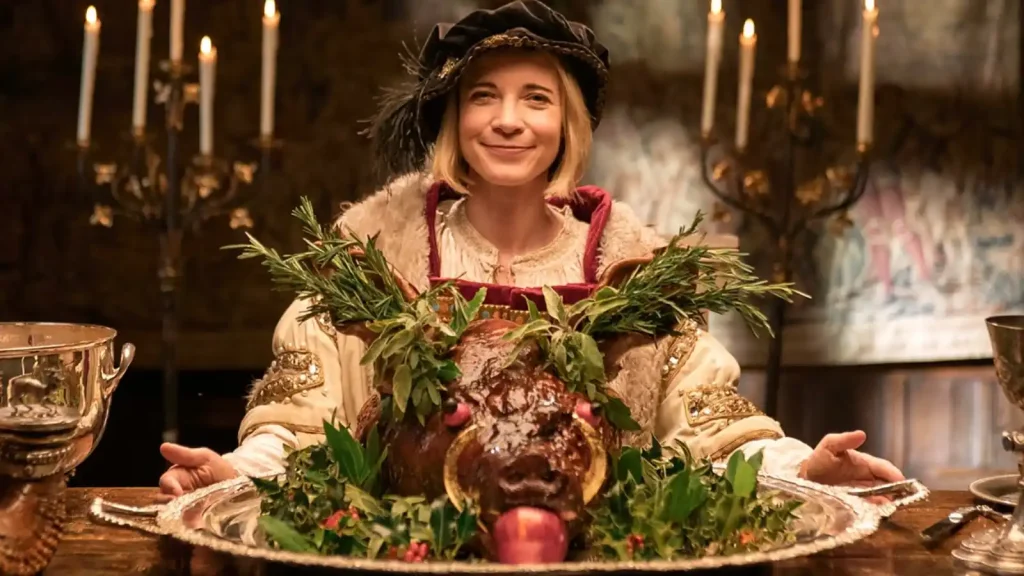
Lucy transforms herself for the occasion. She dresses in full royal costume as Henry VIII himself. The centerpiece of the meal is shocking to modern eyes. It is a stuffed boar’s head. A choir sings praises as the dish arrives. It is a moment of pure theatricality. Afterward, Lucy samples other delicacies. She tries Tudor versions of mince pies. Surprisingly, they are quite different from what we eat today.
Furthermore, she indulges in a sweet tooth’s dream. The Tudors loved sugar. It was a sign of great wealth. Lucy munches on a chess set made entirely of marzipan. She also tastes various sixteenth-century sweets. These sugary treats were the ultimate luxury. They were dazzling displays of power and artistry.
However, the season was not just about eating. It was about entertainment. Lucy joins a group of Tudor carol singers. Together, they perform a festive hit. Remarkably, the song was penned by Henry VIII himself. The King was a talented musician. This highlights a softer side to the often-fearsome monarch.
The revelry continues with a spectacular show. Lucy watches a forerunner of the Royal Variety Show. It is a chaotic and vibrant scene. Dancers dressed as stags leap across the floor. Swords clash in dramatic displays of skill. At the center of the chaos stands the Lord of Misrule. He is an anarchic ancestor of our Father Christmas. Yet, he is wilder and more unpredictable. He ensures the fun gets rowdy.
Nevertheless, Christmas wasn’t only for royalty. Lucy is determined to explore the lives of ordinary people. She wants to know how humble Tudors celebrated. For them, the holidays were a vital escape. Life in the winter was harsh and dark. Therefore, the twelve days of festivities were a welcome break. It was a light in the gloom.
She discovers a surprising fact about Tudor law. The holiday season was the only time for games. Most sports were illegal during the rest of the year. Consequently, people played with intense passion during these twelve days. It was their only chance to let loose. Lucy joins in the fun. She decks a Tudor hall with traditional greenery. Holly and ivy transform the space.
In addition to the games, there was plenty to drink. Lucy tastes the popular beverages of the time. She samples ale and mead. These were the staples for humble folk. They provided warmth against the biting winter chill. The atmosphere is joyous and communal.
But there is also a spooky side to the season. Lucy brings a strange custom back to life. It is a prototype of Halloween trick-or-treating. This tradition feels eerie to modern sensibilities. Yet, it was a standard part of the Tudor winter. It blends the festive with the mysterious.
Beyond the parties, there was serious business. Lucy visits the National Archives. She is thrilled to encounter priceless records. These documents reveal the true cost of Henry VIII‘s celebrations. The numbers are staggering. The King’s lavish lifestyle required immense sums of gold.
Gift-giving was also a high-stakes game. It wasn’t just about generosity. It was about politics. Lucy discovers that presents were an occasion for big spending. Courtiers jockeyed for favor through their gifts. Lucy actually receives some of these historic presents.
For instance, she accepts items offered to the King in 1532. The range of gifts is extraordinary. They vary from cold hard cash to glittering jewelry. However, some gifts were more practical. She receives a brace of greyhounds. Then, she handles a six-foot boar spear. This specific weapon was a gift from Anne Boleyn. It is a chilling reminder of the history behind the festivities.
Amidst the gluttony, religion remained central. Tudor Christmas was far more spiritual than our modern version. Lucy reminds us of the season’s structure. The celebrations only began after a month of fasting. Advent was a time of discipline. The feasting felt more earned because of this denial.
To understand this, Lucy visits a royal chapel. It is one of the ornate places where Henry worshipped. Here, she explores the impact of the Reformation. The religious changes Henry unleashed changed everything. They would eventually alter Christmas forever. The old ways were under threat.
A Merry Tudor Christmas with Lucy Worsley
Throughout the programme, Lucy traces Henry’s personal evolution. We see him change from a handsome prince. We watch him become an ill-tempered old man. His physical and mental decline is palpable. Yet, there are moments of light. Lucy reveals how two of his queens found joy. They managed to enjoy the season despite the tension.
This Yuletide treat is visually stunning. It was filmed at incredible locations. We see the stone walls of Hever Castle. We visit the historic Ingatestone Hall. The cameras capture the beauty of Penshurst Place. Additionally, we see the ancient farm buildings of the Weald and Downland Museum. These settings ground the story in reality.
Expert contributors add depth to the narrative. Historic performance specialist Charlotte Ewart shares her knowledge. Early music specialists Passamezzo provide the soundtrack. Professors Maria Hayward and Meg Twycross offer academic insights. Finally, Father Anthony Howe adds religious context. He is the chaplain to Her Majesty’s Chapel Royal at Hampton Court.
The structure of the show is clever. On each of the twelve days, Lucy explores a new topic. She uncovers fresh insights daily. We learn about the Tudor mind. We see their fears and their joys. Ultimately, A Merry Tudor Christmas with Lucy Worsley casts a new light on the season. It connects our present to the past. It shows us that the spirit of celebration is timeless.
A Merry Tudor Christmas with Lucy Worsley
A Merry Tudor Christmas with Lucy Worsley takes us on a journey through time to uncover how the festive season was celebrated during the reign of Henry VIII. In this exploration of history, we leave behind the modern symbols of the holiday to discover a world of twelve-day feasts, religious abstinence, and subversive social rituals. By stepping into the mindset of the sixteenth century, we gain a new perspective on our own festive heritage and the roots of customs that have survived for five hundred years.
Understanding tudor christmas requires stripping away the inventions of the Victorian era and the commercialism of the twenty-first century. Today, we think of Christmas as a time for stockings, Santa Claus, and decorated trees, yet none of these existed when Henry VIII was on the throne. To truly appreciate the origins of our traditions, we must look at how the people of the countryside and the royals at hampton court marked the mid-winter period.
This historical documentary serves as a vivid window into a time when the calendar was dictated by the church and the rhythms of rural life. While we might start our festivities in November, for the Tudors, the lead-up to the holiday was a period of strict abstinence and hard labor. The transformation from this period of fasting to the twelve days of unrestrained partying is one of the most fascinating shifts in English cultural history.
Exploring tudor history through its seasonal celebrations reveals a society that was deeply religious yet capable of extreme revelry. Lucy Worsley provides an immersive look at this era by recreating the tastes, smells, and sounds of the sixteenth century. From the enormous expenditure of the royal household to the simple “dole” given to the poor, every aspect of the season was designed to reinforce social bonds and political power.
The transition from the cold, miserable work of late December to the official start of the holiday was marked by the birth of Christ. According to the church calendar, this period of rest and celebration lasted from the twenty-fifth of December until the coming of the three wise men on Twelfth Night. It was a time when the law enshrined a total cessation of work, allowing even the lowliest subjects to participate in the festivities.
As we move from the farmhouse to the palace, we see how the scale of celebration increased with wealth and status. Henry VIII used the season to make a political point, spending vast sums of money to show his generosity and secure his popularity. This blend of piety and excess created a unique atmosphere that defined the English winter for generations.
The following sections will detail the specific rituals, culinary delights, and social upheavals that characterized the twelve days of the holiday. We will examine the religious foundations of the season, the elaborate gift-giving ceremonies at court, and the chaotic “misrule” that turned the social hierarchy upside down. By reconstructing these events, we can better understand the world that Henry VIII inhabited.
Finally, we will look at how the Reformation eventually changed these traditions, leading to the loss of many ancient customs. Despite the centuries that have passed, the core sentiment of the season—to make good cheer and be right merry—remains a constant. Through the lens of this period, we find a Christmas that is wilder, weirder, and more profound than anything we experience today.
The Foundations Of A Merry Tudor Christmas with Lucy Worsley
To understand the sixteenth-century holiday, one must first recognize that the month of December was divided into two distinct halves. The first twenty-four days were known as Advent, a period governed by the strict rules of the Catholic Church. During this time, the population engaged in a four-week fast that prohibited the consumption of meat and dairy. For the average person, this meant a grim diet during the coldest and darkest time of the year, while work in the countryside continued unabated.
The atmosphere of the countryside on December the twenty-fourth remained focused on labor, often involving unpleasant and miserable tasks in the winter cold. Unlike the modern era, where shopping and partying begin weeks in advance, the Tudors did not celebrate until the religious calendar permitted. This period of abstinence served to make the subsequent twelve days of feasting feel like a genuine and much-needed release from the hardships of daily life.
On Christmas Eve, the only festive activity allowed was the decoration of homes and parish churches. Tudor people used evergreens like holly, ivy, bay, and rosemary to deck their halls, a practice that symbolized a promise of the return of spring. One unique custom involved decorating the spinning wheel to render it inoperable, signaling that no work should be done during the holiday. This act of “de-tooling” the household was a powerful symbol of the transition from labor to leisure.
Royal Excess And The Feast At Hampton Court
Once the fast ended with Midnight Mass, the feasting began in earnest, particularly at the royal residences. Henry VIII owned more than fifty grand properties, but his favorite location for the winter season was the palace at hampton court. The scale of the royal celebrations was staggering; in his first year as king, Henry spent £7,000 on Christmas alone. To put this in context, his father had spent only £12,000 for the entire household’s annual provision.
The royal kitchens were the heart of this activity, where food historian Annie Grey notes that meat was the primary focus of the menu. Roasts were a centerpiece of the meal, featuring beef, venison from the King’s own deer herds, and spectacular “spectacle birds” like peacock and swan. These dishes were designed to scream wealth and status, serving as a form of “bling” that demonstrated the King’s absolute power and largesse.
Pies were also prominent on the menu, though the mince pies of the era were quite different from modern sweet treats. These “shred pies” were a savory course, containing finely minced suet, beef, and exotic spices like grains of paradise from West Africa and cubeb pepper from Java. The mixture of meat and dried fruits like currants and prunes created a “grown-up” flavor profile that reflects a time before the strict demarcation between sweet and savory dishes.
Symbolic Centerpieces Of A Merry Tudor Christmas with Lucy Worsley
The true star of the royal feast was the boar’s head, a dish so significant it arrived with its own solemn ceremony and carol. The boar was an animal Henry VIII personally liked to hunt with his specialized spears, and its presence on the table was a display of macho prowess. The head was brined for two weeks in red wine and spices, stuffed, boiled for seven hours, and finally decorated with gilded tusks and “angry” red eyes.
Feasting at court was a highly structured affair, even when the King ate in his private dining chamber away from prying eyes. Henry would be served by a royal carver who selected the “choicest morsels” for his plate. This practice of picking and choosing allowed the young, “virile” King to maintain his slender figure while surrounded by an overwhelming abundance of food. The leftovers, known as “broken meate,” were not wasted but distributed to the poor at the palace gates as alms.
The boar’s head carol was even included in the very first book of Christmas carols printed in England during the early years of Henry’s reign. This highlights how music and dining were inextricably linked in the sixteenth century. The combination of religious song and the presentation of “the rarest dish in all the land” underscored the idea that the holiday was both a spiritual event and a physical celebration of the senses.
Charity And Social Order During The Feast Of Stephen
On December the twenty-sixth, known then as the Feast of Stephen rather than Boxing Day, the focus shifted toward charity and the “dole.” St. Stephen was venerated for his charitable works, and in a society where a third of the population lived in poverty, this was a vital custom. Many local landowners followed a contract of hospitality, inviting their tenants to a feast where the rich and poor would banquet together, provided the “miser” opened his door.
However, this charity often came with specific strings attached that reinforced the existing social hierarchy. Historical documents from villages in Somerset reveal that while a landowner might provide bread, ale, and meat with mustard, the tenants were required to bring a gift in return, such as a hen. This was not a modern concept of “no-strings” giving, but a ritualized exchange that ensured everyone stuck to their place in the “pecking order.”
Despite these underlying rules, the holiday allowed for a general relaxation of the strictures of daily life. The Tudor poet Thomas Tusser noted that at Christmas, the door was opened to all, and the spirit of the season encouraged a degree of harmony between the classes. This period of “open house” was a rare break in the rigid structure of tudor history, though it was carefully managed to prevent any real threat to the established order.
The Anarchy Of Misrule And A Merry Tudor Christmas with Lucy Worsley
One of the most subversive elements of the twelve days was the appointment of the Lord of Misrule. This individual, often a high-status courtier or sometimes even a servant, was put in charge of the court’s entertainment. Known by titles such as “The Christmas Prince” or “The King of Christmas,” he acted as a producer and director of “court-ordered chaos.” His role was to organize games, plays, and “disguisings” that parodied the normal operations of the court.
The activities overseen by the Lord of Misrule involved a degree of “edgy anarchy” that often pushed the boundaries of safety. Historical records indicate that these festivities could sometimes get out of control, leading to riots or even accidental deaths. Nevertheless, the practice was a vital “safety valve” for society, allowing people to turn the world upside down for a brief period before returning to the strict hierarchy of the rest of the year.
The Lord of Misrule is often seen by historians as a potential forerunner to the modern Father Christmas. His presence at the center of the revelry, leading his “band of lusty guts” in drinking and sport, created a festive ringleader that embodied the spirit of the season. This “courtly mayhem” was not limited to the palace but was recorded in aristocratic houses, towns, and villages across the kingdom, showing how widespread the desire for festive subversion truly was.
Spiritual Depths And The Commemoration Of Holy Innocents
The holiday was not merely a non-stop party; it possessed solemn depths that are often overlooked in our more secular age. The fourth day of Christmas was the Feast of the Holy Innocents, or Childermass, which commemorated the biblical account of King Herod’s murder of male infants. This was a day of religious mourning, and it resonated deeply in an era where infant mortality was extremely high and many parents lost children before they reached adulthood.
The “Coventry Carol,” a famous song from this period, offers a window into the genuine grief of Tudor mothers. The lyrics, including the haunting phrase “lully, lullay,” were written in everyday spoken English and performed in folk plays. This music allowed the population to express their sorrows within the framework of the holiday, proving that the season was a complex blend of celebration and spiritual reflection.
Even on such a somber day, feasting continued, as the Tudors believed that mourning and celebration could coexist. Carol books from the era show that these songs were sung in taverns, markets, and homes rather than in the church. The church was actually the last place one would expect to hear carols, as they were viewed as secular or folk entertainment that focused as much on drinking and dancing as they did on religious subjects.
The Strategic Exchanging Of Gifts On New Year’s Day
In the sixteenth century, the primary day for gift-giving was not Christmas Day, but the first of January. This was a highly political and ritualized event reserved for the rich and powerful, centered entirely around the King. Henry VIII kept meticulous records of every gift he received and gave, listing them by weight in ounces of gold and silver. These “New Year’s gift rolls” serve as a psychological map of the King’s relationships and the shifting power dynamics of his court.
The gift-giving ceremony took place in the “full face of the court,” where everyone could see and judge what was being presented. The quality and value of a gift directly signaled an individual’s importance and their current standing in the King’s favor. For Henry, the exchange was less about personal affection and more about a form of “bribery” to ensure the loyalty of the bishops and nobility who led his armies and paid his taxes.
The 1532 gift roll provides a particularly sinister example of how Henry used this ritual to “disappear” those who had fallen from grace. The entry for Queen Catherine of Aragon was left blank that year, as she had been banished from court during the “psychodrama” of their failing marriage. In her place, Anne Boleyn was “waiting in the wings,” presenting the King with a Biscayan dart for boar hunting—a well-judged gift that signaled her awareness of his favorite sports and her impending rise to power.
Popular Presents And The Pampered Pets Of The King
While gold and silver plate were the most common gifts for the high-ranking clergy, the nobility often gave more personal or practical items. Aristocratic women frequently gave the King shirts, which were considered luxurious and desirable items. Given that a king might change his shirt three or four times a day, receiving twenty or thirty of them at New Year was a practical necessity. These garments allowed the givers to have the “pleasure” of seeing the King wear their handiwork.
Another popular gift for Henry VIII was money, often presented in opulent packaging such as a single decorative glove. The Earl of Oxford, for instance, famously gave the King ten sovereigns inside a glove, making it the sixteenth-century equivalent of a Christmas stocking filled with hard cash. Cash accounted for over a fifth of the presents Henry received in 1532, and the Venetian ambassador noted that the King essentially made a profit on his holiday gifts every year.
Henry’s love for animals was also reflected in the gifts he received, most notably greyhounds. These dogs were “well and truly pampered,” living in kennels at all the major palaces and being transported between them in specialized carts so they did not have to walk. A brace of greyhounds from the Countess of Westmorland was a gift guaranteed to melt the King’s heart, demonstrating that even a monarch who used gifts as political tools could be moved by a “brace of fine beasts.”
The Culinary Climax Of Twelfth Night And The Sugar Banquet
The festivities reached their ultimate peak on Twelfth Night, also known as Epiphany. This was the day for the “big bash,” featuring a sumptuous banquet that focused entirely on the sweet course. In the Tudor era, a “banquet” was a separate meal of prestigious and expensive treats designed to make the eyes and the palate “zing.” The star of this course was sugar, which was phenomenally expensive as it had to be imported from the Near East.
The royal confectioners created elaborate “sugar plate” figures and objects, such as a gold box made entirely of edible sugar and real gold leaf. Marchpane, the ancestor of marzipan, was modeled into intricate shapes like chess sets. Lucy Worsley notes that these sets, such as the “courier board” Henry sent to the King of France, were flavored heavily with rose water. The taste of these sweets was floral and “zingy,” providing a sugar high that would make any modern “kids’ party” look tame.
Another staple of the Twelfth Night table was the “great cake” or “rich cake,” a precursor to our modern Christmas cake. These cakes were massive, with some recipes calling for “cake hoops a yard across.” They were packed with dried fruits and spices to demonstrate the owner’s wealth. As Henry VIII aged and “piled on the pounds,” his fondness for these rich, spicy cakes only grew, making them the defining flavor of the holiday’s end.
The Professional Artistry Of The Twelfth Night Mask
The twelve days of celebration concluded with a spectacular form of entertainment known as the mask. This was a highly stylized blend of dance, drama, and music, often choreographed by specialists and performed by members of the court. Unlike professional theater, which did not yet exist, the mask allowed the nobility to show off their sophistication through classical references to goddesses like Juno and Diana. These performances were often symbolic debates between virtues, such as married love and chastity.
The mask was not just “po-faced entertainment” but a prime opportunity for flirting and social maneuvering. It featured “dance-offs” between groups, such as “the peacocks and the stags,” and mock combats that displayed a courtier’s nimbleness with a sword. Being a successful courtier required being as skilled on the dance floor as on the battlefield, as these displays of prowess were essential for maintaining status and catching the King’s eye.
A notable event occurred during the festivities of 1541, where the “old wife” Anne of Cleves and the “new wife” Catherine Howard actually danced together after Henry had gone to bed. This moment of harmony between the King’s wives highlights the unique social atmosphere of the holiday. The mask ended with “the revels,” where all the guests joined the performers on the floor, bringing the twelve-day journey through tudor history to a high-energy, celebratory conclusion.
The Reformation And The Decline Of The Twelve Days
The religious revolution unleashed by Henry VIII in the 1530s eventually transformed how Christmas was celebrated in England. By breaking away from the Catholic Church and becoming the supreme head of the Church of England, Henry set in motion a movement that would eventually clamp down on many of the traditions he loved. The new Protestant faith had little room for the many saint’s days that structured the twelve-day holiday.
The most zealous followers of this new religious path, the Puritans, felt that Christians should be far more “godly and sober.” They viewed the Lord of Misrule, the mumming, and the excessive drinking as “fripperies” that distracted from the true meaning of the season. This cultural shift culminated in the seventeenth century under Oliver Cromwell, who officially abolished Christmas. While the holiday was restored after the Civil War, many of the ancient, wilder traditions were lost forever.
It is a profound irony of tudor history that Henry VIII, a man who spent thousands on his festivities and loved the seasonal revelry, initiated the Reformation that would eventually kill off those traditions for centuries. However, the core sentiment of the season managed to endure. The Tudor carols that urged people to “drive the cold winter away” with holly, ivy, and good cheer still resonate today, proving that the human need for light and warmth in the mid-winter remains unchanged five hundred years later.
FAQ A Merry Tudor Christmas with Lucy Worsley
Q: What makes A Merry Tudor Christmas with Lucy Worsley different from typical historical documentaries?
A: This programme stands apart through its immersive experiential approach. Lucy Worsley doesn’t merely narrate historical facts from a distance. Instead, she physically embodies Tudor life by wearing authentic period clothing, consuming sixteenth-century food and drink, and participating in original festivities. Consequently, viewers witness history as a living, breathing experience rather than abstract information. The show recreates specific events like Henry VIII’s royal feast at Hampton Court Palace, complete with elaborate dishes such as stuffed boar’s head. Additionally, expert contributors including food historians, early music specialists, and religious scholars provide layered academic depth. This multi-sensory reconstruction transforms our understanding of how Christmas traditions evolved over five hundred years.
Q: How did Tudor Christmas celebrations differ fundamentally from modern holiday practices?
A: The Tudor Christmas season bore little resemblance to contemporary celebrations. First, the festivities lasted twelve full days from December 25th through Twelfth Night, not just one or two days. Moreover, this period followed a strict month-long Advent fast prohibiting meat and dairy consumption. The modern symbols we cherish—Christmas trees, Santa Claus, stockings—simply did not exist in Henry VIII’s era. Gift-giving occurred on New Year’s Day rather than Christmas morning and served primarily political purposes at court. Furthermore, the holiday blended intense religious devotion with anarchic revelry through figures like the Lord of Misrule. Entertainment featured masques, sword displays, and carol singing in taverns rather than churches. This juxtaposition of piety and excess created an atmosphere far wilder and more spiritually profound than today’s commercialized season.
Q: What role did food play in Tudor Christmas celebrations at Hampton Court?
A: Food served as the ultimate display of royal power and wealth during Tudor festivities. Henry VIII spent £7,000 on Christmas in his first year as king alone—an astronomical sum when his father had budgeted only £12,000 for the entire household annually. The royal kitchens produced spectacular centerpieces including roasted peacock, swan, and venison from the King’s personal deer herds. However, the crowned jewel was the boar’s head, brined for two weeks in red wine and spices, then presented with ceremonial carols. Tudor mince pies differed dramatically from modern versions, containing savory minced beef, suet, and exotic spices like grains of paradise from West Africa. Sugar treats represented phenomenal luxury, with marzipan chess sets and entire boxes crafted from edible gold leaf delighting guests at Twelfth Night banquets.
Q: Who was the Lord of Misrule and what function did he serve?
A: The Lord of Misrule acted as master of ceremonies for court entertainment, orchestrating what historians call “court-ordered chaos.” This appointed figure—sometimes a high-ranking courtier, occasionally even a servant—organized games, plays, and disguisings that deliberately parodied normal court operations. His alternative titles included “The Christmas Prince” or “The King of Christmas,” reflecting his temporary authority. The position embodied sanctioned anarchy, allowing society to turn hierarchies upside down temporarily as a vital safety valve. Activities under his direction could be dangerously edgy, with historical records documenting riots and accidental deaths. Nevertheless, this subversion was considered essential for social harmony. Many historians view him as a forerunner to Father Christmas, though far wilder and more unpredictable. His presence ensured that revelry remained rowdy across aristocratic houses, towns, and villages throughout the kingdom.
Q: Why was New Year’s Day the primary gift-giving occasion rather than Christmas?
A: New Year’s gift exchanges served distinctly political purposes in Tudor court culture. Henry VIII maintained meticulous records of every present given and received, weighing them in ounces of gold and silver. These gift rolls functioned as psychological maps of courtly relationships and power dynamics. The ceremony occurred publicly so everyone could witness and judge the value presented, which directly signaled a person’s importance and current favor. Gold and silver plate dominated gifts from high-ranking clergy, while aristocratic women frequently presented luxurious shirts—practical since the King changed shirts three or four times daily. Cash proved surprisingly popular, accounting for over one-fifth of presents in 1532. The 1532 rolls reveal how Henry weaponized this tradition, leaving Queen Catherine of Aragon’s entry blank after banishing her, while Anne Boleyn presented a boar-hunting spear that demonstrated her strategic understanding of his interests.
Q: What spiritual elements balanced the excessive revelry of Tudor Christmas?
A: Despite raucous festivities, Tudor Christmas possessed profound religious depths often overlooked today. The celebration only commenced after a grueling month-long Advent fast, making subsequent feasting feel genuinely earned through disciplined denial. The fourth day marked the Feast of Holy Innocents or Childermass, commemorating King Herod’s biblical massacre of male infants. This solemn observance resonated deeply in an era of devastating infant mortality rates. The haunting “Coventry Carol” with its “lully, lullay” lyrics allowed Tudor mothers to express genuine grief within the holiday framework. Interestingly, carols were performed in taverns, markets, and homes rather than churches, as they were considered secular folk entertainment. The church calendar structured the entire twelve-day period, with each saint’s day carrying specific meaning. This complex blend of mourning and celebration created a spiritually rich season far more textured than our contemporary secular approach.
A: December 26th, known as the Feast of Stephen rather than Boxing Day, centered on carefully structured charitable practices. St. Stephen was venerated for charitable works, particularly crucial when a third of the population lived in poverty. Many landowners followed a “contract of hospitality,” inviting tenants to feast together, creating rare moments when rich and poor banqueted side by side. However, this generosity came with explicit conditions that reinforced existing social structures. Historical documents from Somerset villages reveal that while landowners provided bread, ale, and meat with mustard, tenants were required to bring gifts like hens in return. This ritualized exchange ensured everyone maintained their proper place in the pecking order. The “dole” of leftover food from royal feasts, known as “broken meate,” was distributed to the poor at palace gates. Thus, charity served dual purposes: genuine relief for the needy and public demonstration of the wealthy’s benevolent power.
Q: What was the significance of the Twelfth Night banquet and sugar displays?
A: Twelfth Night represented the climactic finale of Tudor festivities, featuring an entirely separate sweet course called a “banquet.” Unlike modern usage, this term described prestigious treats designed to make eyes and palates “zing” with delight. Sugar dominated these displays as the ultimate luxury, phenomenally expensive because it required importation from the Near East. Royal confectioners created elaborate “sugar plate” figures including boxes made from edible sugar and real gold leaf. Marchpane, marzipan’s ancestor, was sculpted into intricate chess sets heavily flavored with rose water, producing a floral, zingy taste. Henry VIII even sent such sets as diplomatic gifts to the King of France. Additionally, massive “great cakes” preceded modern Christmas cakes, with some recipes requiring hoops a yard across. These were packed with dried fruits and spices to showcase wealth. As Henry aged and gained weight, his fondness for these rich confections only intensified.
Q: What were Tudor masques and how did they function as courtly entertainment?
A: Masques represented highly stylized performances blending dance, drama, and music that concluded the twelve-day celebration. Since professional theater didn’t yet exist, nobility themselves performed these choreographed spectacles, often referencing classical goddesses like Juno and Diana. These weren’t merely stuffy entertainment but prime opportunities for flirting and social maneuvering. Performances featured symbolic debates between virtues such as married love versus chastity, plus competitive “dance-offs” between groups like peacocks and stags. Mock sword combats allowed courtiers to display battlefield prowess and dancing floor sophistication equally—both essential for maintaining status. A remarkable 1541 event saw Anne of Cleves and Catherine Howard dancing together after Henry retired, demonstrating the holiday’s unique social atmosphere. Masques concluded with “the revels,” when all guests joined performers on the floor, creating a high-energy finale to the festive season.
Q: How did Henry VIII’s Reformation ironically destroy the Christmas traditions he loved?
A: Henry VIII’s break from the Catholic Church in the 1530s unleashed forces that ultimately dismantled the very festivities he cherished. By establishing himself as supreme head of the Church of England, Henry initiated a religious transformation that eliminated many saint’s days structuring the twelve-day holiday framework. The emerging Protestant faith, particularly its Puritan faction, viewed Christmas revelry as ungodly excess. They condemned the Lord of Misrule, mumming, and heavy drinking as “fripperies” distracting from true religious devotion. This cultural shift culminated in Oliver Cromwell’s seventeenth-century official abolition of Christmas altogether. Although the holiday was restored after the Civil War, centuries of ancient, wilder traditions vanished permanently. This represents a profound historical irony: the monarch who spent thousands on lavish celebrations inadvertently triggered their eventual destruction. Nevertheless, core sentiments survived, proving humanity’s enduring need for mid-winter light and warmth remains constant across five centuries.