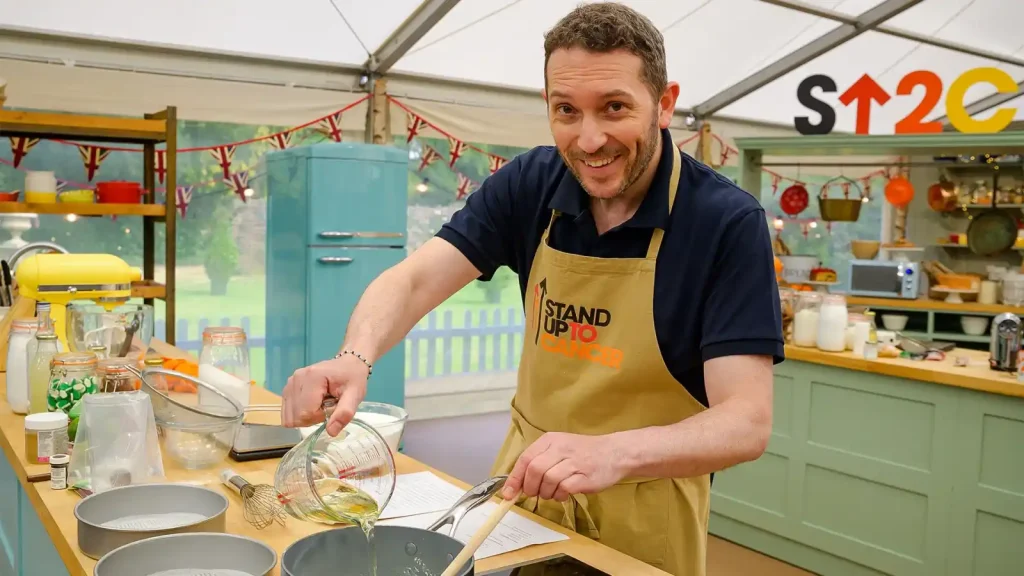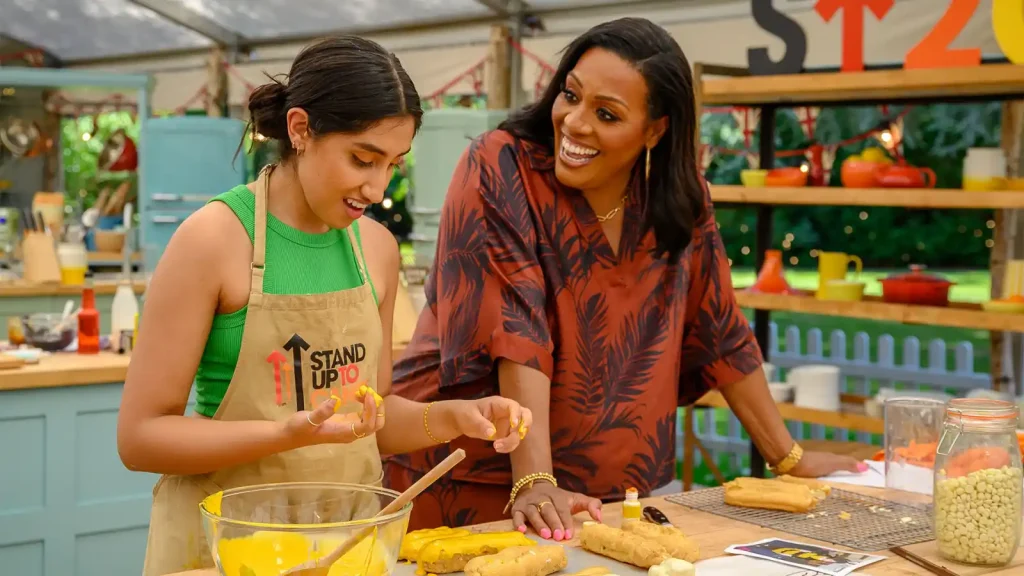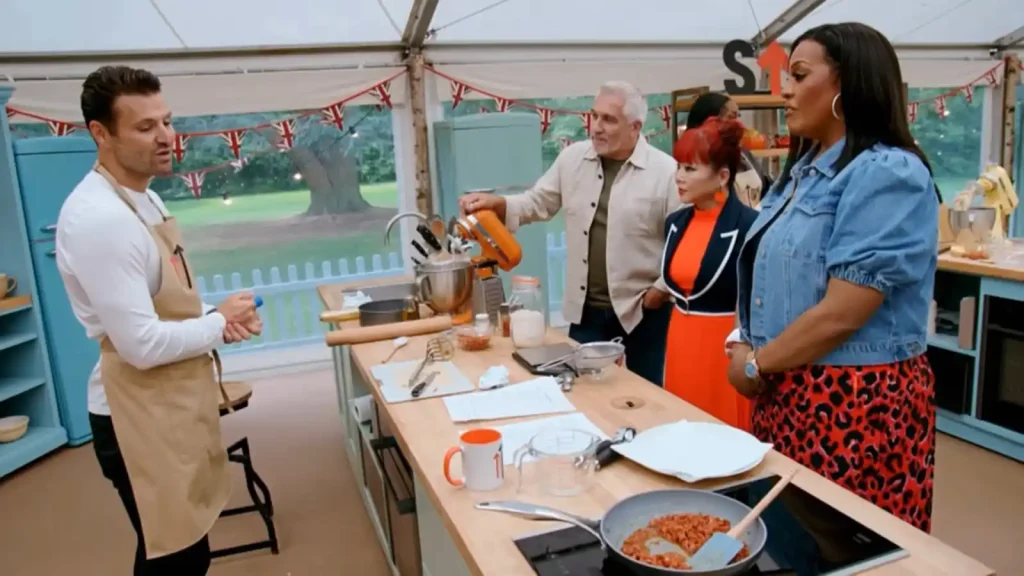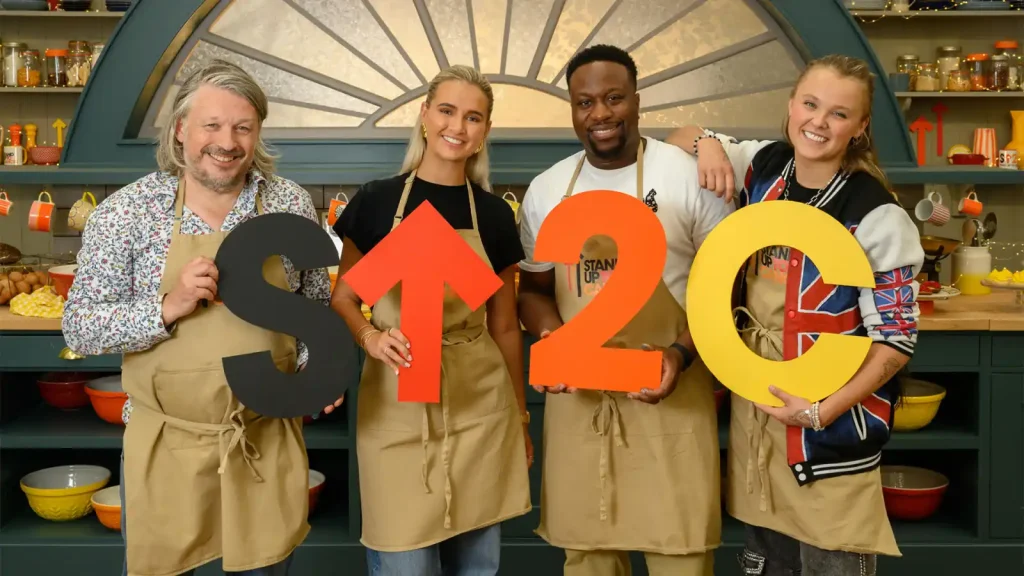
The Great Celebrity Bake Off 2026 episode 2 delivered exactly the kind of controlled chaos that makes the series so compelling to watch — four famous faces, three increasingly demanding challenges, and a tent full of ambition that repeatedly outpaced execution. Molly-Mae Hague, Richard Herring, JoJo Siwa, and Babatunde Aléshé stepped into the famous white marquee carrying very different skill sets, very different temperaments, and, as the day unfolded, very different levels of readiness for what Paul Hollywood had prepared for them. What followed was an episode rich in personality, punctuated by genuine baking disasters, and lifted by moments of real craft and creative daring.
The four bakers arrived under the scrutiny of judges who have seen every possible celebrity baking failure, and who apply the same technical standards whether the person standing at the bench is a professional comedian or a global social media phenomenon. That rigour is precisely what gives the show its tension. Agricultural life and country life provide the bucolic backdrop — the tent sits within a landscape that feels deliberately removed from the pressures of celebrity, encouraging a kind of levelling that the format exploits brilliantly.
The rolling countryside setting, so familiar from programmes celebrating countryfile themes of seasonal rhythms and outdoor craft, creates an irony that the show understands perfectly: nature, wildlife, and the slow patience required for good baking are entirely at odds with the speed and spectacle of modern fame.
The Great Celebrity Bake Off 2026 episode 2 drew its energy from that fundamental tension. Baking demands precision, calm, and accumulated knowledge. Fame, particularly the kind that Molly-Mae Hague and JoJo Siwa have built, tends to reward boldness, instinct, and visual impact. Richard Herring brought a comic’s self-awareness to every stumble, while Babatunde Aléshé balanced competitive spirit with an honesty about his limitations that made him one of the most watchable figures in the tent. Together, the four created an episode that moved through three distinct challenges with increasing stakes and increasing drama.
Across the Signature, Technical, and Showstopper rounds, the bakers tackled decorated traybakes, a classic tarte tatin, and an extraordinary challenge requiring them to recreate childhood toys entirely in biscuit. Each task tested a different combination of skills — flavour instinct, technical knowledge, structural engineering, and decorative artistry — and each produced a different hierarchy of success and failure. The countryfile spirit of honest endeavour and grounded craft hovered over proceedings, a quiet reminder that the tent, however glossy its production, is ultimately about making something real with your hands.
The episode also functioned as a study in how differently people respond to pressure. Molly-Mae Hague arrived with genuine baking experience and a confident aesthetic sensibility. JoJo Siwa brought extraordinary enthusiasm and a colour palette that brooked no subtlety. Richard Herring leaned into failure with the ease of someone accustomed to public humiliation as a professional tool. Babatunde Aléshé worked with focus and ambition, navigating the challenges with a competitive edge that kept him near the front of the pack throughout. By the time the Showstopper concluded, the cumulative picture of all four bakers was vivid, fair, and genuinely revealing.
What makes The Great Celebrity Bake Off 2026 episode 2 worth examining in detail is the quality of the baking conversation that runs beneath the entertainment. Paul Hollywood and Prue Leith did not soften their assessments because their subjects were famous. Their feedback was direct, specific, and consistently grounded in technique — the same standards applied to agricultural life’s seasonal cycles apply here: things either work or they don’t, and the reasons are usually traceable to specific decisions made under pressure. That honesty is what separates the show from mere celebrity spectacle.
The broader context of Countryfile 2026 and its celebration of country life and the natural world provides an interesting lens through which to view the tent’s dynamics. Nature and wildlife operate on their own schedules, indifferent to human ambition. Pastry, similarly, follows its own rules. Butter melts at the temperature it chooses. Caramel burns when neglected. The bakers who fared best in this episode were those who respected those rules rather than trying to impose their own personality on the chemistry. That lesson ran like a thread through every challenge, tying the day’s disasters and triumphs to something larger than any individual performance.
The eight paragraphs above establish the episode’s shape and significance. What follows is a challenge-by-challenge examination of what actually happened inside the tent — who succeeded, who struggled, why the results fell as they did, and what each challenge revealed about the four bakers at the centre of The Great Celebrity Bake Off 2026 episode 2.
The Great Celebrity Bake Off 2026 episode 2
The Great Celebrity Bake Off 2026 Episode 2 Signature Challenge: Decorated Traybakes
The Signature Challenge asked each baker to produce a decorated traybake — a deceptively broad brief that invited creative interpretation while demanding solid foundational baking. A good traybake requires even baking across a wide surface, a balanced flavour profile, and decoration that enhances rather than conceals the bake beneath. All four bakers approached the task with distinct plans, and the divergence in their results was immediate and telling.
Molly-Mae Hague produced a traybake that demonstrated genuine thought about flavour combination and visual presentation. Her decoration showed the kind of considered aesthetic that characterises her wider work — clean, deliberate, and commercially aware. Paul Hollywood’s assessment acknowledged real skill, though he identified areas where the bake itself could have been pushed further. Prue Leith’s response focused on the decorative choices, and the overall picture was of a baker who knows what she wants a finished product to look like and has developed the technique to get reasonably close.
JoJo Siwa’s traybake arrived in a blaze of colour that immediately announced her intentions. JoJo operates in a visual register where more is always more, and her Signature reflected that instinct absolutely. The decoration was bold, exuberant, and unmistakably hers. However, the judges’ feedback pointed to a recurring tension between spectacle and substance — the visual impact was considerable, but the bake beneath the decoration required closer attention to technical execution. It was a pattern that would recur across the day, as JoJo’s enthusiasm consistently generated impressive-looking work that the judges then interrogated at the level of craft.
Richard Herring approached the Signature with characteristic self-deprecation, framing his ambitions modestly and delivering something that hovered between the ambitious and the accidental. His traybake showed moments of genuine flavour interest, but the overall execution was uneven. Richard’s willingness to laugh at his own results gave the segment its comedy, but Paul Hollywood’s assessment was measured and specific — the kind of feedback that acknowledged effort while identifying exactly where the baking had fallen short. Babatunde Aléshé’s Signature demonstrated focus and a genuine desire to produce something technically sound. His approach was methodical, and the result reflected that discipline, placing him towards the stronger end of the field for the opening challenge.
Tarte Tatin and the Technical Challenge in The Great Celebrity Bake Off 2026 Episode 2
The Technical Challenge is the one that strips away preparation, personality, and the safety net of a rehearsed plan. Paul Hollywood’s chosen recipe was a tarte tatin — a classic French dessert built on caramelised apples and a precise, buttery pastry, inverted after baking to reveal a glossy, structured top. The tarte tatin is an unforgiving bake. The caramel must reach exactly the right depth of colour and flavour without burning. The pastry must be handled with restraint. The inversion, performed at the end, either works or it doesn’t.
All four bakers received the same minimal instructions and were left to navigate the recipe largely on instinct and technical knowledge. The results exposed the full range of experience in the tent. JoJo Siwa’s tarte tatin faced challenges from the outset — the caramel proved difficult to manage, and the finished bake reflected those difficulties. Richard Herring’s version generated significant comedy and some genuine tension, as the inversion stage produced results that he greeted with the resigned good humour of someone who had already accepted the outcome. His placing reflected the technical shortfalls honestly.
Molly-Mae Hague’s tarte tatin showed more control, with Paul Hollywood’s feedback indicating a clearer understanding of the pastry requirements and a more disciplined approach to the caramel stage. Babatunde Aléshé’s performance in the Technical was strong enough to place him at or near the top of the ranking, reflecting his methodical approach and competitive instincts. The Technical Challenge ranking placed Babatunde first, confirming that his measured, disciplined approach translated directly into better results when the comfort of preparation was removed. The country life ethic of working carefully within natural constraints — so central to programmes like Countryfile 2026 — applied here with absolute directness.
Childhood Toys in Biscuit: The Showstopper Challenge in The Great Celebrity Bake Off 2026 Episode 2
The Showstopper Challenge asked each baker to recreate a childhood toy using biscuit as the primary medium. This was a task that tested structural engineering, decorative skill, flavour ambition, and — perhaps most importantly — the ability to manage time across a complex, multi-component build. A biscuit showstopper demands that every element be baked, cooled, assembled, and decorated within the time limit, with no margin for structural failure or decorative shortcuts.
JoJo Siwa’s childhood toy selection was entirely in keeping with her broader persona — vivid, large-scale, and packed with detail. Her Showstopper made an immediate visual impact that generated genuine responses from the tent. The colour and ambition were unmistakable, and the scale of what she attempted was considerable. Paul Hollywood and Prue Leith’s assessment acknowledged the visual achievement while returning, as they had throughout the day, to the question of technical underpinning. The biscuit work itself came under scrutiny, and the feedback identified areas where the execution had not fully matched the ambition. Nevertheless, JoJo’s Showstopper captured the spirit of the challenge in a way that was difficult to ignore.
Molly-Mae Hague’s childhood toy biscuit build reflected her characteristic attention to finish. Her choice of subject and her approach to construction showed planning and a clear visual concept executed with genuine care. The judges’ response was positive, with specific praise for the decorative quality and the overall coherence of the design. This was a Showstopper that looked like something conceived in advance and built with real skill — a contrast to some of the more improvisational efforts elsewhere in the tent. Babatunde Aléshé’s Showstopper continued his strong day. His biscuit construction was structurally sound and flavourful, reinforcing the consistency he had shown across all three challenges.
Richard Herring’s Showstopper generated the episode’s most memorable comedy, as his childhood toy choice and its biscuit incarnation diverged from the intended vision in ways that Richard narrated with forensic, cheerful honesty. His willingness to present the result without deflection was endearing, and the judges’ feedback, while pointed, carried the warmth that Richard’s self-awareness tended to produce. His Showstopper was not technically strong, but it was completely, authentically his — which is perhaps the most honest thing that can be said about any bake produced under those conditions.
Molly-Mae Hague’s Performance Across The Great Celebrity Bake Off 2026 Episode 2
Molly-Mae Hague entered the tent with the clearest pre-existing baking capability of the four. Her background suggested someone who had spent genuine time in the kitchen, and her performance across the three challenges confirmed that impression. She approached each task with a plan, executed that plan with reasonable fidelity, and produced results that consistently demonstrated flavour awareness and decorative competence. That combination placed her at or near the top of the field throughout the day.
Her Signature traybake established her credentials early. The decoration showed a developed sense of visual presentation — the kind of finish that comes from practice rather than instinct alone. Paul Hollywood’s technical observations were specific and constructive, identifying refinements rather than fundamental errors, which is a meaningful distinction in a tent where fundamental errors were not in short supply. Prue Leith’s response to the decorative quality was warm, and the overall impression from the Signature round was of a baker operating near the top of her actual ability.
The Technical Challenge reinforced that picture. Molly-Mae’s tarte tatin showed more structural and flavour discipline than several of her competitors, and her placing in the Technical ranking reflected a baker who responds well to the format’s specific pressures. The Showstopper confirmed her as the episode’s most consistently capable baker — someone whose results across all three challenges told a coherent story of preparation, skill, and competitive awareness. Across the full arc of The Great Celebrity Bake Off 2026 episode 2, she was the standout performer.
Babatunde Aléshé and the Value of Discipline in The Great Celebrity Bake Off 2026 Episode 2
Babatunde Aléshé’s day was defined by a quality that the tent consistently rewards but that celebrity participants frequently lack: discipline. He approached each challenge with a clear plan, executed that plan methodically, and produced results that reflected genuine technical engagement rather than inspired improvisation. That approach positioned him as Molly-Mae’s closest competitor across the episode and delivered the day’s most significant single result — a first-place finish in the Technical Challenge.
His Signature traybake showed focus from the outset. Where some of his fellow bakers leaned into personality and spectacle, Babatunde leaned into the bake itself — the flavour logic, the structural requirements, the decorative choices that served the overall concept rather than competing with it. The judges recognised that discipline in their feedback, identifying a baker who understood that the best celebrity baking comes from taking the craft seriously rather than using it as a vehicle for entertainment.
The Technical win was the episode’s most unambiguous statement of ability. Stripped of preparation and visual aids, Babatunde navigated the tarte tatin with enough control to place first in a challenge designed specifically to expose gaps in technical knowledge. That result, set alongside consistent Signature and Showstopper performances, made him a compelling figure throughout the episode. The agricultural life analogy is apt — in country life, consistent, careful work across a season produces results that a single spectacular intervention cannot match. Countryfile 2026 understands that rhythm, and so, it seemed, did Babatunde.
JoJo Siwa’s Baking in The Great Celebrity Bake Off 2026 Episode 2
JoJo Siwa brought a quality to the tent that no other baker in the episode possessed: absolute, unqualified commitment to her own aesthetic. Every bake she produced was unmistakably hers — saturated in colour, generous in scale, and utterly without self-consciousness about the spectacle it created. That commitment was both her greatest strength and the source of her most consistent challenge, because Paul Hollywood and Prue Leith are interested in what lies beneath the spectacle as well as what sits on top of it.
The tension between JoJo’s instinct for visual impact and the judges’ requirement for technical foundation ran through all three challenges. Her Signature traybake was visually striking and immediately identifiable as her work, but the feedback pointed to areas where the bake itself needed to match the decoration’s ambition. Her Technical Challenge tarte tatin faced the specific difficulties that the caramel and pastry stages impose on bakers who approach the task through instinct rather than training. Her Showstopper was perhaps her most successful integration of personality and execution — the scale and colour were fully JoJo, and the biscuit work showed enough craft to earn genuine praise alongside the predictable comments about restraint.
JoJo’s day was honest in the way that the tent tends to make celebrity baking honest. Her results reflected exactly where her skills currently sit — genuinely enthusiastic, visually distinctive, and developing technically. In the context of nature and wildlife, where organisms develop at their own pace and on their own terms, JoJo’s baking trajectory feels entirely coherent: a talent operating at its own speed, in its own colour palette, toward its own version of mastery.
Richard Herring’s Approach to The Great Celebrity Bake Off 2026 Episode 2
Richard Herring’s relationship with the tent was defined by a particular kind of self-awareness that made him enormously watchable and simultaneously honest about his baking limitations. He arrived not as a baker who happened to be a comedian but as a comedian who happened to be baking, and the distinction mattered across every challenge. His instinct was to find the comic potential in each disaster rather than to prevent the disaster in the first place — a strategy that generated tremendous entertainment and consistently modest results.
His Signature traybake had moments of genuine flavour interest, but the overall execution reflected a baker working at the outer edge of his technical comfort. Richard’s willingness to acknowledge that gap — to name the specific thing that had gone wrong and explain it with comic precision — was a quality that the show rewards, because it keeps the baking honest. Paul Hollywood’s feedback was specific and unvarnished, identifying technical shortfalls without softening them for the sake of the format.
The Technical Challenge tarte tatin delivered the episode’s most memorably chaotic inversion moment, and Richard’s response to the result was a masterclass in comic timing applied to genuine misfortune. His Showstopper was similarly authentic — a biscuit construction that diverged from its intended form in ways that Richard narrated with the kind of delighted self-deprecation that only comes from someone entirely comfortable with public failure. Across the full episode, Richard occupied exactly the role the show needed him to occupy: genuinely funny, genuinely limited as a baker, and entirely honest about both. The countryfile spirit of celebrating honest effort alongside skilled execution found its purest expression in his day.
Judging Standards and Technical Feedback in The Great Celebrity Bake Off 2026 Episode 2
The judging across The Great Celebrity Bake Off 2026 episode 2 was notably rigorous — a quality that gives the celebrity format its credibility and distinguishes it from the softer versions of competitive baking that sometimes appear elsewhere. Paul Hollywood’s assessments were direct, technically grounded, and consistent across all four bakers. He did not modulate his standards according to the celebrity status of the person in front of him, which is the fundamental requirement for the format to function as anything more than affectionate entertainment.
Prue Leith’s feedback complemented Hollywood’s technical focus with a broader sensibility that took in flavour, presentation, and the overall impression a bake creates. Her responses to JoJo’s visual exuberance were warm but honest; her engagement with Molly-Mae’s more considered aesthetic was specific and appreciative; her feedback to Richard acknowledged the comedy without allowing it to substitute for baking quality. Together, the two judges created a feedback environment in which all four bakers received genuine, useful assessments of their work.
That rigour is particularly important in the celebrity context because it sets the standard against which the bakers’ performances can be measured. Agricultural life and country life offer a similar kind of honest accounting — in nature and wildlife, outcomes reflect the conditions and the effort applied. There is no celebrity discount for a caramel that burns or a biscuit structure that collapses. The tent applies the same principle, and the judging in episode 2 of The Great Celebrity Bake Off 2026 reflected that commitment fully. Countryfile 2026’s celebration of honest, skilled engagement with the natural world finds its baking equivalent in the tent’s unsparing assessment of what the four bakers actually produced.
The Star Baker and the Final Outcome of The Great Celebrity Bake Off 2026 Episode 2
The cumulative evidence across the Signature, Technical, and Showstopper challenges pointed clearly toward Molly-Mae Hague and Babatunde Aléshé as the episode’s strongest performers. Molly-Mae’s consistency across all three rounds — her Signature’s decorative quality, her Technical’s structural discipline, her Showstopper’s coherent execution — built the kind of cumulative case that Star Baker decisions are made on. Babatunde’s Technical win and his strong performances across the other two challenges kept him in direct competition with her for that recognition.
JoJo Siwa and Richard Herring occupied the lower end of the day’s rankings, though for very different reasons. JoJo’s results reflected a genuinely developing baker whose technical skills have not yet caught up with her creative ambition — a gap that time and practice address. Richard’s results reflected a comedian who approached the tent as an experience rather than a competition, producing entertainment of consistently high quality and baking of genuinely limited quality. Both outcomes were honest, and both were in keeping with what each baker brought to the tent.
The episode’s conclusion, like every episode of The Great Celebrity Bake Off 2026, resolved in a specific judgement that the accumulated evidence of the day’s baking made inevitable. The star baker award and the tent’s final assessment reflected exactly what the four bakers had produced — no more, no less. It is that fidelity to the actual quality of the baking, set within a format that celebrates the attempt as much as the achievement, that makes The Great Celebrity Bake Off 2026 episode 2 worth watching carefully and remembering with genuine affection.
FAQ The Great Celebrity Bake Off 2026 episode 2
Q: Who are the four celebrity bakers competing in The Great Celebrity Bake Off 2026 episode 2?
A: The four celebrities are Molly-Mae Hague, Richard Herring, JoJo Siwa, and Babatunde Aléshé. Each brings a very different personality and skill level to the tent. Judges Paul Hollywood and Prue Leith assess all four using the same rigorous standards applied across the main series.
Q: What are the three challenges in The Great Celebrity Bake Off 2026 episode 2?
A: The episode features a Signature decorated traybake, a Technical Challenge tarte tatin set by Paul Hollywood, and a Showstopper requiring each baker to recreate a childhood toy entirely in biscuit. Each challenge tests a distinct combination of flavour instinct, technical knowledge, and decorative skill.
Q: How does Molly-Mae Hague perform in The Great Celebrity Bake Off 2026 episode 2?
A: Molly-Mae is the episode’s most consistently strong performer. Her Signature traybake impresses with its decorative quality and flavour balance. She handles the Technical tarte tatin with discipline and delivers a well-planned Showstopper. Her results across all three rounds establish her as the standout baker of the episode.
Q: What makes the tarte tatin Technical Challenge so demanding for celebrity bakers?
A: The tarte tatin requires precise caramel work, restrained pastry handling, and a nerve-testing inversion at the end. Bakers receive minimal instructions, relying entirely on instinct and existing knowledge. Caramel burns easily when neglected, and the pastry demands a light touch. These combined pressures expose technical gaps that preparation alone cannot conceal.
Q: Who wins the Technical Challenge in The Great Celebrity Bake Off 2026 episode 2?
A: Babatunde Aléshé wins the Technical Challenge, placing first in the tarte tatin round. His methodical, disciplined approach gives him a clear advantage when the safety net of preparation is removed. The result confirms that consistent, careful technique produces stronger outcomes than instinct alone under Technical conditions.
Q: How does JoJo Siwa approach baking in The Great Celebrity Bake Off 2026 episode 2?
A: JoJo commits fully to her signature aesthetic, producing bakes that are bold, colourful, and large in scale. Her enthusiasm generates immediate visual impact across all three challenges. However, Paul Hollywood and Prue Leith consistently identify a gap between her decorative ambition and her underlying technical execution, particularly in the Signature and Technical rounds.
Q: What role does Richard Herring play in The Great Celebrity Bake Off 2026 episode 2?
A: Richard approaches the tent as a comedian first and a baker second. He treats each setback with self-deprecating honesty and comic precision. His tarte tatin inversion and his Showstopper biscuit build both generate memorable moments. Additionally, his willingness to name exactly what went wrong keeps the baking honest and the episode genuinely entertaining.
Q: What does the Showstopper childhood toy challenge involve in The Great Celebrity Bake Off 2026 episode 2?
A: Each baker must recreate a personal childhood toy using biscuit as the primary building material. The challenge demands structural engineering, precise baking, and careful assembly within a strict time limit. Furthermore, decoration must enhance the overall concept rather than substitute for sound construction. Flavour, finish, and ambition all factor into the judges’ assessment.
Q: How do Paul Hollywood and Prue Leith judge celebrity bakers differently from standard contestants?
A: They do not judge celebrity bakers differently. Both judges apply identical technical standards regardless of fame or public profile. Hollywood’s feedback targets specific craft failures directly, while Leith addresses flavour, presentation, and overall impression. This consistency is what gives the celebrity format genuine credibility beyond its entertainment value.
Q: What is the overall result at the end of The Great Celebrity Bake Off 2026 episode 2?
A: Molly-Mae Hague and Babatunde Aléshé emerge as the episode’s strongest performers based on cumulative results across all three challenges. JoJo Siwa and Richard Herring occupy the lower rankings, reflecting genuine skill gaps rather than lack of effort. The final judgement reflects the baking produced on the day, applied without adjustment for celebrity status.