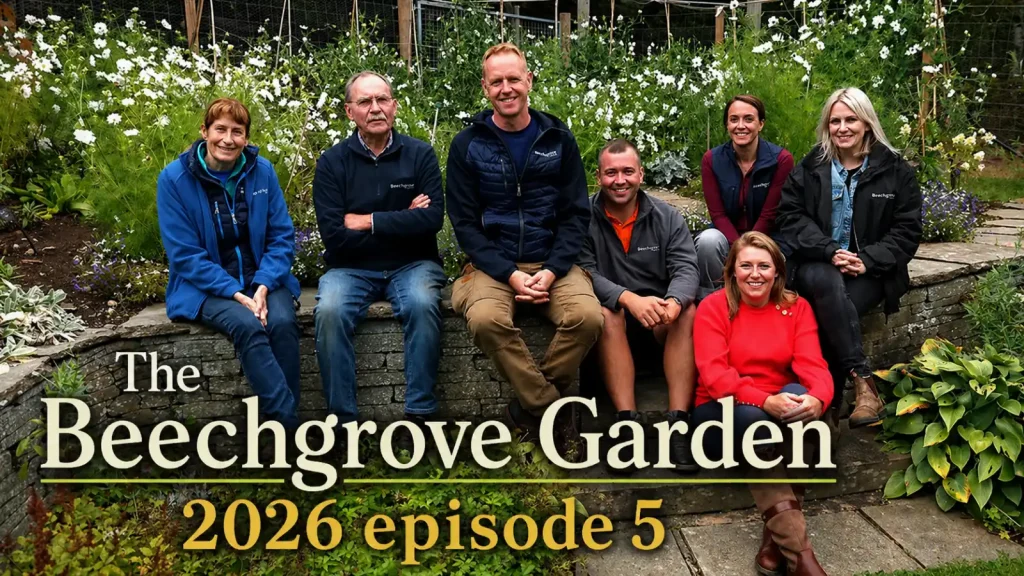
The Beechgrove Garden 2026 episode 4 arrives at a moment when the Scottish growing season is still finding its feet, and yet the team at Beechgrove is already deep into work that will shape the months ahead. Spring in northeast Scotland demands a particular kind of forward thinking — decisions made now in cool soil and uncertain light will determine what fills plates and pleases the eye come summer and autumn. This episode captures that spirit precisely, with two of the garden’s central figures pursuing projects rooted in productivity, practicality, and long-term planning.
George Anderson and Ruth Vichos anchor the episode with work that reflects two very different scales of gardening ambition. George is operating at the scale of the established kitchen garden, returning to his beloved fruit cage after a significant clear-out the previous year. Ruth, meanwhile, is working at the opposite end of the spectrum — demonstrating that even the smallest outdoor space, a patio, a balcony, a narrow strip of ground, can produce a meaningful harvest when the right structures are used. Both approaches speak to a gardening culture increasingly shaped by constraint, whether that constraint is space, time, or the Scottish climate itself.
The episode also makes room for wider garden management, with a visit to Colin Crosbie’s plot near Dumfries for a Back to Basics guide, and an assessment of Beechgrove’s own gravel and grass garden, which faces a season of thinning and replanting. These threads run alongside the main storylines, adding depth and variety to an episode that covers considerable productive ground. The Beechgrove Garden 2026 has always balanced the instructional with the inspirational, and this episode is no exception — every technique demonstrated has a direct application for home gardeners, regardless of how much land they have to work with.
Beechgrove itself sits in Aberdeen, and its climate places genuine demands on its gardeners. The growing season is shorter than in much of the rest of Britain, frosts can arrive late and depart reluctantly, and the soil requires careful management to produce reliably. These conditions are not obstacles so much as the terms under which all good Beechgrove gardening is conducted, and they lend particular weight to the choices made here. A raspberry variety that succeeds at Beechgrove is a raspberry variety that will succeed in many of the harder corners of the UK garden.
Ruth’s vertical garden project carries a kind of urgency that goes beyond personal interest. As urban populations grow and garden sizes shrink, the question of how to produce food in limited space becomes increasingly pressing. Vertical gardening — the practice of growing plants on structures that allow them to climb or stack upwards rather than spreading outward — is one of the most practical responses to that challenge. Ruth returned to a structure she had begun the previous year, and in doing so demonstrated that this approach is not a novelty but a genuine, repeatable method for productive growing.
George’s work in the fruit cage, meanwhile, speaks to a different kind of gardening discipline: the patience required to establish and maintain a space that will produce for years rather than weeks. Replacing old raspberry canes with new varieties requires a willingness to accept a temporary reduction in yield in exchange for better performance over time. His work propagating new fig trees from Beechgrove’s existing specimen adds another layer of long-term thinking — figs do not hurry, and the gardener who grows one from a cutting is making a commitment that will outlast many seasons.
Taken together, these projects offer a coherent vision of what productive gardening looks like in 2026: technically informed, spatially aware, and deeply attentive to the relationship between present effort and future reward. The skills on display — from vertical planting to soft fruit management to fig propagation — are transferable, scalable, and thoroughly grounded in real growing experience. They are not theoretical ideals but practical methods tested in Scottish soil.
What follows moves through each of these elements in detail, drawing on the episode’s demonstrations to offer a thorough account of the techniques, reasoning, and results that make The Beechgrove Garden 2026 such a dependable source of gardening knowledge. From the fruit cage to the vertical garden, from the gravel bed to the allotment near Dumfries, the episode repays close attention.
The Beechgrove Garden 2026 episode 4
Ruth Vichos and the Vertical Garden: Growing Upward in Limited Space
Ruth Vichos began her vertical garden project in the previous season, and episode four sees her returning to it with fresh intent. The structure she uses is designed specifically to allow plants to be grown in stacked layers, effectively multiplying the productive surface area of a small space. For anyone gardening on a patio, a balcony, or a narrow plot, the principle is transformative: instead of spreading outward across ground you do not have, you build upward through air you do.
The vertical structure accommodates a range of plants, and Ruth’s choices reflect a careful balance between what is visually appealing and what is genuinely productive. She plants strawberries in the upper tiers, where they benefit from good light and drainage, and positions other crops at lower levels according to their needs. The result is a layered planting that makes efficient use of every available position on the structure, demonstrating that small-space gardening need not mean reduced ambition.
Ruth is clear that the vertical garden is not simply a display piece. Its purpose is productive, and the episode makes this explicit: the plants chosen are all food crops, and the arrangement is governed by practical logic rather than aesthetics alone. This distinction matters, because vertical gardening is sometimes presented as a decorative idea rather than a serious growing method. Ruth’s approach at Beechgrove pushes back firmly against that perception, treating the vertical structure as a working part of the kitchen garden.
Feeding and Maintaining Vertical Plantings Through the Season
One of the most important practical points Ruth addresses is the question of feeding. Plants grown in vertical structures face particular challenges around nutrition and moisture. Because the growing medium in each tier or pocket is limited in volume, it exhausts its nutrients more quickly than a conventional border or raised bed. Regular feeding is therefore not optional but essential if the plants are to remain productive across the season.
Ruth demonstrates the feeding regime she applies to the vertical garden, using a liquid feed appropriate to the crops in place. The frequency and application method are explained clearly, giving viewers a precise template to follow rather than a vague recommendation. This level of specificity is characteristic of Beechgrove at its best — the instruction is actionable, not merely aspirational. Home gardeners watching can replicate the approach without needing to interpret or adapt it significantly.
Watering, similarly, requires more attention in a vertical structure than in a ground-level planting. Ruth acknowledges this directly, noting that the upper tiers in particular can dry out quickly in warm or windy weather. Building a reliable watering routine from the start of the season is therefore part of the setup, not an afterthought. The vertical garden rewards attentiveness, and Ruth frames this not as a burden but as an extension of the care that any productive garden requires.
The Beechgrove Garden 2026 Fruit Cage: George Anderson Plants New Raspberries
George Anderson’s relationship with the Beechgrove fruit cage is one of the programme’s most enduring storylines, and in episode four it enters a new chapter. After a substantial clear-out the previous year, the cage now has space to receive fresh planting, and George brings in new raspberry varieties to replace what was removed. The choice of varieties is deliberate, reflecting both the specific conditions at Beechgrove and a broader interest in expanding the range of soft fruit available through the season.
Raspberries are among the most rewarding of all soft fruits for Scottish growers. They tolerate cooler summers better than many other crops, they establish relatively quickly, and they produce generously once settled. However, they also deteriorate over time, developing virus problems and losing vigour, which is why periodic replacement is considered good practice rather than failure. George’s decision to clear and replant is therefore a model of sound fruit cage management, not a remediation of something that went wrong.
The new varieties George plants are chosen in part to extend the cropping window. By selecting both summer-fruiting and autumn-fruiting types, he ensures that the fruit cage will be productive across a longer period, rather than delivering everything in a concentrated flush and then going quiet. This kind of planned succession is a recurring theme in Beechgrove’s approach to productive gardening — the goal is always to spread the harvest rather than concentrate it.
Planting Technique and Establishment in the Raspberry Bed
George works through the planting process with the methodical attention to detail that defines his work at Beechgrove. The canes arrive as bare-root stock, and he prepares the bed carefully before planting, working in organic matter to improve the soil’s ability to retain moisture and nutrients. The planting depth and spacing he demonstrates are specific and considered — raspberries planted too deeply can struggle to establish, while overcrowded canes compete for resources and become difficult to manage.
Once planted, the canes are cut back hard. This is a step that often surprises new growers, who may expect to leave the canes at their full height. George explains the reasoning clearly: cutting back encourages the plant to direct its energy into root establishment rather than top growth, which leads to a stronger and more productive plant in subsequent seasons. The short-term sacrifice of removing existing growth is entirely justified by the long-term gain in vigour and yield.
Aftercare in the first season is primarily about keeping the bed weed-free and ensuring consistent moisture. George mulches around the new plants to suppress weeds and reduce water loss, using material that will also break down gradually and enrich the soil. The mulching step is presented not as an optional extra but as a fundamental part of the establishment process, and the depth and type of mulch applied are specified with the practical precision that home gardeners find most useful.
Fig Propagation from Beechgrove’s Established Tree
Alongside the raspberry work, George turns his attention to Beechgrove’s fig tree — a well-established specimen that has been growing in the garden for some years. His goal in this episode is to propagate new plants from the existing tree, a process that allows Beechgrove to multiply a proven performer without any additional cost and without risking the parent plant.
Fig propagation by cuttings is not complicated, but it requires attention to timing and technique. George takes hardwood cuttings from the fig, selecting material that is firm, healthy, and free of damage. The length and preparation of each cutting follows a clear protocol — the cut at the base is made cleanly just below a node, and the cutting is trimmed to remove excess foliage that would otherwise draw moisture from the material before roots have formed.
The cuttings are set into a rooting medium that provides good drainage while retaining enough moisture to support root development. George explains that figs are generally willing to root from cuttings, but that patience is required — this is not a process that produces results in days. The cuttings will need to be kept in appropriate conditions over a period of weeks before any root activity becomes apparent, and the temptation to disturb them should be resisted. Successful propagation here means that Beechgrove will eventually have new fig trees to plant out, trained and managed in the way that the existing specimen has been.
The Beechgrove Garden 2026 Gravel and Grass Garden Under Review
The gravel and grass garden at Beechgrove receives attention in this episode as part of a planned programme of thinning and replanting that will continue across the season. This area has been in place for some time, and like all planted spaces, it has reached a point where its original design needs revisiting. Plants have spread beyond their intended boundaries, gaps have appeared where others have declined, and the overall balance of the planting requires adjustment.
The assessment carried out in the episode is not simply an inventory of what is present but a considered evaluation of what is working and what needs to change. The gravel garden context brings specific challenges: plants in gravel tend to self-seed freely, which can produce a pleasingly natural effect but can also lead to dominant species crowding out others. Managing this balance requires a willingness to remove plants that are performing well in themselves but are undermining the diversity of the planting as a whole.
The replanting programme to follow will introduce new material chosen to complement what remains and to fill the spaces created by the thinning process. The episode establishes the rationale for this work clearly, framing it as an act of garden stewardship rather than renovation. The gravel and grass garden is not being abandoned or redesigned from scratch — it is being refreshed and recalibrated, a distinction that reflects the programme’s broader philosophy of working with what exists rather than starting over unnecessarily.
The Beechgrove Garden 2026 Back to Basics: Colin Crosbie’s Plot Near Dumfries
The Back to Basics segment takes the episode to a different location entirely: Colin Crosbie’s plot just outside Dumfries, in the southwest of Scotland. The contrast with Beechgrove in Aberdeen is instructive — the climate near Dumfries is milder, the growing season somewhat longer, and the range of plants that can be grown with confidence is correspondingly wider. However, the underlying principles Colin demonstrates are applicable across Scotland and beyond.
Colin’s focus in this episode is on foundational technique, the kind of practical knowledge that underpins everything else in the garden. The Back to Basics format is designed specifically to address the skills and approaches that experienced gardeners take for granted but that newer or less confident growers may find intimidating. By returning to the plot on a regular basis and working through these essentials systematically, the series builds a cumulative body of instruction that is genuinely useful to its audience.
The instruction Colin delivers is grounded in his own experience working with the plot, and it is framed in terms of what actually happens in real growing conditions rather than what should happen in ideal ones. This pragmatism is one of the hallmarks of good horticultural education, and it runs through the Back to Basics segments consistently. The gap between the textbook and the garden is always acknowledged, and the advice offered is designed to help viewers navigate that gap rather than pretend it does not exist.
Soil Preparation and Seasonal Timing in Scottish Growing Conditions
Across the episode, one theme emerges with particular clarity: the importance of timing. In Scottish growing conditions, timing is not simply a matter of following a calendar but of reading the soil and the weather with genuine attentiveness. George’s decision to plant raspberries now, rather than waiting for the soil to warm further, reflects a judgment about the balance of risk and benefit — bare-root stock establishes best when the soil is still cool and moist, and delaying planting into warmer, drier conditions can compromise establishment.
Ruth’s work in the vertical garden is similarly timed to take advantage of the conditions available rather than waiting for perfect circumstances. The episode implicitly argues against the kind of horticultural perfectionism that leads to paralysis — the gardener who waits for the ideal moment often finds it has passed. Getting plants into the ground, or into the structure, at the right broadly defined moment is more important than achieving precision that the Scottish climate will rarely deliver anyway.
Soil preparation, feeding, mulching, and watering all appear in the episode as components of a single, integrated approach to productive gardening. None of these elements operates in isolation, and the episode presents them as interconnected practices rather than separate tasks. This systems thinking is characteristic of the way Beechgrove approaches horticulture — the garden is understood as a whole, and interventions are assessed in terms of their effects on that whole rather than their immediate, isolated outcomes.
Productive Gardening at Every Scale: The Beechgrove Garden 2026 in Context
What The Beechgrove Garden 2026 episode four offers, ultimately, is a demonstration that productive gardening is not the exclusive preserve of those with large plots, ideal climates, or decades of experience. Ruth’s vertical garden makes its case powerfully: a small patio space, managed with care and fed consistently, can produce a genuine crop of fruit across a season. George’s fruit cage work shows that even when an established space needs to be cleared and started again, the process of doing so is manageable and the rewards are real.
The episode functions as a kind of argument for ambitious modesty — the conviction that it is worth attempting a great deal even within real constraints, and that the quality of the gardening matters more than the scale of the space. A well-maintained vertical structure outperforms a neglected large garden. A carefully established raspberry bed outperforms a crowded, virus-prone one that has been left to deteriorate. The principles on display here apply as much to a window box as they do to a half-acre plot.
Colin Crosbie’s Back to Basics contribution reinforces this message from a different direction. By returning to foundational technique and demonstrating it in a real working garden rather than a demonstration space, he reminds viewers that good gardening is a practice built on repeated, careful action rather than occasional dramatic intervention. The skills he covers are not glamorous, but they are the foundation on which everything else in the garden depends.
The Beechgrove Garden 2026 and the Long View of the Growing Year
Episode four positions itself deliberately at a point in the season when the work being done is preparatory rather than immediately rewarding. The raspberries planted now will not produce their first significant crop until the following year. The fig cuttings set today will not become productive plants for several seasons. The vertical garden is productive in the current season, but it too has been built on work begun the previous year. This temporal layering is not incidental — it is central to what the episode is teaching.
Beechgrove has always been a programme that takes the long view, and this episode is a good example of why that matters. The temptation in gardening media is to focus on the immediately impressive, the abundant harvest, the spectacular flowering, the transformation achieved in a single day. Beechgrove resists this temptation consistently, and in doing so offers something rarer and more valuable: a model of gardening as an ongoing, cumulative practice in which present effort and future reward are separated by time but connected by skill.
The gravel and grass garden review makes this point in a different register. A garden that has been in place for years is not a static thing — it is a living system that changes, declines in some areas, expands in others, and requires periodic reassessment. The willingness to look at an established planting honestly and decide what needs to change is itself a sophisticated gardening skill, one that demands both knowledge and confidence. The episode models this kind of honest assessment clearly and without sentimentality.
The productive gardening on display in The Beechgrove Garden 2026 episode four is not confined to a single style or a single scale. It encompasses the intimate precision of fig propagation, the structural thinking of vertical gardening, the physical work of establishing a new raspberry bed, and the strategic view required to manage a mature gravel planting. Together, these strands make a compelling case for the breadth and depth of what modern home gardening can achieve, in Scotland and everywhere else that shares its appetite for growing well in difficult conditions.
FAQ The Beechgrove Garden 2026 episode 4
Q: What is the vertical garden project Ruth Vichos works on in The Beechgrove Garden 2026 episode 4?
A: Ruth returns to a vertical garden structure she began the previous year. The structure allows plants to be grown in stacked layers, multiplying the productive surface area of a small space. It is ideal for patios, balconies, or narrow plots where ground space is limited. Ruth plants food crops, including strawberries, at different levels according to their light and drainage needs.
Q: Why is regular feeding essential for plants grown in a vertical garden structure?
A: Each tier or pocket in a vertical structure holds a limited volume of growing medium. That medium exhausts its nutrients far more quickly than a conventional border or raised bed. Consequently, plants rely entirely on supplemental feeding to remain productive across the season. Ruth demonstrates a liquid feeding regime with a specific frequency, giving viewers a precise and actionable routine to follow.
Q: Why did George Anderson plant new raspberry varieties in the Beechgrove fruit cage?
A: George cleared the fruit cage the previous year to remove old, declining canes that had developed virus problems and lost vigour. Raspberries deteriorate over time, making periodic replacement sound practice rather than failure. He selected both summer-fruiting and autumn-fruiting varieties to extend the cropping window, spreading the harvest across a longer period rather than concentrating it in a single flush.
Q: Why are raspberry canes cut back hard immediately after planting?
A: Cutting back newly planted canes directs the plant’s energy into root establishment rather than top growth. This produces a stronger, more productive plant in subsequent seasons. George explains this clearly during planting, noting that the short-term sacrifice of removing existing growth is entirely justified by the long-term gain in vigour and yield. New growers often find this step counterintuitive, but it is essential.
Q: How does George Anderson propagate new fig trees from Beechgrove’s existing specimen?
A: George takes hardwood cuttings from the established fig tree. Each cutting is selected for firm, healthy, damage-free material and trimmed cleanly just below a node. Excess foliage is removed to prevent moisture loss before roots form. The cuttings are placed in a well-draining rooting medium and left undisturbed for several weeks. Figs root willingly from cuttings, though patience is required throughout the process.
Q: What work is planned for the gravel and grass garden at Beechgrove in 2026?
A: The gravel and grass garden will undergo a programme of thinning and replanting across the season. Plants have spread beyond their intended boundaries and dominant self-seeders are crowding out others. The team assesses what is working and what needs to change, removing overperforming plants that undermine overall diversity. New material will then be introduced to fill gaps and rebalance the planting without redesigning the space from scratch.
Q: What does Colin Crosbie cover in the Back to Basics segment filmed near Dumfries?
A: Colin works from his own plot just outside Dumfries, where the milder southwest Scottish climate offers a useful contrast to Beechgrove in Aberdeen. His Back to Basics segment focuses on foundational gardening techniques that experienced growers take for granted but newer gardeners find daunting. He demonstrates practical skills in real growing conditions, acknowledging the gap between textbook guidance and what actually happens in the garden.
Q: How does The Beechgrove Garden 2026 episode 4 approach the question of gardening timing?
A: The episode argues that timing in Scottish gardens means reading soil and weather conditions rather than following a fixed calendar. George plants bare-root raspberry stock while the soil is still cool and moist, as delaying into warmer conditions compromises establishment. Furthermore, Ruth plants into her vertical structure without waiting for perfect circumstances. The episode consistently warns against the perfectionism that leads gardeners to delay until the ideal moment has passed.
Q: Can a small patio space genuinely produce a worthwhile food harvest using vertical gardening?
A: Yes, and Ruth’s project at Beechgrove demonstrates this directly. The vertical structure she uses is productive, not merely decorative, with all plants chosen as food crops. She addresses the specific maintenance demands of vertical growing, including regular feeding and attentive watering, particularly for upper tiers that dry out quickly. A well-maintained vertical garden, she shows, outperforms a larger but neglected growing space in both yield and efficiency.
Q: What long-term gardening philosophy does The Beechgrove Garden 2026 episode 4 demonstrate?
A: The episode champions gardening as a cumulative practice in which present effort and future reward are separated by time but connected by skill. The raspberries planted now will not crop significantly until next year. The fig cuttings taken today will not become productive plants for several seasons. Additionally, the gravel garden review models honest, unsentimental assessment of established plantings. Together, these projects reflect Beechgrove’s enduring commitment to the long view of the growing year.