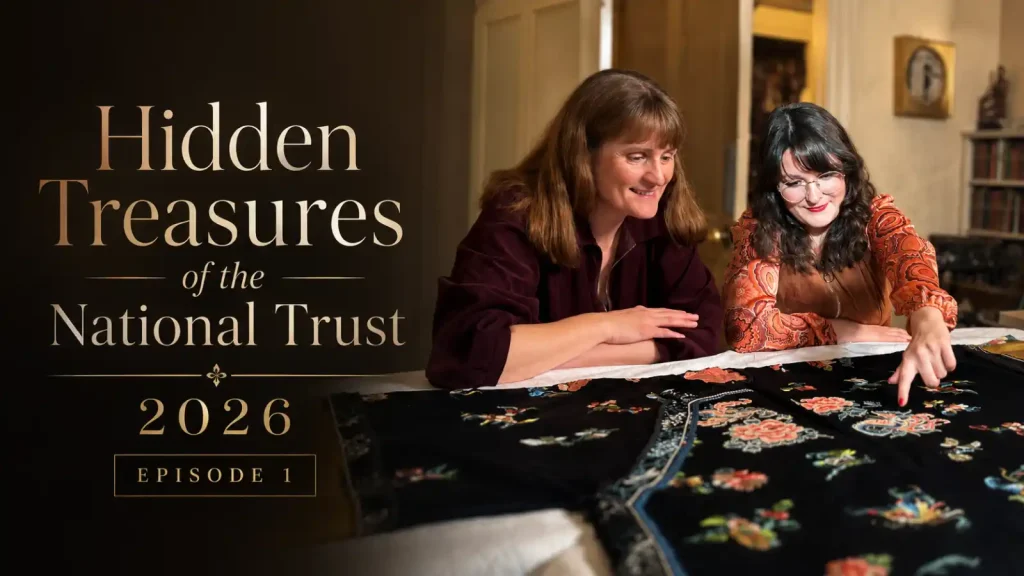
Hidden Treasures of the National Trust 2026 episode 1 opens with two houses, two writers, and two preservation races against time — and the discoveries at stake are extraordinary. At Greenway, the Devon riverside retreat of Agatha Christie, conservators are battling moisture damage threatening a unique wartime painting, while an exquisite Chinese silk robe worn by Christie’s beloved mother clings to existence a century after it was last worn.
Just over 50 miles away in Dorset, the poet and novelist Thomas Hardy spent the last four decades of his life at Max Gate — and the handmade sundial he designed shortly before his death is finally, painstakingly, being restored to the garden wall where he always intended it to hang. Together, these four objects — a robe, a frieze, a house, a sundial — reveal something that neither author’s fiction quite captured: the private, fragile, deeply personal world behind some of Britain’s most enduring literary legacies.
Agatha Christie sold more than two billion copies of her books in over 100 different languages, outsold in history, it is said, only by Shakespeare and the Bible. She wrote 66 detective novels across a career spanning almost 60 years. Yet for all her global renown, she described Greenway — the Georgian mansion sitting above the River Dart near Churston in Devon — simply as “the loveliest place in the world.”
By 1938, already a best-selling crime writer, she and her second husband, archaeologist Max Mallowan, purchased it as a private country retreat. The setting was the draw: a mansion in its finery and glory, looking down over the river, entirely removed from the machinery of being a worldwide literary phenomenon. Greenway was where Agatha Christie went to stop being Agatha Christie.
Thomas Hardy, by sharp contrast, built Max Gate with his own hands in a sense. A working-class boy born into a humble Dorset cottage, his father a builder and his mother a former servant, Hardy designed the house himself. Every wall, every room, every corner of Max Gate was paid for by his writing and shaped according to his own exacting vision. He lived there for 43 years. Where Christie’s Greenway spoke of inherited elegance, Max Gate spoke of an astonishing self-made ascent — and of a man who never truly left the Dorset soil that made him.
Hidden Treasures of the National Trust 2026 episode 1
The Greenway Collection and Agatha Christie’s Hidden Private World
Inside Greenway’s locked cupboards, the collections reveal a Christie few readers ever encounter. James, the property’s Collections and House Officer and a lifelong Agatha aficionado, keeps the house’s first editions under lock and key — including Murder on the Orient Express, The ABC Murders, and the novel that is particularly special to Greenway itself: Dead Man’s Folly. In that book, Hercule Poirot stays in a bedroom overlooking a river, while the principal murder happens in a boathouse. The parallels are unmistakable. Agatha’s bedroom at Greenway overlooks the River Dart. The boathouse still stands on the bank below. The shop at Greenway sells more copies of Dead Man’s Folly than any other shop in the world.
Christie’s characters, it turns out, were barely disguised portraits of people she actually knew. She grew up within a specific stratum of upper-middle-class English society, and her neighbours, her friends, her parents’ friends all found themselves, in recognisable form, written onto the page — their quirks, their pretensions, their anxieties transformed into the Lords and Ladies and duplicitous house-party guests of her fictional world.
Consequently, her books captured something beyond plot: they preserved the atmosphere of a particular England, one that has now largely vanished. She transported readers to a time and place so removed from 21st-century life that the connection still works across every age group and every culture on earth. No matter the background, the age, the country — everybody knows Agatha Christie.
Agatha was also, by the standards of any era, a remarkably modern woman. She surfed in Honolulu, adventured abroad, embraced the fashions and freedoms of the 1920s with clear enthusiasm. Her privileged but emotionally rich upbringing gave her both the material security and the observational acuity to become a trailblazer. Today, cosy crime is a genre unto itself; in its day, what Christie was doing was genuinely new — familiar enough in its characters to be comforting, and then structurally subversive enough to constantly surprise.
Agatha Christie’s Mother’s Chinese Silk Robe and Why It Matters
Among everything Greenway holds, one object stands apart. Senior National Curator Emma and Collections and House Officer Tamara opened the clothing collection to find — behind cocktail dresses and fancy-dress costumes — a Chinese silk robe of extraordinary beauty. The embroidered detail is still vivid, the colours still bright after what is now close to a century and a half. It opens like a butterfly spreading its wings.
The robe did not belong to Agatha Christie. It belonged to her mother, Clarissa. There is, in the Greenway collection, a large coloured portrait of Clarissa actually wearing it — which makes what happened next all the more significant. When Clarissa died, Agatha kept the robe. She did not fold it away on a high shelf. She hung it in her wardrobe, among her own clothes, as if the two women were still sharing a room. A hug between the two, as one curator describes it.
The relationship between Agatha and Clarissa was deep and formative. Agatha was the youngest of three children, with a significant age gap separating her from her older siblings. After her father died when she was just 11, the household shrank quickly to just the two of them — mother and youngest daughter, bound together for years. That bond endured into Agatha’s adult life and marriage. Then came 1926, one of the most catastrophic years Christie ever experienced: her first marriage collapsed and Clarissa died. Agatha Christie’s famous disappearance — the episode that has puzzled biographers ever since — occurred the same year. The grief was total.
Keeping Clarissa’s robe hanging among her own garments was not nostalgia. It was a private act of continuing connection. Now, more than a century since Clarissa last wore it, the silk has deteriorated severely. The lining has come away. Loose threads spread across the fabric. The ribbons are gone entirely. Sections of silk at the edges have begun to dissolve. The robe is leaving Greenway for specialist conservation — carefully packaged with loose puffs of tissue to stop it sliding — because, as its custodians put it, it was so important to Agatha Christie that it is therefore important to them.
The Hidden Treasures of the National Trust 2026 Episode 1 Wartime Frieze Emergency
The preservation challenge at the heart of Hidden Treasures of the National Trust 2026 episode 1 is arguably even more urgent than the robe — and far less expected. While the robe’s fragility is the fragility of age, the frieze in Greenway’s library is experiencing something conservator Ruth had never encountered in a career spent rescuing wall paintings.
In 1944, as D-Day preparations intensified along the Devon coast, Greenway was requisitioned a second time. Child evacuees had come and gone. Now it was the turn of the 10th Flotilla of the United States Coast Guard. American servicemen from the Bronx, from California, from across the country arrived at this quiet Georgian mansion above the Dart. The library became the officers’ mess. Darts were played in the morning room. The kitchen churned out meals for hungry men. Temporary latrines lined the corridors — an addition Agatha, on her return, elected not to retain.
But one officer, Lieutenant Marshall Lee, was doing something extraordinary with his time. Across the library walls, he began painting a frieze: a visual record of his unit’s wartime journey, starting from their home port in Virginia, tracking through Bermuda, across military action in North Africa and Italy, and ending at the house of the world’s best-selling crime writer. The painting is skilled and full of life and movement — vivid, confident brushwork from a young man who clearly had genuine artistic talent. It tells both Greenway’s history and a fragment of world history. It is genuinely irreplaceable.
More than 80 years on, the section between the library windows had blistered catastrophically. A three-inch gap had opened between the wall and the highest point of the blister. The paint at the edges was curling away, brittle and hanging by almost nothing. Greenway is a wet house — sitting directly beside the river, the humidity is perpetually high — and gypsum plaster does not respond well to prolonged moisture. Ruth, the conservation specialist brought in to stabilise it, had never seen gypsum behave quite like this before. She called it extraordinary. The stakes were absolute: without intervention, the frieze would be lost.
Hidden Treasures of the National Trust 2026 Episode 1 Conservation Techniques Under Pressure
Ruth’s approach to the Greenway frieze required extraordinary care. Japanese tissue paper provided temporary strengthening for the curled, brittle edges — a technique used carefully precisely because the paint was too fragile to press back directly. The blisters themselves posed the greater challenge: filling them completely would create a weight the deteriorated plaster could not support, potentially bringing the whole section crashing off the wall.
The process was slow, precise and demanding. Ruth’s conservator partner Torquil worked alongside her throughout. What they confronted was not simply a damaged painting but a structural failure in the substrate itself — the wall behind the paint was no longer doing what a wall is supposed to do. Heritage conservation often confronts this reality: it is not just about preserving the surface but about stabilising the environment and the underlying architecture that carries it.
The result, when complete, was remarkable. The blistering that had dominated the eye disappeared. Detail that had been obscured re-emerged. Ruth even restored the outline of a donkey’s head that had become unreadable, because without it, a section of the narrative simply looked wrong. Curators who had known the frieze for years stood in the library and described it as looking like the day it was done. It was incredible. Unbelievable. And crucially: it was not going to fall off the wall.
Marshall Lee’s Daughter Sees Her Father’s Work Restored
The conservation work at Greenway led to an encounter of remarkable emotional weight. Lieutenant Marshall Lee survived the war. He returned to the United States, became a father, built a successful career in publishing, and lived to the age of 89. He never went back to Greenway. He barely spoke about the war to his children at all. It was a horrible experience, his daughter Valerie explains.
He wanted to forget and move on. And it must have been traumatic — at Omaha Beach on D-Day itself, Lee was delivering troops to the shore while watching his sister ships being sunk in front of him. He managed, somehow, to make a sketch of the action — a drawing in exactly the same confident style as the Greenway frieze.
Valerie made the long trip to Devon to see the restored frieze for the first time. Standing in the library where her father had spent months painting, she said it felt like being there with him. The frieze, she said, was a gift — to her, to her family, and to so many other people. A story completed. Thanks, ultimately, to Agatha Christie’s library walls, Marshall Lee had left something for posterity that he never quite intended to leave, and that his daughter could now stand in front of and feel the whole weight of.
Thomas Hardy and Max Gate: A Working-Class Writer’s Self-Made World
The second house at the centre of Hidden Treasures of the National Trust 2026 episode 1 sits in Dorset, a world away from Greenway in landscape, in literary spirit and in social origin. Thomas Hardy designed and built Max Gate himself, just a couple of miles from the humble cottage where he was born. He lived there for the last 43 years of his life. The whole house was paid for by his writing — by the novels and poetry that emerged from this same Dorset countryside.
Hardy’s roots were genuinely rural working-class. His father was a builder, his mother a former domestic servant. He grew up embedded in the rhythms of country life, knowing farmers, shepherds, labourers — knowing their ways, what made them tick. Everything he observed became literary material. The people and landscapes of 19th-century Dorset fed the novels: Tess of the d’Urbervilles, Jude the Obscure, Far from the Madding Crowd, all written within sight and sound of the world they depicted, set in Hardy’s semi-fictional literary landscape of Wessex.
By the 1890s, Hardy was at the height of his fame. But the Dorset he wrote about was actively disappearing. Railways were threading through the land. Old dialects were fading. Villagers who had stayed in the same places for generations were leaving for factory towns. A way of life Hardy had known intimately since childhood was transforming, almost beyond recognition, around him. There was urgency in his depictions of it — not nostalgia exactly, but the sharp-eyed attention of someone who knows that what they are describing will not survive.
The Cerne Abbas Giant and Hardy’s Deep Connection to Dorset’s Landscape
The National Trust also cares for a very different kind of heritage object in Hardy country. The Cerne Abbas Giant — Britain’s most immediately recognisable chalk figure, carved into a hillside — is explicitly mentioned in Tess of the d’Urbervilles and represents precisely the kind of ancient, landscape-embedded tradition that Hardy spent his career recording. Now believed to have originated in the early Middle Ages as an image of Hercules, the giant has been a feature of Dorset’s hills for centuries, its folklore including longstanding claims as a fertility symbol.
Maintaining the figure is relentless physical work. The site is grazed by sheep twice a year, which keeps the vegetation down but leaves droppings that must be cleared before they promote weed growth in the chalk lines. Rangers and volunteers descend the steep hillside regularly to scrub and clean — backbreaking labour on gradients that test even the most committed. One ranger spent an entire day working on a single armpit. After each session, the white chalk re-emerges, crisper and more visible, the giant restored to something approaching how Hardy would have known it from the valley below.
Thomas Hardy, the experts at Max Gate note, would have been very happy to see it looked after and cared for. The giant was part of the same elemental Dorset that Hardy spent his life writing about — the sun, the wind, the rain, the turning of the seasons, the people who had worked the land for centuries.
Thomas Hardy’s Handmade Sundial and the Hidden Treasures of the National Trust 2026 Episode 1 Restoration
As Hardy aged, he became increasingly reclusive. He would lock himself in his study at Max Gate, writing poetry that still resonates worldwide. But in his final years, something else occupied him alongside the verse: a sundial. Hardy designed it himself, chose the materials, selected the Latin inscription, and arranged for it to be cast at a local foundry shortly before his death. He never saw it completed. He never saw it installed on the garden wall where he intended it to hang.
The restoration of this object is the second major conservation project tracked through Hidden Treasures of the National Trust 2026 episode 1. Craftsman Peter has been working to return the sundial to the condition it would have been in when it first went up — cleaning and refining the numerals, correcting a half-hour time discrepancy that had crept in through a damaged gnomon, the metal arm that casts the shadow. The gnomon had bent over time, throwing the whole mechanism off. With careful repair, the lines all match up again.
When the sundial goes back onto the wall, the numerals look sharp and clear. The gnomon sits straight. The team surrounding it — Max Gate staff, the conservator, a welcome manager who has become an ardent Hardy devotee over six years at the property — express genuine pleasure and relief. It probably looks as good today, one of them observes, as it did when it first went up all that time ago.
The Latin Inscription That Haunts Thomas Hardy’s Final Years
Hardy’s choice of inscription for the sundial is the detail that lingers longest. He chose the Latin phrase “Quid de nocte?” — which translates as “What of the night?” It is a question that seems, on the surface, simply to fit a sundial: a device that measures daylight has an inherent relationship with the coming dark.
But Hardy did not believe in an afterlife. He was an old man, in the final chapter of a long life, ordering a timepiece for his garden wall and choosing, from everything Latin literature offered, a question about what comes after the light. The experts at Max Gate articulate what the inscription seems to carry: a quiet, private wondering. What now? What comes next? How will I be remembered when I’ve passed into the night myself?
The sundial was, in a sense, one of the last acts of Thomas Hardy’s life. It was almost as if he had been putting it off for a very long time, and then realised that there wasn’t much time left. He died before it was finished. The tragedy, one scholar reflects, is that he never saw it completed. Yet the inscription he chose — that searching question to the darkness — suggests he knew what he was doing.
He was a Dorset man, grown out of the soil of Dorset, shaped by its sun and wind and rain and light and dark. He wanted to be remembered, ultimately, not as a global literary giant but as the man who came from this landscape.
What Hidden Treasures of the National Trust Reveals About the Objects Writers Leave Behind
What holds these two stories together is not simply fame or heritage or conservation practice — though all three are present. It is the question of what objects reveal about people who have otherwise been entirely translated into myth. Agatha Christie the brand, the franchise, the two-billion-copy-selling phenomenon, is almost too large to see around.
But the silk robe hanging in her wardrobe among her own clothes, belonging to a mother she lost in the worst year of her life, shrinks that myth to something human and private and raw. The wartime frieze in her library — painted by a young American soldier who never returned, who couldn’t speak about what he’d seen — connects her home to the largest and most violent event of the 20th century in a way no novel could.
Hardy, meanwhile, left a sundial he never saw finished, inscribed with a question about darkness he could not answer, pointing at a landscape that was already disappearing when he wrote about it. Max Gate itself — the house a working-class boy built from the proceeds of his imagination — is the most personal object of all.
The National Trust holds all of this. Behind the lock-and-key cupboards, behind the conservation studio, in the garden where a craftsman is fitting a gnomon straight, these objects still speak — as one of the programme’s contributors puts it — if you listen hard enough. Hidden Treasures of the National Trust 2026 episode 1 makes the case, powerfully, that listening is worth the effort.
FAQ Hidden Treasures of the National Trust 2026 episode 1
Q: Where is Agatha Christie’s Greenway house and why is it significant?
A: Greenway sits above the River Dart in Devon and served as Agatha Christie’s countryside retreat for almost 40 years. She purchased it in 1938 with her second husband, archaeologist Max Mallowan. Christie called it “the loveliest place in the world” — a private escape from her worldwide fame, now cared for by the National Trust and open to visitors.
Q: What is the wartime frieze at Greenway and who painted it?
A: The frieze was painted by US Coast Guard Lieutenant Marshall Lee in 1944, when Greenway was requisitioned as a billet for the 10th Flotilla ahead of D-Day. Using Agatha Christie’s library as the officers’ mess, Lee covered the walls with a vivid painted record of his unit’s wartime journey — from Virginia and Bermuda through North Africa and Italy to Devon. It remains one of the most unusual wartime artefacts held by the National Trust.
Q: Why is the Greenway library frieze in danger and how are conservators saving it?
A: More than 80 years of high humidity — Greenway sits directly beside the River Dart — caused a catastrophic blister to form in the gypsum plaster, opening a three-inch gap between the wall and the paint surface. Conservator Ruth used Japanese tissue paper to stabilise the curling edges before carefully consolidating the blisters, avoiding excess fill weight that could cause the section to detach entirely. Without the intervention, the frieze faced permanent loss.
Q: What is the Chinese silk robe at Greenway and why did Agatha Christie keep it?
A: The robe belonged to Agatha Christie’s mother, Clarissa, and dates back roughly a century and a half. Christie kept it hanging in her own wardrobe among her clothes rather than storing it away — a deliberate act of connection after Clarissa’s death in 1926, the same year Christie’s first marriage collapsed. A portrait of Clarissa wearing the robe survives in the Greenway collection, confirming how closely tied the two women were to this single garment.
Q: What condition is Agatha Christie’s mother’s silk robe in and can it be saved?
A: The robe has deteriorated significantly. The silk lining has separated along its full length, the ribbons are completely missing, loose threads spread across the fabric, and sections of silk at the edges have begun to dissolve. The robe left Greenway for specialist textile conservation, carefully packaged with tissue puffs to prevent movement during transit. Conservators consider it a priority because of its direct personal significance to Agatha Christie.
Q: How many books did Agatha Christie write and how many copies have been sold?
A: Christie wrote 66 detective novels across a career spanning almost 60 years, along with numerous short story collections and plays. Her books have sold over two billion copies in more than 100 languages. She is widely regarded as the best-selling fiction writer in history, outsold only by Shakespeare and the Bible. Dead Man’s Folly, set explicitly at Greenway, remains among her most celebrated titles.
Q: What happened to Lieutenant Marshall Lee after World War Two?
A: Lee survived the war, returned to the United States, raised a family and built a successful career in publishing. He lived to the age of 89 but never returned to Greenway and rarely spoke about his wartime experiences. His daughter Valerie made her first visit to the restored frieze, describing the experience as deeply moving — like being in the library with her father. Lee also sketched the D-Day landings at Omaha Beach while delivering troops ashore.
Q: What is Max Gate and why did Thomas Hardy live there for so long?
A: Max Gate is a Victorian house in Dorset that Hardy designed himself and paid for through his writing. Born into a working-class family — his father a builder, his mother a former servant — Hardy lived at Max Gate for 43 years, writing his most celebrated novels and poetry there. He regarded the house as an expression of his identity and his roots: everything in it reflected his own choices, built from nothing using the proceeds of his imagination.
Q: What is the sundial at Max Gate and why did Thomas Hardy design it?
A: Hardy designed the sundial himself in his final years, selecting the materials, the numerals and a Latin inscription — “Quid de nocte?”, meaning “What of the night?” — before sending it to a local foundry for casting. He never saw it completed or installed; he died beforehand. Conservator Peter restored the sundial’s numerals and corrected a half-hour timing error caused by a bent gnomon, returning it to the garden wall at Max Gate where Hardy always intended it to hang.
Q: What does the Latin inscription on Hardy’s sundial mean and why did he choose it?
A: The phrase “Quid de nocte?” translates as “What of the night?” Hardy, who did not believe in an afterlife, chose it as an elderly man nearing the end of his life. Experts at Max Gate read it as a private question about mortality — what comes next, and how he might be remembered. Hardy ultimately wanted to be recalled as the Dorset man who grew from that landscape: shaped by its sun, wind, rain, light, and the people he knew from childhood.