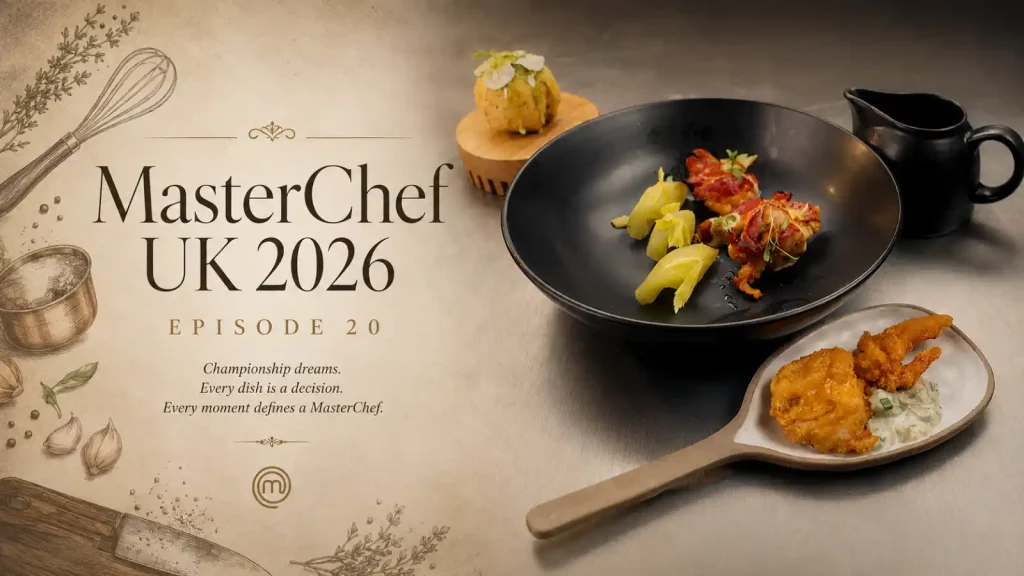
MasterChef UK 2026 episode 20 strips the competition down to its final four amateur cooks and hands them the most punishing test of the entire series: cooking inside a two-Michelin-starred kitchen for some of the best chefs in the country. Set largely at Opheem, chef patron Aktar Islam’s celebrated Indian restaurant in the heart of Birmingham, this penultimate stage forces Antos, Jhane, Matt and Kristen to deliver food at a standard normally reserved for trained professionals. The stakes could not be higher. By the end of the night, only three will survive to fight for the MasterChef trophy.
The drama unfolds across two brutal challenges. First comes Chef’s Table, where each finalist takes sole charge of one course on a tasting menu served to six visiting chefs holding eight Michelin stars between them. Then comes the cook-off, a make-or-break round demanding a classic dish reinvented with personal flair. One finalist will be eliminated on the cusp of the grand final.
What makes MasterChef UK 2026 episode 20 so gripping is the collision of raw amateur ambition with the unforgiving precision of elite gastronomy. These are not chefs by trade. They are a banking manager, a technology programme manager, a PhD student and a communications director, each carrying a personal story into a kitchen where flaws are not tolerated. The result is a portrait of pressure, transformation and the thin line between glory and goodbye.
The episode anchors itself in Opheem, described as Birmingham’s most prestigious restaurant. At its helm stands Aktar Islam, a self-described Brummie born and bred, whose journey gives the challenge its emotional weight. Food mattered enormously in his childhood home, shaped by a mother who treated cooking as one of her greatest passions and a father who worked as a restaurateur. By nine or ten, Islam was already cooking, learning to wash rice as one of his earliest lessons.
His path was far from conventional. A wayward teenager who struggled academically, he left the world of school behind and started working in restaurants at just thirteen. Six years later, he took over his father’s restaurant and transformed it. A modest forty-seater developed waiting lists, a phenomenon Islam notes was almost unheard of for Indian restaurants at the time.
Opheem became the project that defined his career. The cooking celebrates the rich culinary history of the Indian subcontinent, spanning southern cuisine from Tamil Nadu through Sri Lanka and up to the food of the Himalayas. The restaurant earned its first Michelin star within a year, then a second three years later, making it one of only four restaurants in the world recognised at that level for Indian food. For Islam, that ascent represents vindication for a child who was kicked out of school but carried a love of cooking and a deep loyalty to his city.
MasterChef UK 2026 episode 20
Antos and the Sand Carrot Reinvented Eight Ways
The first course of the Chef’s Table falls to banking manager Antos, who must build an entire dish around one humble ingredient prepared in eight different ways. The star is the sand carrot, grown in sandy soil that gives the vegetable an inherent sweetness and a flavour Islam calls totally unique. Antos thrives on the concept of taking something simple and making it extraordinary, and this dish demands exactly that.
The technical load is staggering. In service, the carrots are first pan-roasted with a complex blend of mustard seed, cumin and fennel to build a light crust. A classic tandoori-style marinade follows, packed with powerful aromatic spices, before the carrots are barbecued to capture smoke without burning. Antos then juggles a fryer to crisp a spiced carrot and lentil pakora, plates a carrot slaw, carrot jelly, carrot pickles, a delicate carrot tuile, a green herb chutney and spiced yoghurt, and finishes with a sauce made, fittingly, from carrots.
Nothing is wasted. Every trimming finds a purpose, embodying the no-flaws philosophy that two stars demand. The judges, Anna and Grace, recognise immediately how intriguing and difficult the plate is to execute. With an hour gone, Antos falls behind on his tuiles, a reminder that even one ingredient can overwhelm when held to elite standards. Yet when the course finally reaches the visiting chefs, the verdict is rapturous, with one diner declaring he could eat ten of them and never grow bored. The smoky, layered tandoori carrot earns a standing ovation that leaves Antos feeling on top of the world.
Jhane’s Monkfish Honours Her Bengali Roots Over Coals
Technology programme manager Jhane takes on Aktar Islam’s signature fish course, a dish rooted in personal heritage. Tasked with filleting a whole monkfish tail, she works with an ingredient she has never handled this way before. The fish is marinated with mustard and lime, an inspiration drawn directly from her mother and her parents’ Bangladeshi background, where mustard is woven through the culture.
The cooking must be flawless. Monkfish overcooks into something rubbery and tough, so Islam’s barbecue technique becomes vital. The target is a pearlescent rainbow when the fish is sliced, the marker of perfect doneness. Alongside the monkfish sits a steamed mussel stuffed with a mousse made from the fish trimmings, demanding the mussels stay tender while the mousse cooks through. The plate is completed with a butternut squash bhuna chutney, salsify and a mustard and orange sauce inspired by West Bengal.
That sauce carries the deepest meaning. Passed down from her mother, it must deliver a zingy mustard aroma that defines the entire dish. Jhane manages six pans at once, refusing to rush despite repeated calls for speed, because she wants the plate to be perfect and to do Islam proud. The payoff is extraordinary. The visiting chefs praise the barbecue char, the juicy stuffed mussels and a Bengali mustard sauce one describes as a taste sensation. Daniel Clifford goes further, telling Jhane she has a strong future in the industry, a moment she calls mind-blowing.
Matt Races Through a Venison Saddle With No Room for Error
PhD student Matt draws the most technically demanding course of the day, a venison main built around a heavily spiced loin that touches the northern territories of the Indian subcontinent while celebrating game. Islam warns that whoever takes this dish needs running shoes, because the to-do list is enormous and there is no room for error. Matt has never cooked venison once in his life, making the assignment even more daunting.
The centrepiece loin must be seared and basted over charcoal with chilli and cumin to achieve an even crust, then carved to a beautiful pink. Venison is lean and unforgiving, going dry the moment it overcooks. Surrounding it are an Indian-Nepalese momo dumpling made from braised neck, a spiced kebab from the trimmings with mint chutney, and a glossy sauce built from the bones. As with every dish, every part of the animal is used, with the scrag cooked down in a pressure cooker for the momo filling.
The momo demands the most skill. Matt prepares three differently coloured doughs, using turmeric for one and burnt onion skins to blacken another, then layers them to create a marbled pinstripe effect before filling, shaping and double-cooking each one. The process is relentless, but Matt embraces the chaos, preferring a packed list because it leaves no time to overthink. When the venison reaches the pass, the judges marvel at the perfectly straight stripes, the juicy momo and a sauce described as a masterclass. Islam tells Matt he sees a younger version of himself in him, leaving the finalist floating and emotional.
Kristen Conquers the Fragile Apple Samosa Dessert
Communications director Kristen handles the dessert in the pastry kitchen, a course built around the Himachal region and its famous apples. Her apple samosa reimagines the comfort of apple pie inside an Indian format, with a spiced apple compote folded into samosas that are fried to a golden but never burnt crisp. The samosa rests on more spiced apple filling and arrives with a battery of technically demanding garnishes.
The dish punishes any lapse in timing. A rocher of burnt-butter ice cream, a technique Kristen has never attempted, must be plated fast or it melts into a puddle beside a cold samosa. The burnt butter itself has to develop a toasted depth without tipping into the wrong flavour. A sorrel granita is finished tableside, frozen with liquid nitrogen and kept fine enough to avoid clumping into a large sorrel ice cube. Pastry, as Kristen notes, demands following the recipe to the letter or going down.
The greatest obstacle is a white chocolate tuile made from isomalt and glucose, ingredients she has never worked with and whose behaviour she cannot predict. The tuile is extremely fragile, and her first batch fails entirely, forcing a tense second attempt with service minutes away. The redo succeeds, and the finished plate stuns the room. The judges and visiting chefs praise the soft compote, the shatteringly crisp tuile and the gorgeous burnt-butter ice cream, with the sorrel granita hailed as a clean palate cleanser. Grace names it her favourite dish of the day, calling the result phenomenal.
Why the Chef’s Table Challenge Marks a Turning Point
The Chef’s Table sequence functions as the emotional spine of MasterChef UK 2026 episode 20. Only weeks earlier these four amateur cooks walked through the MasterChef door for the first time. Now they walk into a two-star kitchen and cook for diners holding eight Michelin stars, including chefs whose food they grew up admiring. The disorientation is real, with one finalist joking about Michelin stars coming out of their ears.
Aktar Islam’s own reaction underscores the scale of the achievement. Watching four amateurs arrive in the morning and deliver food of this calibre by lunchtime leaves him dumbfounded, describing the result as an absolute miracle. For the finalists, the experience proves transformative. Several call it one of the best days of their lives, with Matt placing it among his top five days ever and others reaching for words like breathtaking and bucket-list.
This is the moment the competition stops being a televised contest and becomes a genuine career awakening. Jhane speaks of catching the bug of working in a kitchen at this level and wanting more. The challenge crystallises a shared realisation that cooking is no longer a hobby but a possible future. That emotional clarity raises the stakes for everything that follows, because each finalist now understands precisely what they stand to lose.
The Classic-With-a-Twist Cook-Off That Decides the Final Three
After the elation of Opheem comes the cruellest test. Back in the MasterChef kitchen, the finalists receive a deceptively simple brief: cook one classic dish reinvented with a personal twist, in an hour and forty-five minutes, for one of only three places in the grand final. The danger sits in the balance. Push the twist too far and the heart of the dish collapses; play it too safe and the cook vanishes under the radar.
Each finalist reaches for something deeply personal. Kristen fuses an American lobster roll with buffalo wings, building a fermented chilli butter, a spicy lobster bisque, a johnny cake stuffed with lobster knuckle and a deep-fried lobster claw standing in for the wing. Antos revisits his favourite school-dinner dessert, a pineapple upside-down cake made boozy with rum-soaked sponge, ginger ice cream and an attempt at pineapple leather. Jhane bridges continents with rabbit agnolotti, pairing a Tuscan classic with the punchy Thai broth of khao soi. Matt deconstructs coq au vin, breaking a whole chicken into poached breast, confit wing, barbecued thigh, liver parfait and a vin jaune sauce swapped in for the traditional red wine.
The judging exposes the fine margins. Kristen’s lobster excels with outstanding balance and complexity, the johnny cake singled out as superb. Jhane’s flavour explosion of coconut, galangal and ginger draws comparisons to nothing the judges have seen on a menu. Matt’s blown-minds plate earns praise for elegance, skill and a vin jaune sauce called incredible. Antos delivers an elegant dish, but the judges want bigger flavours, more ginger in the ice cream and more rum in the sponge, while his pineapple leather never makes the plate.
Antos Says Goodbye as the MasterChef Trophy Comes Into View
The elimination lands with genuine pain. The judges agree all four dishes would belong in a fine-dining restaurant, making the decision the hardest they have faced. They celebrate Kristen’s invention, Jhane’s masterclass in elevating comfort food and Matt’s chef-level technique. Antos draws admiration for how far he has travelled, described as a reflection of every lesson learned on his MasterChef journey, yet the feedback that he could have gone bigger proves decisive.
Antos is the finalist sent home. He accepts the result with grace, saying he half expected it, and frames the experience as the best of his life. The judges praise his passion and enthusiasm, noting how he evolved before their eyes. Antos leaves promising to dive head first into far more cooking, certain that food has become his passion and his intended future.
For Kristen, Jhane and Matt, the path to the MasterChef trophy now stands wide open. The relief and disbelief pour out, with one finalist marvelling at every cell in her body lighting up and another comparing each challenge to climbing an ever-larger mountain. They have reached the top three of MasterChef UK 2026, and the grand final waits just ahead. One of these three exceptional amateur cooks will be crowned MasterChef champion 2026, and after a day spent cooking beside their idols at Opheem, each now knows exactly how much that final cook will mean.
FAQ MasterChef UK 2026 episode 20
Q: Where was the MasterChef 2026 Chef’s Table challenge filmed?
A: The Chef’s Table challenge took place at Opheem, described as Birmingham’s most prestigious restaurant. Run by chef patron Aktar Islam, Opheem holds two Michelin stars and celebrates the culinary history of the Indian subcontinent. The final four amateur cooks prepared a tasting menu there for six visiting chefs holding eight Michelin stars between them.
Q: Who was eliminated in MasterChef UK 2026 episode 20?
A: Antos, the banking manager, was sent home, narrowly missing a place in the grand final. While the judges praised how far he had evolved, they felt his classic-with-a-twist pineapple upside-down cake needed bigger flavours, more ginger in the ice cream and more rum in the sponge. Kristen, Jhane and Matt advanced to the final three.
Q: Who is Aktar Islam and how did he earn two Michelin stars?
A: Aktar Islam is a Birmingham-born chef who started working in restaurants at thirteen after struggling academically. He took over his father’s restaurant at nineteen, then opened Opheem. The restaurant won its first Michelin star within a year and its second three years later, making it one of only four restaurants worldwide recognised at that level for Indian food.
Q: What is a sand carrot and why was it used in the challenge?
A: A sand carrot is grown in sandy soil, which makes it inherently sweet and gives it a flavour Aktar Islam calls totally unique. Antos built his entire opening course around this single ingredient prepared eight ways, including a tandoori-style barbecued carrot, pakora, slaw, jelly, pickles, tuile and a sauce made from carrots.
Q: Why is monkfish so difficult to cook correctly?
A: Monkfish turns rubbery and tough when overcooked, leaving very little margin for error. Jhane cooked hers over coals, aiming for a pearlescent rainbow finish when sliced, the marker of perfect doneness. She paired it with a steamed mussel stuffed with monkfish mousse and a Bengali mustard sauce inspired by her mother.
Q: What made the venison main course the hardest dish of the day?
A: The venison course carried an enormous to-do list with no room for error, and Matt had never cooked venison before. Because venison is lean and dries out instantly when overcooked, the sear had to be flawless. The dish also required layered, tri-coloured momo dumplings, a spiced kebab and a glossy sauce built from the bones.
Q: How did Matt create the striped pattern in his momo dumplings?
A: Matt made three differently coloured doughs, using turmeric for one and burnt onion skins to blacken another, while keeping a third natural. He layered, cut and re-rolled them to produce a marbled pinstripe effect, then filled, shaped and double-cooked each dumpling. The judges praised the uniform stripes that held together perfectly.
Q: Why did Kristen’s white chocolate tuile cause problems?
A: The tuile was made from isomalt and glucose, ingredients Kristen had never worked with, and it proved extremely fragile. Her first batch failed entirely, forcing a tense second attempt with service minutes away. The redo succeeded, and the shatteringly crisp tuile became a standout element of her award-winning apple samosa dessert.
Q: What was the classic-with-a-twist cook-off and why was it so risky?
A: The finalists had to reinvent one classic dish with a personal twist in one hour and forty-five minutes for a place in the final. The balance was brutal: pushing the twist too far destroyed the dish’s heart, while playing too safe risked flying under the radar. Only three of the four cooks could survive the round.
Q: Who reached the MasterChef UK 2026 grand final?
A: Kristen, Jhane and Matt advanced to the grand final. Kristen impressed with a lobster roll fused with buffalo wings, Jhane delivered rabbit agnolotti with a Thai khao soi twist, and Matt deconstructed coq au vin using vin jaune. One of these three exceptional amateur cooks will be crowned MasterChef champion 2026.


