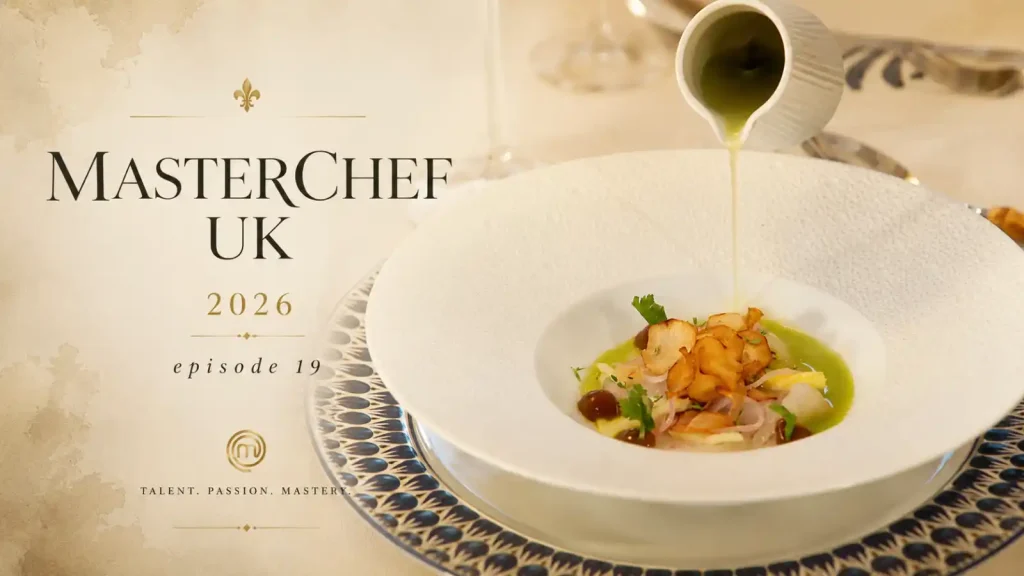
MasterChef UK 2026 episode 19 swaps the familiar gleam of the competition kitchen for the turquoise waters and golden sands of Antigua and Barbuda, sending the final four amateur cooks on the culinary trip of a lifetime. After six weeks of intense competition, only Kristen, Jhane, Matt and Antos remain, and they arrive in the Caribbean facing a cuisine none of them has cooked before. Across three escalating challenges, they wrestle with pig’s tails, conch, breadfruit and the island’s beloved pepperpot stew, cooking for local food experts, a five-star fine-dining restaurant, and a VIP table that includes a genuine cricketing legend.
This is where finals week begins in earnest, and the stakes could not be clearer. Every dish is judged not only by Anna and Grace but by Antiguans who grew up on these recipes and care deeply about getting them right. For four cooks chasing the MasterChef trophy, winning over that audience demands more than technique. It demands respect for a food culture built from African, Carib, Arawak, British and Spanish influences.
What unfolds is a portrait of pressure, transformation and surprising tenderness. Antos nearly unravels under the heat. Jhane discovers a level she did not know she had. Matt builds tortellini at speed in a Michelin-trained kitchen, and Kristen turns a fish she had never filleted into a dish worthy of a five-star pass. By the end, the competition feels less like a contest and more like a shared journey through one of the Caribbean’s richest culinary traditions.
The arithmetic of the competition is brutal by this stage. Six weeks of cooking have eliminated everyone but four amateurs, and each of them now stands within reach of the MasterChef hall of fame. The move to Antigua and Barbuda is not a reward so much as a proving ground, a place designed to push the finalists to limits they did not know were possible.
The cooks feel the shift immediately. None of them has ever cooked Caribbean food, and the unfamiliarity sharpens both their excitement and their nerves. One finalist admits they do not know what they are in for, while another jokes about hearing more steel pans in the kitchen than on the streets. Beneath the humour sits real apprehension about working with ingredients they cannot yet picture, taste or even name.
What makes the islands such a demanding test is the cuisine itself. Antiguan food is a true melting pot, drawing on African heritage, the indigenous Caribs and Arawaks, plus British and Spanish influence. The result is flavourful, soulful and vibrant, but it carries the weight of authenticity. Antiguans are passionate about their food, and they form a tough crowd to please. For the final four, every plate must honour a tradition the diners know intimately.
The judges set the tone before a single ingredient is touched. They promise to push the finalists to limits they did not think possible, and the islands themselves seem built for that purpose. Turquoise waters meet golden sands, steel bands play, and the food arrives full of spice, heat, flavour and joy. The contrast between the relaxed beauty of the setting and the ferocity of the cooking ahead defines the entire week. Paradise, it turns out, is no place to relax when the MasterChef trophy is at stake.
For these amateur cooks, the Caribbean represents both opportunity and exposure. They cannot lean on muscle memory or a lifetime of practising the same dishes. Instead they must absorb a brand-new culinary language in days, then perform it convincingly in front of people who have eaten it their whole lives. That gap between curiosity and mastery is exactly where the competition intends to test them.
MasterChef UK 2026 episode 19
Inside the Nelson’s Dockyard Barbecue Challenge That Pushed the Cooks Hardest
The first task lands the cooks at Nelson’s Dockyard, once a colonial naval base and now a UNESCO World Heritage Site. Working in two teams, they have just three hours to prepare a barbecue feast of traditional Antiguan dishes for 20 locals. The judges call it the hardest task they have ever set, and the spread of ingredients alone is daunting.
Guiding them is local culinary legend Chef Maurine Bowers, who frames Antiguan cooking as flavourful, soulful, vibrant and diverse. Her presence matters, because the recipes are genuinely foreign to the amateurs. The Red team tackles pepperpot stew, Antigua’s national dish, built from chicken, salted pig’s tail and pork, layered with allspice, garlic, thyme and a forest of vegetables. Kristen confronts a mountain of chopping while admitting nerves about her own fingers.
The Red team also takes on johnnycakes, a Caribbean classic with deep historical roots in journeycakes once carried by labourers and enslaved people. Maurine’s twist stuffs them with curry goat, a dish Jhane is determined to cook in honour of her mother’s version. Over on the Blue team, Antos handles barbecued lobster and snapper while Matt grates sweet potato for ducana, a steamed dumpling wrapped in banana leaf and served here, unusually, as dessert with the famed Antiguan black pineapple.
The scale of the unfamiliarity hits the cooks fast. Pig’s tails draw nervous laughter, conch demands careful trimming to reach its sweet, tender white flesh, and breadfruit must char almost to the point of looking inedible before its interior turns beautiful. The Red team’s menu also includes fungee, a cornmeal porridge enriched with okra that must be boiled separately and stirred constantly to avoid lumps. Maurine’s guidance becomes essential, because the cooks simply do not know how these dishes are meant to taste.
Snapper and lobster anchor the Blue team’s barbecue, with the island’s meatier snapper requiring a marinade that penetrates the flesh and a longer cook than the cooks expect. One finalist describes the whole experience as a cookery course on holiday, but turbo-charged. The phrase captures the strange energy of the task: joyful discovery layered over genuine fear of failing in front of an audience that knows every recipe by heart.
How Heat, Time and Unfamiliar Ingredients Tested the Final Four in Antigua
The kitchen at Nelson’s Dockyard becomes a furnace as the sun climbs, and the physical toll quickly shows. One cook says it feels as if they are the food being cooked. The challenges are not only environmental. Matt grates his fingers while preparing ducana, and Kristen battles a never-ending pile of vegetables that seems to regenerate each time she thinks she is finished.
Technique trips them up repeatedly. The Red team’s fungee, a cornmeal porridge destined to become croquettes, fails on the first attempt because the okra is not cooked long enough before the cornmeal goes in. They are forced to throw it out and start again, burning precious minutes. Maurine had warned them to stir constantly to avoid lumps, and the second attempt becomes a critical, sweat-soaked race against the clock.
The Blue team faces its own bottleneck. Antos pours an extraordinary amount of time into the fiddly ducana, wrapping grated sweet potato and coconut in banana leaves, while Matt wrestles slippery conch into a ceviche and breadfruit chars on the open flame. Grace notes the worrying lack of anything actually cooking with the clock ticking down. By midday, with one hour left, both teams are scrambling to turn frantic prep into finished plates.
The final stretch becomes a test of nerve as much as skill. Maurine calls out 30 minutes, then five, as the Reds chase a crisp, golden second batch of fungee and the Blues fight to get lobster and snapper onto the grill. Antos abandons one task to start another, and Matt’s wounded hand keeps him slightly off pace. The cooks describe an environment so hot it feels as though they are being roasted alongside the food, yet they keep moving, refusing to let the conditions dictate the result.
What the Antiguan Diners Said About the Barbecue Feast
When service finally arrives, the verdict comes from celebrated chefs and hospitality figures across Antigua and Barbuda, the very people best placed to judge authenticity. The Blue team leads with conch ceviche and a breadfruit and pumpkin salad. Diners praise the conch as fresh, vibrant and zingy, and single out the smokiness Antos coaxed into the breadfruit. The salad’s seasoning earns two thumbs up.
The Red team’s curry goat johnnycakes draw an even warmer response. One diner had never eaten a filled johnnycake and calls it fluffy, crispy and spectacular, with the goat stealing the show. The pineapple salsa lands as a burst of flavour, and the pairing is described as a match made in heaven. It is exactly the kind of reaction the cooks needed from an audience that grew up on these dishes.
The mains seal the day. Despite never having made pepperpot before, the Red team gets the taste spot-on, with meat described as extremely tender and a flavour close to one diner’s grandmother’s cooking. The deep-fried fungee croquettes surprise everyone, transforming humble cornmeal and okra into something delicate and wonderful. The Blue team closes with the ducana dessert and rum-caramel pineapple, earning a nine out of ten and praise for its genuine coconut whack. The barbecue ends in a group hug and real emotion.
Fine Dining at Jumby Bay Island and the Estate House Test
Day two carries the finalists by boat to Jumby Bay Island, a 300-acre private destination and one of the most exclusive locations in the world. The water alone leaves them stunned, but the real challenge waits at the Estate House, the island’s flagship fine-dining restaurant where Caribbean flavours meet French technique under Antiguan Chef of the Year Eustace Cabral Jr.
Eustace embodies the journey the cooks are on. He trained in Antigua, sharpened his craft in Michelin-starred kitchens across Europe, then returned home to take the island’s food to another level. For a decade at Jumby Bay he has wowed guests with contemporary Caribbean cuisine, and now he hands each finalist responsibility for a single course on an exclusive dinner menu. This is a complete step up, and the pressure is immense.
The dishes are deliberately demanding. Matt must produce goat tortellini with a crystal-clear goat water consomme, having never formed a tortellini before. Kristen takes on pan-fried grouper with cockle beurre blanc and a modernised fungee piped inside thinly sliced plantain. Antos faces pork tenderloin cooked sous-vide then pan-roasted, served with breadfruit and an unusual lobster and avocado butter. Jhane builds a technical tropical dessert around coconut panna cotta, dehydrated black pineapple, mojito sorbet and a chilled pineapple and mango soup.
Eustace transforms humble street food into refined plates, and that translation is the heart of the test. Goat water, an aromatic island broth of herbs, spices and braised goat, becomes a consomme so clear it must be clarified with egg whites. Fungee, the cornmeal porridge that defeated Kristen a day earlier, returns in modernised form, demanding the same constant whisking to stay smooth. The cooks must respect tradition while elevating it, drawing maximum flavour from grouper, goat and breadfruit without losing what makes each ingredient Antiguan.
Precision rules every station. Kristen steams at least 64 cockles for her beurre blanc, leaning on her Australian habit of peeling Christmas seafood to power through. Jhane slices black pineapple thinner than she ever managed at home, fighting to keep the delicate sheets intact. Antos battles breadfruit that falls apart once cooked, and Matt braises goat shoulder for nearly three hours before racing to fold close to 50 tortellini. The kitchen rewards no one who hesitates.
How Each Finalist Performed Under the Pressure of Professional Service
Service at the Estate House is relentless, and it exposes who can hold their nerve. Matt runs out of time to make enough tortellini, so the kitchen serves two per plate instead of three. Once on the pass, though, he finds his rhythm, plating seven dishes at once and earning genuine admiration. Eustace stops needing to help him, and the judges call it an outstanding job given the workload.
Kristen meets the grouper, a thick, meaty fish she must avoid overcooking at all costs. One plate comes back butchered and needs re-cooking, slowing her service in a kitchen running at roughly a million degrees. Yet her final plates look beautiful, and the diners are delighted. The fish lands perfectly cooked, and the fungee piped inside the plantain is hailed as a stroke of genius. She has done herself proud.
Antos struggles most. He misses the first call for his pork and has to scramble, searing the tenderloin late while juggling the delicate breadfruit that keeps wanting to fall apart. The judges note how far he has come, recalling a cook who once could not plate beautifully and has improved with every round. His pork emerges tender and beautifully seasoned. Jhane, working last in pastry against melting coconut creams, executes her chilled dessert with poise. Her consistent, beautiful plates prompt Eustace to praise her for smiling throughout, and the tropical soup is called absolutely gorgeous.
The VIP Villa Dinner With Sir Viv Richards and the Cooks’ Own Menus
The final Caribbean challenge is the toughest yet. The cooks return to Jumby Bay Island to work as private chefs catering a VIP dinner at the luxury Beachert estate, designing their own courses for the first time on the trip. The guest list is intimidating, headlined by cricketing legend Sir Viv Richards, widely regarded as one of the greatest batsmen ever, alongside the Deputy Governor General of Antigua, the Managing Director of Jumby Bay Island and the cooks’ earlier mentors.
Each finalist channels what the islands taught them. Kristen opens with cured grouper, a spicy pineapple and tomato consomme, and a tamarind and rum gel, leaning on the barbecue flavour she has come to love. Antos returns to ducana, the very dish that slowed him in the first task, serving it in discs with red snapper, a jerk-style sauce and crisp breadfruit. It is the element he is most worried about, and the choice is a deliberate confrontation of his weakness.
Jhane takes the main course with tamarind-glazed pork belly, carrot and coconut sambal, okra fries and a charred pineapple pepper sauce loaded with Scotch bonnet heat. Matt closes the meal with two desserts, a rum baba with coconut cream and a panna cotta with Scotch bonnet and pineapple jelly, inspired by the abundance of a holiday buffet. Neither dish is something he has had time to practise, which raises the difficulty considerably.
The menu reflects how far the cooks have travelled in a matter of days. Antos crisps raw breadfruit in the fryer after a tip from one of Eustace’s chefs, while Jhane lends him her jerk expertise to balance a marinade Anna flags as too loose and not hot enough. Kristen cures her grouper with cinnamon and allspice for a Caribbean-specific flavour, judging the timing carefully because the meatier the fish, the longer it needs. Each dish carries a fingerprint of the islands and a piece of the cook who made it.
This is high-end private cheffing at its best, and the personal stakes run deep. For the first time on the trip the cooks own their food entirely, so success or failure rests on their own ideas rather than a chef’s recipe. The presence of Sir Viv Richards, a foodie embedded in local cuisine, sharpens the moment further. Cooking Antiguan food for one of Antigua’s most beloved figures turns a competition task into something closer to a tribute.
Triumph, Tears and Transformation as the Caribbean Journey Ends
The VIP service delivers both high points and hard lessons. Kristen’s cured grouper earns lavish praise for its freshness, its beautiful tamarind gel and a clear consomme that achieves perfect harmony. Antos, by contrast, loses his composure under pressure, openly admitting his head went mid-service. His snapper is delicious, but the ducana comes out too dense and the jerk flavour does not fully land, even as the pineapple and mango salsa wins hearts.
Jhane’s main course is the night’s revelation. The pork belly melts in the mouth, the okra fries crunch, and the coconut sambal ties the flavours together, earning a ten out of ten and the verdict that she is doing fine dining and flying. Antigua has not only inspired her but lifted her to an entirely different level. Matt’s desserts split opinion, with a slightly under-set panna cotta drawing the only real critique, though its Scotch bonnet kick is adored and the rum baba’s sponge praised.
The episode ends in raw emotion. Jhane cries, thinking of her grandparents who came to the UK by boat all those years ago, while she now cooks in Antigua. The cooks speak of paradise, of bonding as a team, of an experience they never want to end. MasterChef UK 2026 episode 19 ultimately rewards transformation as much as technique, leaving four cooks armed with new skills and new inspiration. With the trophy still in play, the next challenge promises to be the most daunting of all: Chef’s Table, and the fight for a place in the final three.
FAQ MasterChef UK 2026 episode 19
Q: Where was MasterChef UK 2026 episode 19 filmed?
A: The episode was filmed across Antigua and Barbuda, sending the final four cooks into the Caribbean for finals week. They cooked at the historic Nelson’s Dockyard, a UNESCO World Heritage Site, then moved to the exclusive 300-acre Jumby Bay Island for both a fine-dining service and a private VIP villa dinner.
Q: Who are the final four cooks in MasterChef 2026?
A: Kristen, Jhane, Matt and Antos make up the final four after six weeks of intense competition. Each arrived in Antigua having never cooked Caribbean food before, facing unfamiliar ingredients like conch, breadfruit and pig’s tails while chasing a place in the MasterChef hall of fame.
Q: What is Antigua’s national dish pepperpot stew?
A: Pepperpot is Antigua’s national dish, a hearty stew traced back to African forefathers who brought it to the Caribbean. It combines chicken, salted pig’s tail and pork with allspice, garlic, thyme and a forest of vegetables. The pig’s tail must cook long enough, otherwise the meat turns tough.
Q: Why did the cooks struggle with fungee in the barbecue challenge?
A: The Red team’s first batch of fungee failed because the okra was not boiled long enough before being added to the cornmeal. They were forced to throw it out and start again. Fungee also demands constant stirring over a moderate flame, otherwise lumps form in the porridge.
Q: What is ducana and how is it served in the episode?
A: Ducana is a sweet potato dumpling made with grated sweet potato and coconut, wrapped in banana leaf and steamed. Traditionally paired with salted fish, it appears in the barbecue challenge as a dessert served with Antiguan black pineapple. The fiddly wrapping process consumed an enormous amount of Antos’s time.
Q: What is the Estate House at Jumby Bay Island?
A: The Estate House is the flagship fine-dining restaurant on Jumby Bay Island, where Caribbean flavours meet French technique. It is led by Antiguan Chef of the Year Eustace Cabral Jr, who trained in Michelin-starred kitchens across Europe before returning home to elevate Antiguan cuisine over a decade of service.
Q: How did Antos perform during finals week in Antigua?
A: Antos struggled most under pressure, missing a service call at the Estate House and openly admitting his head went during the VIP dinner. However, the judges praised his progress, noting a cook who once could not plate beautifully had improved every round. His pork and snapper drew genuine praise.
Q: Why was Jhane considered the standout cook in episode 19?
A: Jhane lifted her cooking to a new level in Antigua, earning a ten out of ten for her tamarind-glazed pork belly at the VIP dinner. Diners said it melted in the mouth, balanced by crunchy okra fries and coconut sambal. The judges described her as doing fine dining and flying.
Q: Who were the VIP guests at the final Antigua dinner?
A: The VIP villa dinner welcomed cricketing legend Sir Viv Richards, widely regarded as one of the greatest batsmen ever. Joining him were the Deputy Governor General of Antigua, the Managing Director of Jumby Bay Island, and the cooks’ earlier mentors. A foodie himself, Richards relished cooking rooted in local cuisine.
Q: How did the cooks use breadfruit throughout the Antigua challenges?
A: Breadfruit, a starchy island favourite, appeared in multiple forms across the week. Antos charred it whole for a smoky barbecue salad, braised it with coconut milk alongside pork at the Estate House, then crisped it raw in the fryer for the VIP dinner. It must char heavily outside to cook through.


