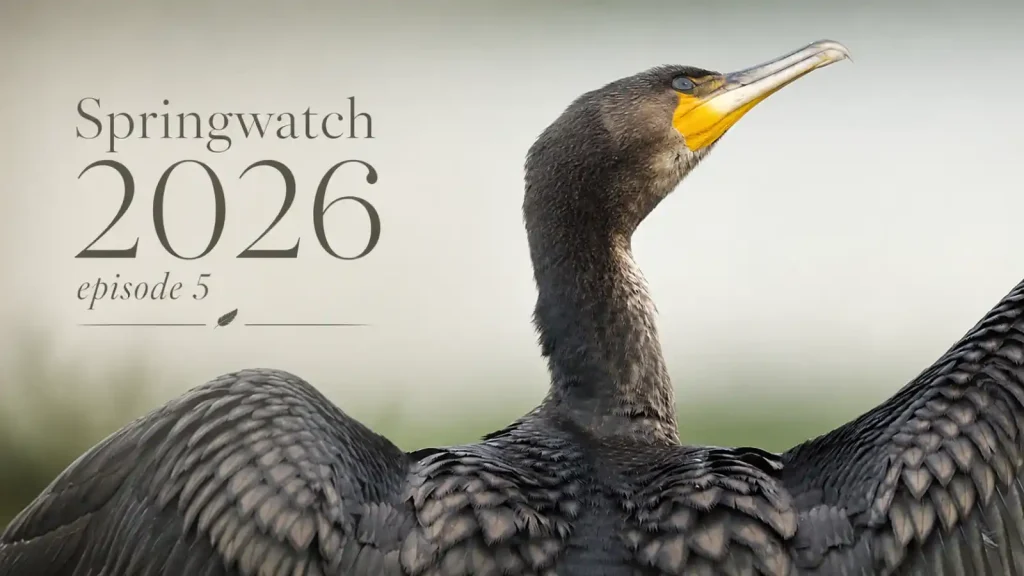
Springwatch 2026 episode 5 opens week two of the flagship live wildlife series with the kind of high-stakes drama that defines British spring. Broadcasting live from the National Trust’s Crom Estate in County Fermanagh, Northern Ireland, presenters Chris Packham and Michaela Strachan reveal a weekend of survival, predation, and rare reintroduction success captured across dozens of live cameras. The headline moment belongs to a white-tailed eagle photographed locally, but Springwatch 2026 episode 5 also delivers harrowing nest predation, a meteor caught on camera at 2.56am, and a science item so strange it sounds invented: moths that eavesdrop on plants.
This is the episode where Springwatch 2026 leans fully into its core promise, showing nature without sentiment. Survival sits beside loss. A nest of joy holds three newly hatched chicks while another, only days old, is emptied in minutes. Across Crom, Sussex, Cornwall and London, the programme tracks the same theme from many angles: every animal here is gambling, and the house edge is brutal.
What makes Springwatch 2026 episode 5 so compelling is how it widens the lens. Iolo Williams trades the Sussex countryside for the capital, uncovering surprising wildlife thriving among nine million Londoners. Meanwhile, the woodland adaptations of one small, perfectly engineered bird earn a quiet star turn. The result is a portrait of British wildlife that feels urgent, intimate, and unusually honest about the odds.
The weekend’s most thrilling capture was a white-tailed eagle, Britain and Ireland’s largest bird of prey. Nicknamed the sea eagle or “flying barn door” for its vast wingspan, the bird is an emphatic symbol of what long-term reintroduction work can achieve. The teams had been hoping to film it for some time. Patience and fieldcraft finally paid off.
This particular eagle carries both a satellite tag and a wing tag, so its story is unusually well documented. The Northern Irish Raptor Study Group confirmed it was released as a chick in 2020 into Lough Derg in County Tipperary, part of phase two of a wider reintroduction programme. Now six years old, she is the female of the only breeding pair in Northern Ireland. Her significance runs deeper still. This pair represents the first white-tailed eagles to breed in Northern Ireland in 150 years.
The pair established their territory in County Fermanagh and are now in their third breeding season, having first bred in 2024. A second eagle filmed during the weekend told another part of the story. Untagged and harder to trace, it is likely Irish-born, descended from the earlier reintroduction phases of 2007 and 2011, when around 100 birds were released into the Republic of Ireland. Seeing reintroduced eagles surviving and breeding is conservation working in real time, written across the sky above Crom.
Springwatch 2026 episode 5
Pine Martens and Stoats Turn Crom’s Nests Into a Battleground
If the eagle represented hope, the weekend’s nest cameras delivered the opposite. Predation dominated, and Springwatch 2026 refused to look away. The great tit chicks survived only because their nest box had been built robustly, with an entrance hole small enough to defeat a hunting pine marten. The marten sniffed, circled, and almost certainly knew the chicks were inside, but it left without breaching the defences. Last week the same predator had taken robin chicks from a larger tree cavity, so the difference of a few centimetres meant everything.
Other nests fared far worse. A grasshopper warbler nest, never formally introduced on the live show, had been doing well, with six chicks and both parents feeding. As a ground-nesting bird, it was acutely vulnerable. Late one evening the adult was startled off the nest, leaving the chicks exposed. A pine marten arrived, took one chick in seconds, then returned and consumed all five remaining chicks in under three minutes. The predator neither cached the prey nor carried chicks back to young, suggesting a single, opportunistic feast.
The pattern of loss didn’t end there. At the bullfinch nest, an Irish stoat struck, rapidly disabling as many chicks as it could before retrieving those that fell and returning for the rest. The science behind the carnage is sobering. Stoats take young birds and eggs as roughly 17 percent of their diet at this time of year, and data on meadow pipits, a comparable ground-nester, shows that 47 percent of breeding attempts are interrupted by predators. As Packham noted, the answer is not to demonise the stoat. Predators and prey together make a functioning ecosystem. The grasshopper warbler, a sub-Saharan migrant, can attempt up to three broods of six, giving it real statistical room to recover.
Inside the Crom Camera Operation Tracking 30 Live Feeds
Beyond the drama, Springwatch 2026 episode 5 pulls back the curtain on the sheer scale of its live operation. The production village at Crom resembles an infrastructure project, knitted together by 13,310 metres of cable feeding a bank of monitors. Between 30 and 36 live cameras run simultaneously, watched around the clock by a dedicated team. This is how the programme catches moments no single observer ever could.
That relentless coverage produced one of the most remarkable captures in the show’s history. At 2.56am, crew members Eleanor and Amy were awake and watching when a meteor streaked across the night sky, landing squarely in the centre of the frame. Getting such a shot demands the camera pointing at exactly the right patch of sky at exactly the right instant, which is why the team celebrated it as genuinely rare. Crom never sleeps, and neither, it seems, do its watchers.
Daytime offered its own jewels. A female kingfisher, identifiable by the orange on her lower mandible, fished repeatedly from the jetty, at one point catching a small pike, a freshwater apex predator in miniature, and dispatching it headfirst against the perch. The estate’s bat life is exceptional too. Every bat species found in Ireland occurs here, with Daubenton’s bats hunting low over the water at dusk, hawking insects much as the swallows and house martins do by day.
The Buzzard Chicks Surviving the Rain on an Astonishing Menu
Crom’s buzzard chicks emerged from the weekend as quiet survivors. After a spell of heavy rain, the two healthy chicks were growing fast, their flight feathers beginning to push through along the wing edge as they walked the nest and practised wing-flapping. The adults had been bringing in fresh sprigs of vegetation, including yew, a behaviour seen in birds of prey that may serve anti-parasitic purposes, even though yew itself is highly toxic.
What set these buzzards apart was their menu. Their diet proved astonishingly varied and opportunistic, and one item stunned the presenters: bats. Initially thought to be a single bat, the prey turned out to be a recurring feature, with footage showing a myotis bat, possibly a Natterer’s, brought to the nest. Quite how a buzzard catches a bat remains genuinely unclear, which only deepens the intrigue.
The chicks themselves displayed the unfiltered behaviour live cameras exist to record. One wore a piece of vegetation; another, embracing “you are what you eat,” wore a frog tucked against its body, while frogs featured heavily in their feeding. Indigestible remains were coughed back up as pellets. The sibling rivalry that marked earlier weeks had calmed, the second chick catching up to equal size, and the prognosis looked encouraging.
Hampstead Heath and the Hidden Wildlife of London
Iolo Williams brought a wholly different perspective to Springwatch 2026 episode 5 by heading into London. Home to around nine million people, the capital still teems with wildlife, from noisy non-native parakeets to a nesting hobby using an old crow’s nest in the city’s heart. London also supports roughly 50 breeding pairs of peregrine falcon, the second largest urban population of any city in the world behind New York. Urban peregrines, remarkably, outperform their rural counterparts.
The episode followed a peregrine pair nesting on Ealing Hospital. Of four eggs, three hatched, but the story carried the show’s characteristic balance of success and loss. One chick walked the ledge, fell and perished, leaving two. For a peregrine, two chicks reaching fledging is a solid outcome, and the programme will track the nest through the week. Williams based himself in Hampstead Heath, North London’s largest green space, where wildflower meadows have recorded around 650 species of plants and animals, the ponds support pollinators, and more than 180 bird species have been logged, including the amber-listed kestrel.
The Heath’s most surprising resident is the grass snake, an unlikely city slicker. Because they are exothermic, ecologists monitor them using felt refugia, mats that warm quickly in the sun and tempt reptiles beneath. Williams lifted one to reveal a young grass snake about 20 centimetres long, curled up for warmth. Uniquely among UK snakes, grass snakes lay eggs rather than birthing live young, and they exploit the heat of rotting compost heaps to incubate them. A cluster of hatched eggs and a large sloughed skin demonstrated their presence. Yet they are struggling nationally, losing habitat through wetland drainage and the disappearance of long grassland, which is why something as simple as a garden compost heap can help.
The Tree Creeper’s Vertical World and a Devoted Nesting Pair
Among the woodland features, the tree creeper earned a beautifully observed spotlight. Known in Welsh as dringwr bach, the little climber, this is a bird supremely adapted to a vertical existence. In a Derbyshire woodland, while most animals work the ground or the canopy, the tree creeper makes a single tree trunk its entire world, foraging across the bark for the majority of its food.
Its anatomy is purpose-built. Long, curved claws hook onto bark to compensate for a weak grip, a stiff tail braces the body like a kickstand, and a finely curved beak probes crevices that other birds cannot reach. There is even an elegant energy strategy at work. Tree creepers can only climb upwards, so to descend they simply glide, letting gravity do the work as they shuttle from one trunk to the next.
The trees offer more than food. Tucked behind loose bark, a devoted pair had built a hidden nest from moss, twigs and spider silk, concealing five tiny eggs. The location shields the brood from both the elements and hungry neighbours. Once the chicks hatched, the parents faced an exhausting schedule, feeding their young hundreds of times a day, working tirelessly so that, by summer, a new generation of bark-runners can emerge into the woodland.
Harvest Mice, Fox Cubs and the Quiet Power of Young Conservationists
Springwatch 2026 also celebrated grassroots conservation through two young people, Eva and Emily, from the West Country. Concerned for the harvest mouse, Britain’s smallest rodent at four to six grams and lighter than a two-pence coin, they began breeding the species, first in a bedroom, then a garage, before releasing them into a friend’s new nature reserve. The odds are stark: roughly one in 100 survives, falling prey to weasels, owls, snakes and other rodents. Yet getting eaten is itself part of a healthy ecosystem.
The project proved a roaring success. Returning to the release site, the pair found a harvest mouse nest, a tennis-ball-sized woven ball about 10 centimetres across, built by stripping living leaves halfway up a stalk to form a framework. Because the nests weren’t there before, the released mice had clearly bred. The girls have since released a further 50 mice, working under the mentorship of conservationist Derek Gow, and are developing a “wild pets” idea encouraging young people to keep and responsibly release species of conservation concern rather than hamsters and gerbils.
Crom’s fox cubs added warmth to the weekend’s footage. Tracked via discreet camera traps spread around a remote den, with crews visiting only every few days to avoid spooking them, at least three cubs were recorded, aged around five weeks. The cameras caught them honing survival skills, one cub playing with a pike jawbone dragged to the den, chewing, pouncing and tossing it like a dog, rehearsing the behaviours adulthood will demand.
A Camouflaged London Spider and Cornwall’s Mothmania
London delivered another secret in the purse web spider, a scarce, specialist species on Hampstead Heath more closely related to tarantulas and trapdoor spiders than to typical British spiders. Its silken tube extends several centimetres underground and is so expertly camouflaged with soil and grass that almost nobody realises it is there. Footage sent by a Belgian ecologist showed the spider seizing a fly through its web, dragging it under, then meticulously patching the silk before retreating to feed. Despite fearsome-looking fangs, the males barely reach a centimetre and females around two, with males noticeably darker.
In Cornwall, the episode profiled Humphrey, a moth-obsessed naturalist who turned an early sense of difference, growing up with an upper limb difference, into a lifelong passion for invertebrates. The UK’s moth diversity dwarfs its butterflies, with quadruple-digit moth species against double-digit butterflies, and names ranging from the oak eggar to the aptly baffling “confused.” Some moths are multi-generational migrants, crossing the Channel over successive short-lived generations, never witnessing the full journey themselves. For Humphrey, moth trapping is communal science, gathering friends outdoors while feeding records into a national recording network.
When Moths Listen to Screaming Plants
The episode’s standout science item, teased from the opening, was the discovery that moths can hear plants. Working through props of two visually similar nettles, researcher Lucy explained the difference between a hydrated plant, packed with a continuous chain of water molecules, and a dehydrated one. As water pressure drops, air is drawn in, forming tiny bubbles that rapidly expand and collapse, producing ultrasonic pops, effectively the sound of a plant in distress.
Scientists at Tel Aviv University recorded and pitched these sounds down so human ears could detect them, much as a bat detector reveals echolocation. The crucial finding came from a controlled experiment. Researchers played the distress sound at the moth’s natural frequency beside one of two perfectly healthy, equally hydrated plants. The moths consistently avoided the “screaming” plant and laid their eggs on the quiet one, proving the sound itself drove the decision.
The logic is sound from a moth’s perspective. A wilting plant may die before its eggs hatch or before the caterpillars mature, so choosing a healthy, silent plant gives offspring the best chance. Crucially, the plant isn’t communicating; the moths are simply exploiting acoustic cues. Researchers suspect other animals with excellent hearing, such as mice, may do the same, and that plant-to-plant signalling could even be involved. Greater wax moths, which use very high frequencies to choose egg-laying sites, occur worldwide, meaning this hidden conversation could be unfolding in gardens everywhere.
As Springwatch 2026 episode 5 closed, the contrasts lingered. Three grieve chicks snuggled beneath a parent’s feathers in what Strachan called her favourite shot of the series, while a wood ant photographed spraying formic acid reminded viewers that nature is never only cute. The week ahead promises the strange bond between a reed warbler and a cuckoo chick, the inner workings of the hedgehog, and more of the capital’s wildlife, proof that Springwatch 2026 still finds fresh wonder in every corner of these islands.
FAQ Springwatch 2026 episode 5
Q: Why is the white-tailed eagle at Crom so significant?
A: The filmed female is part of the only white-tailed eagle breeding pair in Northern Ireland, the first to breed there in 150 years. Released as a chick in 2020 into Lough Derg, County Tipperary, she now nests in County Fermanagh in her third breeding season, proving long-term reintroduction efforts are working.
Q: Why did so many nests get raided over the weekend?
A: Predation surged because pine martens and Irish stoats actively hunt nests in spring. A pine marten ate six grasshopper warbler chicks in under three minutes, while a stoat cleared a bullfinch nest. Stoats take young birds and eggs as roughly 17 percent of their diet at this time of year.
Q: How did the great tit chicks survive the pine marten?
A: Their nest box was built robustly with an entrance hole too small for the marten to enter. The predator sniffed around and almost certainly sensed the chicks inside, but could not breach the defences. A larger cavity nearby had cost robin chicks their lives the week before.
Q: Do buzzards really eat bats?
A: The Crom buzzard chicks were fed a myotis bat, possibly a Natterer’s, and footage confirmed it was not a one-off. Their diet proved astonishingly varied and opportunistic, dominated by frogs. Exactly how a buzzard catches a bat remains genuinely unclear, which makes the behaviour especially fascinating.
Q: Why do urban peregrine falcons do better than rural ones?
A: City peregrines benefit from abundant prey and tall nesting structures that mimic cliffs. London supports around 50 breeding pairs, the second largest urban population worldwide after New York. The pair on Ealing Hospital raised two chicks to a healthy stage, a solid outcome for the species.
Q: What makes the grass snake different from other UK snakes?
A: Grass snakes are the only UK snakes that lay eggs rather than birthing live young. Because Britain is cold, females bury their eggs in compost heaps and let rotting vegetation provide warmth. Ecologists on Hampstead Heath monitor them using felt refugia mats that heat quickly in sunshine.
Q: How is the tree creeper adapted to climbing trees?
A: Long curved claws hook onto bark to compensate for a weak grip, a stiff tail braces the body during climbs, and a finely curved beak reaches crevices other birds cannot. Tree creepers only climb upwards, so to descend they glide, letting gravity save precious energy.
Q: How can moths hear plants?
A: Dehydrated plants lose water pressure, drawing in air that forms tiny bubbles which collapse and produce ultrasonic pops. Moths detect these vibrations as signs of distress. Researchers at Tel Aviv University proved moths avoid plants making this sound, even healthy ones played the noise through a speaker.
Q: Can young people genuinely help save harvest mice?
A: Yes. Eva and Emily bred Britain’s smallest rodent and released them onto a nature reserve, later finding woven breeding nests that confirmed success. Mentored by conservationist Derek Gow, they have since released 50 more. However, only around one in 100 harvest mice survives natural predation.
Q: How many live cameras does Springwatch run at Crom?
A: Between 30 and 36 live cameras operate simultaneously, linked by 13,310 metres of cable and watched around the clock. This constant coverage captured a meteor crossing the sky at 2.56am, landing centre-frame, alongside a female kingfisher catching a small pike off the jetty.